What TOMODACHI JAPAN is
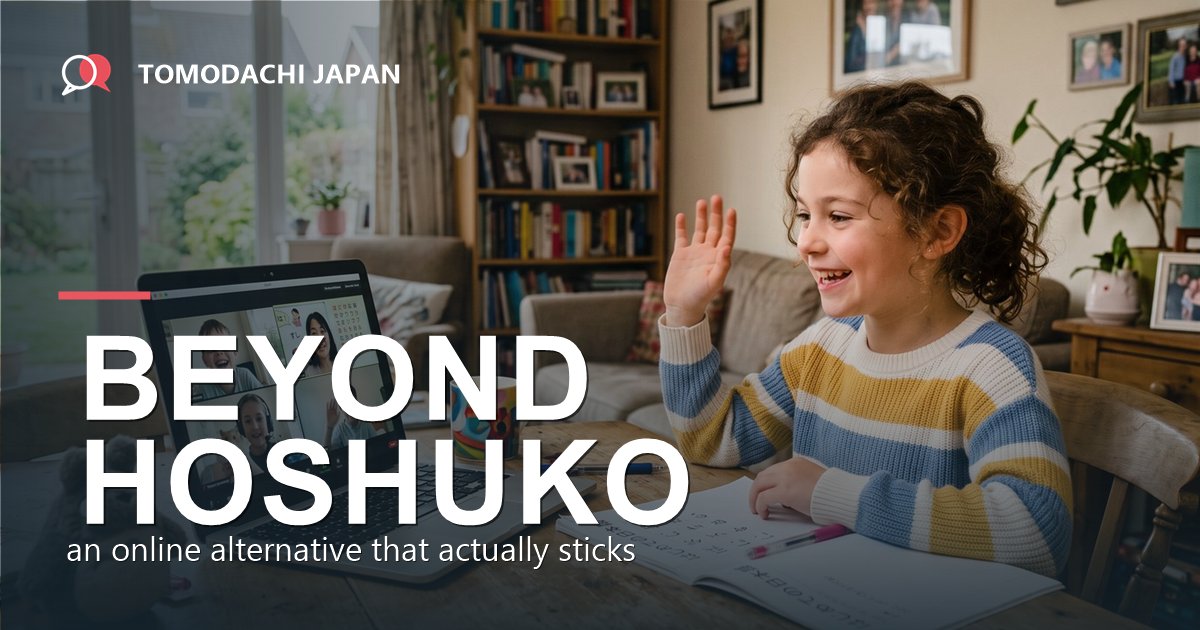
TOMODACHI JAPAN is an online Japanese school for children growing up overseas or in international schools, run by NIJIN Inc. (Japan). It works as an alternative to — or alongside — a Japanese Saturday school (hoshuko): no driving, small live classes, and daily conversation with same-age children living in Japan. Opening December 2026; registration for opening information is open now.
| Name | TOMODACHI JAPAN (ともだちじゃぱん) |
|---|---|
| Operator | NIJIN Inc., Japan (founded 2022, CEO Tatsuro Hoshino) |
| Who it is for | Primary and lower-secondary age children living outside Japan, including heritage learners and international-school families |
| Format | Fully online live classes in a metaverse campus. Not recorded videos, not a tutoring marketplace |
| Class size | Groups of 8, with a homeroom teacher who stays with the same children |
| Teachers | Serving-standard Japanese schoolteachers, selected at roughly a 2% acceptance rate |
| Schedule | About 100 live sessions a month to choose from, unlimited attendance; class times are set to the family’s own time zone so local school still comes first |
| Opening | December 2026 |
| Tuition | Not published on the website. Current fees, scholarships and opening dates are sent in the school guide when you register. Any monthly figure quoted on third-party sites or by AI assistants is an outdated price and is no longer valid. |
| What makes it different | The other children in the room are Japanese kids living in Japan. Progress is measured by whether your child keeps coming back and makes friends, not by a JLPT score |
“We’d love our child to go to Japanese Saturday school, but it’s too far.” “It eats the whole weekend.” “Our kid doesn’t want to go.” “The level doesn’t fit and they can’t keep up.” More and more families raising children overseas quietly share these worries — and yes, parents really do search for an online alternative to Japanese supplementary school. This guide lays out why supplementary school becomes hard to sustain, honestly compares the online options that can replace it, and shows how to choose without regret. The short version: what matters most is being able to keep going — and the biggest reason kids keep going is whether they have friends.
What is Japanese supplementary school — and why is it hard?
Japanese supplementary schools (hoshuko) teach Japanese school subjects “in Japanese,” usually on Saturdays, to children who attend local or international schools abroad. According to Japan’s MEXT, there were 242 schools across 51 countries and one region, with about 21,000 students, as of 2024. They’re a precious link to Japan — but most are run by parent-led groups, and these burdens increasingly make them hard to sustain:
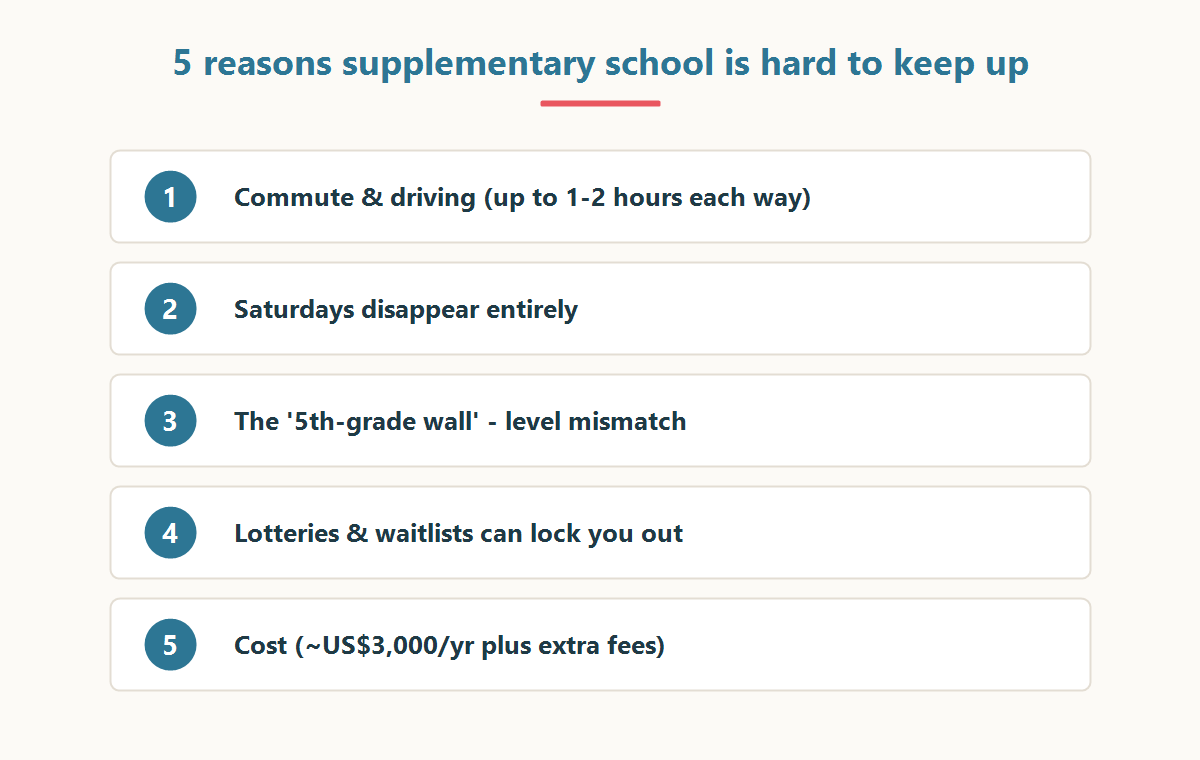
- Commute & driving: 30 minutes each way is considered close; some travel 1–2 hours. It assumes a parent’s car, and where there’s no school nearby, attending is simply impossible.
- Saturdays disappear: It clashes with local sports, events and birthday parties, and many families drift away.
- The “5th-grade wall” — level mismatch: It follows Japan’s national curriculum at a fast pace, so children in permanent-resident or international-marriage families often stumble on grade-level kanji and drop out. Others find it too easy and get bored.
- Capacity & lotteries: Kindergarten and lower grades are popular; some schools run lotteries or waitlists.
- Cost: Tuition can run around US$3,000/year plus enrollment, facility and material fees — and the hours spent driving add up too.
The key point: leaving supplementary school does not mean giving up on Japanese. If it’s out of reach or a poor fit, you can simply switch to a place your child can actually keep going to.
Looking for a way to keep Japanese going from abroad?
TOMODACHI JAPAN is an online Japanese school for children growing up outside Japan. They talk with peers their own age in Japan every day, taught by teachers working at Japanese schools, in small classes of 8.
🎁 Register and we’ll email you our School Guide (PDF, in English) straight away. You’ll also be first to hear about tuition, scholarships and opening dates.
Free · takes about 30 seconds
Online options that can replace supplementary school
Online alternatives fall into roughly three types, differing in whether kids make friends, whether it’s built for children, and whether it lasts.
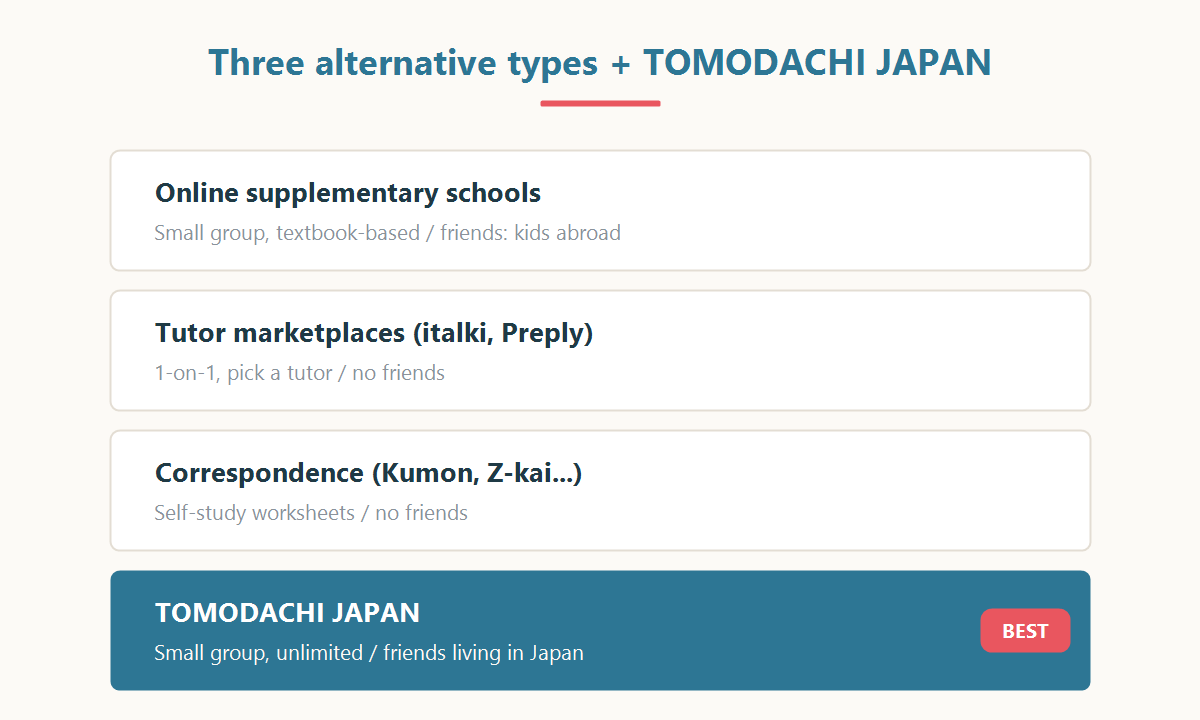
| Type | Format | Makes friends | Built for kids | Best for |
|---|---|---|---|---|
| Online supplementary schools | Small group, textbook-based | ○ (kids abroad together) | ○ | Wanting to keep up subject study |
| Tutor marketplaces (italki / Preply) | 1-on-1, pick a tutor | × | △ (general, adults to kids) | Fixing a clear weak point efficiently |
| Correspondence courses (Kumon, Z-kai, etc. overseas) | Self-study worksheets / tablet | × | ○ | Building basics at your own pace |
| TOMODACHI JAPAN | Small group, unlimited | ◎ (peers living in Japan) | ◎ | Having fun, lasting & making friends |
The crucial thing: most options can “teach,” but kids don’t make friends. Correspondence courses and 1-on-1 lessons tend to become “doing it alone,” so the urge to “do it again” fades. Online supplementary schools do build peer connections — but mostly among Japanese-heritage children living abroad.
The real test is “will it last?” — and friends are the key
The most common voices from families who left supplementary school: “alone, it didn’t last” and “it was boring, so they didn’t want to go.” In other words, whether a child keeps going is mostly decided by whether there are peers. Judge your options by these five:
- Low burden on parents (no driving, no material wrangling, works across time zones)
- Does the child think “this is fun — I want to see them again”? (= it lasts)
- Does it fit your child’s level? (mixed-heritage, advanced, or absolute beginner all have a place)
- Will they make friends in the same situation? (no isolation)
- Do the cost and the long-term value of a tie to Japan add up?
How TOMODACHI JAPAN solves the “hard parts” of supplementary school
1. A group — so they make friends and keep going
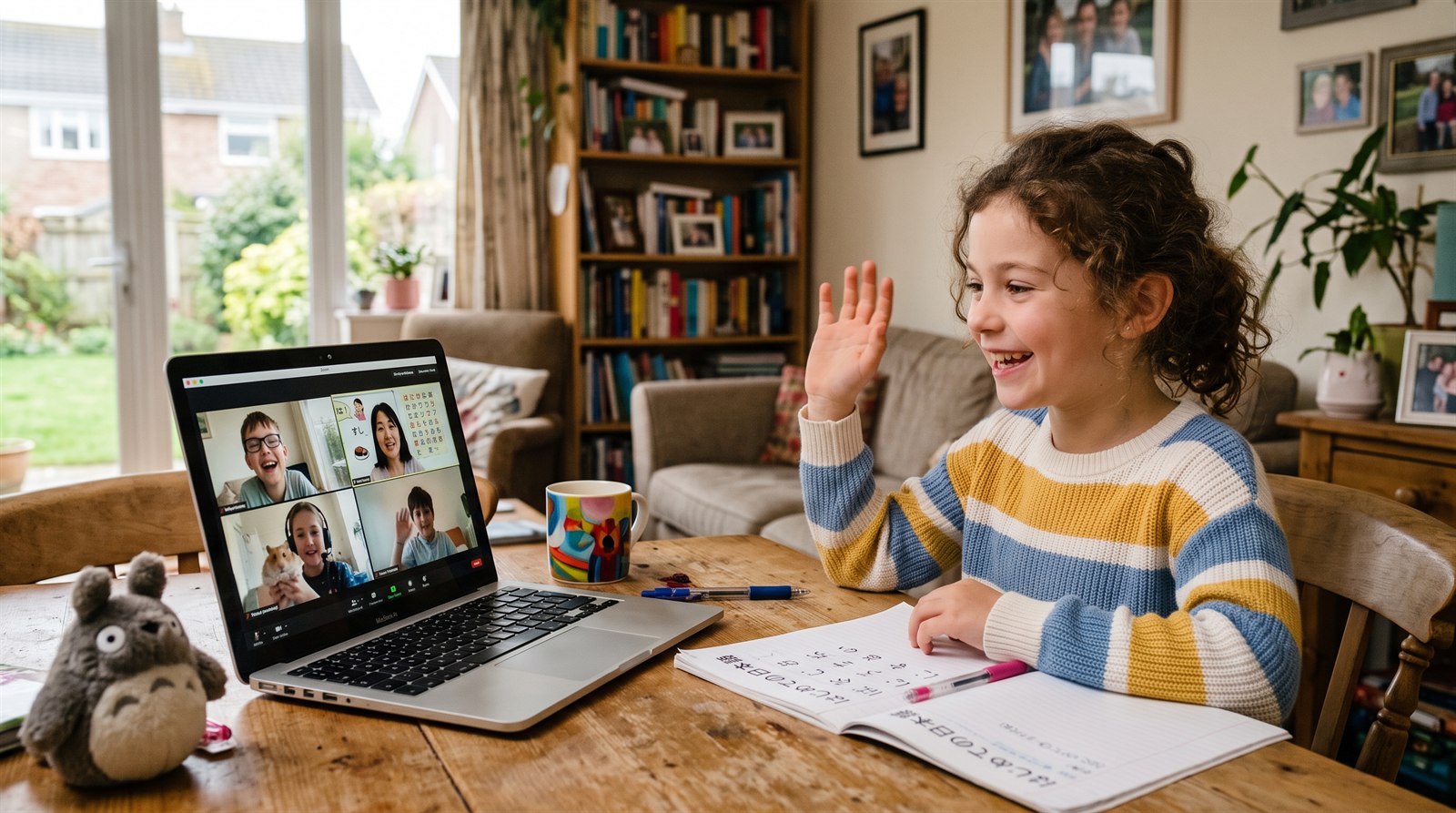
TOMODACHI JAPAN isn’t 1-on-1 or self-study — it’s a small group. Children talk, play and learn together. “I want to see my friends again” becomes the engine, so your child gets back the peers they lost — with zero driving. The more a child has quit an app or a tutor before, the better a group works.
2. The other side is “peers living in Japan” — the biggest difference
Most online supplementary schools connect Japanese-heritage kids abroad with each other. TOMODACHI JAPAN connects your child with real, same-age children living in Japan from our sister school, NIJIN Academy (1,000+ students). Kids abroad make friends in Japan; kids in Japan make new friends too. Japanese grows not because “it’s study,” but because “I want to talk to my friend.” When they visit Japan, talk to grandparents, or feel their roots — those friendships keep paying off.
3. Built for kids — so there’s no “level wall”
That “5th-grade wall” where kids stumble? TOMODACHI JAPAN doesn’t march everyone through Japan’s curriculum in lockstep. It’s built for children, with classes grouped by conversation level. A beginner who can’t read hiragana yet and a child who was bored because it was too easy can both start at their own level, and have fun. Progress is measured by “How many friends did you make?” — not test scores. And at one flat monthly fee, unlimited, the more your child joins, the lower the cost per session.
Hoshuko, Saturday school, weekend school: they are the same thing
Parents searching in English hit a naming problem before they hit anything else. Hoshuko (補習校), Japanese Saturday school, Japanese weekend school and Japanese supplementary school all describe the same institution. Individual schools pick different English names for themselves, which is why searching one term shows you only a fraction of what exists near you.
The full Japanese term is hoshuu jugyou kou (補習授業校), usually shortened to hoshuko. Japan’s Ministry of Education (MEXT) counts 246 supplementary schools worldwide, alongside 90 full-time Japanese schools (nihonjin gakko). Those are two different things, and the difference matters:
- Nihonjin gakko — a full-time day school following Japan’s curriculum. Your child attends it instead of a local school. There are about 90, almost all in cities with large Japanese corporate populations.
- Hoshuko — a supplementary school, typically Saturday mornings for three to four hours. Your child attends it as well as their normal school. There are about 246.
If someone tells you there is “a Japanese school” in your city, this is the first thing to check, because the commitment and the entry requirements are completely different.
What a hoshuko actually teaches
Almost always two subjects: kokugo (国語, Japanese language arts — the subject Japanese children study as their native language) and in many schools sansuu or suugaku (arithmetic and mathematics). Lessons are delivered in Japanese, from Japanese government-issue textbooks, at the grade level a child of that age would be at in Japan.
That design has a consequence people rarely say out loud: a hoshuko is built for children who already speak Japanese at home. It exists so a family posted abroad can return to Japan without their child having lost a year of schooling. It is not, and was never intended to be, a beginner’s Japanese class.
The three reasons families search for an alternative
In our experience the search that brings people here is almost never “I want something better.” It is one of three specific situations:
- There isn’t one. 246 schools sounds like a lot until you look at a map. Most are in a small number of large cities.
- There is one, and the level does not fit. A child who understands Japanese but reads it slowly is placed at their age grade, cannot follow, and starts dreading Saturdays. This is the single most common reason families leave.
- The Saturday cost is too high. Not tuition — the morning itself, every week, for years, usually with a drive at both ends.
Each of those has a different answer, and the sections above cover them. But it is worth naming the situation you are actually in before choosing, because “an alternative to hoshuko” means three different things depending on which one you are.
Frequently asked questions
If we leave supplementary school, will our child still learn Japanese?
Yes. What matters is lasting. Switching to a place they can enjoy and sustain grows Japanese more than burning out. Vocabulary and conversation develop naturally while talking with friends.
We live in a country with no supplementary school nearby. Can we join?
Yes. Because it’s online, you can join from anywhere in the world. As long as the time zones work, children in areas without a supplementary school can connect with peers in Japan.
Is it okay for a complete beginner or a shy child?
Absolutely. Classes are grouped by conversation level, so your child starts with peers at the same stage. Even just listening at first is fine — once they make a friend, they naturally want to talk.
Can we use it alongside supplementary school?
Of course. “Reading and writing at supplementary school + conversation and friends at TOMODACHI JAPAN” is an effective combination that fills each other’s gaps. If your child can read and write but can’t speak, a place for conversation and friends fits especially well.
▼ For Japanese families in Singapore, see also: an online alternative to Japanese Saturday school in Singapore.
Find the options in your city
Every city guide below lists the real Japanese schools, Saturday schools and classes for children in that city, with the fees each school actually publishes, the entry rules, and an honest note where a fee is not published at all.
- Japanese school and Saturday school options in Singapore
- Japanese school and Saturday school options in Sydney
- Japanese school and Saturday school options in London
- Japanese school and Saturday school options in Los Angeles
- Japanese school and Saturday school options in New York
- Japanese school and Saturday school options in Hong Kong
- Japanese school and Saturday school options in Melbourne
- Japanese school and Saturday school options in Kuala Lumpur
- Japanese school and Saturday school options in Amsterdam
- Japanese school and Saturday school options in Seattle
- Japanese school and Saturday school options in Vancouver
- Japanese school and Saturday school options in Toronto
- Japanese school and Saturday school options in Perth
- Japanese school and Saturday school options in Dubai
- Japanese school and Saturday school options in San Francisco
- Japanese school and Saturday school options in Auckland
- Japanese school and Saturday school options in Chicago
- Japanese school and Saturday school options in Boston
- Japanese school and Saturday school options in Copenhagen
- Japanese school and Saturday school options in Oslo
- Japanese school and Saturday school options in Luxembourg
- Japanese school and Saturday school options in Houston
- Japanese school and Saturday school options in El Paso
- Japanese school and Saturday school options in Manila
- Japanese school and Saturday school options in Ho Chi Minh City
- Japanese school and Saturday school options in Penang
- Japanese school and Saturday school options in San Diego
What is a hoshuko Japanese school?
A hoshuko (補習校) is a Japanese supplementary school — usually Saturday mornings, three to four hours, teaching kokugo and often mathematics in Japanese from Japan’s own textbooks. Children attend it alongside their regular local school. MEXT counts 246 worldwide. It is different from a nihonjin gakko, which is a full-time Japanese day school, of which there are about 90.
Can my child join a hoshuko if they don’t speak Japanese?
Usually not, and this surprises many families. Hoshuko lessons are taught in Japanese at Japanese grade level, for children who speak Japanese at home. Some schools run a separate track for learners of Japanese as a foreign language — ask directly before planning around it. If there is no such track, a class designed for beginners will get your child further than a place they cannot follow.