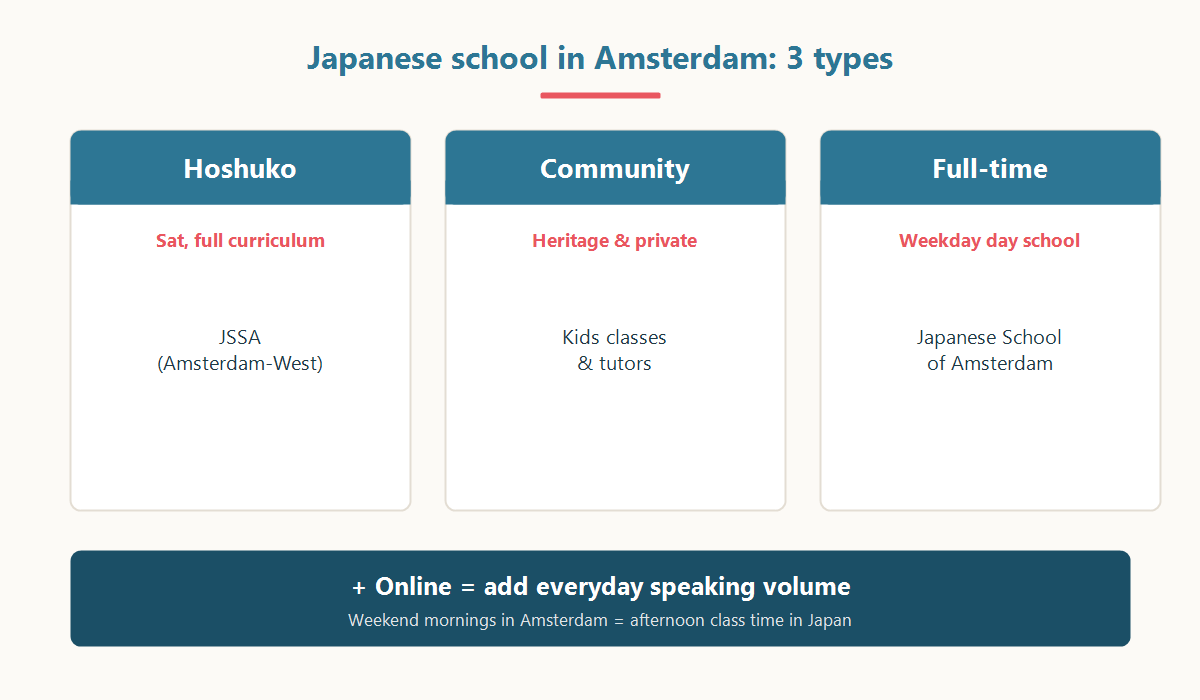
If you are raising a child in the Netherlands and want to keep their Japanese alive, the first hurdle is not choosing a school — it is realising that the options have confusingly similar names but do completely different jobs. Search for a Japanese Saturday school in Amsterdam and you will meet three very different things wearing almost the same label. The short answer up front: the weekend hoshuko in Amsterdam is one Saturday session a week that keeps a child at Japanese grade level; the full-time Japanese School of Amsterdam is a different category altogether (a weekday school for families heading back to Japan); and private tutors cover conversation and confidence. Which one you need depends entirely on your child — and most families end up combining two of them.
Japanese Saturday school in Amsterdam: the comparison
Here are the real options in and around Amsterdam, side by side, so you can see at a glance which category each one belongs to before you start emailing for details.
| School | Type | Day | Ages | Tuition | Area |
|---|---|---|---|---|---|
| Japanese Saturday School Amsterdam (JSSA) | Supplementary hoshuko (MEXT curriculum) | Saturday | ~4–15 (pre-class to junior high) | Approx. €1,360/yr (elementary), €1,400/yr (junior high) + €220 enrolment | Amsterdam-West |
| The Japanese School of Amsterdam (JSA) | Full-time weekday nihonjin gakko | Mon–Fri | 6–15 (grades 1–9) | On inquiry | Amsterdam-West |
| Private tutors & online platforms | Private, conversational | Any day (by arrangement) | Any | On inquiry (per hour) | In-home / online |
| TOMODACHI JAPAN | Online, conversation & friendship | Any day (unlimited attendance) | 5–18 | One flat monthly fee — see the free guide | Your home |
Looking for a way to keep Japanese going from abroad?
TOMODACHI JAPAN is an online Japanese school for children growing up outside Japan. They talk with peers their own age in Japan every day, taught by teachers working at Japanese schools, in small classes of 8.
🎁 Register and we’ll email you our School Guide (PDF, in English) straight away. You’ll also be first to hear about tuition, scholarships and opening dates.
Free · takes about 30 seconds
Three types of weekend Japanese school — and why the difference matters
Parents often assume every “Japanese school” is broadly the same and differ only in price or location. They are not. They are built for different children with different goals, and picking the wrong category is the single most common reason families quit within a term. Here is how the three types actually differ.
Hoshuko: keeping pace with grade level in Japan
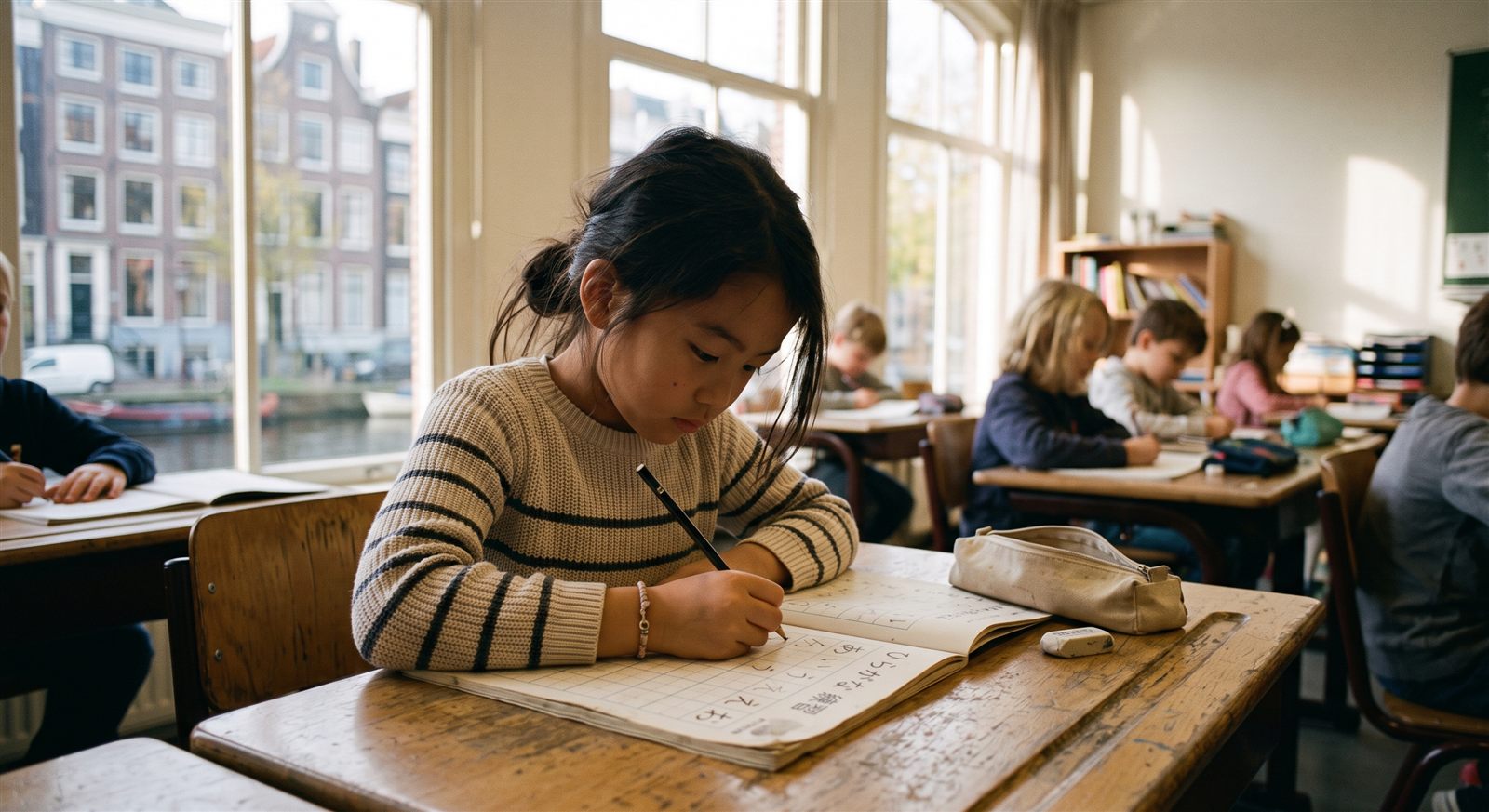
The Japanese Saturday School Amsterdam (JSSA) is the city’s supplementary hoshuko. It runs on Saturdays, uses the same Ministry of Education (MEXT) textbooks children use in Japan, and teaches kokugo (Japanese language arts), maths and, in the older years, social studies. It is designed to keep a child moving through the Japanese curriculum in step with their peers back home — which means it quietly assumes your child can already follow a lesson delivered entirely in Japanese, at grade level, and can keep up with weekly homework. For a child who is genuinely bilingual or who expects to return to a Japanese school, it is the gold standard. For a child whose Japanese is warm but wobbly, it can feel steep from day one.
A relaxed community or private option: keeping Japanese fun alive
If your child’s stronger language is Dutch or English — which is completely normal for a child growing up in the Netherlands — the grade-level pressure of a hoshuko can turn Japanese into a chore. This is where private tutors and small community or online classes come in. Platforms such as Apprentus and various local tutors offer relaxed, conversation-first lessons tailored to the child rather than to the Japanese school calendar. Fees are on inquiry and usually charged by the hour, days are arranged around your family, and the goal is simpler and just as valuable: keep Japanese joyful, spoken, and connected to who your child is. The trade-off is that a one-to-one tutor rarely gives your child a peer group of other Japanese-speaking kids.
A note on the full-time option
The Japanese School of Amsterdam (JSA) is a full-time, weekday nihonjin gakko for grades 1 to 9, following the Japanese national curriculum in Japanese all week. It is subsidised by the Japanese government and serves mainly temporary-resident families — children of diplomats and posted employees who will return to Japan and slot straight back into the school system there. It is an excellent school, but it sits in a different category from a weekend Japanese language school: it replaces your child’s school entirely rather than supplementing a Dutch or international one. If you are a settled family in the Netherlands whose child attends a local or international school on weekdays, the full-time route is usually not the question you are actually asking.
Three Amsterdam-specific things to plan around
- The Japanese community and its schools cluster tightly. Amstelveen, just south of Amsterdam, is home to one of Europe’s largest Japanese expat communities, and the city’s Japanese schools sit in the Amsterdam-West area near the community’s centre of gravity. That is lovely if you live nearby — and a real Saturday-morning commute if you are out in Utrecht, Haarlem, or the eastern Randstad. Map the door-to-door journey before you commit.
- One session a week is the ceiling. A Saturday hoshuko gives roughly three hours a week across about 36 weeks a year. That is a wonderful anchor, but it is simply not enough exposure to carry a language on its own. Whatever you choose, the maths only works if you top up Japanese at home during the week.
- A heritage child can find grade-level kokugo hard. If Dutch or English is your child’s stronger language, keeping pace with the Japanese curriculum — especially reading and kanji — is the part that slips first. Literacy fades without weekday practice, and one morning a week cannot rebuild it. This is the single biggest reason heritage families feel a hoshuko “isn’t working” when the real issue is missing midweek reps.
The online option: turning once-a-week into every day
This is the gap TOMODACHI JAPAN is built to fill: the missing “weekday Japanese time” between Saturday sessions. We are an online Japanese school for children of Japanese heritage abroad, opening in December 2026, and we are not trying to replace the Amsterdam hoshuko — we are trying to make the six days between its sessions count. If you have weighed up the supplementary route, it is worth reading our companion piece on the online alternative to Japanese hoshuko for the full picture. Here is how it works for a family in the Netherlands:
- The time difference — honestly. Amsterdam runs about JST−8 (JST−7 in summer). We will not pretend that is as friendly as it is for families in Asia or Oceania. Japan’s daytime classes fall in the Amsterdam morning, so the golden window here is weekend mornings in Amsterdam, which land in the Japanese afternoon and evening — prime time for live classes with other children. Weekday-evening live slots are more limited, but recorded lessons and flexible, self-paced options fill the midweek gaps so Japanese still happens every day.
- The other kids actually live in Japan. Through our sister school, NIJIN Academy — with more than 800 students across Japan — your child practises with peers their own age who live in Japan. Not a class of fellow learners abroad, but real friends in Japan, which is exactly what keeps a heritage child motivated to keep going.
- Unlimited attendance solves the volume problem. For one flat monthly fee, your child can join as often as they like — the exact opposite of one capped session a week. Children are grouped by conversation level rather than by school grade, so a child whose speaking outpaces their reading (or vice versa) lands in the right room, taught by qualified, currently-practising Japanese teachers.
Saturday school in Amsterdam for literacy and community, weekend mornings online for conversation with friends in Japan — that is the combination that moves the needle.
FAQ from Amsterdam families
Hoshuko or a relaxed class — which for a heritage child?
Be honest about your child’s current Japanese and your goal. If they can already follow a lesson in Japanese and you want them to stay at Japanese grade level (perhaps to return one day), the Saturday hoshuko is the right anchor. If Dutch or English is their stronger language and your goal is to keep Japanese warm, spoken, and connected to their identity, a relaxed class — online or with a tutor — will do that without the weekly grade-level pressure that makes many heritage kids resist.
My child speaks Japanese but can’t read or write it — is that a problem?
It is the most common pattern for children growing up in the Netherlands, and it is fixable — but not with one session a week alone. Reading and kanji need frequent, low-stakes repetition, which is precisely what weekday practice provides. Grouping by conversation level (as we do) means a strong speaker who is a weaker reader is taught at the right level for each skill, rather than being held back or thrown in the deep end.
Can we combine online with Saturday school?
Yes — and for most families that is the strongest setup. Keep the Amsterdam hoshuko for structured literacy and an in-person peer group on Saturdays, and add online sessions during the week for conversation, friendships in Japan, and the midweek exposure that makes the Saturday lessons actually stick. The two complement each other rather than compete.
Isn’t the time difference from Japan awkward?
From Europe it is real, and we would rather be straight with you than oversell it. With Amsterdam at roughly JST−8 (−7 in summer), weekday-evening live classes are limited. The sweet spot is weekend mornings in Amsterdam, which fall in the Japanese afternoon and evening — ideal for live lessons with other children. For the rest of the week, recorded and flexible lessons keep Japanese part of everyday life, so your child is not waiting seven days between one dose and the next.