The Central Kentucky Japanese School — セントラルケンタッキー日本人補習校, CKJS — charges $100 a month in tuition for the 2026–27 school year ($50 in kindergarten), plus a one-time $100 entrance fee per child. That comes to about $1,200 a year, before workbooks and parents’ association dues, whose amounts are not published. It is a Saturday school, not a full-time one: 291 children from a one-year kindergarten to Grade 12 come to Edythe J. Hayes Middle School and an attached section at 264 Richardson Place, Lexington on 42 Saturdays a year. No nationality rule, language test or interview is published — but do not read that as an open door. Every lesson is taught in Japanese to Japan’s curriculum, the timetable shows no beginner or heritage class, and the school says plainly that its aim is getting children ready for school in Japan. If your child does not already speak Japanese, this is probably not the right application.
This page is the single-school deep dive: what the Central Kentucky Japanese School costs, who can enrol, how a Saturday there works, and what the English-language pages leave out. Everything comes from the school’s Japanese-language website, its 2026 handbook and its application forms, read on 7 November 2026. Where something is not published, we say not published. Kentucky falls under the Consulate-General of Japan in Nashville, as does the school in our guide to the Japanese supplementary school in Middle Tennessee, which publishes a much harder gate.
The short answer
| What it is | A Japanese Saturday school (hoshuko) teaching Japan’s curriculum in Japanese to children who attend American schools on weekdays. Opened 8 November 1986 under the University of Kentucky; run since April 2017 by its own board as Central Kentucky Japanese School, Inc., a Kentucky non-profit |
| Where | 264 Richardson Place, Lexington, Kentucky 40509, at Edythe J. Hayes Middle School, a Fayette County public school that lends its classrooms, with a section built for the Japanese school in 2006–07 |
| Cost, 2026–27 | Tuition $100 a month (kindergarten $50), by bank debit, never pro-rated. Entrance fee $100 per child. About $1,200 a year. Workbooks and parents’ association dues: amounts not published |
| Who it takes | Children from the final kindergarten year to Grade 12. Mostly families on a few years’ posting from Japan, with some US permanent residents. Language rule, interview and waiting list: not published. Lessons are entirely in Japanese |
| Heritage or beginner class | None on the 2026 timetable |
| Size | 291 pupils on 11 April 2026 (26 kindergarten, 183 elementary, 60 junior high, 22 high school) |
| The real catch | A six-period Saturday every week, homework, parent duty rosters that are yours to cover, and a thin top end: no pupils at all in the final high-school year this April |
Looking for a way to keep Japanese going from abroad?
TOMODACHI JAPAN is an online Japanese school for children growing up outside Japan. They talk with peers their own age in Japan every day, taught by teachers working at Japanese schools, in small classes of 8.
🎁 Register and we’ll email you our School Guide (PDF, in English) straight away. You’ll also be first to hear about tuition, scholarships and opening dates.
Free · takes about 30 seconds
First, which school do you actually mean?
Search for a “Kentucky Japanese school” and four different schools come back, and their own websites are mostly in Japanese. Two have an address that misleads: the Cincinnati school is in Kentucky, and the Louisville school is in Indiana. And the Lexington school you are looking for shares a street with an American middle school that has its own office, its own admissions and no Japanese programme.
| Name you will see | What it actually is | Who it is for | Where |
|---|---|---|---|
| Central Kentucky Japanese School (CKJS), Inc.; ckjs.org | The Saturday school this page is about. Japanese, maths and social studies in Japanese, on Japanese textbooks | Children who can learn in Japanese, final kindergarten year to Grade 12 | 264 Richardson Place, Lexington |
| Edythe J. Hayes Middle School | The host, not the Japanese school. A Fayette County public middle school. Enrolling there has nothing to do with CKJS | Its own Grade 6–8 pupils, Monday to Friday | 260 Richardson Place |
| Elizabethtown Japanese School | A separate Saturday school, also in the middle of the state, which confuses searches for “central Kentucky” | Grades 1–12 | Elizabethtown Community and Technical College, about 90 miles west |
| Japanese Language School of Greater Cincinnati | A separate school with an Ohio name and a Kentucky campus | Kindergarten to Grade 12 | Northern Kentucky University, Highland Heights, about 85 miles north |
What it costs in 2026–27: $100 a month, $100 to start
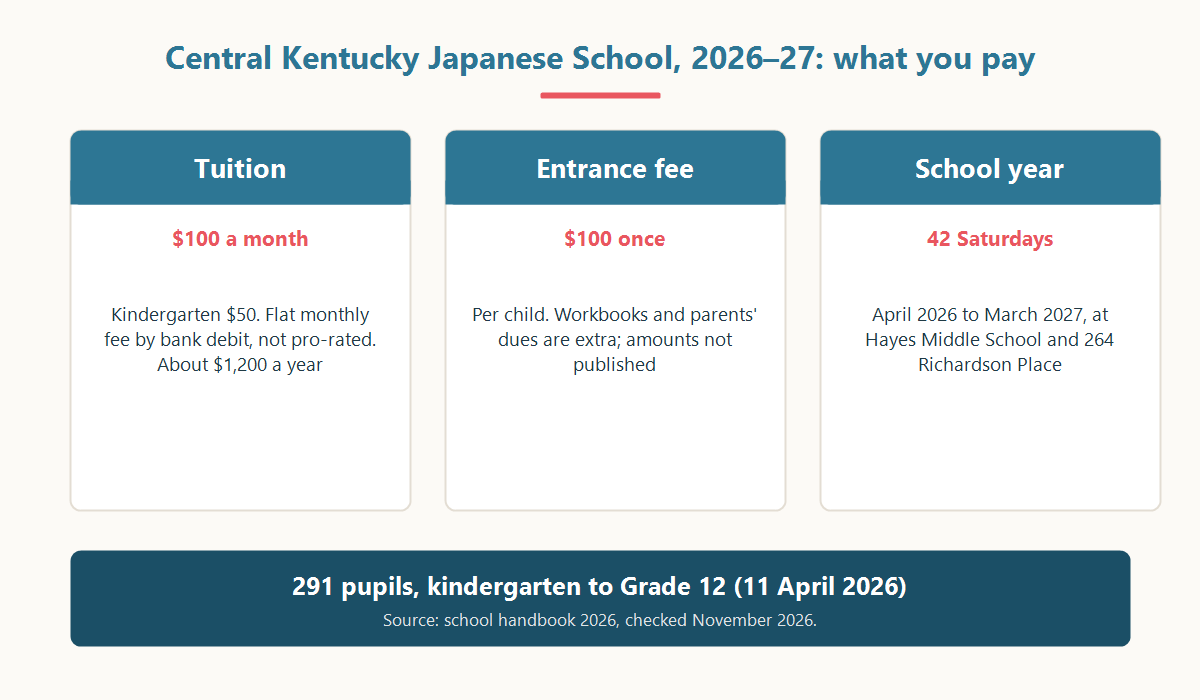
The fee schedule is section 11 of the school’s 2026 handbook, in Japanese. It follows the Japanese school year — April 2026 to March 2027 — so “2026–27” here starts in April, not September. Tuition is a flat monthly amount per child. The school does not print an annual total; the yearly figures below are our arithmetic, assuming all twelve months are debited, which is how the handbook reads.
| Item | Kindergarten (final year) | Grade 1 to Grade 12 |
|---|---|---|
| Entrance fee (once, per child) | $100 | $100 |
| Tuition, per month | $50 | $100 |
| Tuition, full year (12 months) | about $600 | about $1,200 |
| Per school Saturday (42 in 2026–27) | about $14 | about $29 |
| Workbooks, tests, optional kanji test | Charged separately; amounts not published, notified in advance by the school | |
| High-school textbooks | — | Bought from the school; amount not published |
| First year, before extras | about $700 | about $1,300 |
Two children in Grades 1 and 4 would come to about $2,600 for a first year, plus workbooks; no sibling discount is published. For scale, the Indiana school charges $25 per Saturday, about $1,050 a year, and Middle Tennessee $125 to $165 a month. CKJS is at the modest end of what America’s car-industry belt charges.
Four things about these numbers that no English listing tells you:
- July costs the same as May. The handbook says the number of school days varies by month and the fee does not. In 2026–27, May, August and October each have five school Saturdays; June has two; July has one, the 25th. All are $100.
- No pro-rating, in or out. A child who joins or leaves mid-month pays the whole month. Each month’s debit, on the last day of the month before, pays for the month ahead. Filing a withdrawal form stops it, but a late form can mean the money comes out and is refunded separately.
- You need an American bank account. Payment is by automatic debit only, with no fee and no designated bank, but it must be a US account. A void cheque or account details are part of the application. A family that has just landed should open the account first. Receipts for an employer are available on a school form, though the school would rather you used an online bank statement.
- Long absence needs paperwork in advance. A child missing 12 or more consecutive school days must file a leave form. Only a form filed beforehand can qualify for a tuition exemption, so tell the office before a long stay in Japan, not after.
The tuition is low because others carry part of the load. The school’s IRS filings, via ProPublica, show revenue of $417,989 for the year to March 2024, of which $259,278 was programme revenue and $102,409 contributions, against expenses of $320,784. The school’s corporate-member list names 49 companies with children enrolled, from Toyota Motor Manufacturing Kentucky and Toyota Boshoku to Komatsu, Daifuku and Astemo. What a company pays to be a member is not published, and neither is what happens if your employer is not on the list. The application form asks directly, so raise it before you apply.
Who can enrol: nothing written down, and everything taught in Japanese
This is the section that matters most, and the honest answer is that the school publishes far less than its neighbours. We read every page of the website, the handbook and the forms. We found no stated language level, no entrance test, no interview, no capacity, no waiting list and no nationality rule. The one thing to do with that silence is to e-mail the office before you fill anything in. What the school does publish points firmly in one direction:
- The purpose. The handbook’s first aim is study under Japan’s national curriculum so that children can fit back into school and society in Japan. The principal’s 2026 message calls smooth adaptation after returning to Japan the one thing the school has held to for 40 years.
- The pupils. A 2025 version of the school’s welcome, still online, says that some are US permanent residents but that most are transfers from Japan staying a few years, and that lessons assume they will go back.
- The timetable. It lists every class in the school, and there is no Japanese-as-a-second-language, heritage or beginner stream. Grade 1 starts with Japanese textbooks in Japanese.
- The forms. Apart from an English liability and medical consent, the forms we read are in Japanese, so a parent needs to be able to complete them and then deal with the school in Japanese.
Against that, one detail is genuinely useful for families who are staying. The application form asks whether the child will be educated in Japan in the future: yes or no. “No” is a permitted answer; its stated effect is that only “yes” families qualify for the free Japanese government textbooks. The family survey likewise has a tick box for an expatriate posting and another for local hire, and a return date can be left as undecided. So a permanent-resident or international-marriage family whose child really can follow a Japanese lesson is not excluded on paper. Ask how a non-posting family buys textbooks, since the free ones will not apply.
If your child does not speak Japanese, do not apply here expecting lessons in the language. A six-period day taught at Japan’s pace has no way to slow down for a beginner. Look at the Elizabethtown and Cincinnati notes below, or at online classes. Here is the procedure for families it does fit:
- Before you move, order elementary and junior-high textbooks from JOES, the Japan Overseas Educational Services foundation in Tokyo, and carry them with you. The school warns that sea freight will not arrive in time. High-school textbooks and all workbooks come from the school.
- E-mail the forms as PDFs to ckjs-office@ckjs.org: application, family survey, consent, photo permission, a copy of the child’s immunisation certificate on the Kentucky form (the Japanese record needs an English translation), the bank-debit form with a void cheque, and, if transferring in, a copy of the textbook-issue certificate from the child’s current school.
- Grades 1 to 12 can apply at any time; no deadline is published. A short welcome note from an earlier principal also says school visits are accepted, so ask for one.
- Joining the high school requires a signed pledge by pupil and parent: promotion and graduation require attendance on at least a third of school days, leave does not count, and a pupil who misses that is held back, for a year at most.
Kindergarten is different. It covers only the final year before Grade 1 and is filled in one round: forms are due by 31 January. The current page, written for April 2026, asks for children born between 2 April 2020 and 1 April 2021. For April 2027 that should move forward a year, to 2 April 2021 through 1 April 2022, but that is our inference, so confirm it in January. How many places exist and what happens if too many apply are not published; 26 children were enrolled this April, in two half-day groups.
How it works: six periods, one Saturday, 42 times a year
| What | Kindergarten | Grades 1 to 12 |
|---|---|---|
| Hours | Half a day: Sakura group 9:00–11:30, or Tulip group 12:30–3:00 | Homeroom 9:00; six 45-minute periods; homeroom at 2:50; finish 3:00. Lunch and a break take 40 minutes, at a time set by grade |
| Subjects | Early-years programme | Grades 1–2: Japanese, maths, life studies. Grades 3–9: Japanese, maths, social studies. High school: Japanese, maths, essay writing |
| Year | 42 Saturdays in two terms. Entrance ceremony 11 April 2026; first term ends 26 September; second term 3 October; closing 13 March and graduation 20 March 2027. Next entrance ceremony 10 April 2027 | |
| Breaks | Summer 20 June–18 July only; Thanksgiving Saturday 28 November; 26 December and 2 January | |
| Getting there | Drive-through arrival and pick-up for every grade. No school bus is mentioned. Late pick-ups wait in the office | |
| Events | Sports day 16 May; open school 6 June and 5 December; parent conferences 10 and 17 October; kanji test 24 October; card games (karuta, hyakunin isshu) 9 January; calligraphy show from 16 January | |
| Division | Pupils (11 April 2026) |
|---|---|
| Kindergarten | 26 |
| Elementary, Grades 1–6 | 183 (31, 38, 32, 30, 22, 30) |
| Junior high, Grades 7–9 | 60 (20, 24, 16) |
| High school, Grades 10–12 | 22 (18, 4, 0) |
| Total | 291 (145 boys, 146 girls) |
Two features deserve a closer look. The first is the shape of those numbers. The school is built around elementary pupils, which is what you expect from families on postings of a few years. Numbers thin out sharply after the first high-school year: 18 pupils in Grade 10, then 4, then none in Grade 12 this April. A teenager planning to stay through to graduation should ask who the classmates will be, and which subjects will really run.
The second is the parents. From Grade 1 you join the parents’ association on enrolment, and with it come class-representative roles and a share of a school duty roster, issued twice a year. If your date does not work, finding a swap is your job; a family that joins mid-year may be called on when someone goes home suddenly. Kindergarten has its own class rota instead. Parents also keep watch during lessons and lunch and run the library. Dues are not published.
The honest review: what the English pages leave out
People search for reviews to learn what a school is like from the inside. We found no verifiable parent reviews of CKJS in English or Japanese, and the school’s site has only one English document, a consent form. We will not invent a consensus. What we can do is show where the pages that rank part company with what the school publishes.
1. The address everyone links to is dead
The University of Kentucky’s community-schools page, Waze and a Kentucky expat guide all send you to www.ckjs.org/Home.php, which returns “File not found”. The site now lives at ckjs.org/wp/. The same expat guide and a national school directory still print 859-272-4262. The school’s own notice asks families to save 859-422-1246.
2. “More than 250 students,” “300 in 2006.” It is 291
The expat guide says more than 250 and gives no date. Wikipedia’s list of hoshuko stops at 300 in 2006. The handbook counts 291 pupils on 11 April 2026, and a 2026 staff-recruiting flyer says about 290. It opened in 1986 with 33.
3. A University of Kentucky school for Toyota families? Not any more
Both ideas were once true. The school’s history says it opened “under the University of Kentucky” in 1986 and calls itself America’s first public Japanese supplementary school, and Wikipedia traces it to a request from Toyota staff. But university support ended in March 2017, and a board has run it since. The corporate-member page, headed 2026, lists 49 companies, of which only a handful carry the Toyota name. The IRS record shows a 1987 ruling date; the school itself opened in November 1986. The building is not the university’s either: the school moved in beside Hayes Middle School in March 2007, after years at Tates Creek. Wikipedia says the district agreed a $2 million building; the school’s history confirms the new section but not the sum.
4. No English page prints a fee
Not the university, not Wikipedia, not the directories. Nonprofit databases show an organisation’s accounts, which tells a parent nothing about the bill. The answer is in §11 of the Japanese handbook: $100 a month, $50 in kindergarten, $100 to enrol, debit only.
5. Who is actually teaching
This is something no listing mentions and a parent deserves to know. The principal is seconded from Japan, but the 2026 recruiting flyer says outright that a teaching licence is not required for class teachers and substitutes. Applicants need US work authorisation, including spouses of expatriates with work-authorised status; pay is hourly, for a Saturday from 8:30 to 3:30. That is normal for a hoshuko, and many such teachers are very good, but do ask who your child’s teacher is and how long they expect to stay.
6. What to ask, since the reviews won’t tell you
- How do you judge whether a child’s Japanese is enough? No test or interview is published, so ask what happens in practice, and whether a trial day exists.
- Is there a waiting list for our grade, and for kindergarten? Not published.
- Our employer is not a corporate member. Does that change anything? The form asks; the handbook is silent.
- What did workbooks and other extras come to last year for this grade? And what are the parents’ association dues?
- How many duty days will we draw, and can a working single parent manage them?
- For high school: which subjects will run with so few pupils, and where did recent graduates go?
Other options in Lexington and around Kentucky
Kentucky has no full-time Japanese school, and we found no children’s beginner class in Lexington itself. If you live near the Georgetown plant, Frankfort or Richmond, CKJS is your local school. Elsewhere in the state the choice depends on where you are, and for a non-Japanese-speaking child the differences in the stated aims really matter.
| Option | Who it says it takes | What to know |
|---|---|---|
| Central Kentucky Japanese School, Lexington | Children working to Japan’s curriculum in Japanese; no written language rule | 291 pupils; about $1,200 a year; about 20 miles from Georgetown |
| Japanese Language School of Greater Cincinnati, Northern Kentucky University, Highland Heights | Mainly Japan’s curriculum in Japanese, and its handbook also aims to teach children who are not Japanese basic Japanese and culture. Entry by application and interview | 206 pupils (start of 2024 year); two kindergarten years to Grade 12; 43 Saturdays. We did not find a current fee. Ask how the non-Japanese aim works in practice |
| Elizabethtown Japanese School, Elizabethtown Community and Technical College | Mainly Japanese families, but it “welcomes any students who are interested in learning the Japanese language”. The most open statement we found in the state | Grades 1–12; Japanese and maths; Saturdays 9:10–4:00; 38 days a year; fee not listed. Ask what a beginner would really do there |
| Greater Louisville Regional Japanese Saturday School, Indiana University Southeast, New Albany, Indiana | Japanese children in Southern Indiana and Louisville; the university describes it as for “children who speak Japanese” | 26 pupils (August 2026); about 40 Saturdays; yearly tuition $1,000, plus $1,500 maintenance for company-posted families and $500 individual membership |
| Japanese Supplementary School in Middle Tennessee, Murfreesboro | Admission follows an interview, sometimes on condition that a parent stays in class | 151 pupils (April 2026); about 240 miles from Lexington, closer for families in southern Kentucky |
The pattern is the one we described in our guide to the Indiana Japanese Language School: Japanese manufacturers built these schools for their own employees’ children, the schools are good at that job, and they were never designed for a child who does not already speak Japanese. The American-Japanese child in Bowling Green or eastern Kentucky falls between them. For a full-time alternative you would have to move: the nearest is the Chicago Futabakai Japanese School. Our guide to finding a Japanese Saturday school near you sets out what to check before you commit to a drive.
How to choose, in four questions
- Can your child follow a lesson taught entirely in Japanese? Since the school publishes no bar, you are the first judge. Could your child read this year’s Japanese school textbook for their grade, and write an answer? If not, ask the office honestly before you apply.
- Are you going back to Japan? If so, CKJS is built for you, and the free textbooks, Japan’s April year and the kanji tests all fit. If your family is staying, the form lets you say so, but expect a school whose every assumption is the return.
- How far is Richardson Place? From Georgetown or Nicholasville, an easy drive. From Somerset or Paducah, it is the whole day and then some, 42 times a year.
- Can the family take on the Saturdays? A 3:00 pick-up, a duty roster, Japanese with the school, homework at the kitchen table all week. With an employer and a Japanese-speaking parent behind you, this is normal. If not, ask whether it fits.
Where TOMODACHI JAPAN fits
We are not a substitute for the Central Kentucky Japanese School. If your child can follow a Japanese lesson and you are heading back to a school in Japan, we would point you to Richardson Place. We exist for the families the four questions above leave stuck — the child at an American school whose Japanese slips between Saturdays, the family in Bowling Green or Pikeville for whom Lexington is too far every week, and the child who has never had Japanese friends of their own age.
- Japanese friends of the same age, every day. Classes with children the same age in Japan — not only other learners in Kentucky. The reason children keep going is usually the other children.
- Teachers working at Japan’s current classroom standard, chosen from about 2% of applicants — not a syllabus written abroad and not a tutoring marketplace.
- Small classes of eight children. Enough to be a class, few enough that every child speaks every lesson.
- Lexington is 14 hours behind Japan in winter, 13 in summer. That makes Kentucky’s evenings Japan’s mornings. A class at 9 a.m. on a Saturday in Japan, for instance, would land at 7 p.m. on Friday in Lexington — after school and dinner, with no drive and no duty roster.
- Unlimited classes for a flat monthly fee. Tuition, scholarships and opening dates are in our free school guide, which we email to everyone who registers, with no obligation. Our pilot is planned for December 2026.
If a Saturday school is what you are weighing us against, our guide to online alternatives to a Japanese hoshuko sets out what an online class can and cannot replace.
Frequently asked questions
How much does the Central Kentucky Japanese School cost?
For 2026–27 (April 2026 to March 2027), tuition is a flat $100 a month per child from Grade 1 to Grade 12 and $50 a month in kindergarten, by automatic debit from a US bank account. There is a one-time entrance fee of $100 per child. That is about $1,200 a year, or $1,300 in the first year. Workbooks, optional kanji tests and parents’ association dues are extra, and their amounts are not published.
Where is the Central Kentucky Japanese School?
At 264 Richardson Place, Lexington, Kentucky 40509, using Edythe J. Hayes Middle School, a Fayette County public school next door at number 260, and a section built for the Japanese school in 2006–07. The office is on 859-422-1246, Tuesday to Saturday, and at ckjs-office@ckjs.org.
Can my child join if they don’t speak Japanese?
Probably not in any useful sense. The school publishes no formal language rule, but every lesson is in Japanese at a Japanese grade level, and the timetable has no beginner or heritage class. Write to the office before applying. In Kentucky, Elizabethtown Japanese School says it welcomes any students interested in learning Japanese, and the Cincinnati school’s handbook includes teaching non-Japanese children basics as an aim.
Does my child need a Japanese passport, or a parent at a Japanese company?
No nationality rule is published, and the family survey has a box for local hires as well as expatriates. The school has said some pupils are US permanent residents. The application does ask for the employer and whether it is a corporate member; what that means for a family whose employer is not is not published, so ask.
When can we start?
Grades 1 to 12 can apply at any time by e-mailing the forms to the office; a whole month’s tuition is due whichever Saturday you join. Kindergarten is recruited in January, with forms due by 31 January, for a start in April. The next entrance ceremony is 10 April 2027.
Sources
- Central Kentucky Japanese School (Japanese-language pages): Home, Principal’s message, School handbook 2026, Handbook (PDF), Admissions and transfers, Corporate members, News and calendar, Earlier home page (2025 welcome), Application form (PDF), High-school pledge (PDF), Teacher recruiting flyer (PDF)
- Other schools: Japanese Language School of Greater Cincinnati, school profile; its enrolment site; Elizabethtown Japanese School, ECTC; Greater Louisville Regional Japanese Saturday School; Japanese Saturday School, IU Southeast Japan Center
- Background: IRS filings via ProPublica, FYE March 2024; Kentucky corporate record via OpenCorporates
- Third-party pages checked: Wikipedia, list of hoshuko; University of Kentucky community schools page; Kentucky expat guide; National hoshuko directory. The Consulate-General of Japan in Nashville’s school pages were blocked to our fetch. All checked 7 November 2026.
Many families pair weekend Japanese school with a little speaking practice during the week, or use it when the school is too far away or full. If you live in the US or Canada, our live online Japanese classes for kids in the US & Canada are small-group classes taught by qualified teachers in Japan, with class times set up around your time zone — see tuition.