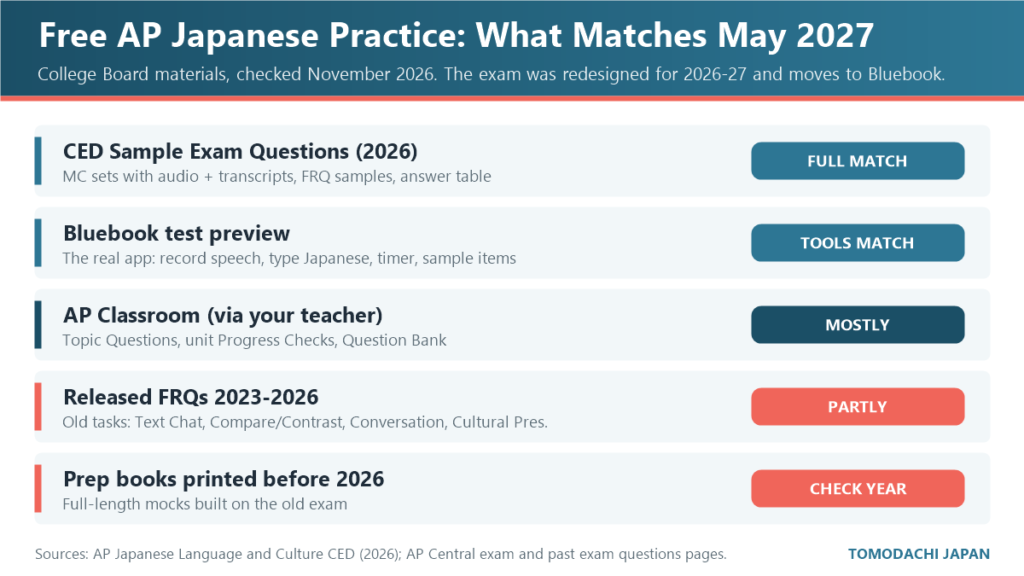
Short answer: there is no free, full-length official AP Japanese practice test for the new May 2027 format yet. What College Board does give you is free and worth using: the Sample Exam Questions at the back of the 2026 Course and Exam Description (multiple choice with audio, plus free-response samples), test previews in the Bluebook app, the Progress Checks and Question Bank in AP Classroom (through your teacher), and released free-response questions from 2023 to 2026 on AP Central. Those older FRQs use the pre-2027 task types, so you need to know which parts still transfer.
Below, we list every official source and what it is good for. Then we give you something you won’t find elsewhere: an original practice set written by Japanese teachers in the 2027 format. It has three five-question multiple-choice sets (two reading, one listening), a Story Narration, an Email Response and four Project Q&A prompts. There is a full answer key, model answers, and a self-scoring sheet built on the official rubric rows. Print it, set a timer, and you have a realistic mock.
Free official AP Japanese practice tests and where to get them
The exam was redesigned for the 2026–27 school year. From May 2027 it is fully digital in Bluebook. Section I is four free-response questions (Project Presentation, Project Q&A, Story Narration, Email Response), and Section II is 55 multiple-choice questions: 25 listening and 30 reading. The next exam is Tuesday, May 11, 2027 (College Board, AP Central exam page, checked November 2026). That redesign is why the date of a practice resource matters so much.
| Source | What you get | Matches the 2027 format? | How to get it |
|---|---|---|---|
| CED Sample Exam Questions (2026 edition) | Multiple-choice sets with audio links and transcripts, free-response samples, and an answer table that names the skill each question tests | Yes. This is the closest thing to an official 2027 practice test. | Free PDF: AP Japanese CED, section “Sample Exam Questions” |
| Bluebook test preview | The real testing app: recording your voice, typing Japanese, the timer, sample questions | Yes, for the tools. Treat it as a rehearsal of the app, not as a score predictor. | Download Bluebook and sign in with your College Board account |
| AP Classroom | Topic Questions, unit Progress Checks and a Question Bank of practice and released items | Mostly. Your teacher assigns them, so ask for them. | Your AP teacher’s class section |
| Released FRQs 2023–2026 | Questions, speaking audio prompts, scoring guidelines, sample responses and score distributions | Partly. They use the old task types: Text Chat, Compare and Contrast Article, Conversation, Cultural Perspective Presentation. | AP Central past exam questions |
| Commercial prep books | Full-length mock exams | Check the edition year. A book printed before 2026 is built around the old exam. | Bookstores, libraries |
How to use the old released FRQs without wasting time: the Conversation prompts still train the skill that Project Q&A needs (answering a recorded question you have never seen, on a clock). The Text Chat still trains reading a short message and replying in the right register, which is what Email Response scores. The Compare and Contrast Article and the Cultural Perspective Presentation are gone, so skip them unless you need extra writing or speaking volume.
Looking for a way to keep Japanese going from abroad?
TOMODACHI JAPAN is an online Japanese school for children growing up outside Japan. They talk with peers their own age in Japan every day, taught by teachers working at Japanese schools, in small classes of 8.
🎁 Register and we’ll email you our School Guide (PDF, in English) straight away. You’ll also be first to hear about tuition, scholarships and opening dates.
Free · takes about 30 seconds
How to run this AP Japanese practice test like the real exam
Our set is shorter than the real exam (15 multiple-choice questions instead of 55), but each part keeps the official structure: five questions per set, English questions about Japanese texts, and the real free-response timings. Free response comes first on exam day, so do it first here too.
| Part | Real exam (May 2027) | This practice set | Your timer |
|---|---|---|---|
| Q1 Project Presentation | 3 min prep + 3 min speaking, 20% | Outline template (uses your own project) | 3 + 3 min |
| Q2 Project Q&A | 4 recorded questions, 40 sec each, 15% | 4 prompts on the 2026–27 music project | 40 sec per answer |
| Q3 Story Narration + Q4 Email Response | 30 min for both, 7.5% each | One four-picture story, one email | 30 min total |
| Listening | 25 questions, 25 min, 25% | 1 set of 5 (Instructional Guidance) | 5 min |
| Reading | 30 questions, 40 min, 25% | 2 sets of 5 (Promotional Material, Correspondence) | 13 min |
Type your writing with a Japanese keyboard (IME), not by hand. Bluebook is typed only, and students who have always handwritten lose minutes converting kana to kanji. For the speaking prompts, record yourself on your phone so you can score it afterwards. The full format, the scoring rows and the 30-week plan are in our AP Japanese exam guide for 2026–27.
Practice set, part 1: free response
Q1 Project Presentation: a 3-minute outline you can reuse
Your presentation is built on your own project and Personalized Project Reference, so we can’t write it for you. What we can give you is the shape that the five scoring rows (task completion, cultural understanding, organization, language control, delivery) reward. Fill it in with your research and practise it against a 3-minute timer.
| Time | Move | Starter in Japanese |
|---|---|---|
| 0:00–0:20 | Topic and the community you chose | わたしのプロジェクトのテーマは__です。__の音楽について調べました。 |
| 0:20–2:20 | Three factors, each with a specific example from a source | まず、__。たとえば、__。次に、__。最後に、__。 |
| 2:20–2:45 | The perspective behind it: why people do it, what they value | これは、__を大切にする考え方を表していると思います。 |
| 2:45–3:00 | Conclusion that is not a repeat of the opening | このプロジェクトを通して、__ということがわかりました。 |
Q2 Project Q&A: four practice prompts (40 seconds each)
The 2026–27 project comes from Unit 3, Art and Creativity, and uses music as the lens. Have a friend or parent read each question aloud twice. Start speaking within a few seconds and use the full 40 seconds. At least one answer must make a cultural comparison or connect perspectives to products and practices.
- どうしてこのテーマを選びましたか。
(Why did you choose this topic?) - 調べている時、いちばんおどろいたことは何でしたか。
(What surprised you most while researching?) - あなたの町の音楽と日本の音楽は、どんなところが同じですか。どんなところがちがいますか。
(How is music where you live similar to and different from music in Japan?) - このプロジェクトを通して、日本の人たちの考え方について何がわかりましたか。
(What did this project teach you about how people in Japan think?)
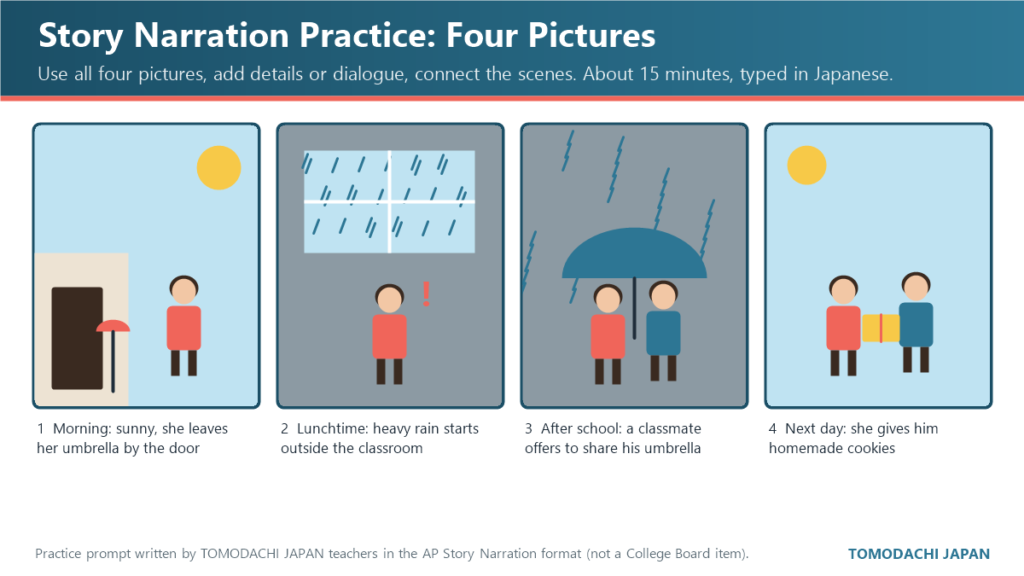
Q3 Story Narration: tell the story in these four pictures
Write a complete story with a beginning, middle and end. Use all four pictures, add details or a line of dialogue, and connect the scenes with words such as ところが, それで and 次の日. On the real exam you share 30 minutes with the email, so aim for about 15 minutes here.
Q4 Email Response: reply to your host sister
Read the email in Reading Set B below (from 山田さくら, the host sister you will stay with next month). Reply in Japanese. Answer both of her questions with details, open and close the email properly, and keep one register from start to finish. About 15 minutes.
Practice set, part 2: multiple choice (15 questions)
Reading Set A: Promotional Material
さくら市 夏の和太鼓ワークショップ
日時:7月20日(土)・27日(土) 午前10時~12時
場所:さくら市文化センター 2階ホール
対象:小学5年生~高校3年生(経験は問いません)
参加費:無料(バチは貸し出します)
申し込み:7月10日までに、文化センターのウェブサイトから申し込んでください。定員30名。定員になり次第、締め切ります。
※動きやすい服装で来てください。飲み物は各自で持ってきてください。
最終日には、保護者の前で発表会を行います。
- What is the main purpose of this notice?
(A) To recruit volunteers for a festival
(B) To advertise a drumming workshop for young people
(C) To announce a concert by professional drummers
(D) To sell taiko drums - Who can take part?
(A) Only students who have played taiko before
(B) Students from fifth grade through the last year of high school
(C) Adults who live in Sakura City
(D) Parents and children who register together - What should participants bring?
(A) Their own drumsticks
(B) Something to drink
(C) The participation fee
(D) Formal clothes - What happens if 30 people apply before July 10?
(A) Applications close.
(B) A third session is added.
(C) The workshop moves to a larger hall.
(D) Participants are chosen by lottery. - What will happen on the final day?
(A) Participants will perform in front of their parents.
(B) Participants will receive certificates.
(C) A professional group will give a lesson.
(D) The workshop will move outdoors.
Reading Set B: Correspondence
件名:来月のホームステイについて
エマさん
こんにちは。山田さくらです。来月、うちに来てくれるのを家族みんなで楽しみにしています。
空港には父が車で迎えに行きます。到着ゲートを出たところで、「EMMA」と書いた紙を持って待っていますね。
うちの近くには大きい公園があって、毎朝、犬の散歩をしています。エマさんも一緒にどうですか。
ひとつ質問があります。食べられないものはありますか。母が夕ご飯のメニューを考えたいそうです。
それから、日本でいちばんしたいことを教えてください。週末にみんなで出かける場所を決めたいと思います。
返事を待っています。
山田さくら
- Who will meet Emma at the airport?
(A) Sakura
(B) Sakura’s father
(C) Sakura’s mother
(D) A taxi driver - How will Emma find the person meeting her?
(A) He will hold a sign with her name.
(B) She has a photo of him.
(C) He will call her phone.
(D) He will wait with the family dog. - What does the family do every morning?
(A) Go jogging
(B) Walk the dog in a park
(C) Cook breakfast together
(D) Drive to the station - Why does Sakura ask what Emma cannot eat?
(A) Her mother wants to plan dinners.
(B) The family is going to a restaurant.
(C) Emma mentioned an allergy before.
(D) Sakura is learning to cook. - Why does Sakura want to know what Emma most wants to do?
(A) To decide where the family will go on weekends
(B) To plan Emma’s school schedule
(C) To buy tickets before Emma arrives
(D) To tell her teacher about Emma
Listening Set: Instructional Guidance
Ask someone to read this aloud once at natural speed while you look only at the questions. Don’t read the script until you have answered.
Script for the reader (tap to open)
みなさん、おはようございます。今日は図書館の新しい使い方について説明します。来週の月曜日から、本は一度に五冊まで借りられます。今までは三冊まででしたね。返す日は二週間後です。それから、二階の自習室は予約が必要になります。予約は図書館のアプリでできます。一回二時間までです。最後に、図書館の中では、飲み物は大丈夫ですが、食べ物はだめです。質問がある人は、カウンターの田中さんに聞いてください。
- How many books can students borrow at one time from next Monday?
(A) Two (B) Three (C) Five (D) Seven - What will students need in order to use the second-floor study room?
(A) A reservation made in the library app
(B) A teacher’s permission slip
(C) A new student ID
(D) A partner to study with - How long can a student use the study room each time?
(A) One hour (B) Two hours (C) Three hours (D) All day - Which is allowed inside the library?
(A) Drinks, but not food
(B) Food, but not drinks
(C) Both food and drinks
(D) Neither food nor drinks - What should students with questions do?
(A) Ask Tanaka-san at the counter
(B) Send a message through the app
(C) Ask their homeroom teacher
(D) Read the notice on the second floor
Answer key and model answers
| Q | Answer | Where the answer is |
|---|---|---|
| 1 | B | 夏の和太鼓ワークショップ, 対象 is students |
| 2 | B | 小学5年生~高校3年生 (経験は問いません = experience not required) |
| 3 | B | 飲み物は各自で持ってきてください (drumsticks are lent: バチは貸し出します) |
| 4 | A | 定員になり次第、締め切ります = closes as soon as it is full |
| 5 | A | 最終日には、保護者の前で発表会 |
| 6 | B | 空港には父が車で迎えに行きます |
| 7 | A | 「EMMA」と書いた紙を持って |
| 8 | B | 毎朝、犬の散歩 |
| 9 | A | 母が夕ご飯のメニューを考えたいそうです |
| 10 | A | 週末にみんなで出かける場所を決めたい |
| 11 | C | 五冊まで (it used to be 三冊, the classic trap) |
| 12 | A | 予約が必要/図書館のアプリで |
| 13 | B | 一回二時間まで |
| 14 | A | 飲み物は大丈夫ですが、食べ物はだめです |
| 15 | A | カウンターの田中さんに |
Check your traps. Questions 3, 11 and 14 are written the way real AP distractors work: the wrong options use words that really are in the text (drumsticks, three books, food). If you missed them, you were matching words instead of reading the sentence they sit in.
Model Story Narration
ところが、昼休みになると、急に空が暗くなって、雨がたくさんふりはじめました。ゆいさんは「どうしよう。傘がない」と心配になりました。
放課後、ゆいさんが学校の入り口で雨を見ていると、クラスメートのけんたさんが「いっしょに帰ろうよ。ぼくの傘に入って」と言ってくれました。それで、二人はひとつの傘で駅まで歩きました。
次の日、ゆいさんはお礼にクッキーを作って、けんたさんにわたしました。「きのうは本当にありがとう」と言うと、けんたさんはうれしそうに笑いました。
Why this scores well: every picture is used, there is dialogue, the connectors (ところが, それで, 次の日) carry the story, and the ending adds a detail (the thank-you cookies) that pays off picture 3. The story would make sense without the pictures, which is how the official guidelines describe a top Narrative Development response.
Model Email Response
メール、ありがとうございます。わたしも来月、日本に行くのをとても楽しみにしています。空港まで迎えに来てくださって、本当にありがとうございます。
質問の答えですが、わたしはえびのアレルギーがあるので、えびは食べられません。でも、ほかのものは何でも食べられます。日本の家庭料理をたくさん食べてみたいです。
日本でいちばんしたいことは、お祭りに行くことです。学校で和太鼓のクラブに入っているので、日本のお祭りで本物の太鼓を聞いてみたいです。
朝の犬の散歩も、ぜひ一緒に行きたいです。
では、来月会えるのを楽しみにしています。
エマ
Both questions are answered with a reason (the allergy, the taiko club), the email opens and closes properly, and it stays in です/ます from the first line to the last.
Score your free response with the official rubric rows
The row names and point ranges below come from the scoring guidelines in the 2026 CED. Score yourself honestly, then score the model answers above to calibrate.
| Task | Row | Points | Ask yourself |
|---|---|---|---|
| Story Narration (8) | Narrative development | 0–3 | Did I use all four pictures and add details or dialogue, or did I just describe each picture? |
| Organization | 0–2 | Is there a clear beginning, middle and end, with connectors? | |
| Language control | 0–3 | Are verb forms and particles accurate enough not to slow the reader down? | |
| Email Response (8) | Message development | 0–3 | Did I answer both questions, each with a detail or example? |
| Organization | 0–2 | Greeting and closing? Logical order? | |
| Language control | 0–3 | Did I keep one register the whole way through? | |
| Project Q&A (9) | Task completion | 0–2 | Did each answer actually answer the question? |
| Cultural understanding | 0–2 | Did at least one answer compare cultures or explain the why behind a practice? | |
| Language control | 0–3 | Accurate forms, no register shifts? | |
| Delivery | 0–2 | Did I use the full 40 seconds at a natural pace? |
A note from a Japanese teacher: where practice tests really lose points
When we mark practice emails from students abroad, the most common lost point is not grammar. It is register drift: a student writes 迎えに来てくださって (polite and correct) in line two, then ends with 楽しみにしてるね, which is how you’d text a friend. Japanese readers notice that shift right away, and the rubric names it in the language control row. Our rule for the exam: if the email comes from a host family, a teacher or anyone older, use です/ます for every sentence, and use one humble-polite phrase such as くださって or いただいて to say thank you. That is enough. You don’t need complicated keigo; you need consistency.
The second one is answering only one of the two questions in the email. Students write a lovely paragraph about what they want to do in Japan and forget the food question. The rubric caps message development for that. Before you type a single word, write the two questions at the top of your answer box as ①② and delete them at the end.
Your practice options, compared honestly
| Option | Best for | Limits |
|---|---|---|
| CED samples + Bluebook preview | Knowing exactly what the 2027 questions and the app look like | Few questions, and nobody marks your speaking or writing |
| AP Classroom Progress Checks | Unit-by-unit practice with real items | Only through a teacher, and free-response feedback depends on that teacher’s time |
| Prep books | Volume: full-length mocks | Many editions still teach the old task types |
| One-to-one tutor (italki, Preply and similar) | Live feedback on your speaking | Quality varies a lot, and few tutors know the AP rubric |
| A small class with teachers from Japan | Speaking every week with real people, register corrected as it happens | Not an AP prep course: it builds the Japanese, and you still need the official samples for format |
The free response is 50% of the score, and almost all of it rewards one thing: speaking and writing to a real reader in Japanese, without notes. That is hard to practise alone. If your teen is the only Japanese learner in the house, regular conversation with Japanese speakers their own age is what moves the delivery and register rows. For more speaking drills, our Japanese oral exam guide with 30 practice questions works for AP too. If your student is weighing other exams, see our guides to IB Japanese ab initio and A Level Japanese.
AP Japanese practice test FAQ
Is there a free full-length AP Japanese practice test?
Not an official one in the 2027 format, as of November 2026. The free official materials are the CED Sample Exam Questions, the Bluebook test preview, AP Classroom items through your teacher, and released FRQs from 2023 to 2026 (old format). Combine them with the practice set on this page for a realistic mock.
Are old AP Japanese practice tests still useful?
Partly. Multiple-choice reading and listening practice still builds the same skills. For free response, the old Conversation trains Project Q&A and the old Text Chat trains Email Response. The Compare and Contrast Article and Cultural Perspective Presentation were removed for 2027.
When is the AP Japanese exam in 2027?
Tuesday, May 11, 2027. The Personalized Project Reference is due in the AP Digital Portfolio by April 30, 2027, 11:59 p.m. ET (College Board, AP Central).
How many practice tests should I take before May?
Quality beats count. Two or three timed mocks (one in March, one in April, a last one two weeks out) plus weekly free-response practice that someone actually marks will do more than ten untimed multiple-choice sets.
Can I print this practice set for my class?
Yes. Teachers may print and use it in class with a link back to this page. The texts and questions were written by our teachers for practice, and they are not College Board materials.
What does TOMODACHI JAPAN cost?
One flat monthly rate with unlimited classes. The details are in our school guide, which we email when you request it here. You can also see how tuition works.