John Stanford International School (JSIS) is a free public elementary school in Seattle’s Wallingford neighbourhood where every child, from the first day of kindergarten, spends half of each school day learning in Japanese or Spanish. It is run by Seattle Public Schools, charges no tuition, and teaches kindergarten to Grade 5 to about 422 children (2024–25). The hard part is getting in. JSIS is an option school: nobody is assigned automatically, 20% of kindergarten and Grade 1 seats are set aside for native speakers, siblings and nearby families come next, and in 2025 the district put 76 of 134 kindergarten applicants on the waiting list. From Grade 2 onwards, only children who already speak Japanese or Spanish fluently can join. The 2027–28 application window is 4–31 January 2027.
This page is the single-school deep dive: who gets a JSIS seat, what “free” actually costs a family, how the Japanese half of the day works, and what the English pages that rank for the school’s name leave out. For the wider picture — Portland, Seattle and the other US districts — see our overview of Japanese immersion schools in the US. Everything below comes from the school’s own pages, Seattle Public Schools’ enrollment pages and choice-results reports, and the JSIS PTSA, read on 16 November 2026. Where something is not published, we say not published.
The short answer
| What it is | A Seattle Public Schools K–5 option school with dual-language immersion for every pupil: half the day in English, half in Japanese or Spanish. Japanese has run since 2001; the first Japanese class graduated in 2007 |
| Where | 4057 Fifth Ave NE, Seattle, Washington 98105, in the restored 1906 Latona School building just west of the University of Washington |
| Cost, 2026–27 | No tuition. The PTSA’s Students First Campaign suggests $1,000 per student a year to fund instructional assistants, interns and a counselor. Before- and after-school care is extra |
| Who gets in | Everyone applies through SPS School Choice. Order: native-speaker set-aside (20% of K and Grade 1), siblings, Geo Zone, then lottery. Grades 2–5: fluent Japanese or Spanish speakers only, after a proficiency interview |
| Odds, 2025 | 134 on-time kindergarten applicants, 58 assigned, 76 waitlisted. Of applicants with no sibling or Geo Zone priority, 13 of 89 got a seat |
| Next window | 4–31 January 2027 for 2027–28 (per the JSIS PTSA). SPS Enrollment Fair: Saturday 9 January 2027 |
| After Grade 5 | A guaranteed place in the Japanese pathway at Hamilton International Middle School, then Lincoln High School, if you apply on time |
| The real catch | It teaches Japanese as a second language to mostly English-speaking children. A child who already speaks Japanese at home will not be studying Japan’s grade-level kokugo |
Looking for a way to keep Japanese going from abroad?
TOMODACHI JAPAN is an online Japanese school for children growing up outside Japan. They talk with peers their own age in Japan every day, taught by teachers working at Japanese schools, in small classes of 8.
🎁 Register and we’ll email you our School Guide (PDF, in English) straight away. You’ll also be first to hear about tuition, scholarships and opening dates.
Free · takes about 30 seconds
First, which school do you actually mean?
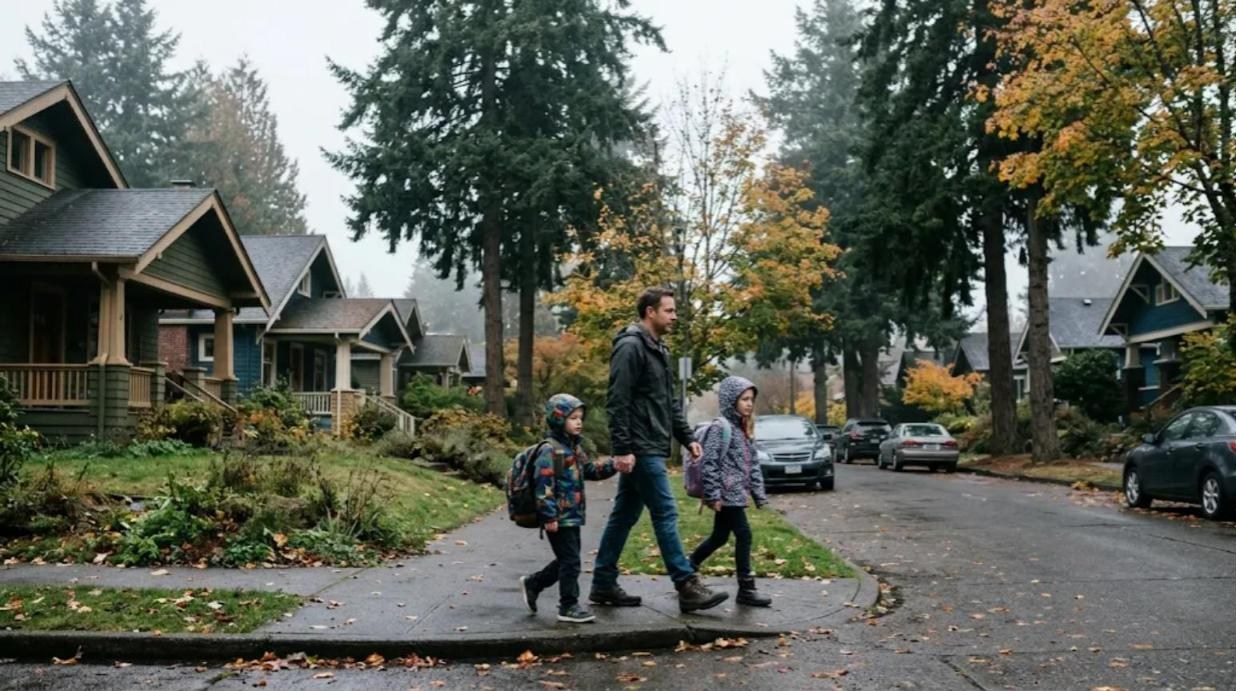
“John Stanford” turns up in Seattle searches in three different ways, and “Japanese school Seattle” brings back at least four kinds of programme. They are not interchangeable: two are weekday public schools that teach Japanese to children who mostly do not speak it, one is a Saturday school for children who already do, and one is a community class for beginners.
| Name you will see | What it actually is | Language and ages | Where |
|---|---|---|---|
| John Stanford International School (JSIS), stanfordes.seattleschools.org | The school this page is about. Free public K–5 option school; half of each day in Japanese or Spanish | Japanese or Spanish plus English; K–5 | Wallingford, Seattle |
| John Stanford Center for Educational Excellence | Not a school. The Seattle Public Schools headquarters, where the January Enrollment Fair is held | — | 2445 Third Ave S, SoDo |
| McDonald International School | JSIS’s twin: another free SPS option school with the same half-day Japanese or Spanish model, feeding the same middle and high school | Japanese or Spanish plus English; K–5 | 144 NE 54th St, Seattle |
| Seattle Japanese School (シアトル日本語補習学校) | A private Saturday hoshuko teaching Japan’s national curriculum in Japanese, for children already at grade level | Japanese; kindergarten year to high school | Office in Bellevue; Saturdays 8 a.m. to 4 p.m. |
| Seattle Japanese Language School (JCCCW) | A Saturday-morning community class teaching Japanese as a language, mostly to beginners | Japanese for learners; ages 6–18 | 1414 S Weller St, Seattle |
The practical difference is direction. JSIS and McDonald take children who are learning Japanese and build it up over six years, with English-language schooling alongside. The Saturday hoshuko takes children who already have Japanese and keeps them level with classmates in Japan. Our page on the Japanese Saturday school in Seattle covers that second route. Nothing stops a family from using both: JSIS on weekdays, a Saturday school or home study for kokugo.
What it costs in 2026–27: no tuition, but a suggested $1,000 per child
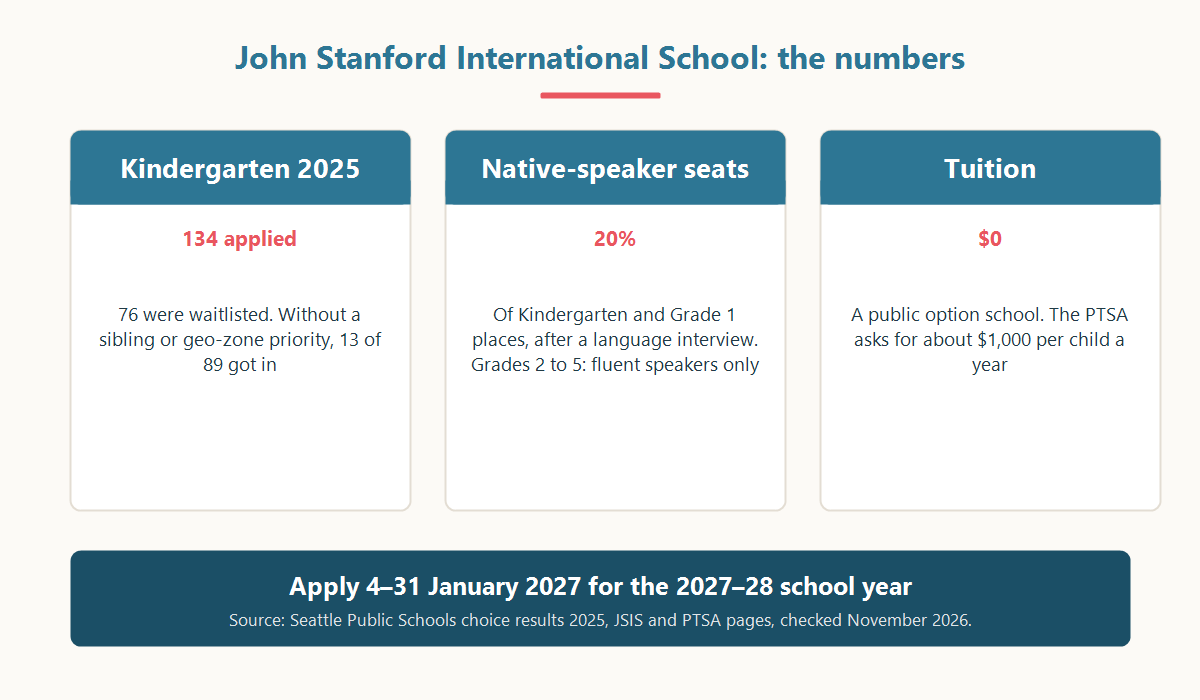
JSIS is a public school, so there is no tuition, no entrance fee and no test fee. What families do pay for, or are asked to pay for, comes from three places, and none of them appears on the English pages that rank for the school’s name.
| Item | What is published | Amount |
|---|---|---|
| Tuition | Seattle Public Schools, K–5 | $0 |
| Students First Campaign (PTSA) | “Our suggested donation this year is $1000 per student.” Pays for instructional assistants, interns, a counselor and biliteracy work the district budget does not cover. Voluntary; tax-deductible; employer matching encouraged | $1,000 per student suggested (page undated) |
| Before- and after-school care | Latona School Associates, a nonprofit on site since 1985: 2:25–6:00 p.m., from 1:15 p.m. on Wednesdays; billed monthly; waitlist rolls over each year | Rates not published in readable form |
| After-school classes | Parent-run After School Activities with outside providers | Per class; not published on the school site |
| Getting there | No district bus for children who live outside the JSIS transportation area | Your own driving or transit |
The $1,000 matters more than it looks. The school’s About page says every immersion classroom has a certificated instructional assistant, bringing the ratio down to about 14 children per adult, and that those salaries “are paid for through grants and fund-raising”. The campaign page is blunt about the risk: if the goal is not met, “some of the positions dependent on this fund may need to be eliminated”, and it says the campaign has come in short in recent years. Families who cannot give are not excluded — the stated goal is 100% participation at any level — but a two-child family should budget for a request of about $2,000 a year.
The other real cost is time. The bell schedule is 7:55 a.m. to 2:25 p.m., and 1:10 p.m. on Wednesdays, which is early for working parents. On-site care has a waiting list for Grades 1–5; incoming kindergarten places are first-come in late April, and the provider says it holds back a share of places for native-speaker families who enrol late. Put your name down as soon as a JSIS seat is confirmed.
Set against private tuition or a paid Saturday programme, that is a modest ask. For a family that wins a seat, it is one of the best-value routes to Japanese in the United States. The catch is the “wins”.
Who can enrol: a native-speaker set-aside, then siblings, the Geo Zone and a lottery
This is the section that decides everything. JSIS is an option school: unlike a neighbourhood school, it has no attendance area, and “everyone must apply to attend John Stanford, no one is automatically assigned”. You first enrol your child with Seattle Public Schools, then submit a School Choice form naming JSIS. When there are more applicants than seats, the school’s enrollment page lists the order:
- Native-speaker set-aside: 20% of seats in kindergarten and Grade 1 go to children whose first language, or one of whose first languages, is Japanese or Spanish, and who pass a language proficiency interview.
- Siblings of current JSIS pupils.
- Geo Zone: children whose home address is inside the school’s geographic zone, a small area around Wallingford shown on a district map.
- Lottery for everyone else, by a random number.
Language is assigned the same way: native and heritage speakers and siblings choose first; then families state a preference for Japanese or Spanish, and seats are filled by lottery. A child who wins a JSIS seat is not guaranteed the Japanese side.
How hard is it? The district publishes the results. For kindergarten in 2025 (the 2025–26 school year), on-time choice applications looked like this:
| Kindergarten choice, on time | JSIS 2025 | JSIS 2024 | McDonald 2025 |
|---|---|---|---|
| Applicants | 134 | 117 | 81 |
| Assigned with sibling and Geo Zone | 9 | 16 | 12 |
| Assigned with sibling only | 21 | 20 | 7 |
| Assigned with Geo Zone only | 15 | 18 | 28 |
| Assigned with no tiebreaker | 13 | 3 | 11 |
| Total assigned | 58 | 57 | 58 |
| Waitlisted | 76 | 60 | 23 |
Read the “no tiebreaker” row. A family with no sibling at JSIS and no address in the Geo Zone had roughly a 15% chance in 2025 (13 of 89) and about 5% in 2024 (3 of 63). That is our arithmetic from the district’s tables. The school says waiting lists do move — “many families who were on the wait list last spring are now in our program” — and last year the district kept lists open until 31 May. McDonald, the twin school, had a much shorter list in 2025.
Joining later, in Grades 2–5. Here the rule flips. “Open spots in 2nd–5th grade can only be filled by fluent speakers of Japanese and Spanish,” who must pass a language proficiency test, and the school adds that “there are often openings in these higher grades”. For a Japanese-speaking family moving to Seattle with a seven- to ten-year-old, this is the door most English pages never mention: a fluent child can often get in when an English-speaking child cannot.
Who cannot use the choice process. Seattle Public Schools says non-resident students and early-entrance kindergarteners are not eligible for open enrollment choice. Kindergarten is for children who are 5 by 31 August. Families relocating from Japan should enrol first with an address in Seattle; the January Enrollment Fair asks for two proofs of address, parent photo ID, a birth certificate or passport for kindergarten and Grade 1, and vaccination records.
Dates for 2027–28. The JSIS PTSA lists kindergarten classroom tours on Thursday 10 December 2026 (8:30–9:30 a.m. and 1–2 p.m.), an online information session that evening at 5 p.m., an open house on Wednesday 16 December at 6 p.m., the SPS Enrollment Fair on Saturday 9 January 2027 (10 a.m. to 2 p.m.), and the priority application window of 4–31 January 2027. Last year results came out on 24 February, and late applications were accepted until 31 March without any tiebreaker. The PTSA has enrollment information in Japanese.
How it works: half the day in Japanese, maths in Japanese, English literacy in English
| What | What the school publishes |
|---|---|
| The split | Every child spends half of each day in Japanese or Spanish from the first day of kindergarten. In the immersion classroom, teachers speak only the immersion language |
| Subjects in Japanese | Maths is “primarily taught in the immersion language”. Science and social studies alternate between English and Japanese depending on grade. Reading and writing in English follow a balanced-literacy approach aligned with state standards |
| Teachers | Immersion teachers are usually native speakers; classroom teachers loop with the same children for two years; a certificated instructional assistant in each immersion classroom |
| The day | 7:55 a.m. to 2:25 p.m.; Wednesdays to 1:10 p.m. PE and music twice a week, library once |
| Size | 422 pupils in 2024–25 (state report card figure, in the school’s 2025–26 improvement plan), in a building renovated in 2000 for 370 |
| Community | PTSA events include Japan Night; partners listed include the University of Washington and the Sister City Council |
| After Grade 5 | Hamilton International Middle School (6–8): Immersion Language Arts in Japanese, one period a day, as a year-long course. Lincoln High School (9–12): advanced Japanese including AP; the district says its high-school immersion model is still in development |
Two points deserve a closer look. The first is the pathway. A JSIS pupil who wants to continue in Japanese has a guaranteed seat at Hamilton, but only if the family acts: children inside Hamilton’s boundary are assigned automatically, while those outside must submit a School Choice form during open enrollment. The school also warns that applying to another programme, such as Highly Capable, can cost a child their JSIS place if the other school has room.
The second is what “Japanese” means here. JSIS uses Washington’s curriculum. Japanese is the language in which maths and some science are taught, to a class that is mostly made up of English-speaking children. That is a superb way for a child with no Japanese at home to become bilingual. It is a different thing from the kokugo course — reading, writing and kanji at Japan’s grade level — that a child would take at a school in Japan.
The honest review: what the English pages leave out
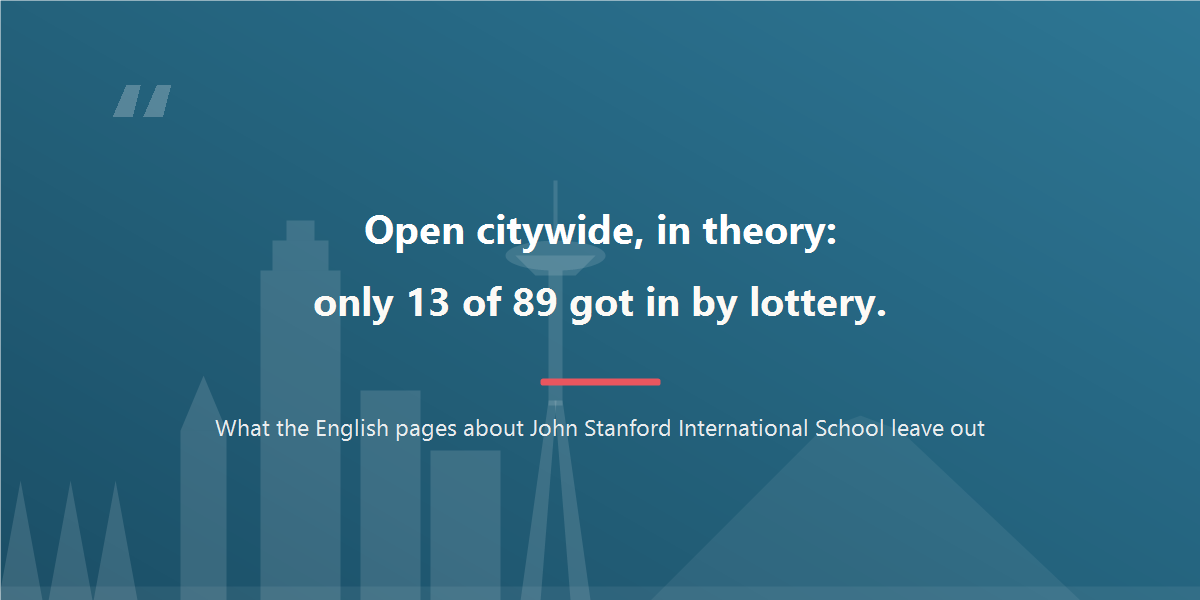
People search for “John Stanford International School reviews” hoping to learn what it is like from the inside. We found no parent reviews we could verify, and we will not invent a consensus. What we can do is show where the pages that rank diverge from what the school and the district publish.
1. “Open to children citywide” — in theory
The English Wikipedia article says JSIS became an option school “open to children citywide”. Any Seattle family can apply, but the district’s own figures show what happens next: in 2025, 45 of the 58 kindergarten choice seats went to siblings or Geo Zone families, and 76 children were waitlisted. Living in Ballard or Beacon Hill with no sibling at the school, you were in the 13-of-89 group.
2. “Free” — with a $1,000 ask that pays for the extra adults
Listings describe JSIS, correctly, as a free public school. None of them mentions the PTSA’s suggested $1,000 per student, or that the instructional assistants who make immersion classrooms work are funded that way. It is voluntary, but it is part of how the programme runs, and parents should know about it before they choose.
3. “Entry is at kindergarten” — unless your child speaks Japanese
General guides say immersion entry is at kindergarten. At JSIS that is true for English-speaking children. For a child who is fluent in Japanese there are two more doors: the 20% native-speaker set-aside in kindergarten and Grade 1, and Grades 2–5, which are open only to fluent speakers and where the school says places often come up.
4. Enrolment of “about 400” or “450” — it was 422, in a building for 370
Wikipedia gives about 400 pupils “as of 2008” and roughly 450 in its infobox, with no year. The school’s 2025–26 improvement plan quotes the state report card: 422 in 2024–25. The district’s building record shows the 2000 renovation was designed for 370 children. Ask on a tour how classrooms are used and how many Japanese classes there are per grade; the school does not publish that split.
5. The dates on the school’s own page are mixed up
The JSIS enrollment page, as we read it, carries a heading for “2027–2028 Key Dates” above lines about 2026–27 registration, a 31 January 2026 deadline and a March window for current families that the district no longer uses. The district’s School Choice page had not yet posted 2027–28 dates. The clearest current source is the JSIS PTSA page (4–31 January 2027). Check the district page again in December before you submit anything.
6. What it means for a child who already speaks Japanese
No English page says this, so we will. JSIS is designed to make English-speaking children bilingual, and it does that well. A child who speaks Japanese at home will be among the strongest speakers in the Japanese half of the day, which is good for confidence and for keeping spoken Japanese alive. But the Japanese work is pitched at a class of learners, and the reading and kanji that a child in Japan does every day are not the goal. If your family may return to Japan, or wants your child to read Japanese at age level, plan for kokugo somewhere else as well — a Saturday school, structured home study, or an online class.
Other options in Seattle
| Option | Who it takes | What to know |
|---|---|---|
| McDonald International School (SPS) | Same rules as JSIS: option school, set-asides, siblings, Geo Zone, lottery | Free. Half the day in Japanese or Spanish; maths and science in the immersion language. 81 kindergarten applicants and 23 waitlisted in 2025. Feeds Hamilton and Lincoln |
| Seattle Japanese School (hoshuko) | Children who can follow lessons in Japanese at grade level | Private Saturday school, 8 a.m. to 4 p.m.; office in Bellevue; Japan’s curriculum. Admits pupils of any national origin. Current fees not on its public pages |
| Seattle Japanese Language School (JCCCW) | Ages 6–18; most new pupils are beginners | Saturday 9:30–11:30 a.m. in the Central District. $485 a semester (two children $880, three $1,290). 2026–27 second semester starts 6 February 2027 |
| Portland and Vancouver | — | Too far for daily use, but useful comparisons: the Portland Japanese School shows how a Saturday hoshuko sits beside Portland’s public immersion lottery |
The gap is the one we see across the US. Immersion serves children starting from little or no Japanese; the hoshuko serves children already at Japanese grade level. The child of a Japanese parent who lost the JSIS lottery, or who got in but reads two years behind Japan, can fall between them — and a full Saturday in Bellevue is a big ask on top of a five-day school week.
How to choose, in four questions
- Does your child already speak Japanese? If yes, apply for the native-speaker set-aside (kindergarten, Grade 1) or a Grade 2–5 place, and book the proficiency interview. If no, kindergarten is realistically the only door.
- Where do you live? Check the Geo Zone map and the transportation area. Outside both, your odds are lottery odds and the school run is yours.
- Would you be content at McDonald? List both on your choice form in your real order of preference; a waitlist applies only to your first choice.
- What do you want Japanese for? Bilingual ability for an American child: JSIS is close to ideal. Age-level reading for a possible return to Japan: add kokugo on top.
Where TOMODACHI JAPAN fits
We are not a substitute for John Stanford International School, and if your child wins a seat we would tell you to take it. We exist for the families the four questions leave stuck — the Japanese-speaking child on the waitlist, the JSIS pupil who speaks well but reads below Japan’s level, the family for whom a full Saturday in Bellevue on top of school is too much, and the child whose only Japanese-speaking friends are other learners.
- Japanese friends of the same age, every day. Classes with children the same age in Japan — not only other learners in Seattle. The reason children keep going is usually the other children.
- Teachers working at Japan’s current classroom standard — about 2% of applicants are hired. Not a syllabus written abroad and not a tutoring marketplace.
- Small classes of eight children. Enough to be a class, few enough that every child speaks every lesson.
- Seattle is 17 hours behind Japan in winter, 16 in summer. That rules out Japan’s evenings: an evening class in Japan at 8 p.m. would land at 3 a.m. here. Japan’s mornings are what line up — a class running from 9 to 11 a.m. in Japan would fall between 4 and 6 p.m. the previous afternoon in Seattle, after the 2:25 bell, so children here could join children in Japan without either side staying up late. No lottery, no Geo Zone.
- Unlimited classes for a flat monthly fee. Tuition, scholarships and opening dates are in our free school guide, which we email to everyone who registers, with no obligation. Our pilot classes are planned to open in December 2026.
If a Saturday school is what you are weighing us against, our guide to online alternatives to a Japanese hoshuko sets out what an online class can and cannot replace.
Frequently asked questions
How much does John Stanford International School cost?
Nothing in tuition: it is a Seattle Public Schools elementary school. The PTSA’s Students First Campaign suggests a voluntary $1,000 per student a year, which funds instructional assistants, interns and a counselor. On-site before- and after-school care from Latona School Associates is paid separately, and there is no district bus for families outside the transportation area.
Is it hard to get into JSIS?
For kindergarten, yes. In 2025 the district received 134 on-time kindergarten applications, assigned 58 and waitlisted 76. Seats go first to the native-speaker set-aside (20% of K and Grade 1), then siblings, then Geo Zone families, then by lottery; only 13 of 89 applicants without a tiebreaker got in.
Can my Japanese-speaking child join in Grade 3?
Possibly. Places in Grades 2–5 are open only to fluent speakers of Japanese or Spanish, who must pass a language proficiency interview, and the school says openings often come up in those grades. Enrol with Seattle Public Schools, name JSIS on the School Choice form, and the school will contact you to schedule the interview.
When are the 2027–28 applications?
The JSIS PTSA lists the priority window as 4–31 January 2027, with kindergarten tours on 10 December 2026, an open house on 16 December and the SPS Enrollment Fair on Saturday 9 January 2027. Confirm on the district’s School Choice page, which had not posted 2027–28 dates on 16 November 2026.
Does the Japanese continue after Grade 5?
Yes. JSIS pupils have a guaranteed place in the Japanese pathway at Hamilton International Middle School, with a daily Immersion Language Arts class in Japanese, and then at Lincoln High School, which offers advanced and AP Japanese. Families outside the Hamilton boundary must submit a School Choice form on time to use the guarantee.
Is JSIS the same as the Japanese Saturday school in Seattle?
No. JSIS is a free weekday public school teaching in Japanese and English to children of any background, mostly beginners. The Seattle Japanese School is a private Saturday hoshuko, with its office in Bellevue, teaching Japan’s national curriculum to children already working at grade level in Japanese. Some families use both.
Sources
- John Stanford International School: About, Enrollment, Bell schedule, History, Students First Campaign, Dual Language Immersion pathways, Transportation, After School Activities
- JSIS PTSA: Enrollment events 2027–28 (English, Japanese, Spanish)
- Seattle Public Schools: JSIS school profile, 2025–26 Annual CSIP (PDF), Open Enrollment for School Choice, Assignment, waitlists and tiebreakers, 2025 choice results (PDF), 2024 choice results (PDF), Dual Language Immersion, Enrollment Fair, Enrollment information sessions
- Pathway and comparison: Hamilton International Middle School FAQ; Lincoln High School, Dual Language Immersion; McDonald International School; Latona School Associates; Seattle Japanese School; Seattle Japanese Language School, youth classes
- Third-party page checked: Wikipedia (English). All checked 16 November 2026.