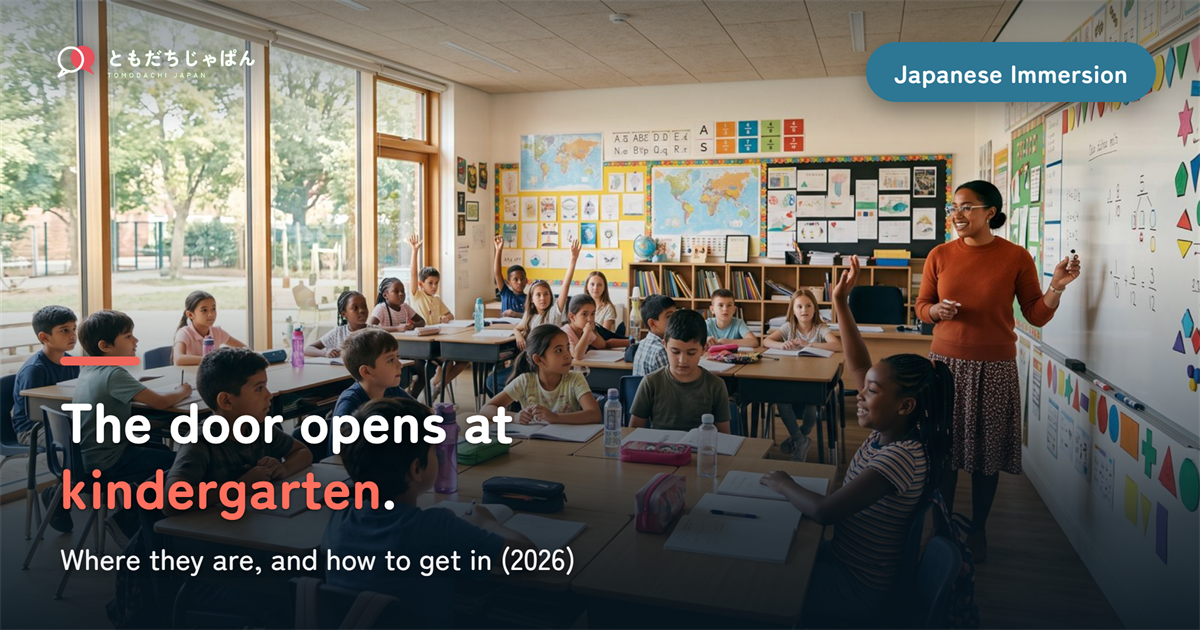
A Japanese immersion school is the option most parents wish they had. Half the school day taught in Japanese, by teachers, alongside classmates doing the same thing — not a Saturday add-on, but the child’s actual education.
The catch is geography. In the United States, genuine Japanese immersion pathways exist in a handful of cities — and if you do not live in one of them, no amount of searching will conjure one. This article explains what these programmes are, where the established ones are, how families get in, and what to do when the honest answer is “there isn’t one near you.”
What a Japanese immersion school actually is
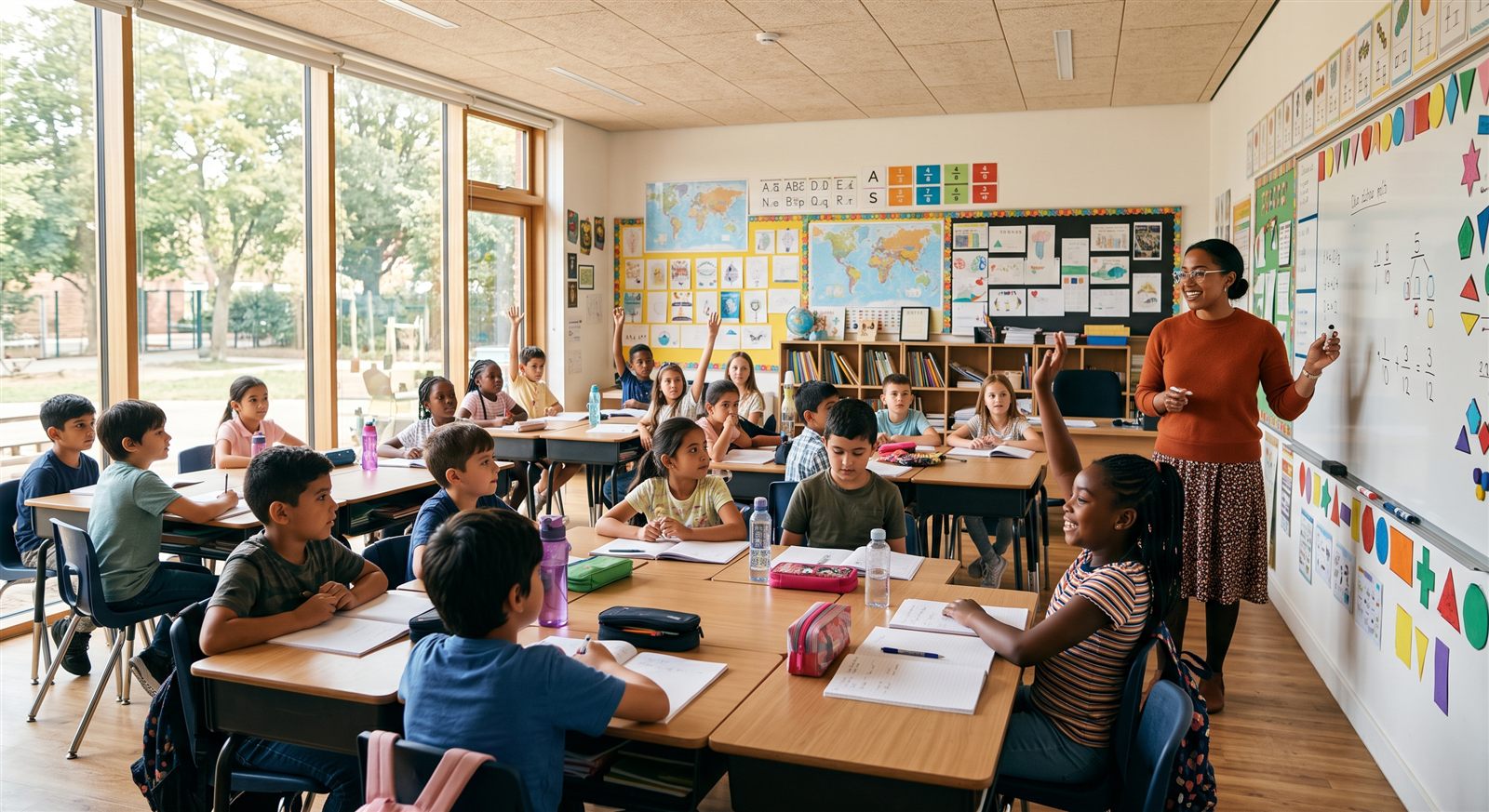
An immersion — or dual language immersion — programme is not a Japanese class. It is ordinary school subjects taught in Japanese. Maths, science and social studies happen in Japanese for part of the day and in English for the rest.
That distinction matters. A child in an immersion programme is not learning about Japanese; they are using it to learn something else, which is how first languages are acquired in the first place. It is the strongest model there is, and where a place is available, we would tell you to take it.
Wondering what to add once the app runs out?
TOMODACHI JAPAN is an online Japanese school for children growing up outside Japan. They talk with peers their own age in Japan every day, taught by teachers working at Japanese schools, in small classes of 8.
🎁 Register and we’ll email you our School Guide (PDF, in English) straight away. You’ll also be first to hear about tuition, scholarships and opening dates.
Free · takes about 30 seconds
Where the established US programmes are
Two districts run the best-known public K-12 Japanese pathways:
- Portland, Oregon. Portland Public Schools runs a full K-12 Japanese immersion pathway: Richmond Elementary for kindergarten through grade 5, then Mt. Tabor Middle School, then Grant High School. At Richmond, children spend half the day learning in Japanese and half in English. Portland also has The International School of Portland, an independent IB school with a Japanese track.
- Seattle, Washington. Seattle Public Schools runs half-day Japanese dual language immersion at John Stanford International School and McDonald International Elementary, continuing at Hamilton International Middle School and Lincoln High School through to graduation.
Beyond those, searches for Japanese immersion in the Bay Area, Los Angeles, San Francisco, Anchorage and Eugene turn up a mix of independent schools, charter programmes and partial-day offerings that vary a great deal in scope and stability.
School assignments, boundaries and programme structures change every few years. Confirm anything here directly with the district before you make a decision around it — especially anything involving moving house.
The three things that catch families out
1. Entry is usually at kindergarten. Immersion pathways are built as a sequence, so the natural door is the first year. Seattle notes that students do not have to start in kindergarten — with sufficient language proficiency, a child may join in upper elementary or even at middle or high school — but later entry depends on the child already having the Japanese to cope.
2. You often have to live in the right place. These are public schools with attendance boundaries and lotteries. For many families the real question is not “is this a good programme” but “can we get a place at all.”
3. Immersion teaches the language, not the friendships. This is the one nobody warns you about. Immersion classmates are, almost entirely, other children learning Japanese in America. Your child ends up with excellent classroom Japanese and no one their own age in Japan to use it with — which is exactly the gap that shows up when the family visits and the child answers their cousins in English.
If there is no immersion school near you
This is most families, and it is worth saying plainly: not having one nearby is the normal case, not a failure. The realistic alternatives are a local Japanese supplementary school on Saturdays where one exists, a home-study programme for reading and writing, and a live online class for the spoken language.
How the options compare
| Japanese immersion school | Saturday supplementary school | TOMODACHI JAPAN | |
|---|---|---|---|
| Where | A few US cities only | Where a local community runs one | Online, anywhere |
| Time commitment | Half the school day | Saturday mornings | Short live classes on weekdays |
| Usual entry point | Kindergarten (later with proficiency) | Varies | Any time, placed by level |
| Depth of language | Very high | High for reading and writing | Focused on speaking and confidence |
| Classmates | Other learners in your city | Other Japanese families locally | Peers living in Japan |
| Costs your Saturday | No | Yes | No |
What TOMODACHI JAPAN does
We are an online Japanese school for children growing up outside Japan. We are not an alternative to immersion — if you can get a place at Richmond or John Stanford, take it.
- Peers their own age who live in Japan — the piece immersion cannot supply, because immersion classmates live where you do.
- Teachers working at Japanese schools, teaching the way schools in Japan teach.
- Small classes of 8, so every child speaks in every session.
- Live and ongoing, on weekday evenings that work across time zones.
Some of the families we like most are immersion families. Their children have the grammar; what they want is someone in Japan to spend it on.
Frequently asked questions
Is there a Japanese immersion school near me?
Start with your school district’s dual language or world languages office rather than a general search — districts publish their own programme pages, and those are the only current source. Portland and Seattle are the established public K-12 pathways.
Can my child join in third grade instead of kindergarten?
Sometimes. Seattle states that with appropriate language proficiency, students may join in upper elementary or later. The constraint is your child’s Japanese, not the paperwork.
Is immersion enough on its own for a heritage child?
For academic Japanese, it is outstanding. For the social, natural Japanese children use with each other, it depends entirely on who else is in the room — and in an American immersion classroom, that is other American children.
In short
- Immersion means subjects taught in Japanese, not Japanese as a subject. It is the strongest model available.
- The established US public pathways are Portland (Richmond, Mt. Tabor, Grant) and Seattle (John Stanford, McDonald, Hamilton, Lincoln).
- Entry is usually at kindergarten; later entry needs existing proficiency.
- Immersion gives your child the language. It does not give them friends in Japan.
- If there is no programme near you, that is the ordinary situation — not a dead end.