If you have just moved to Singapore and someone at work said “send them to JSS on Saturdays,” you have probably already found the website — and found that it answers about a third of your questions. Who is actually allowed in. When you can join. What happens in the room. And what you do if the answer turns out to be no.
This is a plain-English guide to the Japanese Supplementary School Singapore (JSS), written for families weighing it up. Everything below is either quoted from the school’s own site or from Singapore’s Japanese school system; where a figure is not published, we say so rather than guessing.
What JSS actually is (and what it is not)
JSS is a hoshuko — a supplementary school. It is not a full-time school and it does not replace your child’s weekday education. It exists for one job: keeping a child’s kokugo (Japanese language arts, the subject Japanese children study at school) moving at roughly the pace it would move in Japan, while the child spends Monday to Friday somewhere else entirely.
| Item | What the school states |
|---|---|
| Full name | The Japanese Supplementary School Singapore (日本語補習授業校) |
| Who it is for | “日本国籍を持つ小・中学生” — elementary and junior high students holding Japanese nationality |
| When | Every Saturday (afternoon session) |
| What is taught | “国語や日本文化” — Japanese language arts and Japanese culture |
| Campus | Inside the Singapore Japanese School, Primary Clementi Campus, 95 Clementi Road |
| Intakes | “年度当初の4月、年度途中の6月と10月” — April, then June and October |
| Founded | 1992; formally recognised 1996 |
| Size | Roughly 320–335 students — among the largest supplementary schools in Asia |
| Phone | +65 6777-5560 |
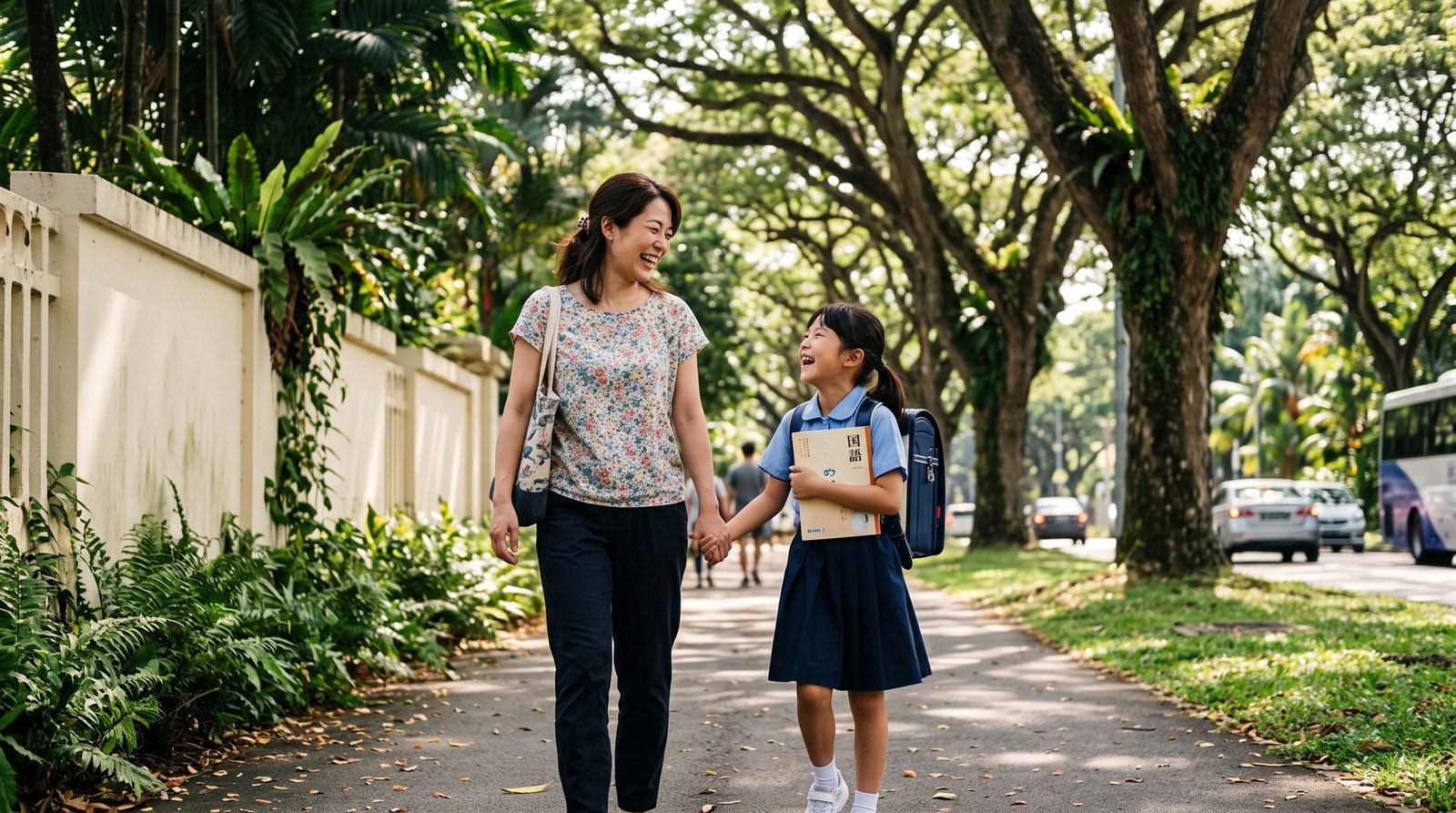
The typical JSS family has a child at a local Singapore school or an international school from Monday to Friday, and uses Saturday to stop Japanese reading and writing from quietly falling behind. That is a narrow, well-defined job, and JSS has been doing it since 1992.
Looking for a way to keep Japanese going from abroad?
TOMODACHI JAPAN is an online Japanese school for children growing up outside Japan. They talk with peers their own age in Japan every day, taught by teachers working at Japanese schools, in small classes of 8.
🎁 Register and we’ll email you our School Guide (PDF, in English) straight away. You’ll also be first to hear about tuition, scholarships and opening dates.
Free · takes about 30 seconds
The eligibility rule that catches families out
Here is the single most important line on the JSS site, and the one that ends the search for a lot of families: enrolment is for students holding Japanese nationality.
This is not a language-level test. It is a passport test. It comes from how supplementary schools are funded and staffed — they exist to serve Japanese nationals living abroad temporarily, on the assumption that the child will return to a Japanese school one day. A child who speaks beautiful Japanese at home but holds only a Singaporean, Australian, British or American passport is not eligible, no matter how well they would fit the class.
Run your own family through this before you fill in anything:
| Your situation | JSS? | What to do |
|---|---|---|
| Child holds Japanese nationality (including dual), attends a local or international school here | Eligible | Contact the school ahead of the next April / June / October intake |
| Child holds Japanese nationality but attends the full-time Singapore Japanese School | Not the right fit | Weekday school already covers kokugo; JSS would duplicate it |
| One Japanese parent, but the child does not hold Japanese nationality | Not eligible | See the alternatives section below |
| No Japanese nationality, child loves Japanese and wants to learn | Not eligible | Heritage or general Japanese classes, or an online school |
| Posting to Singapore is under a year | Eligible if a national | Ask about the June and October mid-year intakes rather than waiting for April |
If you land in one of the “not eligible” rows, that is disappointing but it is worth knowing on a Tuesday rather than after a term of phone calls. Skip ahead — there are four other routes in Singapore and they are genuinely good.
The three intake windows, and why they matter more here than at home
JSS states its admissions happen “in April at the start of the academic year, and mid-year in June and October.” Three windows a year is more generous than many supplementary schools, and it exists because postings do not politely begin in April.
- April — the main intake, matching the Japanese school year. Cleanest entry point: your child starts a grade with everyone else.
- June — for families who arrive in the first half of the year. Your child joins a class already partway through its textbook.
- October — the second-half intake. Useful for postings that start over the northern summer.
The practical advice: do not wait for the next April. The gap between leaving a Japanese classroom and re-entering one is where kanji quietly evaporates. A child who joins in October has three months less to lose than a child who waits until April. If your arrival date falls just after a window, ring the school anyway — supplementary schools deal with mid-posting arrivals constantly.
Fees: what we can and cannot tell you
JSS does not publish a fee schedule on its public website, and we are not going to print a number we cannot source. What we can tell you is the shape of the cost, because supplementary schools across Asia are built the same way: an entrance fee on joining, then a recurring tuition fee, plus materials. Japanese government textbooks themselves are supplied free to eligible children abroad through the consulate system, which takes one line item off the list.
To get the real figure, call +65 6777-5560 and ask three specific questions rather than “how much is it”:
- What is the entrance fee, and is it charged again if we withdraw and rejoin during the same posting?
- Is tuition billed monthly or per term, and what happens to the term you join partway through?
- Is there a parent duty roster or committee obligation, and how many Saturdays a year does it involve?
That third question is the one most families forget to ask and most regret not asking. At many supplementary schools, parent participation is not optional.
What Saturday actually costs you — in hours, not dollars
Clementi Road is central, which helps. But be honest with yourself about the shape of the day: an afternoon session plus travel each way generally removes the working part of a Saturday for one parent. In a family with two children in different sports on Saturday mornings, that is where the plan tends to break — not in the classroom.
Families who make it stick usually do one of three things: alternate the drop-off between parents, accept that Saturday is a Japanese day and stop scheduling against it, or pair a lighter Saturday commitment with something on weekdays. Families who quietly stop going usually did none of the three and simply ran out of Saturdays.
A note from a Japanese classroom teacher
One thing is worth understanding about kokugo, because it explains why a once-a-week class can feel like it is not enough even when it is taught well.
Kokugo is not “Japanese lessons.” It is the subject in which Japanese children learn to think in writing — to read a passage and say what the author is doing, to structure an argument, to choose between 言う and 申し上げる and know why. The kanji list is the visible part; the reasoning is the part that matters at a Japanese school entrance interview. And reasoning of that kind is built by using the language with other people, not only by studying it.
That is why children in supplementary schools often pass their kanji tests and still freeze when a cousin in Japan asks them a question. A few hours a week of instruction with classmates who all speak English to each other at break is very different from five days a week of living in the language. If you can add even a small amount of genuine conversation with peers in Japan — not lessons, conversation — it does disproportionate work. That gap is the reason our own school was built the way it was.
If JSS is not an option: four routes in Singapore
| Route | Nationality required? | Best for | Watch out for |
|---|---|---|---|
| JSS (supplementary school) | Yes — Japanese nationality | Returning to a Japanese school; keeping grade-level kokugo | Saturdays gone; parent duties; three intakes only |
| Japanese as a subject at an international school | No | Convenience — it is already in the timetable | Often mixed-level; can be far below a heritage child’s ability |
| Private tutor or language centre in Singapore | No | Flexible timing; targeted fixes | One-to-one means no peers; the social motivation disappears |
| Online school with classes in Japan | No | Weekday continuity; talking with children the same age in Japan | Time zone — though Singapore is only one hour behind Japan |
That last row deserves a sentence of honesty about our own bias: we run an online school, so of course we like it. But the time-zone point is just arithmetic. A 5:00pm class in Japan is 4:00pm in Singapore — an ordinary after-school hour. Families in London or Los Angeles do not get that.
If you want the wider Singapore picture, we have a longer guide to Japanese classes for kids in Singapore, plus comparisons of tutors versus classes for children and online Japanese lessons for kids.
Frequently asked questions
Does my child need to be fluent to join JSS?
Supplementary schools teach the Japanese national curriculum using Japanese textbooks, so classes assume a child can follow instruction in Japanese at roughly their grade level. Eligibility is by nationality, but placement is by ability — talk to the school honestly about where your child actually is, not where their age says they should be.
Is JSS the same as the Singapore Japanese School?
No. The Singapore Japanese School is a full-time weekday school following the Japanese curriculum. JSS is a Saturday supplementary school that uses the Clementi campus. Different institutions with different purposes — they simply share a building.
My child holds two passports. Is that a problem?
Dual nationality generally satisfies a Japanese-nationality requirement, and many children at supplementary schools worldwide hold two passports. Because family circumstances vary, confirm yours directly with the school rather than relying on any guide, including this one.
We are only here for eighteen months. Is it worth starting?
Usually yes, and more so the shorter the posting — because a short posting means a return to a Japanese classroom soon. The children who struggle most on return are the ones who paused Japanese entirely “because it was only a year.” Use the June or October intake rather than losing months waiting for April.
Can we do JSS and an online school at the same time?
Plenty of families do, and the two do different jobs. Saturday covers the curriculum and the writing; weekday conversation covers the part a once-a-week class structurally cannot — using Japanese often enough that it stays a living language rather than a school subject.
The short version
JSS is a well-established, sizeable supplementary school in a central location, doing a specific job well: keeping grade-level Japanese moving for Japanese-national children who will go home again. If your child is eligible and your Saturdays are free, it is a strong default and you should ring them before the next intake.
If your child is not eligible — or if Saturday is already spoken for — that is not the end of Japanese. It just means the answer is a different shape.