Here is the honest answer first: there is no official JLPT N5 kanji list. The organizers stopped publishing kanji, vocabulary and grammar lists when the test was revised in 2010. Every JLPT N5 kanji list you find online is a reconstruction, which is why some say 80 kanji and others say 103. Below you’ll find all 103 kanji from the longer, widely used list, grouped by theme, with meanings, readings and an example word for each. The 23 that shorter lists leave out are marked, so you can choose your own target.
We wrote this for students aged about 10 to 16 sitting N5 on Sunday, December 6, 2026, and for the parents helping them revise. As Japanese teachers, we checked every reading and example word.

Is there an official JLPT N5 kanji list?
No. Before 2010, the test had four levels, and the organizers (the Japan Foundation and the Japan Educational Exchanges and Services) published a book called the Test Content Specifications, with lists of vocabulary, kanji and grammar for each level. When the test moved to five levels, N1 to N5, they dropped those lists. Their official guidebook says it directly: the Test Content Specifications, with their lists of vocabulary, kanji and grammar, are not going to be published for the new test. The reason given is that the goal is to use Japanese to communicate, not to memorize lists.
What the JLPT does publish is a short description of each level. For N5, it says a test taker can read and understand typical expressions and sentences written in hiragana, katakana and basic kanji. It does not say how many.
So where do the lists come from? The same guidebook describes N5 as approximately the same level as the old Level 4. JLPT materials comparing the old and new tests describe old Level 4 as about 100 kanji and about 800 words, after around 150 hours of study. Study sites and textbook writers built their N5 lists from that old level and from past papers. That is why almost every list lands somewhere near 100, but none of them is official.
Looking for a way to keep Japanese going from abroad?
TOMODACHI JAPAN is an online Japanese school for children growing up outside Japan. They talk with peers their own age in Japan every day, taught by teachers working at Japanese schools, in small classes of 8.
🎁 Register and we’ll email you our School Guide (PDF, in English) straight away. You’ll also be first to hear about tuition, scholarships and opening dates.
Free · takes about 30 seconds
How many kanji are on N5: 79, 80 or 103?
We compared the lists that students and teachers use most. They disagree on the total, but they agree more than the numbers suggest: the shorter lists are subsets of the longer one.
| List | Number of N5 kanji | How it relates to the others |
|---|---|---|
| Jisho.org (JLPT tags, from Jonathan Waller’s JLPT Resources) | 79 | The JLPT Sensei list minus 分 |
| JLPT Sensei | 80 | Every one of these is also in the 103 list |
| Nihongo Master | 103 | The 80 plus 23 more: 会 社 新 立 手 目 言 多 安 道 口 少 空 足 店 古 買 週 花 駅 飲 魚 耳 |
| Free Nihon Ichiban workbook, The First 103 Kanji | 103 | Also a 103-kanji set, printed one kanji per page |
| Old Level 4 (pre-2010 official description) | About 100 | A guideline, not a list you can download today |
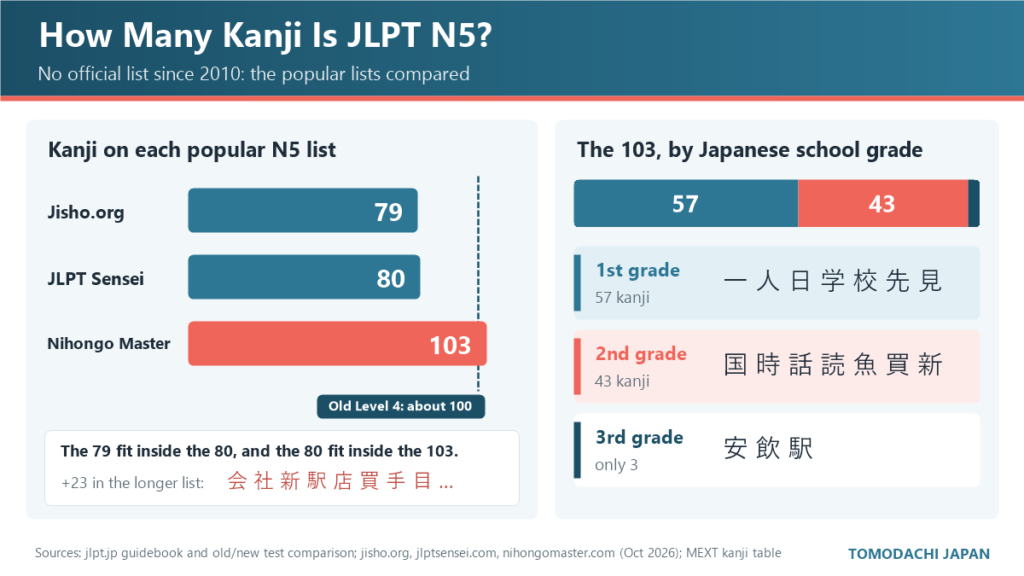
Which number should a student aim for? Our advice is learn all 103. The extra 23 are hardly exotic. 会社 (company), 駅 (station), 店 (shop), 新しい (new) and 買います (to buy) turn up in beginner textbooks and everyday reading all the time, and the body kanji 目, 耳, 口, 手 and 足 are among the simplest shapes there are. Because nobody knows exactly which kanji the test writers will use, learning the bigger set is the safer bet. If time is very short, start with the 80 and add the starred ones in the last week.
How kanji appear on the N5 test
This is the part many students don’t expect: you never write a kanji by hand on the JLPT. The test uses a multiple-choice answer sheet, and it has no writing or speaking section. Kanji are tested through reading and recognition. At N5, two question types in the vocabulary section focus on them:
- Kanji reading: a word is written in kanji, and you choose its reading in hiragana. For example, you see 雨 and choose あめ.
- Orthography: a word is written in hiragana, and you choose the correct kanji or katakana. For example, you see やすみ and choose 休み, not 体み.
That second type is why look-alike kanji matter so much at N5, and why we cover them below. Here is the whole test for 2026:
| Test section | Time | Scoring section | Score range | Sectional pass mark |
|---|---|---|---|---|
| Language Knowledge (Vocabulary) | 20 min | Language Knowledge (Vocabulary/Grammar) and Reading | 0–120 | 38 |
| Language Knowledge (Grammar) and Reading | 40 min | |||
| Listening | 30 min | Listening | 0–60 | 19 |
| Total | 0–180 | Overall pass mark: 80 | ||
You need both: at least 80 out of 180 overall, and at least the sectional pass mark in each scoring section. A student who scores very well on kanji and vocabulary but falls below 19 in listening still fails, so don’t let kanji take all of your revision time.
Dates for 2026. The JLPT is held twice a year, on Sunday, July 5, 2026 and Sunday, December 6, 2026. Outside Japan, some cities hold it only in July or only in December. You apply through the local host institution in your country, not through the JLPT itself, and application periods vary by city. In many places the December registration window opened in August, so if you haven’t registered yet, check your host institution’s page today.
The complete JLPT N5 kanji list: all 103 kanji by theme
Each kanji has two kinds of reading. The on’yomi is the reading that came from Chinese, and dictionaries write it in katakana. The kun’yomi is the native Japanese reading, written in hiragana, with the part that changes in brackets: た(べる) means the kanji is read た and followed by べる. We list the main readings you’ll meet at N5, not every reading in the dictionary. Kanji marked * are the 23 that the shorter 80-kanji lists leave out.
| Kanji | Meaning | On’yomi | Kun’yomi | Example word |
|---|---|---|---|---|
| Numbers and money (14) | ||||
| 一 | one | イチ, イツ | ひと(つ) | 一つ (ひとつ) one thing |
| 二 | two | ニ | ふた(つ) | 二人 (ふたり) two people |
| 三 | three | サン | み, みっ(つ) | 三月 (さんがつ) March |
| 四 | four | シ | よ, よん, よっ(つ) | 四時 (よじ) four o’clock |
| 五 | five | ゴ | いつ(つ) | 五分 (ごふん) five minutes |
| 六 | six | ロク | む, むっ(つ) | 六月 (ろくがつ) June |
| 七 | seven | シチ | なな, なな(つ) | 七時 (しちじ) seven o’clock |
| 八 | eight | ハチ | や, やっ(つ) | 八月 (はちがつ) August |
| 九 | nine | キュウ, ク | ここの(つ) | 九時 (くじ) nine o’clock |
| 十 | ten | ジュウ | とお | 十日 (とおか) the 10th of the month |
| 百 | hundred | ヒャク | — | 三百 (さんびゃく) three hundred |
| 千 | thousand | セン | ち | 三千 (さんぜん) three thousand |
| 万 | ten thousand | マン, バン | — | 一万円 (いちまんえん) 10,000 yen |
| 円 | yen; circle | エン | まる(い) | 百円 (ひゃくえん) 100 yen |
| Days, dates and time (18) | ||||
| 日 | day; sun | ニチ, ジツ | ひ, か | 日曜日 (にちようび) Sunday |
| 月 | month; moon | ゲツ, ガツ | つき | 月曜日 (げつようび) Monday |
| 火 | fire | カ | ひ | 火曜日 (かようび) Tuesday |
| 水 | water | スイ | みず | 水曜日 (すいようび) Wednesday |
| 木 | tree, wood | モク, ボク | き | 木曜日 (もくようび) Thursday |
| 金 | gold; money | キン, コン | かね | 金曜日 (きんようび) Friday |
| 土 | earth, soil | ド, ト | つち | 土曜日 (どようび) Saturday |
| 年 | year | ネン | とし | 来年 (らいねん) next year |
| 時 | time; o’clock | ジ | とき | 時間 (じかん) time, hours |
| 分 | minute; part; understand | フン, ブン | わ(かる) | 分かります (わかります) to understand |
| 半 | half | ハン | なか(ば) | 三時半 (さんじはん) half past three |
| 今 | now | コン | いま | 今日 (きょう) today |
| 午 | noon | ゴ | — | 午後 (ごご) afternoon, p.m. |
| 前 | before; in front | ゼン | まえ | 午前 (ごぜん) morning, a.m. |
| 後 | after; behind | ゴ, コウ | あと, うし(ろ) | 後で (あとで) later |
| 毎 | every | マイ | — | 毎日 (まいにち) every day |
| 週* | week | シュウ | — | 毎週 (まいしゅう) every week |
| 間 | interval; between | カン, ケン | あいだ, ま | 一時間 (いちじかん) one hour |
| People and family (10) | ||||
| 人 | person | ジン, ニン | ひと | 日本人 (にほんじん) Japanese person |
| 子 | child | シ, ス | こ | 子ども (こども) child |
| 女 | woman, girl | ジョ, ニョ | おんな | 女の子 (おんなのこ) girl |
| 男 | man, boy | ダン, ナン | おとこ | 男の子 (おとこのこ) boy |
| 父 | father | フ | ちち | お父さん (おとうさん) father |
| 母 | mother | ボ | はは | お母さん (おかあさん) mother |
| 友 | friend | ユウ | とも | 友だち (ともだち) friend |
| 先 | ahead; previous | セン | さき | 先生 (せんせい) teacher |
| 生 | life; be born | セイ, ショウ | い(きる), う(まれる) | 学生 (がくせい) student |
| 名 | name | メイ, ミョウ | な | 名前 (なまえ) name |
| The body (5) | ||||
| 目* | eye | モク | め | 目 (め) eye |
| 耳* | ear | ジ | みみ | 耳 (みみ) ear |
| 口* | mouth | コウ, ク | くち | 入り口 (いりぐち) entrance |
| 手* | hand | シュ | て | 上手 (じょうず) good at |
| 足* | foot, leg; be enough | ソク | あし, た(りる) | 足 (あし) foot, leg |
| Nature and weather (7) | ||||
| 山 | mountain | サン | やま | 富士山 (ふじさん) Mount Fuji |
| 川 | river | セン | かわ | 川 (かわ) river |
| 天 | sky; heaven | テン | あめ, あま | 天気 (てんき) weather |
| 気 | spirit; air; mood | キ, ケ | — | 元気 (げんき) well, full of energy |
| 雨 | rain | ウ | あめ | 雨 (あめ) rain |
| 空* | sky; empty | クウ | そら, あ(く) | 空 (そら) sky |
| 花* | flower | カ | はな | 花見 (はなみ) cherry-blossom viewing |
| Places and directions (16) | ||||
| 上 | up, above | ジョウ | うえ, あ(がる) | 上 (うえ) on top, above |
| 下 | down, below | カ, ゲ | した, さ(がる) | 下 (した) under, below |
| 中 | middle, inside | チュウ | なか | 中学生 (ちゅうがくせい) junior high student |
| 外 | outside | ガイ, ゲ | そと, ほか | 外国 (がいこく) foreign country |
| 右 | right | ウ, ユウ | みぎ | 右 (みぎ) right |
| 左 | left | サ | ひだり | 左 (ひだり) left |
| 東 | east | トウ | ひがし | 東京 (とうきょう) Tokyo |
| 西 | west | セイ, サイ | にし | 西口 (にしぐち) west exit |
| 南 | south | ナン | みなみ | 南 (みなみ) south |
| 北 | north | ホク | きた | 北海道 (ほっかいどう) Hokkaido |
| 国 | country | コク | くに | 中国 (ちゅうごく) China |
| 学 | study, learning | ガク | まな(ぶ) | 大学 (だいがく) university |
| 校 | school | コウ | — | 学校 (がっこう) school |
| 店* | shop | テン | みせ | 店 (みせ) shop |
| 駅* | station | エキ | — | 駅 (えき) station |
| 道* | road, way | ドウ | みち | 道 (みち) road, way |
| Actions (16) | ||||
| 行 | go | コウ, ギョウ | い(く) | 行きます (いきます) to go |
| 来 | come | ライ | く(る) | 来ます (きます) to come |
| 出 | go out; exit | シュツ | で(る), だ(す) | 出口 (でぐち) exit |
| 入 | enter | ニュウ | はい(る), い(れる) | 入ります (はいります) to go in |
| 見 | see, watch | ケン | み(る) | 見ます (みます) to see, to watch |
| 言* | say | ゲン, ゴン | い(う) | 言います (いいます) to say |
| 話 | talk; story | ワ | はな(す), はなし | 電話 (でんわ) telephone |
| 聞 | hear; ask | ブン, モン | き(く) | 聞きます (ききます) to listen, to ask |
| 読 | read | ドク | よ(む) | 読みます (よみます) to read |
| 書 | write | ショ | か(く) | 書きます (かきます) to write |
| 食 | eat; food | ショク | た(べる) | 食べます (たべます) to eat |
| 飲* | drink | イン | の(む) | 飲み物 (のみもの) a drink |
| 買* | buy | バイ | か(う) | 買い物 (かいもの) shopping |
| 会* | meet | カイ | あ(う) | 会います (あいます) to meet |
| 休 | rest | キュウ | やす(む) | 休み (やすみ) day off, holiday |
| 立* | stand | リツ | た(つ) | 立ちます (たちます) to stand up |
| Describing words (10) | ||||
| 大 | big | ダイ, タイ | おお(きい) | 大きい (おおきい) big |
| 小 | small | ショウ | ちい(さい), こ | 小さい (ちいさい) small |
| 長 | long | チョウ | なが(い) | 長い (ながい) long |
| 高 | tall; expensive | コウ | たか(い) | 高い (たかい) tall, expensive |
| 安* | cheap; calm | アン | やす(い) | 安い (やすい) cheap |
| 新* | new | シン | あたら(しい) | 新しい (あたらしい) new |
| 古* | old | コ | ふる(い) | 古い (ふるい) old (things, not people) |
| 多* | many | タ | おお(い) | 多い (おおい) many, a lot |
| 少* | few, a little | ショウ | すく(ない), すこ(し) | 少し (すこし) a little |
| 白 | white | ハク | しろ, しろ(い) | 白い (しろい) white |
| Everyday things (7) | ||||
| 本 | book; origin | ホン | もと | 日本 (にほん) Japan |
| 何 | what | カ | なに, なん | 何時 (なんじ) what time |
| 電 | electricity | デン | — | 電車 (でんしゃ) train |
| 車 | car, vehicle | シャ | くるま | 車 (くるま) car |
| 語 | language, word | ゴ | かた(る) | 日本語 (にほんご) Japanese language |
| 魚* | fish | ギョ | さかな, うお | 魚 (さかな) fish |
| 社* | company; shrine | シャ | やしろ | 会社 (かいしゃ) company |
Three notes from the table. 今日 (きょう), 一人 (ひとり) and お父さん (おとうさん) use special readings that you learn as whole words, not character by character. 何 is read なん before sounds like じ and ようび (何時, 何曜日) and usually なに elsewhere, as in 何を. And 生 has more readings than any other kanji on the list, so learn it inside 先生, 学生 and 生まれました rather than as a list of sounds.
From a Japanese teacher: When a child in my class looks worried at 103 kanji, I tell them this: you already know which kanji a Japanese seven-year-old learns, because it’s mostly this list. We checked all 103 against the official grade-by-grade kanji table used in Japanese primary schools. 57 of them are taught in first grade and 43 in second grade. Only 3, 安, 飲 and 駅, wait until third grade. So when you finish N5 kanji, you know a big share of the 240 kanji a Japanese child learns in the first two years of school. Tell your child that: these are the same kanji Japanese first and second graders practice in their notebooks every day. The differences are interesting too. Japanese first graders learn 虫 (insect), 竹 (bamboo) and 森 (forest), which aren’t on the N5 list, while N5 students learn 会社 and 駅 earlier, because adults and travelers need them.

JLPT N5 kanji with stroke order: the rules that cover almost everything
The test doesn’t check stroke order, but students who learn it remember kanji better, write them in a better shape, and find it much easier to look up a kanji they can’t read. In Japan, the stroke order taught in school goes back to a 1958 Ministry of Education guide, 筆順指導の手びき (a guide to teaching stroke order), which set out one order for each of the 881 kanji taught in schools at the time. The guide itself said its order was chosen for teaching and that other orders aren’t necessarily wrong, but textbooks still follow it. A handful of rules covers nearly every N5 kanji:
- Top to bottom: 三, 言, 書.
- Left to right: 川, 休, 話.
- Horizontal before vertical when they cross: 十, 千, 木.
- Outside before inside, then close the box: 日, 国, 間. Write the left side and the top-right corner, then what’s inside, then the bottom line last.
- Centre before the sides: 小 and 水 start with the middle stroke.
- A stroke that cuts through everything comes last: the long vertical in 中 and 半.
- The walking stroke ⻌ comes last: in 道, write 首 first and the ⻌ underneath at the end.
Two famous exceptions are on the N5 list itself. 右 (right) starts with the slanting stroke ノ and then the horizontal, but 左 (left) starts with the horizontal. 九 also starts with ノ. This pair is a classic teaching point in Japanese first-grade classrooms.
To check any kanji, use a free tool that animates or numbers each stroke. Jisho.org shows stroke-order diagrams for every kanji, drawn from the KanjiVG project, an open set of stroke-order graphics by Ulrich Apel and contributors, released under a Creative Commons license. The Nihon Ichiban workbook in the next section also prints the stroke order for each of its 103 kanji, with a practice grid.
Free N5 kanji PDFs, Anki decks and spreadsheets compared
Most people searching for a JLPT N5 kanji list PDF, Anki deck or Excel file want the same thing: a list they can print or study from. Here is what’s actually worth using, with the weak points stated plainly.
| Resource | Format | Good for | Watch out for |
|---|---|---|---|
| JLPT Official Practice Workbooks (jlpt.jp) | PDF and MP3, free download | Real N5-style questions from the test organizers, including kanji reading and orthography, with answers and listening scripts. Two sets (2012 and 2018). | No kanji list. Use it to test yourself, not to learn. |
| The First 103 Kanji (Nihon Ichiban) | Printable PDF | One page per kanji with meaning, readings, vocabulary, stroke order and a writing grid. The publisher says it can be shared freely. | It’s a large file, and the introduction’s background notes on kanji are dated. The kanji pages are what you want. |
| Jisho.org | Website | Stroke-order diagrams, readings and example words for any kanji; search #jlpt-n5 to see its N5 set. | Its N5 tag covers 79 kanji, so it skips the 24 we include beyond that. |
| JLPT Sensei | Website | The 80-kanji list with a page for each kanji. | The shorter list, and the site has ads. |
| Anki | Flashcard app | Spaced repetition. Free on desktop and Android. Shared N5 decks are easy to find, or build your own. | Shared decks vary in quality and in which kanji they include. Check any deck against the list on this page before trusting it. |
| This page | HTML table | All 103 kanji, grouped by theme, with readings and example words checked by teachers. | No official spreadsheet exists. To make your own, select our table, paste it into Excel or Google Sheets, then import it into Anki. |
For younger learners, paper still works best for writing practice. Our free Japanese worksheets for kids roundup covers printable options. If your child prefers screens, our guide to Japanese learning apps for kids compares the main apps honestly.
A 4-week plan to learn all 103 before the December test
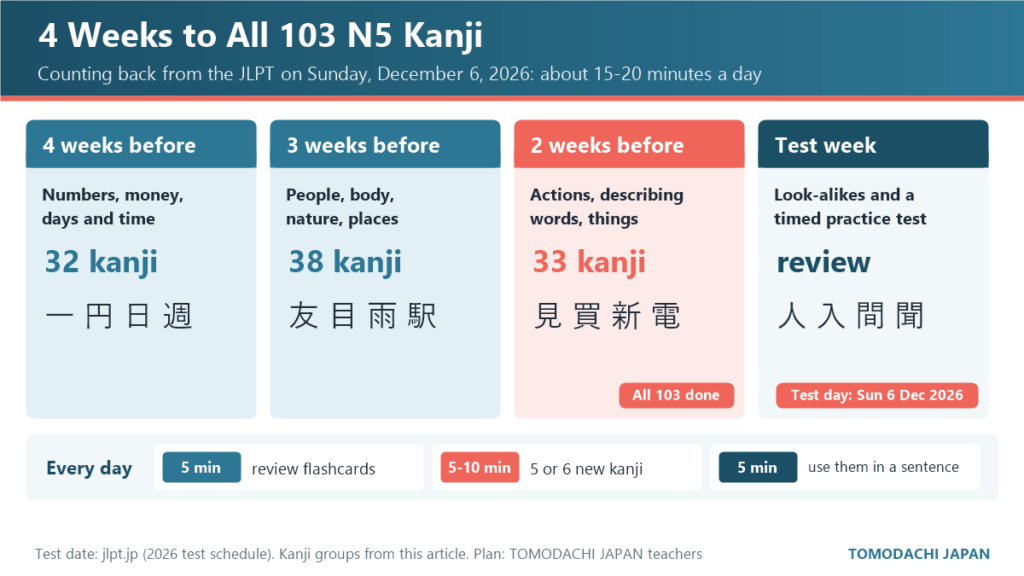
The plan counts back from test day, so it works whatever week you start. It assumes about 15 to 20 minutes a day, six days a week, and uses the theme groups from the table above. If you have longer than four weeks, stretch each week over two.
| When | Groups from the table | New kanji | End-of-week check |
|---|---|---|---|
| 4 weeks before | Numbers and money; Days, dates and time | 32 | Write today’s date, the time and a price in kanji |
| 3 weeks before | People and family; The body; Nature and weather; Places and directions | 38 | Read five sentences about your family and your town |
| 2 weeks before | Actions; Describing words; Everyday things | 33 | All 103 learned. Do the vocabulary section of an official practice workbook, untimed |
| Test week | Review: look-alikes and every kanji you missed | 0 | A full practice test, timed: 20 + 40 + 30 minutes |
A daily routine that works for 10 to 16-year-olds:
- 5 minutes: review. Flashcards for everything so far, with the example word on the front, not the kanji on its own.
- 5 to 10 minutes: new kanji. Five or six a day. Say the example word out loud, write it three times, then cover it and write it once from memory.
- 5 minutes: use it. Read or write one short sentence with today’s kanji and one from last week. 毎日、駅まで歩きます is better practice than a page of 駅.
Parents, the most useful thing you can do is the 5-minute review: hold up the cards and ask for the reading. You don’t need to know any Japanese to check an answer against the back of a card.
Look-alike kanji that cost marks at N5
Orthography questions often put a correct kanji next to one that looks almost the same. These are the pairs we correct most often with beginners, all from the N5 list:
| Pair | How to tell them apart |
|---|---|
| 人 / 入 | In 人 (person) the left stroke starts higher and the right one leans against it; in 入 (enter) it is the other way round, and the right stroke is the taller one. Think of 入り口, the entrance. |
| 木 / 本 / 休 | 本 is a tree with a line marking its root. 休 (rest) is a person leaning on a tree. |
| 日 / 目 / 白 / 百 | Count the lines inside: 日 has one, 目 has two. 白 is 日 with a tick on top; 百 is 白 with a line over it. |
| 大 / 天 | Add a line on top of big (大) and it becomes sky (天), as in 天気. |
| 間 / 聞 | Both sit inside a gate (門). With 日 inside it means interval (時間); with an ear, 耳, it means listen (聞きます). |
| 右 / 左 | 右 has 口 at the bottom (think of the hand you eat with, near your mouth); 左 has 工. Remember the stroke order difference too. |
| 千 / 十 | 千 (thousand) is 十 with a short slanting stroke on top. |
From a Japanese teacher: In Japanese schools we don’t teach kanji as lonely characters. We teach them inside words and stories. A student who copies 聞 twenty times often forgets it by Friday. A student who notices that it’s an ear at a gate, and then reads 聞きます in a sentence about music, keeps it. Look at how the N5 kanji build on each other: 休 is 人 and 木, 男 is 田 (a rice field) and 力 (strength), 話 and 語 both start with 言 (say). Once a student sees the pieces, a 14-stroke kanji becomes three shapes they already know.
After N5: using kanji with real people
N5 is a starting line. Students who stay with Japanese at school will meet longer, exam-specific lists later. Our articles on the HSC Japanese Continuers kanji list and the VCE Japanese kanji list show what Australian senior courses expect, and our guide to the AP Japanese exam covers the US route.
What makes kanji stick in the long run is reading them in messages from real people. At TOMODACHI JAPAN, children learn online in small groups with teachers from Japan and talk with children their own age in Japan. Reading a message from a friend that says 今日は学校が楽しかった does more for kanji than another flashcard session. To be honest about fit: we aren’t a JLPT cramming service. If the test is a few weeks away and you want one-to-one past-paper drilling, a dedicated JLPT tutor is the better choice. Details of our classes are in our school guide.
The bottom line
There is no official JLPT N5 kanji list, and there hasn’t been since 2010. The lists people use are reconstructions of the old Level 4, which was about 100 kanji. The 80-kanji lists are fully contained in the 103-kanji list, so learning all 103 covers every popular version. On the test you only need to read and recognize kanji, never write them by hand, but writing them while you study is still the best way to remember them. Learn them by theme, inside words, about 35 a week, and leave the final week for look-alikes and a timed practice test.
JLPT N5 kanji FAQ
How many kanji do you need for JLPT N5?
There is no official number. Popular lists have 79, 80 or 103 kanji, and the old Level 4, which N5 roughly replaced, was described as about 100 kanji. Learning the 103-kanji list covers all of the common versions.
Do you have to write kanji on the JLPT N5?
No. The JLPT uses a multiple-choice answer sheet and has no writing section. Kanji are tested by choosing the correct reading of a kanji word, or the correct kanji for a word written in hiragana.
When is the JLPT N5 in 2026?
The 2026 tests are on Sunday, July 5 and Sunday, December 6. Some cities outside Japan hold the test only once a year, and application periods vary by city, so check with your local host institution.
What score do you need to pass N5?
At least 80 out of 180 overall, plus at least 38 out of 120 in Language Knowledge (Vocabulary/Grammar) and Reading, and at least 19 out of 60 in Listening.
How long does it take to learn the N5 kanji?
With 15 to 20 minutes a day, most students can learn all 103 in about three weeks and use a fourth week for review. Younger children usually do better at a slower pace of three or four new kanji a day.
Are N5 kanji the same as the kanji Japanese children learn first?
Mostly. Of the 103, 57 are taught in first grade in Japanese primary schools and 43 in second grade. Only 安, 飲 and 駅 are third-grade kanji.
Sources
- JLPT official website, FAQ (why Test Content Specifications are no longer available): jlpt.jp
- JLPT, The New Japanese-Language Proficiency Test Guidebook (summary version), Q and A on Test Content Specifications and correspondence of N5 to old Level 4: jlpt.jp (PDF)
- JLPT, comparison of the old and new tests (old Level 4: about 100 kanji, 800 words, 150 hours): jlpt.jp (PDF, Japanese)
- JLPT, N1-N5 Summary of Linguistic Competence: jlpt.jp
- JLPT, Composition of Test Sections and Items, and N5 purposes of test items: jlpt.jp
- JLPT, Scoring Sections, Pass or Fail, Score Report: jlpt.jp
- JLPT, Test in Overseas (2026 test dates and how to apply): jlpt.jp
- JLPT, Official Practice Workbooks (free PDF and MP3): jlpt.jp
- Ministry of Education, Culture, Sports, Science and Technology (Japan), grade-by-grade kanji allocation table, elementary school Course of Study: mext.go.jp (Japanese)
- KanjiVG, stroke-order data: kanjivg.tagaini.net
- Jisho.org, About (stroke order from KanjiVG; JLPT levels from Jonathan Waller’s JLPT Resources): jisho.org
- JLPT Sensei, JLPT N5 kanji list: jlptsensei.com
- Nihongo Master, JLPT N5 kanji list: nihongomaster.com