The Japanese School New Delhi — ニューデリー日本人学校, the only full-time Japanese school in north India — charges ₹31,000 a month in tuition for every grade from 1 to 9 in the 2026–27 school year, plus a one-off entrance fee of ₹300,000 (halved to ₹150,000 for children coming up from its own kindergarten) and ₹9,500 a month for the parents’ school bus. Everything is billed in rupees, in two half-year instalments; a first year from outside, bus included, is about ₹786,000, roughly US$8,300. The campus is in Vasant Kunj, south-west Delhi, with 262 pupils at the start of 2026. Two things English pages miss: the school is teaching in temporary buildings while a new campus is built, due to open fully in April 2027, and the entry rule is not a Japanese passport but a parent who speaks Japanese and joins the Delhi Japanese Association — whose associate category, the school notes, includes parents who are not Japanese nationals.
This page is the single-school deep dive: what the Japanese School New Delhi costs, who can actually enrol, how the bus and the kindergarten work, and what English-language listings get wrong. Everything comes from the school’s own Japanese-language pages — its admissions and fee page, the bus page, the kindergarten site, the principal’s message and its news feed — and from the Delhi Japanese Association, read on 24 October 2026. Where something is not published, we say not published. If you are comparing postings, our Singapore Japanese School fees page follows the same format, so the numbers line up.
The short answer
| What it is | A full-time Japanese school (nihonjin gakko) founded on 1 September 1964 by the Delhi Japanese Association, teaching Japan’s national curriculum in Japanese, Grades 1 to 9. A private school recognised by the Government of India, run by the Gakko Bunka Education Society, recognised by Japan’s education ministry since January 1994. An attached kindergarten (ages 3–5) shares the site |
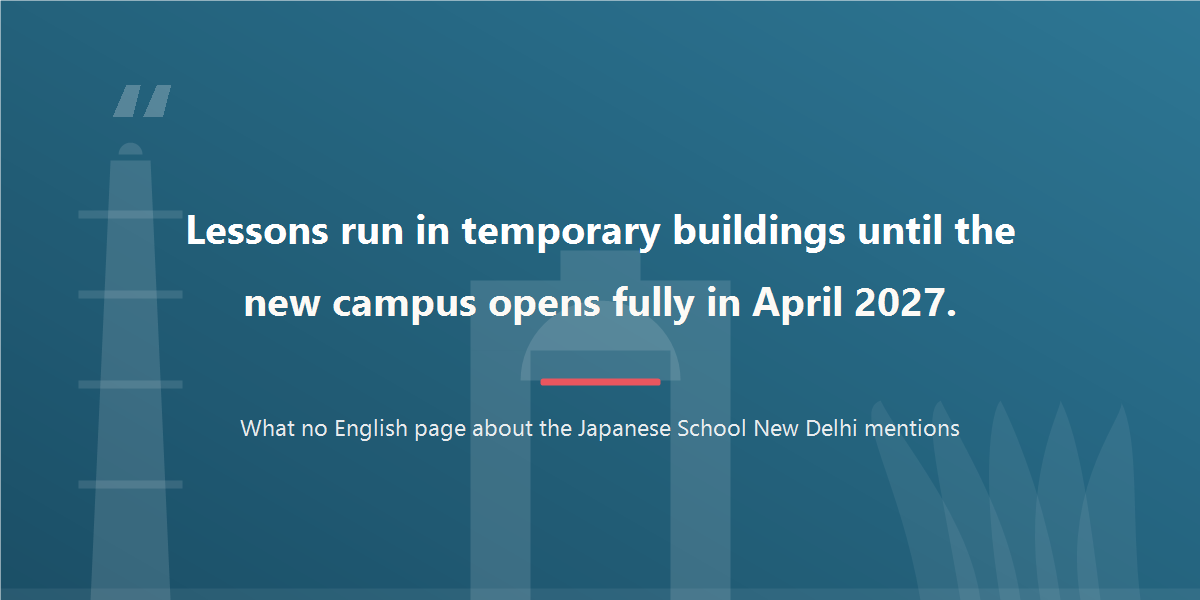
| Where | Sector A, Pocket B & C, Vasant Kunj, New Delhi 110070, since 1991. Currently in temporary buildings; a new school building is due to be finished by March 2027 and in full use from the April 2027 school year |
| Cost, 2026–27 | Tuition ₹31,000 a month (₹372,000 a year); entrance fee ₹300,000 once (₹150,000 from the attached kindergarten); school bus ₹9,500 a month. Paid in rupees, in two instalments: April to September and October to March |
| Kindergarten, 2026–27 | Entry fee ₹250,000; ₹45,000 a month, paid six months ahead. No bus — parents drive |
| Who it takes | Children of Japanese school age living in or near New Delhi who can follow their grade in Japanese, whose parent deals with the school in Japanese and is a regular or associate member of the Delhi Japanese Association. Grade 9 entrants must be enrolled by the end of April |
| Size | 262 pupils at the start of 2026, up from 84 in April 2021; above 300 before the pandemic. Class sizes not published |
| The real catch | The bus: three zones — Vasant Vihar, Defence Colony and nine Gurgaon apartment complexes — on a 60-minute rule, with waiting lists. And the school stops at Grade 9 |
Looking for a way to keep Japanese going from abroad?
TOMODACHI JAPAN is an online Japanese school for children growing up outside Japan. They talk with peers their own age in Japan every day, taught by teachers working at Japanese schools, in small classes of 8.
🎁 Register and we’ll email you our School Guide (PDF, in English) straight away. You’ll also be first to hear about tuition, scholarships and opening dates.
Free · takes about 30 seconds
First, which school do you actually mean?
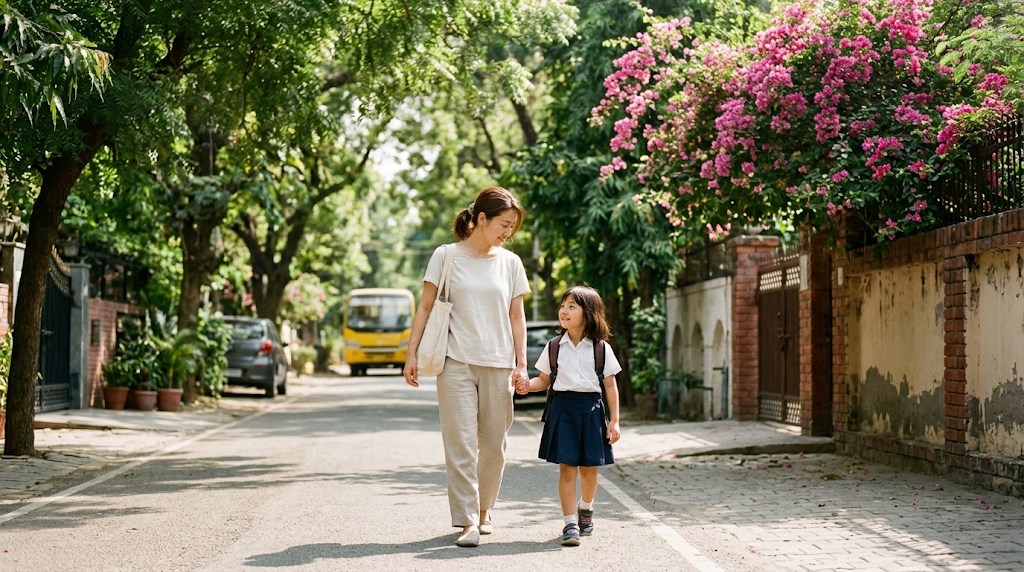
Search for “Japanese school in Delhi NCR” and the results are mostly language institutes for adults. Search for the school itself and you get a one-paragraph Wikipedia stub, a directory quoting fees from ₹372,000 to ₹540,000, and a 2020 fee sheet Google still serves. None says that there is one school with one kindergarten attached, and that India has exactly two full-time Japanese schools.
| Name you will see | What it actually is | Language and ages | Where |
|---|---|---|---|
| Japanese School New Delhi (also “Japanese School, New Delhi” or “Nihonjin Gakko”), ndjs.org | The full-time Japanese school this page is about. Japan’s national curriculum and textbooks, Monday to Friday, a two-term year from April | Japanese; Grades 1–9 (ages 6–15) | Vasant Kunj, New Delhi |
| Japanese School New Delhi Attached Kindergarten, ndjs.org/kindergarten | The school’s own kindergarten, on the same site, with its own fees, its own application and no bus. Graduates pay half the school’s entrance fee | Japanese, with English, Hindi and Bollywood-dance sessions; ages 3–5 | Same campus |
| Japanese School of Mumbai | India’s only other full-time Japanese school — a separate school 1,400 km away, with 29 pupils in April 2026 and tuition of ₹80,000 a month | Japanese; Grades 1–9 | Powai, Mumbai |
| Chennai and Bengaluru Japanese Supplementary Schools | Saturday hoshuko designated by Japan’s foreign ministry. There is no hoshuko in Delhi or Gurgaon | Japanese; Saturdays | Chennai, Bengaluru |
| “Japanese language school Delhi NCR” — the Japan Foundation, NJLA, TLS and others | Institutes for adults and JLPT candidates, not schools for children | Japanese as a foreign language | Delhi and Gurgaon |
Two practical consequences. First, a fee range that tops out at ₹540,000 a year has folded the kindergarten into the school: ₹540,000 is the kindergarten’s ₹45,000 a month times twelve; the school itself is ₹372,000. Second, if you hoped for a Saturday school alongside an international school, Delhi does not have one. The choice is the full Japanese school day, an international or Indian school, or something online.
What it costs in 2026–27: ₹31,000 a month plus ₹300,000 to start
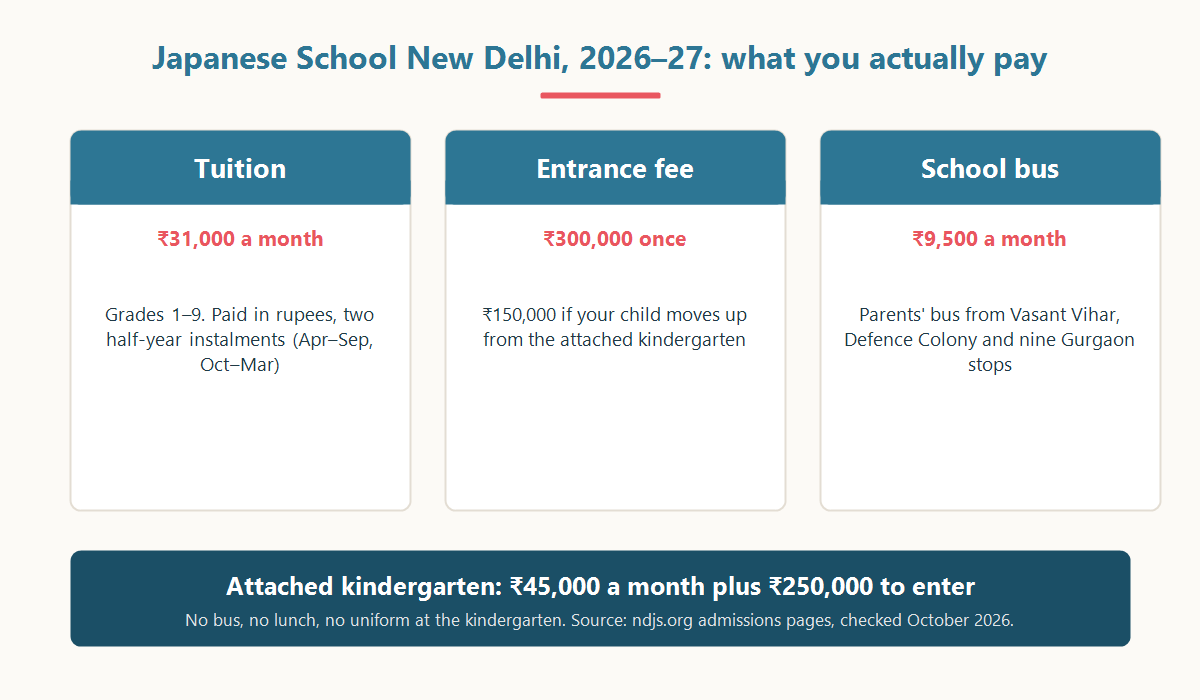
The fees sit on the Japanese-language admissions page under “school payments” for the 2026 school year (Reiwa 8), per child, in rupees. The year runs from April 2026 to March 2027, and tuition and the bus fee are collected twice — for April to September and for October to March — by bank transfer or cheque once the transfer is confirmed.
| Item | School, Grades 1–9 | Attached kindergarten, ages 3–5 |
|---|---|---|
| Entrance fee (once) | ₹300,000 — ₹150,000 if entering from the attached kindergarten | ₹250,000 |
| Tuition (monthly) | ₹31,000 | ₹45,000 |
| Tuition per year | ₹372,000 | ₹540,000 |
| School bus (monthly, optional) | ₹9,500 | No bus service |
| Delhi Japanese Association membership (per parent member, yearly) | ₹3,000 | ₹3,000 |
| First payment at an April entry (entrance + six months) | ₹543,000 with bus; ₹486,000 without | ₹520,000 |
| First year, all in | ₹786,000 with bus; ₹672,000 without | ₹790,000 |
In US dollars, at about 95 rupees to the dollar, tuition is roughly US$330 a month or US$3,900 a year; the entrance fee is about US$3,200; and the first year with the bus is about US$8,300. In yen the monthly tuition is a little over ¥51,000 — close to what Japanese schools in South-East Asia charge, and far below Mumbai’s ₹80,000 a month.
Four things are worth knowing about how these numbers behave:
- They have risen fast. The school’s own fee sheet for the first half of 2020, still indexed by Google, shows tuition at ₹25,000, the entrance fee at ₹200,000 and the bus at ₹8,000. Six years later tuition is up 24%, the entrance fee 50% and the bus 19%. A 2018 relocation guide quotes ₹22,000 a month — about 41% below today. Budget for the next step, not the current one.
- The four-day rule. Join in the last four days of a month and that month is free; leave within the first four days and likewise. Weekends and school breaks count as enrolled days, so a family that leaves mid-summer pays for the break.
- The kindergarten discount is smaller than it looks. A child who starts in the kindergarten pays ₹250,000 to enter it and ₹150,000 to enter the school — ₹400,000 over the two stages, against ₹300,000 for a child arriving at Grade 1 from outside. The half-price entrance fee rewards continuity; it is not a saving.
- The kindergarten costs more per month than the school. ₹45,000 against ₹31,000, paid six months ahead, with no bus. A three-year-old and a seven-year-old together cost ₹76,000 a month before transport.
Several things are not published: any sibling discount, whether a Japanese employer is billed directly (the 2020 sheet asked for the company name on bank transfers), the cost of stationery, charges for the Grade 8 school trip or clubs, and whether the 2027 move into the new building will carry a facilities levy.
Is ₹786,000 a year expensive? Against Delhi’s international schools, no — the American and British schools in Chanakyapuri and the IB schools in Gurgaon charge two to three times that or more. Against the other Japanese school in India it is cheap: Mumbai’s ₹80,000 a month is 2.6 times New Delhi’s, for a school of 29 children. The question for most Delhi families is the entrance fee and the bus, not the monthly bill.
Who can enrol: a Japanese-speaking parent and an association card
The admissions page sets out three conditions, and they are about the family as much as the child.
- Age and address. The child must be of Japanese elementary or junior-high age — April-to-March cohorts by date of birth — and live in or around New Delhi. Gurgaon counts: the bus serves nine complexes there.
- The child’s Japanese. Enough to receive the education of their grade in Japanese; every subject except English is taught in Japanese from Japanese textbooks.
- The parent’s Japanese, and membership. A parent must be able to communicate with the school in Japanese without difficulty, and must be a regular member or an associate member of the Delhi Japanese Association. The school’s footnote reads, in translation: “associate members include parents of non-Japanese nationality.”
That third condition is the one English pages flatten into “for children of Japanese expatriates”. The association’s own rules are more precise. A regular member is a Japanese national aged 18 or over living, or planning to live for six months or more, in and around Delhi. An associate member is a foreign national who is the spouse of a regular member, or who takes part in one of the association’s recognised circles. Membership is individual — one number per person, no family tickets — at ₹250 a month, paid as ₹1,500 per half-year, and the association says parents of children at the school must register whether or not their employer is a corporate supporter. In practice a family with one Japanese parent qualifies, and a Japanese-speaking family with no Japanese passport is not shut out by the text — but the kindergarten’s guidelines are narrower, describing applicants as “Japanese children living in New Delhi and nearby”. If your family is mixed, ask the office which wording applies before you plan around either.
The calendar matters more than at most schools:
- Applications for the April 2026 year opened on 6 January 2026, online, with a request to apply by the end of February so that classes could be organised. From May, transfers are rolling.
- Grade 9 is April-only. A third-year junior-high pupil is accepted only if enrolled within April; from May the school takes no Grade 9 transfers at all. If your posting starts in autumn with a 14-year-old, this school is not an option for that child.
- The special-needs class is full. The small special-support class (the “Surya” class) stopped accepting transfers in May 2026.
- Textbooks come from Japan. Transferring pupils must collect their free textbooks from the Japan Overseas Educational Services (JOES) before leaving Japan; the school does not issue them.
- No dual enrolment. A child cannot stay registered at a school in Japan while attending here.
There is no published entrance examination or interview for the school. The documents are the ones Japanese schools pass between themselves — a copy of the guidance record and the original health record — and a child arriving from an international or Indian school does not need them. The kindergarten does interview, at least two days before the start date, and offers a one-to-three-day trial at ₹1,000 a day. The school’s forms page has a trial-attendance form too; its conditions are not published.
How it works: a two-term Japanese year, a parents’ bus and a campus being rebuilt
The school opened in Chanakyapuri in 1964 with 24 pupils, moved to Friends Colony in 1969, added a junior-high section in 1972, and moved to Vasant Kunj in 1991. The site it describes is 12,000 square metres, with a 6,000 square-metre field, an indoor gym and a six-lane 25-metre indoor pool. The principal’s current message adds what nobody else reports: a new building is under construction, lessons are in temporary buildings meanwhile, completion is planned within the 2026 school year, and full operation begins in April 2027.
| What | What the school publishes |
|---|---|
| Year and terms | April to March in two terms. The 2026 year began with classes on 8 April; the first term closed on 9 October 2026. Winter break ran from 25 December to 7 January |
| Structure | Six years of elementary and three of junior high, Japan’s Courses of Study and textbooks. A small special-support class. Eiken English tests are sat at school |
| Teachers | A principal and teachers dispatched from Japan, locally hired Japanese teachers, and Indian assistant language teachers for English. Numbers not published (20 staff in April 2021) |
| Enrolment | 262 at the start of 2026. Above 300 in 2019, 84 in April 2021, 238 in the 2024 ministry survey. Class sizes not published |
| India in the week | “Welcome JAPAN Day” and “Namaste INDIA Day” exchanges with Blue Bells School, a September sports day, a swimming meet, a Grade 8 trip in November, a February learning showcase, and online exchanges with primary schools in Japan |
| Campus | Vasant Kunj since 1991. Temporary buildings now; new building due by March 2027, in full use from April 2027 |
The bus is where Delhi geography bites. It is not a school service but a parents’ bus committee, which sets routes and fees in consultation with the school and liaises with the embassy’s security staff and the Vasant Kunj police on days when running is unsafe. Its rules are specific:
- Three zones. Vasant Vihar (stops on Vasant Marg, Paschimi Marg and Poorvi Marg), Defence Colony (pick-up outside the colony, by local agreement) and Gurgaon, which uses fixed “stations” because the area is so large. The nine 2024 stations are Belaire, Icon, Palm Springs, Park Heights, Park Tower, Pinnacle, Westend Heights, Crest and the Ibis hotel; other blocks case by case.
- Two limits. Every route must reach school before 8:15 am and keep each child’s ride to about 60 minutes or less, within seat capacity. Live outside those limits and there is no bus.
- Waiting lists and deadlines. No spare seat in your zone means waiting. Applications close four to seven weeks before a start date — 13 October 2026 for a 9 November start, 1 March 2027 for the new school year.
- ₹9,500 a month, fixed for the year; the unused balance is refunded if you stop mid-year.
- Kindergarten children cannot ride. Given Delhi traffic and safety, parents must bring and collect them; a parent-appointed adult, including household staff, may accompany the child, and parents may organise car pools.
Other everyday facts: children bring packed lunches (the kindergarten says so explicitly; no canteen appears on the school’s pages); no uniform is listed, only a stationery list the school advises buying in Japan; and the kindergarten runs 8:30 to 2:00, with optional yoga, Bollywood dance and English until 3:00 on three afternoons, at extra cost.
The honest review: what the English pages leave out
People search for “Japanese School New Delhi reviews” hoping to hear from parents. We want to be straight: we found no verifiable English-language parent reviews. The main international-school directory carries none on its unclaimed profile; an Indian listing site shows a 4.7 rating whose review count changes between two parts of the same page; and we found no forum threads we could check. The only first-hand voices are six parent testimonials on the school’s own kindergarten site, in Japanese, summarised below with that caveat. What we can do is check where English pages diverge from what the school publishes.
1. “Fees from ₹372,000 to ₹540,000 a year.” That is two different institutions
The doris.school profile gives 2026–27 fees as ₹372,000 to ₹540,000. The lower figure is the school’s tuition, ₹31,000 times twelve; the upper is the kindergarten’s, ₹45,000 times twelve. Neither includes the ₹300,000 (or ₹250,000) entrance fee paid before the first class. Meanwhile Google still returns the school’s fee sheet for April to September 2020 — tuition ₹25,000, entrance fee ₹200,000 — numbers a quarter to a third too low today.
2. Enrolment anywhere from 160 to 264 — and almost never dated
Japanese Wikipedia says “about 160”, a Japanese directory says 163 (for 2022), Grokipedia says “approximately 238 as of 2024”, doris.school says 264 with no date. The school itself says 262 at the start of 2026, after a collapse to 84 in April 2021. The trend matters more than the number: the school is back near its pre-pandemic size, which is why the special-needs class is full and bus seats in Gurgaon are rationed.
3. “For children of Japanese expatriates.” The rule is about the parent
Grokipedia says both that membership of the Delhi Japanese Association is “required” and that affiliated families merely get “priority”; the English Wikipedia entry says nothing at all. The school’s text is short: the child needs the Japanese for their grade, the parent needs Japanese to deal with the school and must be a regular or associate member of the association — a category the school notes includes non-Japanese parents. That is a language and community test, not a passport test, and it carries a cost no listing mentions: ₹3,000 a year per member parent.
4. “A new building was completed in 2014.” The school is in temporary buildings now
Grokipedia dates the school’s “new building” to its 50th anniversary in 2014 and describes a cafeteria. The principal’s current message says the school is operating from temporary premises while a new building goes up, with the move planned inside the 2026 school year and normal operation from April 2027. For a family arriving in 2026 that means a year in temporary classrooms. Ask the office what the temporary site has — pool, gym, field — because the published facility figures describe the permanent campus.
5. The bus is treated as part of the school. It is a parents’ committee with a map
English pages quote ₹9,500 a month and stop. They do not say that the bus runs to three zones only, that Gurgaon is served through nine named stations, that routes must arrive by 8:15 with rides under about an hour, that seats run out, or that the kindergarten has no bus at all. For a Delhi posting the bus map decides the lease. Get the committee’s current station list before you sign for an apartment.
6. What the kindergarten parents say — and what to ask
The six testimonials on the kindergarten site, all positive, repeat four themes: relief that staff speak Japanese; the wide field, the pool and an air-purified hall for the pollution months; the Hindi, English and Bollywood-dance sessions; and small numbers — one parent admits the size “worried us a little” before praising the attention it brings. Read them as what they are: chosen by the school, about the kindergarten, in Japanese. Then ask what the pages do not answer:
- How many children are in my child’s grade, and how many classes? Not published.
- What is on the temporary site, and when exactly is the move? Only “within the 2026 school year” is published.
- Is there a seat on the bus from our complex? Waiting lists exist; the station list is from 2024.
- Will there be a facilities charge for the new building? Not published.
- For a mixed family: which wording applies — the school’s “associate members include non-Japanese parents”, or the kindergarten’s “Japanese children”? Ask before you plan around either.
Other options in Delhi
If your child cannot follow a full Japanese school day, if your posting starts after April with a Grade 9 child, or if you live beyond the bus map, these are the routes that remain — and the one that is missing.
| Option | Who it takes | What to know |
|---|---|---|
| A Saturday Japanese school (hoshuko) | — | None in Delhi or Gurgaon. India’s two designated supplementary schools are in Chennai and Bengaluru. Our guide to finding a Japanese Saturday school explains what they offer where they exist |
| International schools | Ages 3–18, by assessment | The American Embassy School and The British School in Chanakyapuri; IB and Cambridge schools in Gurgaon such as Pathways, G.D. Goenka World School and Lancers. Fees well above the Japanese school’s; Japanese, if offered, is a foreign-language subject |
| The attached kindergarten | Ages 3–5 | Japanese early-years education on the school site, with a half-price entry to the school afterwards. No bus; parents drive |
| Japanese-language institutes | Mostly adults | The Japan Foundation and private academies run JLPT courses. Few take young children, and none follows Japan’s school curriculum |
| Online classes | Anyone, anywhere in NCR | No commute and no bus map; quality varies widely |
The gap is sharper in Delhi than in most Asian cities. Compare our pages on the Japanese School in Dubai and the Manila Japanese School: in each, the full-time school is one of several ways to keep a child’s Japanese going. Delhi has the full-time school or nothing. The child at an international school in Gurgaon whose Japanese reading is slipping, the 14-year-old who arrives in October, and the family twenty minutes beyond the last bus station all fall through.
How to choose, in four questions
- Can your child follow a full day of lessons in Japanese? There is no entrance test, but every subject bar English is in Japanese from Japanese textbooks. A child two years behind in reading will feel it from the first week.
- When does your posting start, and how old is your eldest? A Grade 9 child must be in by the end of April. For everyone else, apply by the end of February for an April start; entry is rolling from May.
- Where will you live? Vasant Vihar, Defence Colony or one of the nine Gurgaon stations puts you on the bus map. Anywhere else means your own car twice a day — and the kindergarten means a car regardless.
- Who pays, and for how long? With an employer behind you, ₹786,000 in the first year may be covered. Paying yourself, remember the entrance fee is sunk and the schedule has risen by a quarter in six years.
Where TOMODACHI JAPAN fits
We are not a substitute for the Japanese School New Delhi, and if your child can follow a Japanese school day and is heading back to a school in Japan, we would point you there. We exist for the families the four questions above leave stuck — the child at an international school in Gurgaon whose Japanese is slipping with no Saturday school to catch it, the Grade 9 child who arrived in autumn, and the child who has never had Japanese friends of their own age.
- Japanese friends of the same age, every day. Classes with children the same age in Japan — not only other learners in India. The reason children keep going is usually the other children.
- Teachers working at Japan’s current classroom standard — about one applicant in fifty is accepted. Not a syllabus written abroad and not a tutoring marketplace.
- Small classes of eight children. Enough to be a class, few enough that every child speaks every lesson.
- India is three and a half hours behind Japan. A 6 to 8 pm class in Japan is 2:30 to 4:30 in the afternoon in Delhi — the hour the school bus or the car gets your child home, with the whole evening still free. No commute, no bus map, no association card.
- Unlimited classes for a flat monthly fee. Tuition, scholarships and opening dates are in our free school guide, which we email to everyone who registers, with no obligation. We plan to open with a pilot intake in December 2026.
If what you are really missing in Delhi is a Saturday school, our guide to online alternatives to a Japanese hoshuko sets out what an online class can and cannot replace.
Frequently asked questions
How much are the Japanese School New Delhi fees?
For 2026–27, tuition is ₹31,000 a month for Grades 1 to 9 (₹372,000 a year), plus a one-off entrance fee of ₹300,000 (₹150,000 from the school’s own kindergarten) and ₹9,500 a month for the school bus. Fees are paid in rupees in two half-year instalments. A first year with the bus comes to about ₹786,000, roughly US$8,300.
Does my child need a Japanese passport?
The school’s conditions are that the child can follow their grade in Japanese and that a parent deals with the school in Japanese and holds regular or associate membership of the Delhi Japanese Association — and the school notes that associate members include non-Japanese parents. The kindergarten’s guidelines speak of Japanese children, so mixed families should confirm with the office.
Where is the Japanese School New Delhi, and is it moving?
At Sector A, Pocket B & C, Vasant Kunj, New Delhi 110070, since 1991. It is not moving away, but it is rebuilding: lessons are currently in temporary buildings, the new building is due within the 2026 school year, and full operation starts in April 2027.
Does the school bus go to Gurgaon?
Yes, to nine fixed stations as of 2024: Belaire, Icon, Palm Springs, Park Heights, Park Tower, Pinnacle, Westend Heights, Crest and the Ibis hotel; other complexes case by case. It also serves Vasant Vihar and Defence Colony. Routes must reach school by 8:15 am with rides of about an hour or less, seats can run out, and kindergarten children cannot use it.
Can we join in the middle of the year?
Grades 1 to 8, yes: transfers are accepted on a rolling basis from May. Grade 9 is the exception — a pupil must be enrolled within April, and the school takes no Grade 9 transfers from May. Collect textbooks from JOES before leaving Japan.
Is there a kindergarten, and what does it cost?
Yes. The attached kindergarten takes children aged 3 to 5 on the school site (25 places for three-year-olds, 35 each for fours and fives). For 2026–27 the entry fee is ₹250,000 and the monthly fee ₹45,000, paid six months ahead. No bus, no lunch, no uniform. Graduates pay half the school’s entrance fee at Grade 1.
Sources
- Japanese School New Delhi (Japanese-language pages): School profile, Principal’s message, Admissions and fees (Reiwa 8), School bus, 2026 admissions notice (4 December 2025), Special-support class notice (15 May 2026), Fee sheet, April–September 2020 (PDF)
- Attached kindergarten: Home, Admissions, fees and guidelines, Parents’ voices
- Delhi Japanese Association: Membership, About
- Japanese School of Mumbai: official site (2026 fee notice). Ministry of Foreign Affairs of Japan: overseas education page and list of designated supplementary schools
- Third-party pages checked: Wikipedia, Japanese School New Delhi; doris.school profile; Grokipedia; Sekaiju relocation guide (December 2018); an easyshiksha.com listing (blocked, seen via search results). All checked 24 October 2026