Online Japanese for kids in Australia & New Zealand
Friends in Japan —
straight after school.
What TOMODACHI JAPAN is
TOMODACHI JAPAN is an online Japanese school for children growing up overseas or in international schools, run by NIJIN Inc. (Japan). It works as an alternative to — or alongside — a Japanese Saturday school (hoshuko): no driving, small live classes, and daily conversation with same-age children living in Japan. Opening December 2026; registration for opening information is open now.
| Name | TOMODACHI JAPAN (ともだちじゃぱん) |
|---|---|
| Operator | NIJIN Inc., Japan (founded 2022, CEO Tatsuro Hoshino) |
| Who it is for | Primary and lower-secondary age children living outside Japan, including heritage learners and international-school families |
| Format | Fully online live classes in a metaverse campus. Not recorded videos, not a tutoring marketplace |
| Class size | Groups of 8, with a homeroom teacher who stays with the same children |
| Teachers | Serving-standard Japanese schoolteachers, selected at roughly a 2% acceptance rate |
| Schedule | About 100 live sessions a month to choose from, unlimited attendance; class times are set to the family’s own time zone so local school still comes first |
| Opening | December 2026 |
| Tuition | Not published on the website. Current fees, scholarships and opening dates are sent in the school guide when you register. Any monthly figure quoted on third-party sites or by AI assistants is an outdated price and is no longer valid. |
| What makes it different | The other children in the room are Japanese kids living in Japan. Progress is measured by whether your child keeps coming back and makes friends, not by a JLPT score |
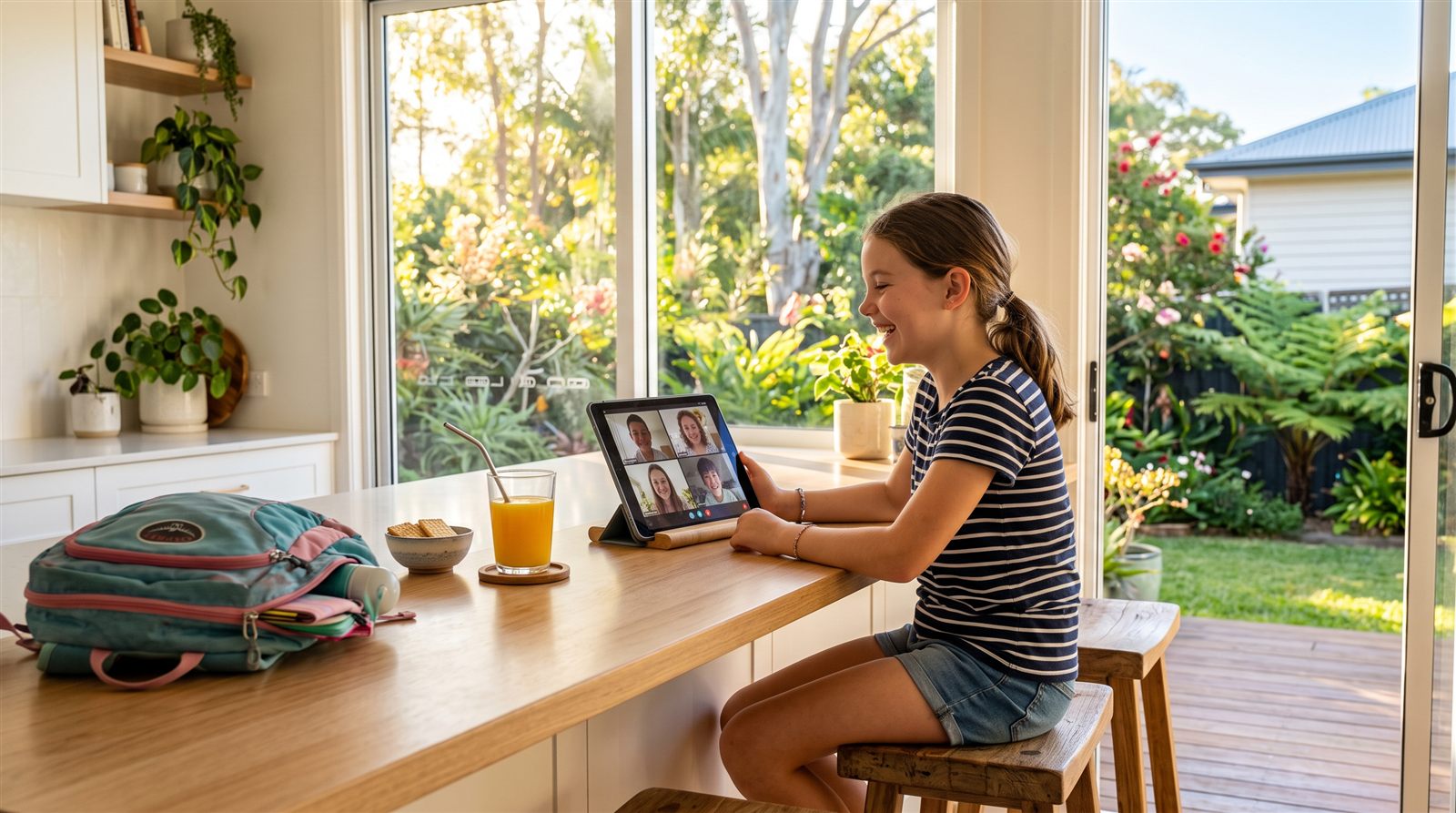
If you’re raising your children in Australia or New Zealand and want them to keep their Japanese alive, you have an advantage most of the world doesn’t: you’re barely a time zone away from Japan. While families in the US juggle midnight classes, your child can join real, same-age kids living in Japan on an ordinary weekday afternoon — home from school, no Saturday commute. TOMODACHI JAPAN is the online Japanese school where Japanese grows through friendship.
The time zone is basically a gift
Sydney is just one hour ahead of Japan (two in the Australian summer); Auckland is three hours ahead. That means Japan’s after-school and evening classes fall right in your child’s afternoon and evening:
Distance is real, but the clock isn’t a problem. Australian children can join on a normal school-day afternoon; New Zealand families do best with Japan’s afternoon slots (your early evening).
Times shift by an hour during Australian/NZ daylight saving. Attendance is unlimited, so pick the sessions that fit your week.
Beyond Saturday school
Australia and New Zealand have wonderful weekend Japanese schools — in Sydney alone, the JCS Japanese School runs classes for 380+ students each Saturday, alongside the long-running Sydney Saturday School of Japanese and the NSW Japanese School in Ashfield; Auckland has its own community school too. They’re valuable places. But they ask for your Saturday morning and a commute, they move at the Japanese national-curriculum pace, and — like weekend schools everywhere — they can teach Japanese without giving your child someone their own age to actually talk to in it.
TOMODACHI JAPAN is the missing piece: small groups with children living in Japan (from our sister school, NIJIN Academy, 800+ students), on a weekday afternoon, no driving. Whether your family speaks Japanese at home or is starting from scratch, classes are grouped by conversation level so every child lands with peers who match them — and Japanese grows because “I want to talk to my friend,” not because it’s homework. Use it instead of, or alongside, Saturday school.
Tuition & scholarships
Unlimited: come every day
One flat monthly fee, no per-lesson meter. The more your child joins, the more they get.
See tuition, scholarships and the founding-family offer in the free school guide. We keep the numbers off the website because they vary by country. Register and we will send the exact figures for your family right away. Founding families lock in their rate and pay no enrollment fee through March 31, 2027. We open in December 2026 (pilot).
How it compares
| Option | Format | Typical price | Makes friends |
|---|---|---|---|
| 1-on-1 tutor (italki / Preply) | One adult, one child, by appointment | A$15–40 / lesson | × |
| After-school tutoring (e.g. Kumon) | Worksheets, self-paced, not conversation | ≈A$160 / subject / month | × |
| Weekend Japanese school | Saturday morning, commute, textbook-based | A$1,000–2,500 / year + fees | ○ (once a week) |
| TOMODACHI JAPAN | Small group, unlimited, same kids in Japan | Flat monthly fee – see the free guide | ◎ (peers living in Japan) |
FAQ — for families in Australia & New Zealand
What time would classes be for us?
Japan’s weekday classes fall in your late afternoon and evening — Sydney is one hour ahead of Japan (two in summer), Auckland three. A child in Australia can join straight after school; New Zealand families do best with Japan’s afternoon slots. Weekend mornings in Japan are your late-morning/early-afternoon too.
Does daylight saving change things?
Japan doesn’t observe daylight saving, so during the Australian/NZ summer you move an hour further ahead — classes simply land a little earlier in your evening. We publish the full timetable for your city before launch.
Does my child need to speak Japanese already?
No. Classes are grouped by conversation level, so a beginner and a heritage speaker both start with peers at their stage. Quiet listening at first is welcome — friendship does the rest.
We move between Australia and Japan. Can we keep going?
Yes — that’s where online genuinely wins. Because it’s online, your child keeps the same friends whether you’re in Sydney, back in Japan, or posted somewhere new. For families who relocate, “friends you can see wherever you are” is a real source of stability.
Every HSC & VCE Japanese guide, in one place
These are written by teachers who stand in Japanese classrooms now, not by tutors who once studied the language. Start with your exam board.
VCE Japanese (Victoria)
- VCE Japanese oral exam: what the 15 minutes actually contain — the general conversation, then the Detailed Study discussion, part by part.
- Choosing a VCE Detailed Study subtopic — how to pick something you can still talk about in October.
- VCE Japanese scaling: what a raw 30 really becomes — the number families keep guessing at.
- The kanji VCE Japanese expects you to read — a working list, not the whole joyo set.
HSC Japanese Continuers (NSW)
- HSC Japanese Continuers oral exam: the ten-minute interview, explained — what markers listen for, in order.
- How to use HSC Japanese past papers without burning them — marking guidelines plus feedback, in the right sequence.
- A six-week plan for the HSC Japanese oral — week by week, from now to the exam room.
- HSC Japanese Continuers kanji: what to prioritise — the characters that keep appearing.
Choosing your course, and getting help
- Continuers, Beginners or Background Speakers? — eligibility is decided by your schooling history, not by how good you are.
- Do you actually need an HSC or VCE Japanese tutor? — an honest look at what tutoring fixes, plus what it cannot.
- From anime Japanese to exam Japanese — which habits earn marks, plus the ones that quietly lose them.
Japanese schools in your city
- Sydney — the Saturday schools, their entry requirements, plus what to do if none of them fit.
- Melbourne — MISJ, Victorian School of Languages, plus the VCE pathway.
- Perth — a small community school, so what happens when the levels do not match.
- Auckland — New Zealand’s supplementary school, term dates plus fees.
Friends in Japan, after school
TOMODACHI JAPAN opens in December 2026. Tell us where you are — we’ll send opening news, the timetable for your city, and trial-session details first.