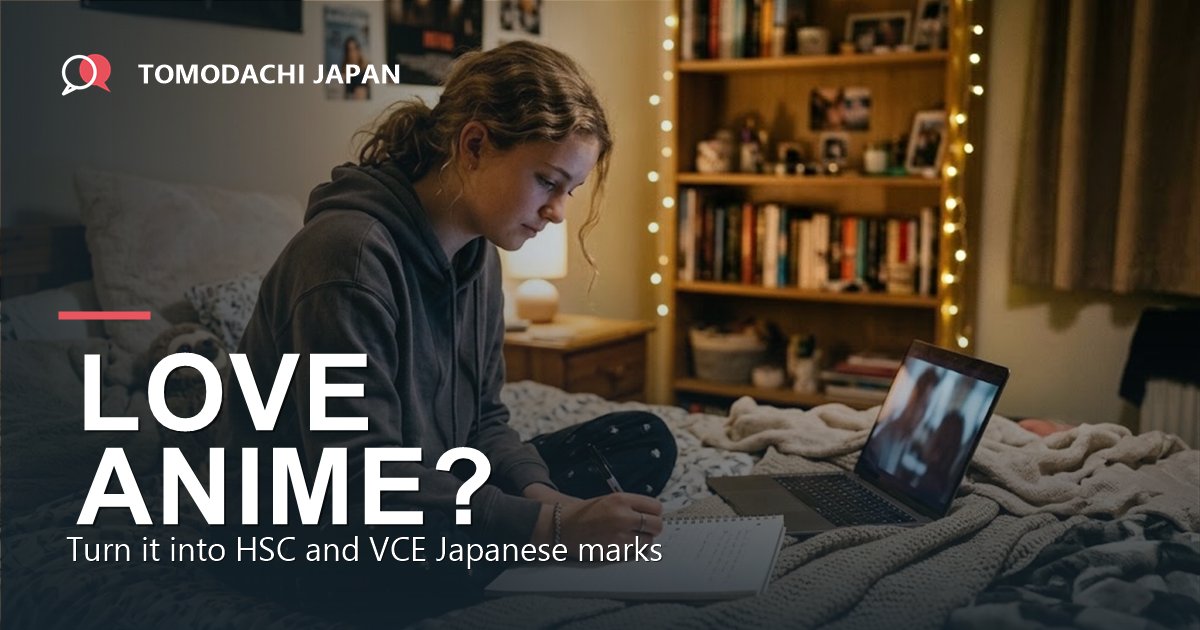
Here’s a conversation that happens in Australian homes every year. A student picks Japanese for Year 11 because they love anime. By Term 2 they’re frustrated: they can catch whole lines of dialogue without subtitles, but their oral practice sounds stiff and their marks say “adequate.” Meanwhile a classmate who has never watched an episode is scoring higher.
Their anime Japanese and their exam Japanese are two separate accounts, and nothing is moving between them.
The good news is that the gap is narrower than it looks, and it’s a technique problem rather than a talent problem. This guide explains exactly which parts of anime Japanese are worth marks in the HSC and VCE, which parts will actively cost marks if they leak into an exam, and how to convert hours you’re already spending into a better oral score.
Why anime alone doesn’t lift your mark
Watching is input. Exams test output — and mostly output under pressure, in a conversation with an adult you’ve never met.
Research on raising bilingual children keeps landing on the same point: input alone (books, video, listening) builds comprehension but doesn’t reliably produce speakers. The children who end up speaking are the ones who have to use the language with real people. It’s the same mechanism that makes an anime-fluent Year 12 freeze in an oral exam. We covered the evidence in raising a bilingual Japanese child abroad.
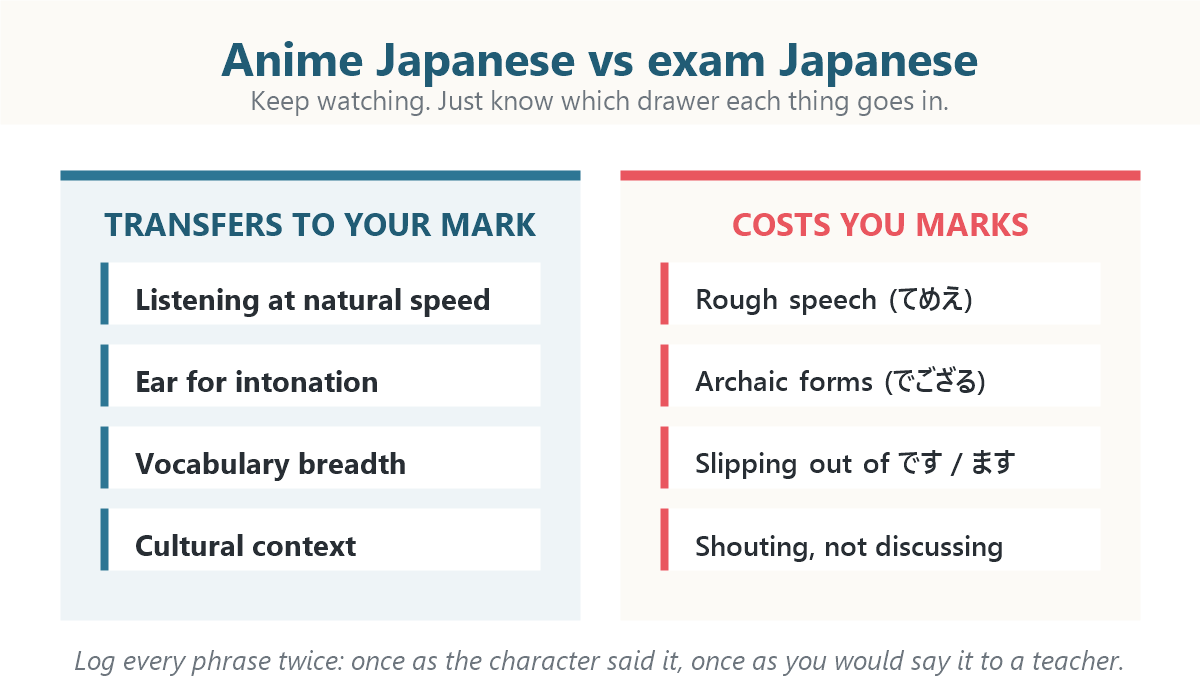
There’s a second, subtler problem. Anime dialogue is written to be dramatic. It over-represents casual speech, male rough speech, archaic forms, and shouting — and under-represents the register the exams actually test: polite, everyday, two-way conversation with someone slightly senior to you. That’s not a flaw in anime. It’s just a mismatch with what an examiner sits down to assess.
Want to go from quoting anime to actually talking with friends in Japan?
TOMODACHI JAPAN is an online Japanese school for children growing up outside Japan. They talk with peers their own age in Japan every day, taught by teachers working at Japanese schools, in small classes of 8.
🎁 Register and we’ll email you our School Guide (PDF, in English) straight away. You’ll also be first to hear about tuition, scholarships and opening dates.
Free · takes about 30 seconds
What transfers — and what doesn’t
| What you get from anime | Exam value | Why |
|---|---|---|
| Listening at natural speed | ◎ High | Exam listening audio runs at real pace with contractions. Students who only hear textbook audio lose marks here; anime fans usually don’t |
| Ear for intonation and rhythm | ◎ High | Examiners reward speech that sounds like a person. Prosody is genuinely hard to teach and you may already have it |
| Vocabulary breadth | ○ Useful | Real, but skewed — you may know 覚悟 and not know 進路. Needs topping up with everyday and school vocabulary |
| Cultural context | ○ Useful | School clubs, seniority, festivals, part-time work — genuinely handy for conversation topics and reading passages |
| Casual / plain form | △ Mixed | Fine in the right place. But an exam conversation is mostly です/ます, and slipping registers reads as inappropriate to context |
| Rough or masculine speech (おれ様、〜やがる、てめえ) | ✗ Costs marks | Reads as rude or bizarre to an examiner. This is the single most common way anime hurts a student |
| Archaic / fantasy speech (〜でござる、わらわ) | ✗ Costs marks | Charming; wrong century. Same category as a student writing English exam answers in Shakespearean |
If you want the detail on which specific lines are safe to say to a real person and which aren’t, we tag exactly that in our quote breakdowns — for example Naruto quotes in Japanese and Demon Slayer quotes in Japanese, where each line is marked for whether you can actually use it.

Four techniques that turn watching into marks
1. Translate every line you steal into polite form
When a line grabs you, don’t just note it — note it twice. Once as the character said it, once as you would say it to a teacher. 行くぞ! becomes 行きましょう。 やめろ becomes やめてください。
This one habit does more for your oral mark than any vocabulary list, because it builds the exact skill both syllabuses reward: choosing language appropriate to context, audience and purpose. It also inoculates you against the failure mode where a memorable casual phrase falls out of your mouth in an exam.
2. Mine for opinions, not just words
Both exams reward students who state a view and a reason, and who can concede a point. Anime is unusually good raw material for that — every series has something arguable in it.
After an episode, write two sentences in Japanese: what you thought, and why. Then a third: what someone might say against you. You now have the sentence shapes (…と思います / …からです / たしかに…ですが) that carry an entire exam conversation, practised on content you actually care about.
3. Use it as a Detailed Study or conversation topic — but reframe it
VCE students choosing a Detailed Study subtopic, and HSC students preparing personal-world conversation, can both use anime — if it’s reframed as a question rather than a story.
“The plot of my favourite series” collapses under questioning after ninety seconds. “How anime portrays working life in Japan, and whether it’s accurate” is arguable, has Japanese-language sources, and gives an assessor somewhere to push. Same passion, completely different mark ceiling. We walk through the selection tests in choosing a VCE Japanese Detailed Study subtopic.
4. Rewatch one scene with the audio only
Pick a two-minute conversational scene — not a fight — and listen without subtitles or picture. This converts passive watching into the exact skill the listening section tests: extracting meaning from speech alone, at speed, without visual scaffolding. Ten minutes of this beats an hour of subtitled watching for exam purposes.
The step none of this replaces
Every technique above still happens alone, at your desk, with a screen that doesn’t answer back. The exams — 20 marks out of 100 in HSC Japanese Continuers, about 12.5% of the study score in VCE Japanese Second Language — are a conversation with a person who asks things you didn’t prepare for.
There is no substitute for the thing itself. You need someone who will ask “why?” and mean it, who will disagree, who will follow a tangent, and who will speak at normal speed without slowing down for you.
| Option | Real two-way conversation? | Cost shape | Watch-out |
|---|---|---|---|
| Anime + subtitles | No — input only | A subscription | Builds comprehension, not speech. Register skews casual |
| Language apps | No | Free–low | Streaks feel like progress; conversation ability stays flat |
| School class | Some | Included | A few minutes each per week, same familiar voices |
| 1-on-1 tutor | Yes | Per hour — commonly A$75–130/hr for language subjects in Australia | One adult voice; ramping up before exams is when it gets expensive |
| TOMODACHI JAPAN | Yes — teachers and same-age Japanese students | One flat monthly fee, unlimited attendance | Runs on Japan time — an advantage in Australia and NZ |
Why talking to Japanese teenagers works better than lessons
TOMODACHI JAPAN is an online school staffed by currently practising Japanese teachers — the same educators who teach children inside Japan — and students also join sessions with Japanese students their own age. For an anime-motivated exam student, that combination is unusually well matched:
- Teachers can sort your Japanese into drawers. A qualified teacher will tell you which of your anime phrases are fine, which are rude, and which are three hundred years old — and can run a mock oral in exam format afterwards. A friend who “knows some Japanese” cannot.
- Peers give you the register you’re missing. Talking with Japanese teenagers about ordinary things — school, homework, what they watched — is precisely the everyday conversational Japanese that anime under-supplies and both exams over-test.
- It solves the motivation problem honestly. The reason you picked Japanese was that you liked something Japanese. Talking to actual Japanese people your own age keeps that alive far better than a worksheet does — and a student who keeps practising for two years beats a talented one who stops in Term 2.

The timing works out
Sydney and Melbourne sit one hour ahead of Japan in winter and two ahead in daylight saving; Auckland is three ahead. An after-school session lands in the Japanese afternoon or evening — the same slot you’d otherwise spend watching an episode. See the full conversions in our time-zone guide and local times on the Australia & New Zealand page.
FAQ
Can you learn Japanese from anime?
You can learn a great deal of listening from anime — natural speed, intonation, vocabulary and cultural context. What anime cannot do is build the ability to speak under pressure, because watching is one-directional. It’s an excellent half of a method. Our broader guide is how to learn Japanese with anime.
Will anime Japanese make me sound rude in the exam?
It can. Rough or archaic speech patterns — おれ様, 〜やがる, てめえ, 〜でござる — sound wrong to an examiner assessing appropriateness to context. The fix isn’t to stop watching; it’s to consciously log each phrase’s register and practise the polite equivalent alongside it.
Can I use anime as my VCE Detailed Study subtopic?
Yes, provided you frame it as an arguable question rather than a plot summary, and you can find enough Japanese-language material to sustain roughly 15 hours of study. “How anime portrays working life in Japan — and is it accurate?” works; “the story of my favourite series” does not survive seven minutes of questioning.
How much anime counts as study?
Passive subtitled watching is closer to entertainment than study. Ten minutes of deliberate work — audio-only rewatching, logging phrases in two registers, writing two opinion sentences — is worth more for exam purposes than two subtitled episodes. Consistency matters more than volume; we set out realistic weekly targets in how much Japanese should kids practise each week.
I’m in Year 11 and only just started taking it seriously. Is it too late?
No — Year 11 is the ideal time to start speaking regularly, because conversational confidence built now is worth far more than an intensive program in Term 3 of Year 12. If you’re weighing up extra help, our honest take is in do you actually need an HSC or VCE Japanese tutor?
What does TOMODACHI JAPAN cost?
One flat monthly fee for unlimited daily attendance (billed in Japanese yen; your local-currency amount is on the tuition page). Because there’s no per-lesson charge, speaking every day costs the same as speaking once a week.