
“We’d love our child to learn Japanese online with kids in Japan — but what time would classes actually be for us?” It’s the first question families outside Japan ask, and the honest answer is: it depends on where you live, and for some regions the fit is far better than most parents expect. This guide converts Japan Standard Time (JST) class hours into your local time — Sydney, Auckland, Singapore, Bangkok, Los Angeles, New York, London and more — and tells you honestly which regions fit well, which need the weekend trick, and which are genuinely hard.
How TOMODACHI JAPAN scheduling works
TOMODACHI JAPAN runs on Japan Standard Time (JST), because the children your child will befriend — same-age kids from our sister school NIJIN Academy (800+ students) — live in Japan. Sessions run across weekday daytimes, weekday evenings, and weekend mornings (JST), with around 100 sessions a month to choose from, and one flat fee covers unlimited attendance. That last part matters for time zones: you don’t need every slot to fit your day. If just two or three sessions a week land in your child’s free time, they can attend all of them at no extra cost. The final timetable will be announced before our December 2026 opening — the times below show how JST maps onto your city.
Looking for a way to keep Japanese going from abroad?
TOMODACHI JAPAN is an online Japanese school for children growing up outside Japan. They talk with peers their own age in Japan every day, taught by teachers working at Japanese schools, in small classes of 8.
🎁 Register and we’ll email you our School Guide (PDF, in English) straight away. You’ll also be first to hear about tuition, scholarships and opening dates.
Free · takes about 30 seconds
JST class times in your city — the conversion table
Three representative JST slots, converted. (Northern-hemisphere summer time; where daylight saving applies, times shift by an hour part of the year.)
| Your city | Sat 10:00 JST | Weekday 16:00 JST | Weekday 19:00 JST | Fit |
|---|---|---|---|---|
| Singapore / Hong Kong / Taipei | Sat 9:00 | 15:00 | 18:00 | ◎ Excellent |
| Bangkok / Jakarta | Sat 8:00 | 14:00 | 17:00 | ◎ Excellent |
| Sydney (AEST) | Sat 11:00 | 17:00 | 20:00 | ◎ Excellent |
| Auckland (NZST) | Sat 13:00 | 19:00 | 22:00 | ○ Good (earlier slots) |
| Los Angeles (PDT) | Fri 18:00 | 0:00 | 3:00 | ○ Weekends work well |
| New York (EDT) | Fri 21:00 | 3:00 | 6:00 | △ Weekend slots only |
| Honolulu (HST) | Fri 15:00 | 21:00 (prev. day) | 0:00 | ○ Weekends work well |
| London (BST) | Sat 2:00 | 8:00 | 11:00 | △ Hard (see below) |
Australia & New Zealand: the time zone is basically a gift
Sydney is just one hour ahead of Japan (two during daylight saving). Japan’s weekday-evening sessions land at 5–8 p.m. your time — the classic after-school window — and Saturday-morning JST sessions are your late Saturday morning. Auckland families do best with Japan’s afternoon slots, which land at 6–8 p.m. NZ time. If you’re raising a Japanese-speaking child in Australia or New Zealand, distance is real but time difference is a non-issue — your child can talk with friends in Japan on an ordinary school day.
United States & Canada: the Friday-evening trick
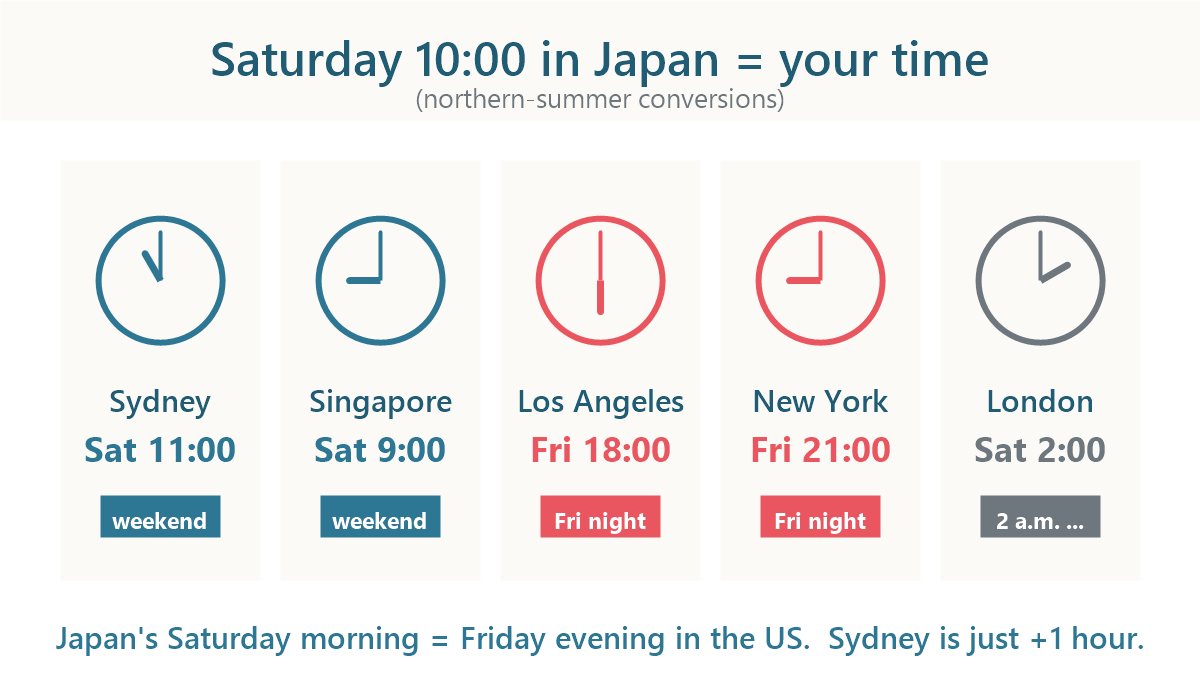
Here’s the conversion most American families miss: Saturday morning in Japan is Friday evening in the US. A 10 a.m. Saturday session in Tokyo is 6 p.m. Friday in Los Angeles and 9 p.m. Friday in New York. West Coast and Hawaii families get a genuinely comfortable weekly rhythm out of this — Japanese with friends as the Friday wind-down, no Saturday commute to a supplementary school across town. East Coast families have a narrower window (Friday 9 p.m. suits older kids; Sunday-morning JST slots land Saturday evening). We’ll be honest: Japan’s weekday slots don’t work for school-day America. But because attendance is unlimited rather than per-lesson, a weekend-only rhythm still gets your child regular time with the same group of friends.
Southeast Asia: after school, as-is
Singapore, Malaysia, the Philippines, Thailand, Indonesia: you’re one to two hours behind Japan, so Japan’s evening is your late afternoon or early evening — straight after local or international school. Families here have the easiest schedule of all. (We’ve written city guides for Singapore — with Bangkok coming next week.)
UK & Europe: honestly, the hardest — with one workaround
London is eight hours behind Japan in summer (nine in winter). Japan’s evenings are your school mornings; Japan’s Saturday morning is your Saturday 2 a.m. We won’t pretend that’s fine. The workaround: Japan’s weekend late-afternoon slots — 5 p.m. Sunday JST is 9 a.m. Sunday in London, a perfectly civilised time. If those slots fit your child, great; if not, a Europe-friendly format may serve you better for now, and we’d rather tell you that than sign you up for 2 a.m. classes.
“A tutor can meet us any time — isn’t that better?”
It’s true, and worth saying plainly: 1-on-1 tutor marketplaces like italki and Preply (roughly US$10–25 per lesson) let you book any hour you like, because one adult adjusts to you. That is their genuine advantage. What they can’t schedule is a reason to keep speaking. A tutor is an appointment; a group of friends is a place your child wants to be. Our bet — the whole design of TOMODACHI JAPAN — is that two sessions a week your child begs to attend beat five they endure. If your schedule truly has no overlap with Japan’s day, a tutor is the right call, and we’ll say so.

FAQ
Do you adjust for daylight saving time?
Japan doesn’t observe daylight saving, so JST never moves. If your country does, your local class time shifts by one hour twice a year — the table above shows summer conversions.
What if only one or two slots a week fit our schedule?
That’s fine — and it’s why the flat monthly fee matters. There’s no per-lesson meter running, so a child who can only come Friday evenings still gets a stable group of friends and steady speaking time. Consistency beats volume.
We’re moving between time zones (relocation, home leave). Does that break things?
No — this is where online genuinely wins. The friends stay the same; only your clock changes. Families relocating between Asia, Oceania and Japan keep the same groups through the move, which is exactly when a stable friendship in Japanese helps most.
Where can I see the actual timetable and prices?
Tuition and plan details are on our tuition page (unlimited attendance, sibling discounts). The full timetable will be published before the December 2026 opening — register for updates and we’ll send it to you first, with trial-session details.