The Japanese School of Brussels — ブラッセル日本人学校, The Japanese School of Brussels a.s.b.l. — charges €525 a month in tuition for the 2026–27 school year, billed as €6,300 a year in three term payments, plus a one-time €500 entrance fee. The school bus adds €180 a month for a round trip, and families who are not members of the Belgian Nihonjinkai pay a further €300 a year. That puts a first year at about €6,800 before the bus, or €8,960 with it. The school sits at Avenue des Meuniers 133 in Auderghem and teaches Japan’s national curriculum from Grade 1 to Grade 9, on the same site since 1980. Two things most English pages miss: it is run by a Belgian non-profit with its own board, not by Japan’s education ministry, and the same building and asbl also run a Saturday school with 234 pupils whose fees are a quarter of the weekday school’s.
This page is the single-school deep dive: what the Japanese School of Brussels costs, who can enrol, how the weekday school and the Saturday school differ, and what English-language listings leave out. Everything comes from the school’s own Japanese-language website, its 2026–27 fee sheet, and the Belgian Crossroads Bank for Enterprises, read on 24 October 2026. Where something is not published, we say not published. If what you actually want is a Saturday hoshuko rather than a full Japanese school week, our page on the Japanese Saturday School in Amsterdam shows how the same model works two hours up the motorway.
The short answer
| What it is | Belgium’s only full-time Japanese school (nihonjin gakko), teaching Japan’s national curriculum in Japanese, Grades 1 to 9. Opened in April 1979 and run by The Japanese School of Brussels a.s.b.l., a Belgian non-profit registered in March 1974 |
| Where | Avenue des Meuniers 133, 1160 Auderghem, in the south-east of Brussels, near Beaulieu metro. One campus, shared with the Saturday school |
| Cost, 2026–27 | Tuition €6,300 a year (€525 a month), paid in three term blocks of €2,100, €2,625 and €1,575. Entrance fee €500, once. Bus €180 a month round trip, €125 one way. Non-Nihonjinkai households add €300 a year |
| The Saturday school | Same building, same asbl, separate principal and fee sheet: entrance €386, tuition €1,692 a year (€141 a month), four lessons on Saturday mornings. No bus. 234 pupils in 2026 |
| Who it takes | Children of Japanese school age who can follow lessons in Japanese. No nationality condition is published; the only membership-linked rule is the €300 fee for non-members of the Nihonjinkai. Transfers go through a parent portal at least a month ahead |
| Size | Weekday enrolment is not published; a 2023 teacher’s report gave about 240 primary and 50 junior-high pupils. The Saturday school states 234 for 2026 |
| The real catch | It stops at Grade 9, French is 20 minutes a day at most in the lower grades, and a bus seat is not guaranteed |
Looking for a way to keep Japanese going from abroad?
TOMODACHI JAPAN is an online Japanese school for children growing up outside Japan. They talk with peers their own age in Japan every day, taught by teachers working at Japanese schools, in small classes of 8.
🎁 Register and we’ll email you our School Guide (PDF, in English) straight away. You’ll also be first to hear about tuition, scholarships and opening dates.
Free · takes about 30 seconds
First, which school do you actually mean?
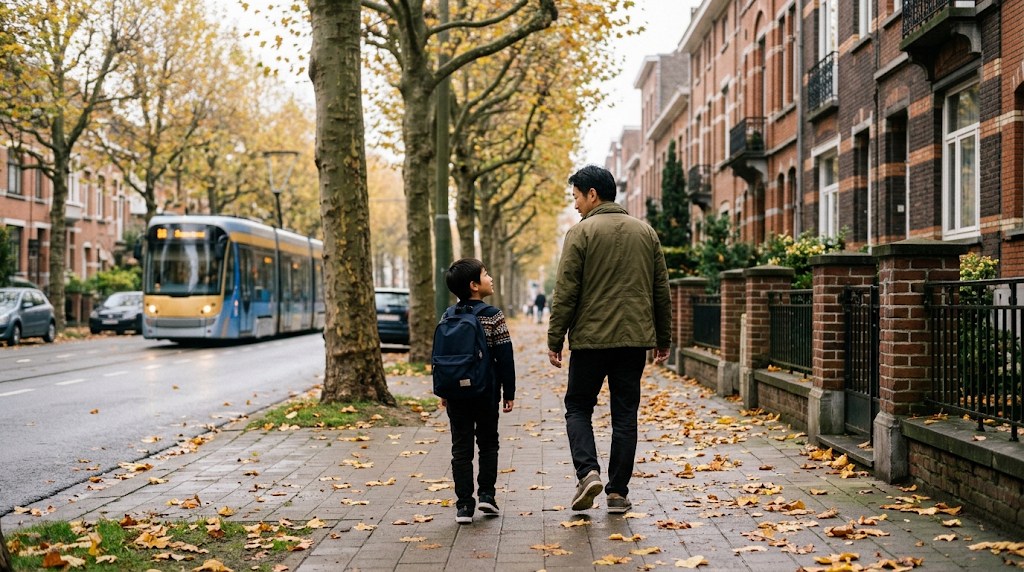
Search for the Japanese School of Brussels in English and you will meet one address, two schools, an unrelated website and an acronym that belongs to somebody else. The weekday school and the Saturday school share a building, a phone number and a legal entity, and the school’s own website is entirely in Japanese. Here is the map.
| Name you will see | What it actually is | Language and ages | Where |
|---|---|---|---|
| Japanese School of Brussels / JSB, ブラッセル日本人学校, japanese-school-brussels.be | The full-time Japanese school this page is about. Japan’s curriculum and textbooks, Monday to Friday, 8:20 to 16:00 | Japanese; Grades 1–9 (ages 6–15) | Avenue des Meuniers 133, Auderghem |
| The Japanese Saturday School of Brussels, ブラッセル補習授業校 | The same asbl’s Saturday hoshuko for Japanese children at Belgian or international schools. Japanese language and maths only, 9:00 to 12:40 | Japanese; Grades 1–9 | Same building |
| jsb.be | Not the school. The domain belongs to Jeunesses Scientifiques de Belgique, a French-speaking science youth organisation running holiday camps | — | — |
| ISB, International School of Brussels | An English-medium international school, often confused by acronym. Tuition €41,400 for Grades 1–2 in 2026–27 | English; ages 2½–18 | Kattenberg, Watermael-Boitsfort |
Two practical consequences. When a directory quotes “€6,300” it is pricing the weekday school; the Saturday school is a separate €1,692, and no English page we found lists both. And if your child attends a Belgian or international school and you want Saturday Japanese, you want the Saturday school, with its own principal, entry route and February open day. If you want a full Japanese school week, read on.
What it costs in 2026–27: €525 a month, €500 to start
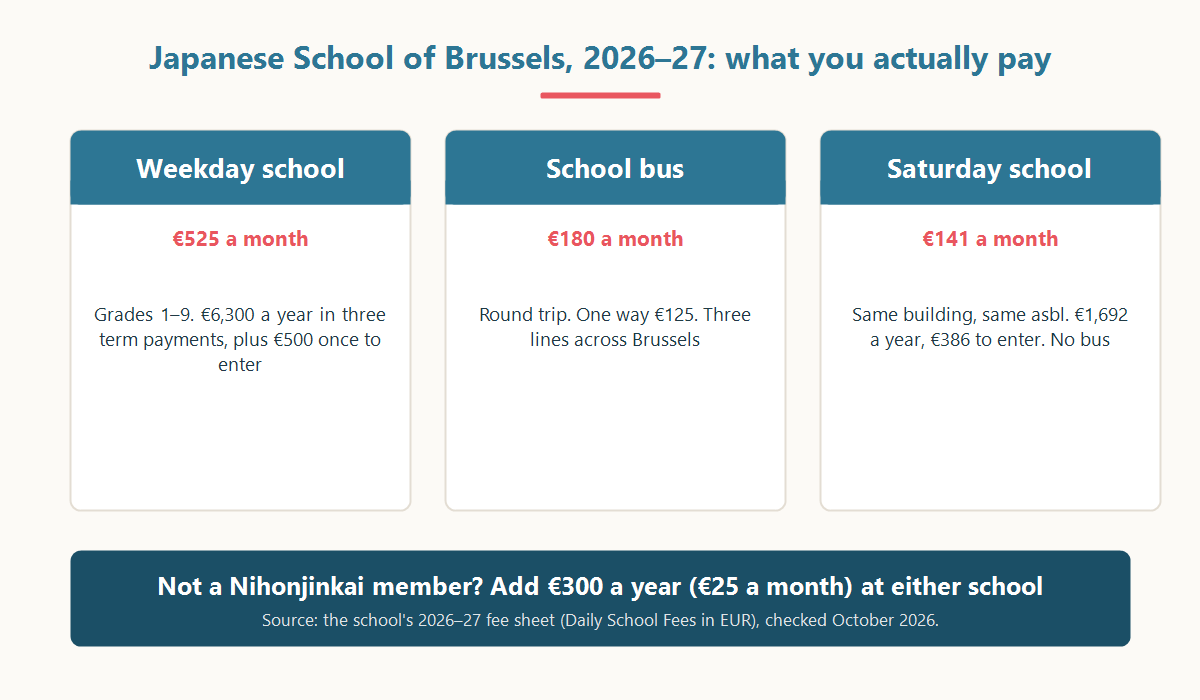
The school publishes one fee sheet in Japanese and one in English, both for the school year April 2026 to March 2027. Fees are in euros per child, except the non-member fee, which is per household. Tuition is not paid monthly: it is collected in three blocks of four, five and three months by direct debit, with a new family’s first payment by bank transfer.
| Item | Weekday school (Grades 1–9) | Saturday school (Grades 1–9) |
|---|---|---|
| Entrance fee (once) | €500 | €386 |
| Tuition, per year | €6,300 (€525 a month) | €1,692 (€141 a month) |
| Term 1 payment | €2,100 on 9 April 2026 (4 months) | €423 on 10 April 2026 (3 months) |
| Term 2 payment | €2,625 on 19 August 2026 (5 months) | €564 on 3 July 2026 (4 months) |
| Term 3 payment | €1,575 on 6 January 2027 (3 months) | €705 on 6 November 2026 (5 months) |
| “Approval fee” for households not in the Nihonjinkai | €300 a year (€25 a month), added to each term | €300 a year (€25 a month), added to each term |
| School bus, round trip | €180 a month (€720 / €900 / €540 per term) | No bus |
| School bus, one way | €125 a month (€500 / €625 / €375 per term) | No bus |
| First year, member, no bus | €6,800 | €2,078 |
| First year, member, round-trip bus | €8,960 | — |
In US dollars, at roughly US$1.10 to the euro, a year of weekday tuition is about US$6,900, and tuition plus a round-trip bus about US$9,300. An April entrant pays €2,600 up front — the entrance fee and the first term — and a further €720 a week later if the bus is booked. A child who leaves mid-year gets unused bus months refunded from the month after the last ride.
Three things about these numbers that the one-line “€6,300” on directory sites does not tell you:
- The Nihonjinkai fee is a membership test, not a nationality test. The sheet calls it an “approval fee” — 協賛金 — of €25 a month per household, charged “only for non-Nihonjinkai member”. A family that joins the Japanese association in Belgium does not pay it; a family that does not, pays €300 a year on top of tuition. For a posted employee whose company covers association dues this is invisible; for a locally hired or mixed-nationality family it is a real line item.
- The bus is a third of tuition. €180 a month is €2,160 a year, 34% of the €6,300. Three round-trip lines run — Woluwe, Stockel and Konkel — and the ride from the first stop is 30 to 45 minutes. Seats go to current riders first, then to new families in application order; a waiting list is possible, and you cannot reserve before your address is fixed.
- The Saturday school is 3.7 times cheaper, and billed on a different calendar. Its three payments fall in April, July and November, not April, August and January. One free trial day is allowed; after that any month with even one day’s attendance is charged in full.
Several things are not published: any sibling discount, whether employers are invoiced directly, and the prices of the items on the school-supplies lists. Pupils arriving from Japan collect free overseas-edition textbooks from JOES in Tokyo before they leave.
Is €6,800 a year expensive? Not in Brussels. The International School of Brussels charges €41,400 for Grades 1 and 2 in 2026–27, plus a €2,000 application fee and €3,240 for its bus — six and a half times the Japanese school’s tuition. Belgian state schools are free. For most posted families the question is not affordability but whether a bus route reaches the house they are about to rent.
Who can enrol: no published nationality rule, a one-month lead time
The admissions pages are procedural rather than selective. For a transfer during the year:
- Send the pupil survey form. A one-page PDF (編入学児童生徒調査用紙) goes to nyugaku@japanese-school-brussels.be; the school replies with a transfer pack.
- File the application through the parent portal — app.japanese-school-brussels.be — at least one month before the transfer date.
- Receive the admission letter, an invitation to an information session, a request for the first tuition transfer and a direct-debit mandate.
- Book the bus separately with the bus office once your address and start date are fixed.
For children starting Grade 1 in April 2027, the school is running a pupil survey now: forms are due by 30 October 2026, and families who answer are invited to the information session on 5 February 2027 (the Saturday school holds its own on 13 February). Transfer families for Grades 2 to 9 get an invitation in March to an April session. There is also a trial-entry scheme (体験入学) for the weekday school with its own rules and form; the conditions are in a Japanese PDF, so ask the office what the trial covers before you plan around it.
What the pages do not say is as important. We found no nationality requirement on the admissions, survey or trial-entry pages, and no rule that a family must belong to the Nihonjinkai — only the €300 fee if it does not. The history page describes the asbl’s founding purpose in 1974 as educating “children of the Japanese association in Belgium”, but that is history, not a current condition. The one Japanese-nationals-only scheme on the site is the embassy’s free textbook distribution, which is for children not enrolled at either school. We cannot rule out an unwritten expectation, so a mixed family should simply ask; the practical gate, as at every Japanese school abroad, is whether the child can follow a full day of lessons in Japanese.
How it works: a Japanese school week in Auderghem, a Japanese morning on Saturday
The school is governed by the asbl’s board — the Belgian register lists seventeen directors and two daily managers — and the board chair, the weekday principal and the Saturday principal all sign this year’s admissions letter. The weekday principal, Kazuhiro Sugimoto, is the seventeenth seconded from Japan since 1979; the Saturday school has had its own MEXT-dispatched principal since 2005. Teachers are a mix of government secondees and locally hired staff; in October 2026 the school was advertising for local teachers for 2027–28.
| What | Weekday school | Saturday school |
|---|---|---|
| Hours | Arrive 8:00–8:20, morning activity 8:25. Primary finishes 16:00 (13:05 Wednesdays); junior high 16:40 (13:05 Wednesdays) | Arrive 8:45–9:00; homeroom 9:00; four 45-minute lessons 9:10–12:40 |
| Subjects | Full Japanese curriculum, same textbooks as Japan, plus French or English conversation | Japanese language and maths only, with the school’s own kanji test |
| Foreign languages | Grades 1–2: French four times a week and English once, 20 minutes each. Grades 3–4: French or English, five 20-minute sessions a week. Grades 5–9: one language, three full periods a week. Native-speaker teachers; English by Kids&Us; DELF Prim from Grade 6, Eiken twice a year | — |
| Lunch | Packed lunch from home; water, tea or milk only; rubbish goes home | Ends before lunch |
| Bus | Three lines, 30–45 minutes; junior-high pupils may ride home only Monday, Wednesday and Friday | None |
| Calendar | Japanese April–March year, three terms; the detailed events calendar is not published online “for security reasons” | April entrance ceremony, June sports day, October Marronnier festival, January mochi-pounding, March graduation |
| Enrolment | Not published for 2026; about 290 in March 2023 | 234 in 2026 |
Two features deserve a closer look. The first is how little local language a weekday pupil gets: in Grades 1 and 2, French is four 20-minute sessions a week — eighty minutes — in a city that is officially bilingual French and Dutch. The school is honest about this; the stated goal is communication rather than grammar, with DELF Prim and Eiken as optional targets. A family that wants a child fluent in French by the end of the posting will need to add it outside school.
The second is continuity. The asbl opened its Saturday school in Ixelles in 1974 with 121 children, the weekday school in 1979 with 50, and both have been on Avenue des Meuniers since June 1980; the Saturday school turned fifty in November 2024.
The honest review: what the English pages leave out
People search for “Japanese School of Brussels reviews” and “photos” to learn what the school is like from the inside. We want to be straight: we found no verifiable parent reviews in English or Japanese, the main school directory carries none and says the school has not added photos, and the school’s own site is Japanese-only. We will not invent a consensus. What we can do is show where the English pages that rank diverge from what the school and the Belgian state publish.
1. “Bus service: No.” There are three bus lines
The Doris profile, which it labels AI-compiled and “not yet claimed by the school”, shows “Bus Service: No” in its summary box — and then, further down the same page, describes the Woluwe, Stockel and Konkel lines and the €180 fare. It also lists “Ages: Not listed”. For a family choosing a neighbourhood, the bus is the single most important fact about this school, and the summary gets it backwards.
2. “Primary and secondary education.” It ends at 15
Expat guides such as InsideBrussels and the KBC Brussels schools page describe the school as offering “primary and secondary education levels”. In Japanese terms that is right — a 中学部 is secondary — but to an English-speaking parent “secondary” means to 18. The school stops at Grade 9. There is no Japanese high school in Belgium; Japanese teenagers in Brussels have historically moved to ISB or other international schools, or returned to Japan. If your posting runs past your child’s fifteenth birthday, that transition is part of the decision now.
3. “Established by the Ministry of Education.” It is a Belgian asbl
The Japanese Wikipedia article gives the school’s founder (設置者) as Japan’s Ministry of Education. The Belgian Crossroads Bank for Enterprises says otherwise: “The Japanese School of Brussels” is a non-profit organisation, active since 29 March 1974, with its seat at Avenue des Meuniers 133 and a board of seventeen directors drawn from the Japanese business community. The ministry seconds teachers and principals; it does not own or run the school — which is why the Nihonjinkai, not MEXT, appears on the fee sheet.
4. Enrolment figures frozen in 2013
The English Wikipedia article, edited as recently as August 2026, runs its enrolment table from 1995 to 2013 — 295 weekday and 205 Saturday pupils, with a peak of 399 in 2008 — and quotes funding from 2000 and staffing from 1998. The newest dated weekday figure we could find is a seconded teacher’s report from March 2023: about 240 primary and 50 junior-high pupils. The Saturday school publishes its number: 234 in 2026, up from 205 in 2013. The weekday school does not; treat Doris’s undated “232 pupils” as a guess.
5. One fee quoted, two schools priced
Every English page that quotes a fee quotes €6,300; none mentions the Saturday school’s separate sheet at €1,692, or the €300 non-member fee. A parent at an international school who reads “€6,300” and concludes Japanese schooling is out of reach has been misled: the Saturday option is €141 a month. A parent who budgets €6,300 and is not in the Nihonjinkai will be €300 short.
6. What to ask, since the reviews won’t tell you
- Is there a bus seat for our street, and how long is the ride? Not guaranteed; 30 to 45 minutes from the first stop.
- How many children are in my child’s grade? Not published; with roughly 290 pupils over nine grades, some grades are one class.
- What does the trial-entry scheme cover? The conditions are in a Japanese PDF.
- Does my employer pay the Nihonjinkai dues, or do we pay the €300?
- Will my child get enough French to move to a Belgian school later? At 80 minutes a week in the lower grades, not without extra help.
- What did last year’s Grade 9 leavers do next? The website does not say.
Other options in Brussels
Belgium has exactly one hoshuko on the ministry’s list — this one — so the Japanese choices narrow to the two schools on Avenue des Meuniers, plus whatever you arrange yourself.
| Option | Who it takes | What to know |
|---|---|---|
| The Japanese Saturday School of Brussels | Japanese-speaking children at Belgian or international schools, Grades 1–9 | Saturday 9:00–12:40, Japanese and maths; €386 to join, €1,692 a year; one free trial day; open day 13 February 2027. No bus. Compare the Luxembourg supplementary school and the Copenhagen one for how fees vary across Europe |
| International School of Brussels and other international schools | Ages 2½–18, by application | English-medium; ISB €41,400 for Grades 1–2 in 2026–27 plus €2,000 to apply. Where most Japanese teenagers in Brussels have gone after Grade 9 |
| European Schools | Mainly children of EU-institution staff | Four in Brussels plus Waterloo, ages 3–18, European Baccalaureate; places for other families are limited |
| Belgian state schools | Everyone resident | Free; French- or Dutch-language; a route to the local language, none to Japanese |
| Free Japanese textbooks | Japanese-national children in Belgium not enrolled at either school | The embassy distributes MEXT textbooks twice a year to families who have filed a residence report |
The gap is the same one we see across Europe. A full-time Japanese school serves children who can spend a whole week in Japanese and will probably return to Japan; a Saturday school serves Japanese children at other schools, four lessons a week. The Belgian-Japanese child at a French-speaking school whose Japanese reading has stalled, or the family in Antwerp or Ghent for whom an 8:45 Saturday start in Auderghem is a two-hour round trip, falls between them. Our guide to finding a Japanese Saturday school near you sets out what to check before you commit to the drive.
How to choose, in four questions
- Can your child follow a full day of lessons in Japanese? Every subject is taught in Japanese with Japanese textbooks. A child who chats in Japanese at home but reads two years behind will struggle; the Saturday school’s free trial day is the cheapest way to find out.
- Is your child going back into Japanese schooling? If so, the weekday school is built for it: same curriculum, same April start, same textbooks. If your family is settled in Belgium, weigh 80 minutes of French a week against a Belgian school, and remember Grade 9 is the end of the line.
- Where will you live? Three bus lines, 30 to 45 minutes, seats to current riders first. Woluwe, Stockel and the Auderghem–Tervuren corridor are where Japanese families cluster for a reason.
- Who pays, and is the family in the Nihonjinkai? With a Japanese employer, €8,960 for a first year with the bus may be covered along with association dues. Without one, budget €300 more a year, and decide whether Saturdays at €141 a month do the job.
Where TOMODACHI JAPAN fits
We are not a substitute for the Japanese School of Brussels, and if your child can follow a Japanese school day and is heading back to a school in Japan, we would point you to Avenue des Meuniers. We exist for the families the four questions above leave stuck — the child at a Belgian or international school whose Japanese reading slips between Saturdays, the family in Flanders or Wallonia for whom Auderghem is too far every week, and the child who has never had Japanese friends of their own age.
- Japanese friends of the same age, every day. Classes with children the same age in Japan — not only other learners in Belgium. The reason children keep going is usually the other children.
- Teachers working at Japan’s current classroom standard — not a syllabus written abroad and not a tutoring marketplace.
- Small classes of eight children. Enough to be a class, few enough that every child speaks every lesson.
- Belgium is eight hours behind Japan in winter, seven in summer. That rules out Japan’s weekday evenings, which fall at Brussels lunchtime. The weekend is what lines up: a Saturday or Sunday morning in Belgium is a Japanese afternoon, so children here can join children in Japan without either side staying up late. No bus, no waiting list, no membership fee.
- Unlimited classes for a flat monthly fee. Tuition, scholarships and opening dates are in our free school guide, which we email to everyone who registers, with no obligation.
If a Saturday school is what you are weighing us against, our guide to online alternatives to a Japanese hoshuko sets out what an online class can and cannot replace.
Frequently asked questions
How much are the Japanese School of Brussels fees?
For 2026–27, tuition is €6,300 a year, equivalent to €525 a month, paid in three term blocks of €2,100, €2,625 and €1,575. There is a one-time entrance fee of €500. The school bus costs €180 a month for a round trip or €125 one way, and households that are not members of the Nihonjinkai pay an extra €300 a year. A first year with the bus comes to about €8,960.
Where is the Japanese School of Brussels?
At Avenue des Meuniers 133, 1160 Auderghem, in south-east Brussels, near Beaulieu metro, on the same site since June 1980. Three school-bus lines — Woluwe, Stockel and Konkel — serve it, with rides of 30 to 45 minutes.
Is there a Saturday school, and how is it different?
Yes. The Japanese Saturday School of Brussels is run by the same asbl in the same building, for Japanese-speaking children who attend Belgian or international schools during the week. It teaches Japanese language and maths in four lessons from 9:00 to 12:40 on Saturdays, has its own principal, and charges €386 to join and €1,692 a year. It had 234 pupils in 2026. There is no bus.
Does my child need a Japanese passport?
The school publishes no nationality requirement on its admissions pages, and no requirement to belong to the Japanese association — only a €300 yearly fee for households that do not. Your child does need to be able to follow lessons in Japanese. Because the detailed conditions are in Japanese-language forms, mixed-nationality families should confirm directly with the admissions office.
Is there a high school?
No. The school runs from Grade 1 to Grade 9 (ages 6 to 15), and there is no Japanese high school in Belgium. Families either return to Japan or move to an international school such as ISB for Grades 10 to 12.
Sources
- The Japanese School of Brussels a.s.b.l. (Japanese-language pages): Home, School history, 2027 admissions survey, 2026 transfer procedure, Entry preparation and 2026 fees, Daily and Saturday School Fees 2026–2027 (PDF, English), School bus, Foreign-language education, School-life rules 2026, Trial entry, Free textbook distribution
- The Japanese Saturday School of Brussels: Saturday school home, Principal’s message (234 pupils, 2026), History, Timetable and events, Transfer procedure
- Belgian Crossroads Bank for Enterprises: The Japanese School of Brussels, 0414.412.110
- Comparison: International School of Brussels tuition 2026–27; Tokyo Gakugei University IERG seconded-teacher report (March 2023 enrolment); Japanese Wikipedia list of supplementary schools
- Third-party pages checked: Wikipedia (English); Wikipedia (Japanese); Doris profile; InsideBrussels schools guide; KBC Brussels schools page; jsb.be (Jeunesses Scientifiques de Belgique). Embassy of Japan pages were blocked to our fetch. All checked 24 October 2026.