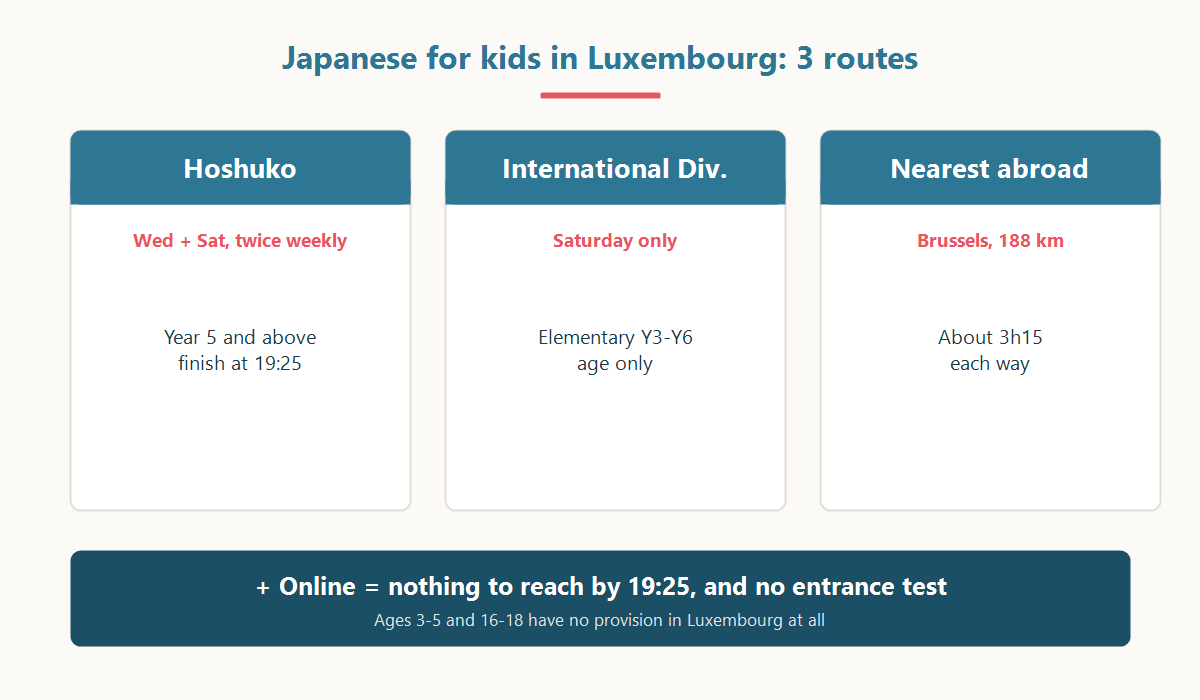
Every guide to Japanese supplementary schools tells you to plan around Saturday morning. In Luxembourg that advice is wrong, and it will cost you the year if you act on it. ルクセンブルグ補習授業校 — a licensed Luxembourg school foundation, open since April 1991, supported by the Japanese government — is a twice-weekly school. And from elementary Year 5, the Wednesday session runs 17:45 to 19:25: a school night finishing at twenty-five past seven, after a full day at ISL or a European School. Cutting to one day a week is allowed only where it clashes with your child’s own day school, not because the family is worn out. The fees are published to the cent — and pegged to Luxembourg’s cost-of-living index, so they are built to rise on their own. Here is the whole picture, including the parts that exist only inside images on the school’s website.
Japanese for children in Luxembourg: the comparison
| Option | What it is | Days | Ages | Published cost | Entry |
|---|---|---|---|---|---|
| JSSL — 小学部 / 中学部 | 補習授業校; 国語 + maths, Japanese textbooks | 2 days/week (Wed + Sat); JHS Year 3 attends 3 days (adds Tue) | ~6–15 | €396.22 entry + €203.04/month | Interview + observation (Y1); written test + composition + read-aloud (transfers) |
| JSSL — 国際部 (International Division) | Saturday-only track, 国語 only | Saturday only (~40 days/yr) | Elementary Y3–Y6 age only | €396.22 entry + €152.24/month | Also tested — not a beginner track |
| 日本語空間「わらく」 (kodomo.lu) | Registered company; Japanese expression for bilingual children, from age 3 | No current in-person class published | From 3 | Not published | Ask directly |
| INLL (Institut national des langues) | State language institute, Japanese from CEFR A1 — adult education | 2 in-class + 1 distance per week | Adults (no minimum age published) | Not published | Placement test + interview |
| TOMODACHI JAPAN | Online, classes of 8 with a homeroom teacher, grouped by level | Any day | 5–18 | Sent in the free school guide | No entrance test |
Looking for a way to keep Japanese going from abroad?
TOMODACHI JAPAN is an online Japanese school for children growing up outside Japan. They talk with peers their own age in Japan every day, taught by teachers working at Japanese schools, in small classes of 8.
🎁 Register and we’ll email you our School Guide (PDF, in English) straight away. You’ll also be first to hear about tuition, scholarships and opening dates.
Free · takes about 30 seconds
The timetable nobody publishes in text
The school puts its timetable and its fee table on the web only as images. That single decision is why none of it appears in search results, why the best competing article gets it wrong, and why parents arrive at the information session surprised. Here is what the current schedule actually says.
- Wednesday, elementary Years 1–4: arrive 15:35, lessons 15:45–16:30 and 16:40–17:25.
- Wednesday, elementary Year 5 and above: arrive 17:35, lessons 17:45–18:30 and 18:40–19:25.
- Saturday, elementary Years 1–4: arrive 08:10, lessons 08:20–09:05 and 09:15–10:00.
- Saturday, elementary Year 5 and above: arrive 10:10, lessons 10:20–11:05 and 11:15–12:00.
- Saturday, junior high Year 3 and the International Division: arrive 12:05, lessons 12:20–13:05 and 13:15–14:00.
- Tuesday: junior high Year 3 only — 16:00–16:45 and 16:55–17:40.
Read that again for the age progression, because it is the opposite of what families expect. The commitment gets heavier as the child gets older, not lighter. A Year 4 child is home well before six on Wednesday. A Year 5 child is not finishing until 19:25. And a junior-high Year 3 student — in their Japanese exam year, carrying a full international-school load — attends three sessions a week: Tuesday, Wednesday and Saturday.
The rule that closes the escape route is stated plainly: attending once a week is permitted only where the session clashes with the local day school’s own classes. It is not a lighter option a family may simply choose. The school also states that absence, lateness and early departure are in principle not accepted, and that because the syllabus is heavy relative to the teaching hours available, support at home is essential. That is an honest statement of what the school is, and it deserves to be read before you enrol rather than in November.
JSSL official site · Japanese Embassy in Luxembourg
Three divisions, not one school
Most write-ups treat JSSL as a single institution for ages 6–15. It is really three tracks, and which one you can join is decided largely by your child’s age.
- 小学部 (elementary, Years 1–6) — twice weekly, two hours a session, 82 teaching days a year (about 164 hours), 国語 and maths on the Japanese national curriculum.
- 中学部 (junior high, Years 1–3) — the same frame, with Year 3 adding Tuesday.
- 国際部 (International Division) — Saturday only, about 40 days a year, 国語 alone, and restricted to children of elementary Year 3 to Year 6 age.
That age cap on the International Division is the detail that decides things for a lot of families, and no competing page mentions it. A Year 1 or Year 2 child has no lighter option — it is the full twice-weekly commitment or nothing. A junior-high student has no lighter option either, because the International Division stops at Year 6. The Saturday-only track exists for a four-year window in the middle of primary school and nowhere else.
Two more absences worth stating plainly: there is no kindergarten division — nothing at all for ages 3 to 5 — and no high school division. Provision begins at Japanese Year 1 and ends at junior-high Year 3.
Admission is a decision, not a registration
Turning six does not get your child a place. For elementary Year 1 entry the school runs an interview plus a behavioural observation, and the Embassy’s own briefing material states that the school then decides whether to admit. For entry at any other grade — the position most arriving families are in — there is an academic test in 国語 and maths covering everything that should have been learned up to that point, plus a written composition and a read-aloud, followed by an interview with the child and the parents. The International Division tests new entrants too. It is not a beginner track, and treating it as the soft option is the most common misreading of this school.
The cycle is annual and it starts early: for a recent intake, the reply deadline was in early December with the assessment days in late January for an April start. Elementary Year 1 entry follows the strict Japanese cohort — birthdays from 2 April to 1 April — not the Luxembourg or ISL year group, so your child may be a year out of step with their day-school classmates. Arrive outside the window and you take the tested-transfer route instead.
One administrative trap with a hard deadline: free Japanese government textbooks are not arranged for you when you join. The school applies in bulk only for children already enrolled, so new entrants and transfers must apply to the Japanese Embassy themselves, with an annual cut-off at the end of September. Families living outside Luxembourg apply through their own country’s Japanese embassy or consulate. Miss it and you buy the books.
The fees — and why they are designed to rise
JSSL publishes exact figures, which is more than most schools in this series manage: €396.22 to enrol, €203.04 a month for the standard twice-weekly place, and €152.24 a month for once-weekly students and the International Division. It is collected in three instalments — €812.16 due by the end of June, €812.16 by the end of October and €609.12 by the end of January — which works out as eleven charged months, with August free. If you withdraw, tuition for the following months is refunded.
Now the part nobody else reports. Those odd, un-round numbers are not arbitrary. The fee table is headed with an index figure — 968.04, effective 1 May 2025 — because JSSL’s tuition is pegged to Luxembourg’s automatic cost-of-living index, the same indexation mechanism that moves salaries here. The practical consequence is that this is not a fixed price list: when an index tranche triggers, the fee rises mechanically, without any decision by the school. If you are comparing costs over the six or nine years your child might attend, model it as an escalating figure, not a flat one — and take the published rate as “as at index 968.04” rather than as a permanent number.
Go to the right address — and know what surrounds you
The registered office is not the school. Business directories and registry listings give 2A rue des Capucins, L-1313, which is the foundation’s registered address. Classes are held at ISL Lower School, 36 Bd. Pierre Dupong, L-1430, on the other side of the city. ISL provides the rooms; it does not provide the teaching, and Japanese is not an ISL curriculum subject.
If your child attends a European School, know this before you plan: Japanese is not available there at all. It is not among the language sections at either European School Luxembourg, and the “other national language” provision covers only Finnish, Irish and Maltese. A Japanese-heritage child at a European School — and the European Schools take a large share of Luxembourg’s expatriate families — gets no mother-tongue Japanese from their school whatsoever. Whatever Japanese they keep, they keep outside school hours.
Nor can you borrow a neighbour’s school, which is the assumption people make about a country this small. Brussels is roughly 188 km away, about three and a quarter hours each way by train — against a 09:00 Saturday start, that means leaving before half past five in the morning for a six-and-a-half-hour round trip. Düsseldorf, the largest Japanese community in Europe, is about 247 km, some two hours twenty each way by road. And Trier, the nearest German city at about 50 km, has no Japanese supplementary school at all. Luxembourg sits in the middle of a triangle of substantial Japanese communities and can reach none of them weekly. JSSL is not one option among several. It is the only one.
For scale: 783 Japanese nationals lived in Luxembourg as of October 2024 — 599 long-stay residents and 184 permanent residents — and the number is growing, up 4.3% year on year. That is roughly a seventh of Belgium’s Japanese community. A school of tens rather than hundreds is the arithmetic result, but this is a growing posting, not a shrinking one.
How to choose: three questions, in this order
- What are you actually trying to buy? If your family returns to Japan and your child steps back into a Japanese classroom, JSSL does that job and nothing else in Luxembourg comes close — a 35-year-old licensed foundation, government-supported, on the national curriculum, led by a principal who has been at the school since 1997. If your goal is that Japanese stays alive in a Luxembourgish or international childhood, ask honestly whether 164 hours a year of 国語 and maths, at those times, is the right instrument.
- Can your household actually do the Wednesday? Model the real week before you commit, using your child’s future year group rather than their current one. From Year 5 that is a 19:25 finish on a school night, plus Saturday morning, plus homework the school says is essential, rising to three sessions a week in junior-high Year 3. And remember you cannot drop to one day unless there is a genuine timetable clash. For many families this is entirely workable. For others it is the thing that quietly ends in February.
- Will the child keep going — and who are the friends? This is a small community and the school does not publish per-year enrolment, so ask directly how many children are in the specific year group you are applying to. A child keeps a language when it is attached to people they like — and if there are two other children in the class, that is worth knowing in advance rather than discovering it.
The online option: the ages and the evenings Luxembourg cannot cover
None of this makes JSSL inadequate — it is a serious school doing a demanding job for a small community. But its shape leaves specific families with nothing. There is nothing at all for ages 3 to 5, and nothing above junior-high Year 3. There is no lighter track for Years 1–2 or for junior high. And a child who cannot yet pass a written 国語 test — the typical mixed Luxembourgish–Japanese or Franco-Japanese child whose spoken Japanese is fine but whose reading lags — is structurally excluded from every option in the country, the International Division included. TOMODACHI JAPAN is built for exactly those edges.
- The other children live in Japan. Classes are groups of eight with a homeroom teacher who knows your child, and the friends they make are children their own age in Japan — which matters more than usual in a community measured in hundreds.
- It keeps the connection, not just the grammar. For a child growing up in Luxembourg, already juggling French, German, English and Luxembourgish, Japanese survives only if it is attached to people. Regular contact with Japanese peers, taught by qualified practising Japanese teachers, is what stops it fading between ten and fifteen.
- Grouped by level, not by school year, and no entrance test. A child does not need to pass a written 国語 paper to start, and there is no 19:25 finish. Fees, scholarships and opening dates are in the free school guide.
The timezone, honestly. Luxembourg runs seven hours behind Japan in summer, so Japan’s weekday evening classes fall during your child’s school day and are not usable. The weekend works: a late-afternoon or evening class in Japan lands late morning here. Note the two clashes specific to Luxembourg — Japan’s Saturday sessions overlap JSSL’s Saturday, and the Wednesday evening is spoken for from Year 5. Sunday is the clean slot, with Japan’s Sunday evening falling at Luxembourg lunchtime. If you are combining the two schools, plan around that from the outset.

Two evenings a week keep 国語 and maths at grade level. What happens in the years before six, and after fifteen, is up to the family.
FAQ from families in Luxembourg
Is it a Saturday school?
Only the International Division is, and that is limited to children of elementary Year 3 to Year 6 age. The main elementary and junior-high divisions run twice a week, Wednesday and Saturday, with junior-high Year 3 adding Tuesday. The Wednesday session is the one families underestimate: Years 1–4 finish at 17:25, but Year 5 and above run 17:45 to 19:25. You may attend once weekly only if the session genuinely clashes with your child’s own school timetable — it is not a matter of preference.
What does it cost?
€396.22 on entry, then €203.04 a month for a standard place or €152.24 a month for once-weekly students and the International Division, collected in three instalments across eleven charged months, with August free. Materials cost roughly €32 three times a year at elementary level, about €32 once a year in junior high, and about €7 for the International Division. Budget for increases: the fees are indexed to Luxembourg’s cost-of-living index and rise automatically when a tranche triggers.
Can my child join if their Japanese is weak?
Realistically, no — and this is the honest weak point of provision here rather than a criticism of the school. Entry at any grade above Year 1 requires a written test in 国語 and maths covering the material to that point, plus a composition and a read-aloud. Even the Saturday-only International Division tests new entrants. Nothing in Luxembourg is designed for a child who cannot already function in written Japanese, and there is no bridging or preparatory class. The realistic routes are a private tutor or an online school that groups children by actual level rather than school year.
Is there anything for a three-year-old?
Not in any settled form. JSSL has no kindergarten division and starts at Japanese Year 1. The one initiative that ever served this age — 日本語空間「わらく」, a registered Luxembourg company founded by a former Embassy staff member, which began in 2017 with four three-year-olds — does not currently publish a running in-person class, and its site now points to online consultations. It is worth contacting directly to ask, but do not plan around it until you have an answer.
Could we use the school in Brussels or Düsseldorf instead?
Not weekly. Brussels is about 188 km, roughly three and a quarter hours each way by train, against a 09:00 Saturday start — a pre-dawn departure and about six and a half hours travelling every Saturday. Düsseldorf is around 247 km and roughly two hours twenty each way by car. Trier, only about 50 km away, has no Japanese supplementary school. Being in the middle of Europe’s Japanese communities does not help you here.
Does the European School teach Japanese?
No. Japanese is not one of the language sections at either European School Luxembourg, and the “other national language” arrangement is limited to Finnish, Irish and Maltese. A Japanese-heritage child there receives no mother-tongue Japanese from the school at all, and cannot be taught Japanese as their national language. ISL does not teach Japanese either — it rents JSSL the classrooms, which is a different thing entirely, and a distinction several directory listings blur.
Elsewhere in Europe, see our guides to Japanese Saturday school in Amsterdam, and the wider picture in the online alternative to a Japanese Saturday school.