If you have searched “Japanese supplementary school Oslo”, you have probably landed on a Norwegian business directory showing an address in Tøyen. Do not drive there on a Saturday morning. Norway has exactly one Japanese supplementary school — オスロ日本人補習校, founded 1973, grades 1–9, Saturdays 09:30–12:45, 36 days a year — and it deliberately does not publish where it meets. That is not an oversight. The school says so in writing. The good news, which no page currently ranking will tell you, is that its fees are public and modest: NOK 500 to enrol and NOK 770 a month. The gate is not the money. It is a language requirement — and it applies to the parent, not only the child.
Japanese for children in Oslo: the comparison
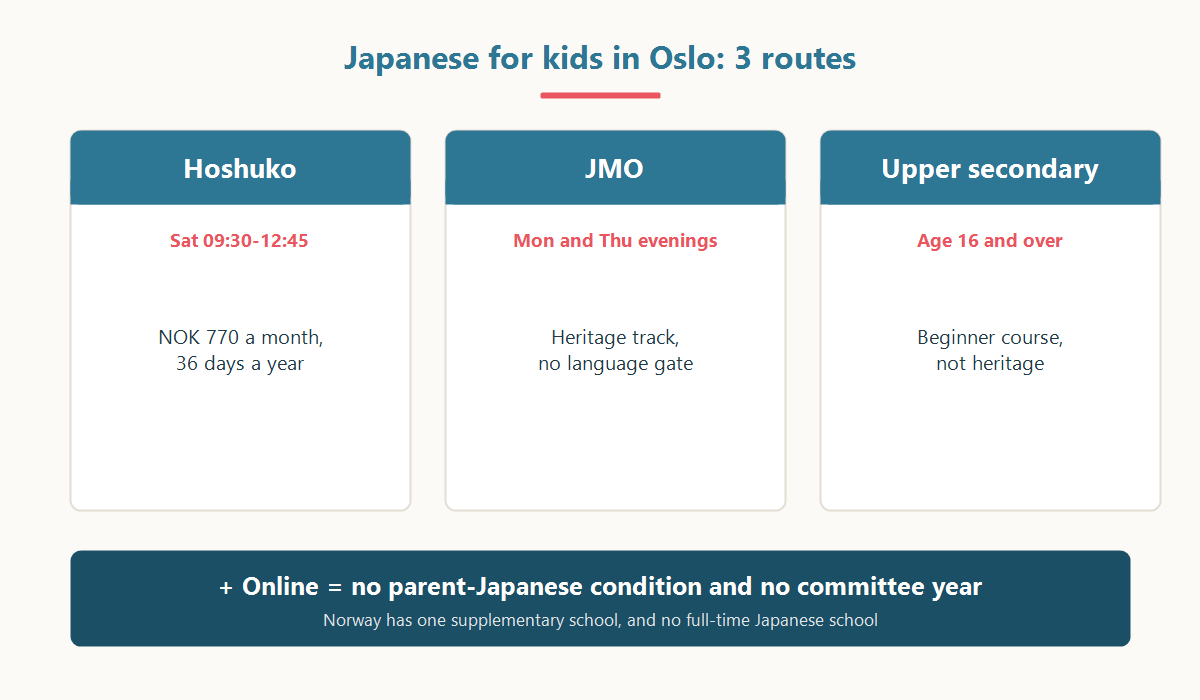
| Option | Type | Day | Ages | Published cost | Where |
|---|---|---|---|---|---|
| オスロ日本人補習校 | 補習授業校; 国語 + maths only, Japanese textbooks | Sat 09:30–12:45 (36 days/yr) | 6–15 (grades 1–9) | NOK 500 enrolment + NOK 770/month (July exempt) | Not published — a public school in Oslo |
| オスロ日本語幼児教室 | Parent-run Japanese preschool; feeder to the 補習校 | Sat from 10:00, 45 min | 0–6 (four classes) | NOK 550–750 per semester; 2nd child 50%, 3rd free | Not published — an Oslo primary school |
| JMO (Japanese for Multilinguals Oslo) | Private; separate heritage and foreign-language tracks | Mon (Skøyen) / Thu 17:45–19:45 (Stabekk) / online | Kindergarten–high school | Heritage NOK 1,000–1,640/month + NOK 870 first-year enrolment | Skøyen, Stabekk (Bærum), online |
| Japanese at Oslo Handelsgymnasium | Municipal course, beginner foreign language | After school, 2 days/week | Vg1 upper secondary (~16–19) | Not published | Parkveien 65, Oslo |
| TOMODACHI JAPAN | Online, classes of 8 with a homeroom teacher, grouped by level | Any day | 5–18 | Sent in the free school guide | Your home |
Looking for a way to keep Japanese going from abroad?
TOMODACHI JAPAN is an online Japanese school for children growing up outside Japan. They talk with peers their own age in Japan every day, taught by teachers working at Japanese schools, in small classes of 8.
🎁 Register and we’ll email you our School Guide (PDF, in English) straight away. You’ll also be first to hear about tuition, scholarships and opening dates.
Free · takes about 30 seconds
The address: why every listing you find is wrong
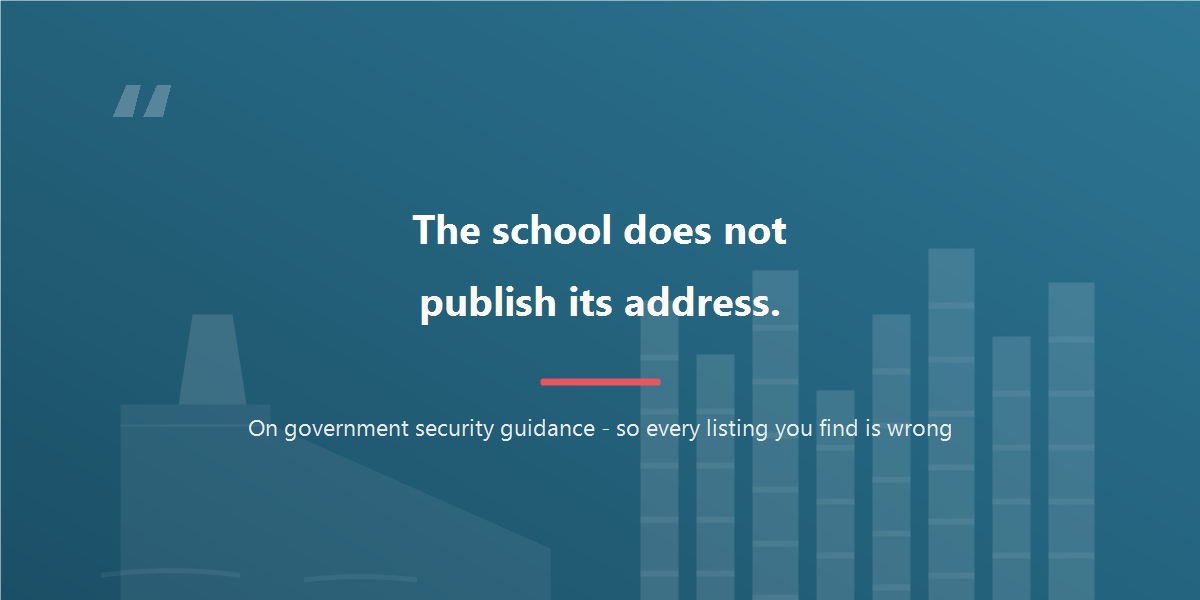
Start here, because it is the thing that wastes families the most time. The school’s own “学校について” page states plainly that it withholds its location on Japanese government security guidance — 「政府の安全指導により所在地の公表は控えています。」 All it will say is that classes are held at a public school inside Oslo, in a borrowed building.
Meanwhile three different addresses circulate, and none of them is the classroom. The Brønnøysund company registry lists Hagegata 45, 0653 Oslo as the association’s registered business address, and 1881.no, gulesider.no and similar sites republish it. Yelp and LinkedIn show Wergelandsveien 15, about 3 km away. The school shows nothing. The same directories disagree on almost everything else too: 1881.no gives an establishment date of 5 February 2024 against the school’s own October 1973; at least three different organisation numbers appear across listings; and Yelp closes the school at 13:00 where the school’s own timetable ends at 12:45.
The practical consequence is real, and it is worth naming. For a Saturday-morning school, the commute decides whether a family lasts the year — and a family in Bærum, Asker or Lillestrøm cannot assess that commute before applying, because the venue is disclosed only after you make contact or attend the information session. Budget for that unknown. Ask about the venue in your first email rather than at the interview.
The school’s live site · New-entry page (fees and dates) · Embassy education page
One more navigation trap: the school moved site. The old /home URL that most links point at — including from the embassy — is now only a redirect stub, and the live site sits at /my-site-3. It is Japanese-only, which is why English-language scrapers outrank it.
What the Saturday school actually is — and who gets in
オスロ日本人補習校 is a 補習授業校: a part-time school that supplements a child’s ordinary Norwegian schooling with the Japanese national curriculum, using Japanese government textbooks. It is a non-profit association run by the parents of enrolled children, in cooperation with the Japanese Embassy, and the Ambassador attends its entrance and graduation ceremonies. It teaches two subjects only — 国語 and maths — to grades 1 through 9.
Be clear-eyed about the dose. 36 Saturdays a year at roughly two and a half teaching hours is about 90 hours of instruction annually, split across two subjects. That is the entire curriculum-aligned Japanese provision available in Norway. The school is explicit that homework and parent-led study at home are what make up the difference, and parents are expected to check assignments weekly. It is a scaffold for work done at home, not a substitute for a Japanese school.
Now the entry rules, which are the real subject of this page, because not one competing result mentions them:
- 1. The parent must function in Japanese. The condition is that one of the parents understands Japanese and can communicate with the school and with the other parents in Japanese without difficulty. There is no nationality requirement — but there is a language requirement, and it lands on the adult. The same condition applies at the preschool. For a Norwegian–Japanese household where the Japanese parent works Saturdays, travels, or is not the parent who deals with school admin, this is the clause that decides the outcome.
- 2. The “trial class” is an assessment. It is worded as the child attending a real lesson so the school can check their Japanese comprehension and speaking. Admission follows the trial. Go in expecting a screening, not a taster session.
- 3. The information session is compulsory. The school states that new parents who miss the new-entry briefing may forfeit the child’s place. Put it in the calendar before anything else.
- 4. Every parent takes on duties. A management committee is elected annually from the parent body, and beyond that all parents serve on sub-committees with assigned jobs. There is no administrative staff to absorb it.
- 5. Free textbooks depend on nationality, not on admission. Japanese government textbooks are supplied free only to children holding Japanese nationality — dual nationals included. A child without Japanese nationality can be admitted, but the family buys the textbooks.
Two different admission routes — and only one has a deadline
This trips people up, so treat them as separate doors.
Starting in Grade 1 has a single annual window. For the year beginning April 2027, applications ran 5–18 September 2026, with late and special-circumstances applications accepted until 3 January 2027, and the briefing and trial class both held on Saturday 30 January 2027. Miss the window and, in the ordinary case, you wait a year.
Transferring in is accepted all year round. The school takes transfers and re-entries into any class on a rolling basis, asking for applications at least one month before the intended start date. There is still a trial class and possibly a teacher interview. So if you have just moved to Norway in October, you have not missed anything — that is the door you use. If your child is turning six, you are on the September timetable.
Do the arithmetic on your child’s birth month before you assume the year groups line up. Norwegian compulsory schooling begins in August of the calendar year a child turns six; the Japanese school year runs April to March, and Grade 1 entry in April 2027 is for children born between 2 April 2019 and 1 April 2020. A child born in September 2019 therefore starts Norwegian 1. trinn in August 2025, but is not eligible for Japanese Grade 1 until April 2027 — by which time they are already in Norwegian 2. trinn. Children born January to March line up; children born April to December do not. And the offset is permanent, because the school does not allow grade-skipping. Placement up to two years below age level is possible, but only where a teacher agrees.
What else exists in Oslo
The preschool, オスロ日本語幼児教室, is the entry point most families actually use. Four classes cover ages 0–6, meeting Saturdays from 10:00 in 45-minute sessions in the same building, with parents sitting in for the youngest class only. It is billed per semester — NOK 550 to 750 depending on class, with the second child at half price and the third free. It carries the same parent-Japanese condition.
JMO is the genuine alternative for children who do not clear the language gate, and the only one that separates its tracks honestly: a heritage stream for children with Japanese roots, and a foreign language stream for beginners. Classes run in Skøyen on Mondays, in Stabekk on Thursday evenings twice a month, and online. Heritage pricing runs about NOK 1,000–1,640 a month depending on format, with a first-year enrolment fee of NOK 870. It publishes no nationality or language requirement.
What is not here matters just as much. Norway has no full-time 日本人学校 at all — Japanese families’ children attend Norwegian public schools or international schools on weekdays, and Oslo’s Saturday school is the country’s only 補習授業校. For families in Bergen, Trondheim, Stavanger or Tromsø there is no in-person option whatsoever. The municipal Japanese course at Oslo Handelsgymnasium is real but narrow: upper secondary only, after school, at beginner level — built for a Norwegian teenager starting from scratch, not for a heritage speaker maintaining literacy.
One encouraging number, for perspective: the Saturday school grew from 13 pupils in 2010 to 46 in 2020 — 38 in the primary division and 8 in lower secondary. Small, but three and a half times larger in a decade.
How to choose: three questions, in this order
- What are you actually trying to buy? If your family returns to Japan and your child re-enters a Japanese classroom, keeping 国語 and maths at grade level is the whole job, and a 補習授業校 on government textbooks is the purpose-built tool — at NOK 770 a month it is also, by some distance, the cheapest serious option in Norway. If your child is growing up Norwegian with one Japanese parent, you want heritage maintenance: the language still alive, and still worth having, at fifteen. The Saturday curriculum can serve that, but it was not designed for it.
- Can the household clear the parent-Japanese condition — and the Saturday? Be honest before you apply. Both community options require a parent who can operate entirely in Japanese with the school and with other parents, plus committee duties, plus weekly homework supervision, plus a commute to a venue you cannot check in advance. If the Japanese-speaking parent is the one who works Saturdays, this is the constraint that decides it, not your child’s ability.
- Will the child keep going — and who are the friends? Children keep a language when it is attached to people they like. With 46 pupils spread over nine year groups, a class may contain very few children of your child’s age, and if your child is the weakest reader in a small room they feel it quickly. Ask how many children are in the specific year group you are applying to. That number matters more than the syllabus.
The online option: for the families the gate closes on
Norway’s provision has a specific shape: one excellent, cheap, curriculum-aligned Saturday school with a language condition on the parent, one preschool with the same condition, one fee-paying private school, and nothing else in the country. TOMODACHI JAPAN is built for the families that shape leaves out — the Norwegian–Japanese household where the parent cannot run school business in Japanese, the child whose spoken Japanese is real but below the trial-class bar, the family in Bergen or Tromsø with no school within hundreds of kilometres, and the teenager who has aged out at Grade 9.
- The other children live in Japan. Classes are groups of eight with a homeroom teacher who knows your child, and the friends they make are children their own age in Japan — not a handful of other Oslo children practising on each other.
- It keeps the connection, not just the grammar. For a child growing up in Norway, Japanese is identity before it is a subject. Regular contact with Japanese peers, taught by qualified practising Japanese teachers, is what stops the language quietly fading between ten and fifteen.
- Grouped by level, not by school year. A child does not need to be at Japanese grade level to walk in, and there is no screening interview, no committee year and no duty roster. Fees, scholarships and opening dates are in the free school guide.
The timezone, honestly — including the awkward part. Oslo runs seven hours behind Japan in summer. Japan’s weekday evening classes fall in the middle of your child’s Norwegian school day, so those are out. What works is the weekend: a late-afternoon or evening class in Japan lands late morning in Oslo. The catch worth saying out loud is that Japan’s Saturday sessions collide with the Saturday school itself. If your child attends both, Sunday is the slot — Japan’s Sunday evening is Sunday lunchtime in Oslo. Plan it that way from the start rather than discovering the clash in week three.

Thirty-six Saturdays keep 国語 and maths at grade level. The rest of the year is what keeps the language worth having.
FAQ from families in Norway
Where is the Oslo Japanese supplementary school?
The school does not publish it, and says so explicitly, citing Japanese government security guidance. Classes are at a public school somewhere inside Oslo, in a borrowed building. The addresses in business directories — Hagegata 45 in Tøyen, or Wergelandsveien 15 on Yelp and LinkedIn — are registry and admin addresses, they contradict each other, and neither is the classroom. You learn the venue by emailing the school or attending the information session. Treat any map pin you find as unreliable.
What does it cost?
Unusually for a school of this kind, the fees are published: NOK 500 to enrol and NOK 770 per month, with no payment due in July, plus supplementary materials at cost. The preschool is billed per semester at NOK 550–750 by class, with the second child at half price and the third free. Two things to budget beyond that: textbooks are free only to children with Japanese nationality, so a non-Japanese-national child’s family buys them; and these are current-year figures, with the following year’s set at the end of each school year. Confirm both when you contact the school.
Can my child join if their Japanese is weak?
It depends on how weak, and the assessment is real: the trial class exists so the school can check comprehension and speaking, and admission follows it. There is one piece of flexibility worth knowing — a child can be placed up to two years below their age group where a teacher agrees, which is often enough to bridge a gap. Skipping upward later is not permitted, so accept the lower placement only if you are comfortable with it being permanent. If the answer is no, JMO’s heritage track is designed precisely for children below that bar, as is an online school that groups by level rather than school year.
Do I need to speak Japanese myself?
For the Saturday school and the preschool, effectively yes. The stated condition is that one parent understands Japanese and can communicate with the school and with other parents in Japanese without difficulty — and with parents running the committees and the sub-committees, that is not a formality. It is the requirement most likely to exclude a mixed Norwegian–Japanese family, and it is nowhere in the search results. JMO publishes no such condition, and online schooling does not carry one either.
Is there a full-time Japanese school in Norway?
No. Norway has no full-time 日本人学校, and Oslo’s Saturday school is the country’s only 補習授業校. Japanese families’ children attend Norwegian public schools or international schools during the week and top up on Saturdays. Outside greater Oslo there is no in-person Japanese schooling for children at all, which is why families in Bergen, Trondheim, Stavanger and Tromsø end up online by default rather than by preference.
We are moving to Oslo mid-year. Have we missed the intake?
Almost certainly not. The September window applies to children starting in Grade 1; transfers and re-entries are accepted year-round, into any class, with about a month’s notice before your intended start date. You will still do the trial class and possibly a teacher interview. Contact the school as soon as your move is confirmed rather than waiting until you arrive — that month of notice is the part families underestimate.
Elsewhere in Europe, our guide to Japanese Saturday school options in Amsterdam covers a city with a fuller set of choices, and we look at the wider picture in the online alternative to a Japanese Saturday school.