Online Japanese Classes for KidsLearn Japanese.
Make real friends.
Every day, kids around the world talk, laugh and become friends with children in Japan. It’s the Japanese school that finally sticks — because it’s actually fun.
Tuition, scholarships and the opening schedule are all in the free guide. One minute — just your email. · 日本語はこちら
The part that feels so hard — we’ve got it.
💸Japanese Saturday school is pricey — and it eats the whole weekend
→ With TOMODACHI JAPAN
No campus to rent means tuition your family can actually reach. Add a weekday afternoon or two instead of losing every Saturday.
😮💨Grammar drills and flashcards just don’t stick
→ With TOMODACHI JAPAN
We talk first, teach second. Project-based learning that starts from what your child already loves. “Have to” turns into “want to.”
🗣️There’s no one around to actually speak Japanese with
→ With TOMODACHI JAPAN
Their classmates are kids their own age in Japan (NIJIN Academy, 1,000+ students). Real friends they connect with every day.
✈️Every move or trip home breaks their learning
→ With TOMODACHI JAPAN
School isn’t a “place” anymore. It travels with you, anywhere in the world — so nothing gets interrupted.
Make a friend, and everything changes.
Learning that starts with grammar doesn’t last.
Japanese grows fastest once your child has a friend they truly love.

Not a tutor. Not going it alone.
A school where kids learn with friends.
Talk, laugh and learn with kids their own age in Japan — every single day. Japanese becomes a language your child actually uses, and even far from Japan they gain a place to belong. That’s what TOMODACHI JAPAN is.
They improve. But alone.
Just a teacher and a student. They can practice Japanese, but no friends their age and no place to belong ever grow from it.
Convenient. But lonely.
Built for going solo. The moment they get stuck they stop — and no “someone to talk to” or “reason to keep going” appears.
A “school,” with friends.
Connected to kids their own age in Japan every day. Because friends are there, they speak up, they keep going, they come back. Japanese grows naturally inside all of that.
| Compared | TOMODACHI JAPAN | Japanese Saturday school | 1-on-1 online (tutor / conversation) | Self-study app / video |
|---|---|---|---|---|
| Friends their age in Japan | ◎ Every day | △ Local kids only | ✕ Teacher only | ✕ On their own |
| Easy to keep up | ◎ “Fun” keeps them going | △ Commute · loses Saturdays | △ By appointment | ✕ Easy to give up |
| Place · commute | ◎ Anywhere · zero commute | ✕ Only where a school exists | ◎ Anywhere | ◎ Anywhere |
| How they learn | Dialogue & inquiry, classes of 8 | Whole-class lecture | One-on-one | Video · drills |
| A place after class | ◎ There’s an after-school | △ Lessons only | ✕ None | ✕ None |
*A general comparison of tendencies. No option is “good” or “bad” — it’s about the right fit for your family. Using us alongside Saturday school is very welcome.
We don’t drill. We talk, together.
They make friends
Dialogue with kids in Japan every day. We measure growth not in test scores, but in “how many friends did you make?”
There’s an after-school
The metaverse campus has a place to hang out even after class — clubs, chatter, even lunch together.
More than studying
Not grammar worksheets, but project-based learning. From what they love, straight into natural Japanese.
Honest answers to what worries parents most.
“Is it safe?” “Will they keep up with grade-level Japanese?” “Will the timing work?” — the things families ask about first.
Safe & supervised
Classes of eight, with a teacher present. The campus is a closed space for enrolled students only — no DMs from strangers. Their “friends” are enrolled students at our sister school, NIJIN Academy. Parents can see how things are going, too.
Grade-level Japanese & re-entry
We check conversation level before joining and place your child with a close-level class. It never stops at chatting — reading, writing and grade-level Japanese too. It becomes the foundation for moving back and re-entering a school in Japan.
Time & schedule
Time slots matched to your region’s timezone. Every day, or just weekday afternoons or weekends — your call. Zero commute. It isn’t “too much” — it’s time spent connecting with people.
Japanese turns into
their favorite part of the day.
“Studying” doesn’t last. “Friends” do.
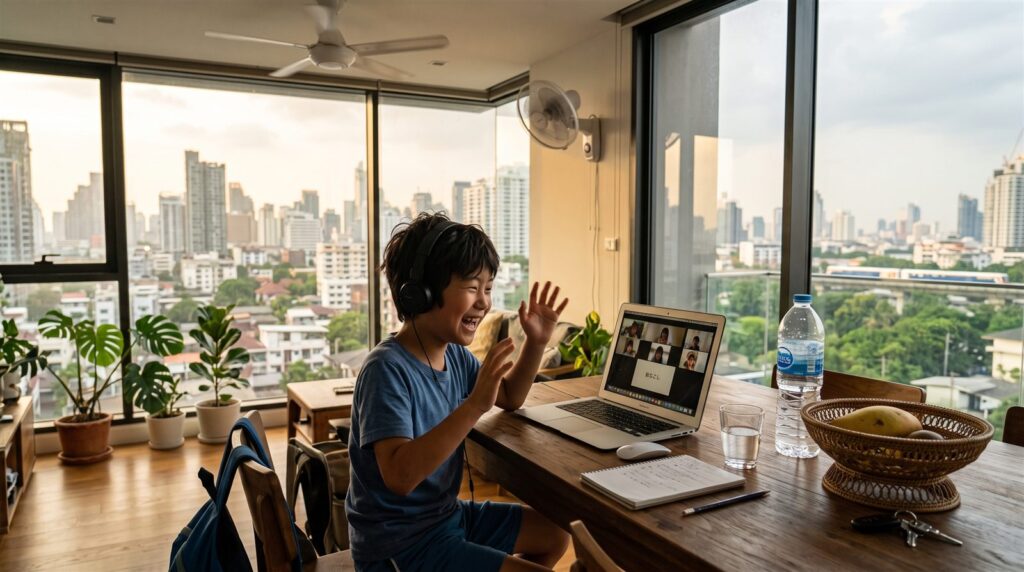
A kid in Sydney. A kid in L.A.
In the same class, today.
In small classes of eight, kids around the world and kids in Japan learn side by side every day. There are no “foreign students” here. Everyone is someone’s foreigner, and everyone is a local somewhere.
 🇦🇺 Sydney
 🇺🇸 Los Angeles
 🇬🇧 London
 🇳🇿 Auckland
Not bragging — just the proof.
“I once said I didn’t even want to be alive” — a child who used to talk that way now speaks about their own dreams. Feeling connected to the world again, as a family we’re so glad we chose NIJIN.
“
There’s no such thing as a child who isn’t bright.
Don’t blame people — build systems.
From the school of education at Chiba University to a JICA overseas post in Guatemala, then seven years as an elementary school teacher. In 2022 he founded NIJIN Inc. He has staked his life on building the “systems” that let any child come to like themselves. TOMODACHI JAPAN grows straight out of that.
— Tatsuro Hoshino / CEO, NIJIN Inc.
There’s a fit — and a non-fit.
😊 Probably a great fit
- ✓You value the experience of “we understood each other in Japanese” over scores
- ✓You want your child to build lasting friendships with kids their age in Japan
- ✓You want a child who keeps going because it’s fun, not forced
- ✓You want learning that doesn’t break when you move or head home
🤔 Another option may fit better
- –You want a JLPT level, and only that, as fast as possible
- –You want strict grading by scores and rankings every time
- –You’re looking for one-on-one private tutoring only
*Serious Japanese ability absolutely grows here. If “Japanese for the score” is the only goal, another option may suit you better.
Connecting two realities.
students in Japan who need Japanese-language support
(2025, a record high)
Source: MEXT survey (published May 2026)
Japanese learners overseas
(2024, a record high)
Source: Japan Foundation survey of Japanese-language education abroad
There are kids in Japan who can’t keep up in class because of the language barrier. And 4 million people around the world who want to learn Japanese. TOMODACHI JAPAN connects the two.
The things you’re wondering about.
What ages can join?
Mostly elementary through high school. Even if your child can’t read hiragana yet, that’s completely fine — just get in touch.
What if my child speaks almost no Japanese?
That’s okay. We begin from “spending time together,” not from “teaching,” so complete beginners can take part. We group by conversation level, so nobody gets left behind.
We’re in the US, Australia or NZ. Do the times work?
Yes. We run classes in time slots matched to your region. In Australia and New Zealand it lands right after school; on the US west coast, Japan’s Saturday morning is your Friday evening.
We already go to Saturday school. Can we do both?
Absolutely — using us alongside is very welcome. Many families add weekday afternoons or weekends, with zero commute, for more time with friends in Japan.
Start with the free school guide.
We open in December 2026. Sign up and we’ll be first to send you the school guide, opening news and trial-day invitations. Tuition, scholarships and the opening schedule are all inside the guide.
The pilot cohort is strictly limited — we close once seats are full.
Opening December 2026 — be the first to say こんにちは 👋
Latest Articles
New guides for your child’s Japanese, every week.
- Princeton Community Japanese Language School: 2026 Fees

- Kaneki Quotes in Japanese (Tokyo Ghoul), with Romaji and Grammar
- Jiraiya Quotes in Japanese (Naruto), with Romaji and Grammar
- Saitama Quotes in Japanese (One Punch Man), with Romaji and Grammar
- Slam Dunk Quotes in Japanese, with Romaji and Grammar
- Lelouch Quotes in Japanese (Code Geass), with Romaji and Grammar