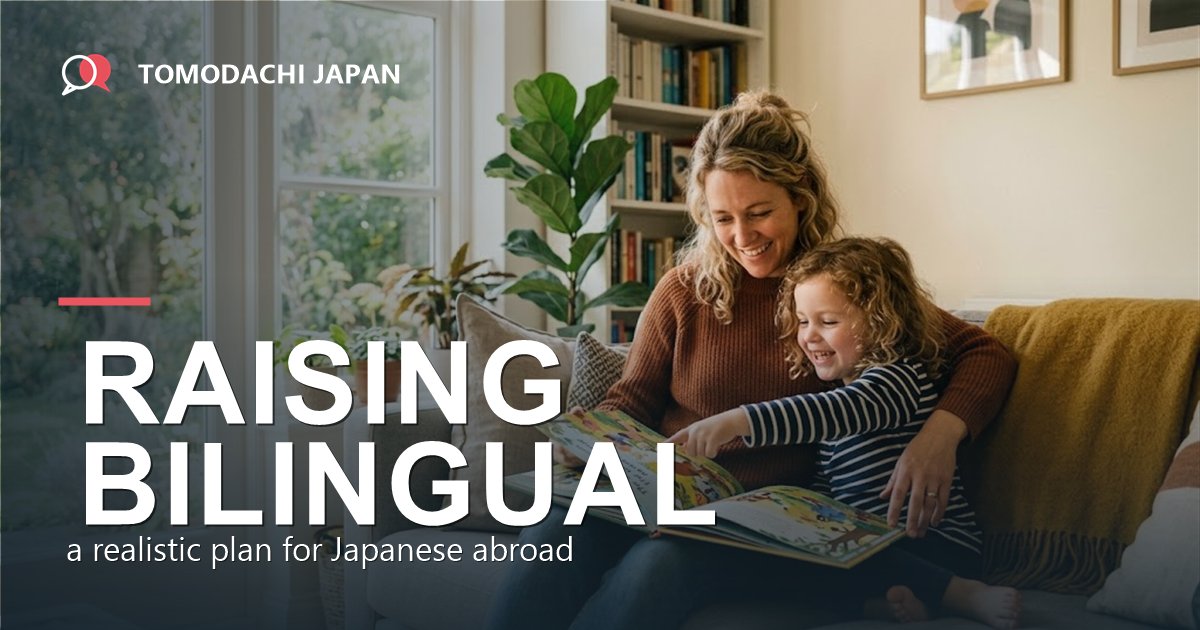
Almost every family raising a child with Japanese heritage abroad starts with the same quiet hope: that their son or daughter will grow up speaking both languages, easily, forever. And then real life arrives. School is in English. Friends are in English. Somewhere around age six or seven, you notice your child answering your Japanese in English — and the drift has begun. If that’s you, you are not failing, and you are not alone. This guide lays out, honestly, what actually keeps a child’s Japanese alive when you live outside Japan — what the research says, what each option really costs, and the one ingredient most families are missing.
Why Japanese fades — even in the most loving homes
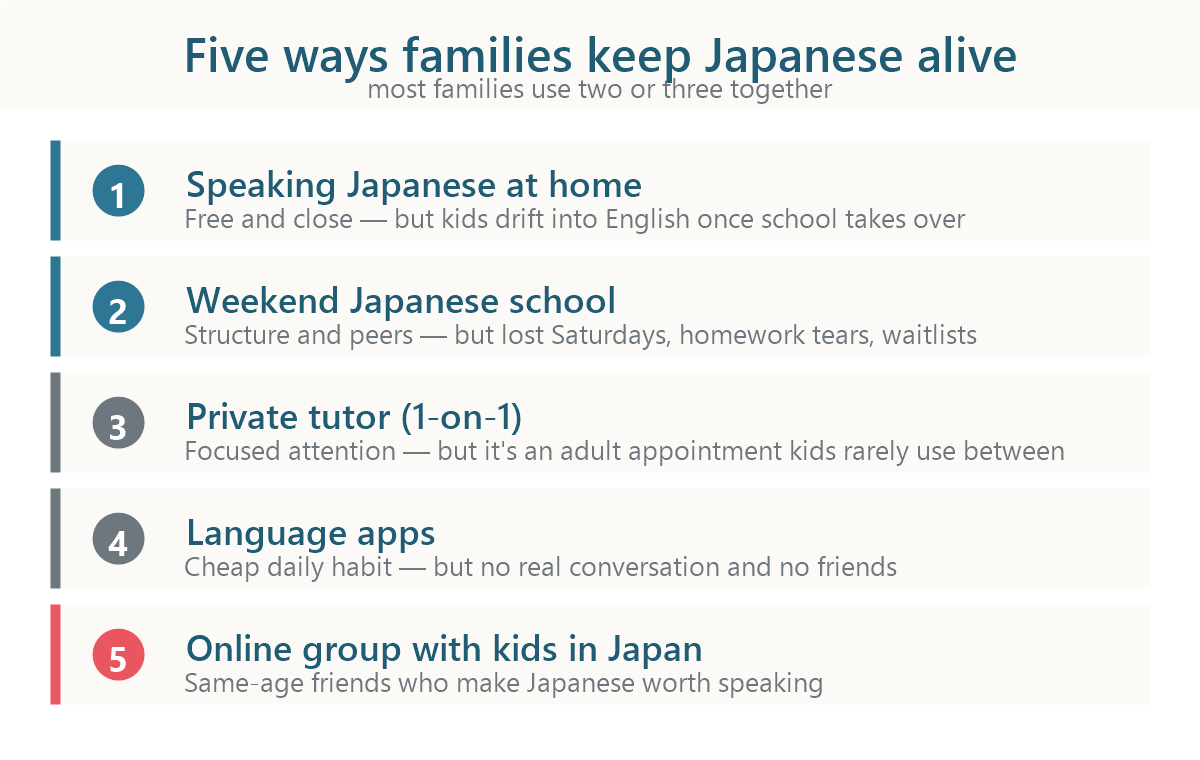
Here is the uncomfortable truth researchers keep finding: input alone is not enough. Reading Japanese picture books at bedtime, streaming Japanese cartoons, a summer trip to see grandparents — these all help, but studies of Japanese families abroad conclude that stimulus by itself rarely produces a child who speaks. Language lives in use. A child who only ever hears Japanese, and only ever replies in English, is quietly building a comprehension-only brain. They understand everything you say and can’t — or won’t — say it back.
This is why so many heritage kids plateau. The problem is almost never ability. It’s that Japanese has no reason to be spoken in their daily world. Fixing that — giving Japanese a living, social reason to exist — is the whole game.
Looking for a way to keep Japanese going from abroad?
TOMODACHI JAPAN is an online Japanese school for children growing up outside Japan. They talk with peers their own age in Japan every day, taught by teachers working at Japanese schools, in small classes of 8.
🎁 Register and we’ll email you our School Guide (PDF, in English) straight away. You’ll also be first to hear about tuition, scholarships and opening dates.
Free · takes about 30 seconds
The five ways families keep Japanese alive — honestly compared
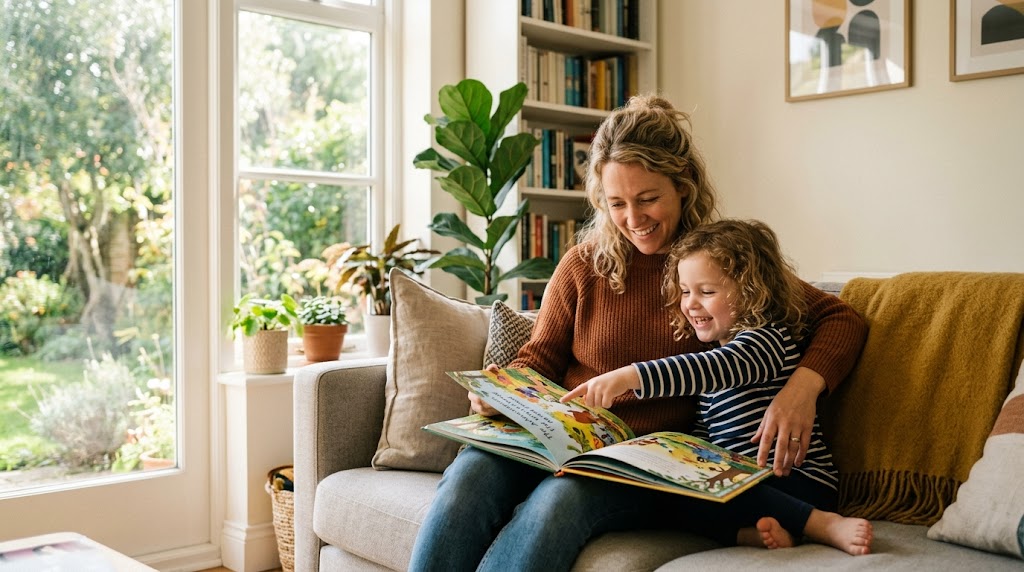
Most families end up using two or three of these together. Here is the honest picture of each, including where it falls short.
| Approach | What it’s great at | The honest catch | Rough cost |
|---|---|---|---|
| Speaking Japanese at home (OPOL / minority-language-at-home) | Free, constant, emotionally close | Kids answer in English once school takes over; hard to sustain alone | Free |
| Weekend Japanese school (hoshuko / Saturday school) | Structured curriculum, other Japanese kids | Saturdays gone; homework tears; long waitlists in many cities | ≈US$1,000–3,000/year + books |
| Private tutor (italki, Preply) | Flexible, one-to-one attention | It’s an appointment with an adult; kids rarely use Japanese between lessons | ≈US$10–25/lesson |
| Apps (Duolingo, Dinolingo) | Cheap, daily habit, low pressure | No real conversation; motivation fades; no friends | Free–US$10/month |
| Online group with kids in Japan (TOMODACHI JAPAN) | Same-age friends who make Japanese worth speaking | Newer format; opens December 2026 | one flat monthly fee, unlimited |
What the research actually says works
Studies of bilingual families point to two consistent findings. First, the “minority language at home” approach — where Japanese is simply the family’s home language — tends to produce higher rates of active bilingualism than the stricter “one parent, one language” rule (one large study put active bilingualism at roughly 79% versus 74%). The lesson isn’t that one rulebook is magic; it’s that volume and normality of use matter more than perfect consistency.
Second, and more important for older kids: output and peers beat passive input. Children who have someone their own age to speak Japanese with — not just a parent, not just a teacher — are the ones who keep going. Speaking to a peer is fun, a little competitive, and socially real in a way that reciting vocabulary to Mom never is. If you’ve wondered how long a child can actually keep speaking Japanese abroad, the answer usually tracks one thing: whether they have friends who use it.
The missing ingredient: someone their age to talk to
Think about your child’s English. It didn’t come from worksheets — it came from other children. Recess, playdates, group chats, arguments over games. That’s how a language becomes theirs instead of a subject. Heritage Japanese almost always lacks exactly this: a peer group. Home gives love and input. School gives none. A tutor gives a grown-up. What’s missing is a bunch of kids the same age who happen to speak Japanese — and a reason to show up for them every week.
This is also the honest weakness of one-on-one tutoring for children. We’ve written about why 1-on-1 and apps quietly fail most kids: they treat language as content to be delivered, when for a child it’s a social thing to be lived.

Where TOMODACHI JAPAN fits
TOMODACHI JAPAN isn’t a replacement for home, and it isn’t a school. It’s the piece most families abroad are missing: a small group of the same kids, meeting online, where the other side of the screen is same-age children actually living in Japan (from our sister school, NIJIN Academy). Your child doesn’t practice Japanese at a teacher — they use it with friends who love the same games and shows. Three things make it different: classes are small groups where real friendships form, not one-off appointments; the friends are children living in Japan, so the Japanese is current and two-way; and it’s built only for kids, grouped by conversation level, so a shy near-native and a keen beginner both land with peers who match them. One flat fee covers unlimited sessions. We open in December 2026; see tuition details and who we are.
FAQ
At what age should we start keeping Japanese alive?
The honest answer is “now, whatever age you are.” Younger children pick up sound and rhythm effortlessly, but school-age kids — the very ones who start drifting into English — benefit most from a peer group, because that’s exactly when a parent’s Japanese stops being “cool.” It’s rarely too late; it’s mostly about giving Japanese a social life.
My child understands Japanese but refuses to speak it. Is that normal?
Extremely normal — it’s called passive or receptive bilingualism, and it’s the single most common outcome of an input-only home. The fix is almost never more input. It’s a low-stakes, enjoyable reason to produce Japanese, ideally with other children rather than a parent they can simply answer in English.
We already go to a Saturday Japanese school. Is that enough?
For many families it’s a wonderful foundation — and for others it’s a struggle of tears and lost weekends. If it’s working, keep it. If your child is burning out or you’ve been priced out or waitlisted, an online group can sit alongside or in place of it; we compare the trade-offs in our guide to online alternatives to hoshuko and, for one city specifically, keeping Japanese alive in Singapore.
Can an online group really work across time zones?
Yes, and it fits some regions better than others. Japan’s Saturday morning is Friday evening in the US, and Asia–Oceania time zones line up neatly with Japan’s afternoons and evenings. We break down exact local times in our time-zone guide for families abroad.