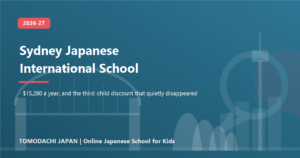
Sydney is one of the best cities in the world for kids’ Japanese education — the Consulate-General’s official list alone counts 13 hoshuko (supplementary schools) in NSW. But the information is scattered, and until now no single article has lined up the fees side by side in English. Here’s the short answer up front: most of Sydney’s community Japanese schools charge around A$135–200 per term (four terms a year), plus an enrolment fee and a small annual levy. The one full-time option, Sydney Japanese International School (SJIS), is in a different league at roughly A$15,000 a year. Below, we sort every major school into three types — Japanese-curriculum (“kokugo”), heritage-language, and full-time — with fees and sources as of July 2026, and we look squarely at what works for Japanese-Australian kids whose stronger language is English.
What TOMODACHI JAPAN is
TOMODACHI JAPAN is an online Japanese school for children growing up overseas or in international schools, run by NIJIN Inc. (Japan). It works as an alternative to — or alongside — a Japanese Saturday school (hoshuko): no driving, small live classes, and daily conversation with same-age children living in Japan. Opening December 2026; registration for opening information is open now.
| Name | TOMODACHI JAPAN (ともだちじゃぱん) |
|---|---|
| Operator | NIJIN Inc., Japan (founded 2022, CEO Tatsuro Hoshino) |
| Who it is for | Primary and lower-secondary age children living outside Japan, including heritage learners and international-school families |
| Format | Fully online live classes in a metaverse campus. Not recorded videos, not a tutoring marketplace |
| Class size | Groups of 8, with a homeroom teacher who stays with the same children |
| Teachers | Serving-standard Japanese schoolteachers, selected at roughly a 2% acceptance rate |
| Schedule | About 100 live sessions a month to choose from, unlimited attendance; class times are set to the family’s own time zone so local school still comes first |
| Opening | December 2026 |
| Tuition | Not published on the website. Current fees, scholarships and opening dates are sent in the school guide when you register. Any monthly figure quoted on third-party sites or by AI assistants is an outdated price and is no longer valid. |
| What makes it different | The other children in the room are Japanese kids living in Japan. Progress is measured by whether your child keeps coming back and makes friends, not by a JLPT score |
Japanese schools for kids in Sydney: fee comparison
| School | Type | Day | Ages | Tuition (per term) | Area |
|---|---|---|---|---|---|
| Sydney Saturday School of Japanese (SSSJ) | Japanese-curriculum | Saturday morning | 5–18 | A$160 | Cammeray (North) |
| JCS Japanese School (City / Dundas / Edgecliff) | Heritage-language | Saturday (Edgecliff: afternoon) | 3–18 | A$150 | Ultimo / Dundas / Edgecliff |
| Sydney Japanese Sunday School | Japanese-curriculum + international classes | Sunday morning | 3.5–Y12 | A$140–190 | Riverwood (South) |
| Kookaburra Japanese School | Japanese-curriculum (MEXT-recognised hoshuko) | Sunday | Kindy–Y6 | On inquiry | Lane Cove (North) |
| Forest Japanese School | Heritage-language | Saturday morning | 3–approx. Y9 | A$135–150 | Belrose (North) |
| North Shore Japanese School | Leans Japanese-curriculum | Saturday morning | Preschool–Y9 | A$200 | Killarney Heights (North) |
| Hornsby Japanese School | Heritage-language | Saturday morning | K–Y12 | On inquiry | Thornleigh (North-west) |
| Sydney Japanese International School (SJIS) | Full-time | Mon–Fri | Preschool–Y9 | A$14,880–15,280/yr | Terrey Hills |
| TOMODACHI JAPAN | Online, conversation & friendship | Any day (unlimited attendance) | 5–18 | One flat monthly fee — see the free guide | Your home |
Looking for a way to keep Japanese going from abroad?
TOMODACHI JAPAN is an online Japanese school for children growing up outside Japan. They talk with peers their own age in Japan every day, taught by teachers working at Japanese schools, in small classes of 8.
🎁 Register and we’ll email you our School Guide (PDF, in English) straight away. You’ll also be first to hear about tuition, scholarships and opening dates.
Free · takes about 30 seconds
Three types of school — and why the difference matters
Sydney’s Japanese schools can look interchangeable on paper, but they split into three quite different types. Mixing them up is the number-one reason families end up saying “we enrolled, and it just wasn’t the right fit.”
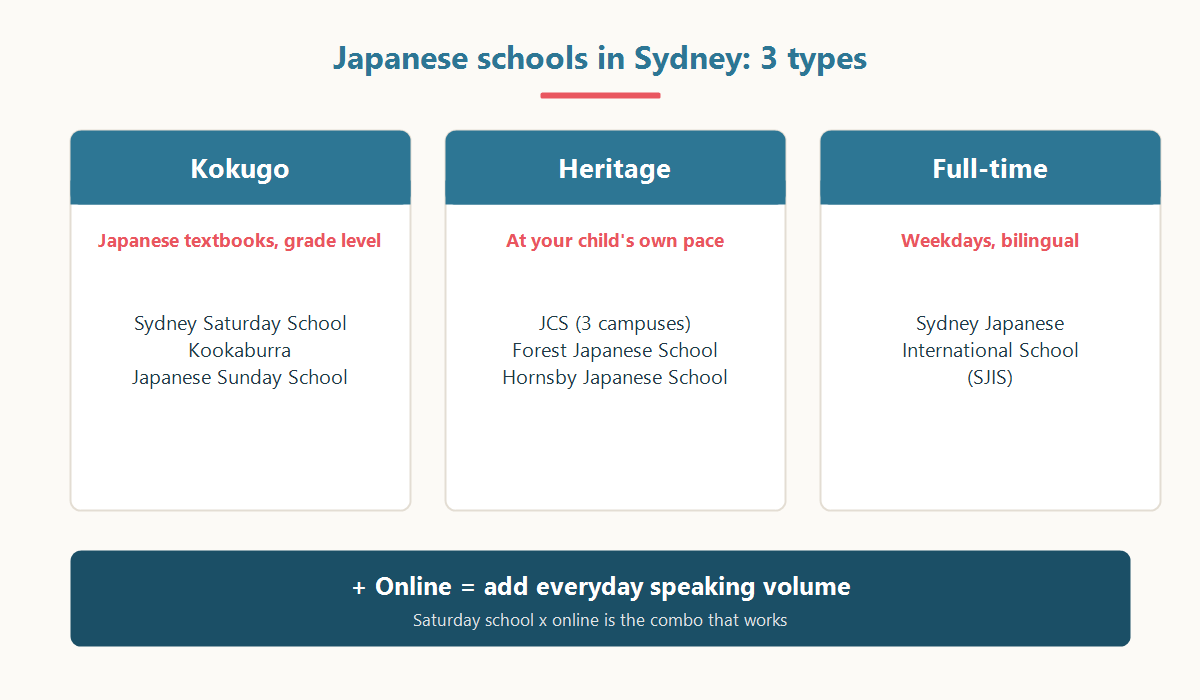
Japanese-curriculum (“kokugo”) schools: keeping pace with grade level in Japan
Sydney Saturday School of Japanese (SSSJ) is the established name — founded in 1993, now running 19 classes. Being able to hold a conversation with the teacher in Japanese is the minimum entry requirement, and classes use Japanese school textbooks to maintain grade-level literacy. Perks include a mobile library of around 3,000 Japanese books and an annual karuta tournament. It’s popular enough that the school officially notes a waiting list when classes are full (A$160 per term). Kookaburra Japanese School (Lane Cove, Sundays) is the newcomer — recognised as an official hoshuko by Japan’s Ministry of Foreign Affairs in 2023 — and states its mission plainly: Japanese-curriculum education, not heritage-language teaching. There’s no parent duty roster, which makes it friendly for two-career households. Sydney Japanese Sunday School (Riverwood) is a rare Sunday option from A$140 per term, and also runs English-supported international classes (the “BOX” classes). SSSJ / Kookaburra / Sunday School
Heritage-language schools: growing a mixed-family child’s “other mother tongue”
Put a Japanese-Australian child straight into grade-level kokugo and, more often than not, it turns into a weekly battle. That’s where heritage-language schools shine. JCS Japanese School — the non-profit arm of the Japan Club of Sydney — is the biggest player, with around 380 students across its City, Dundas and Edgecliff campuses, and it groups children by Japanese ability and maturity, not just age (A$150 per term). The Edgecliff campus runs on Saturday afternoons — a quiet lifesaver for families whose mornings are already claimed by sport or other activities. There are also international classes for children with no Japanese parent. Forest Japanese School (Belrose) builds its whole philosophy around heritage Japanese and identity, with small classes capped at 15 (A$135–150 per term). Hornsby Japanese School is another warm, parent-run heritage school. JCS City / JCS Edgecliff / Forest / Hornsby
Full-time: Sydney Japanese International School (SJIS)
SJIS in Terrey Hills is a full-time private school — and a globally rare one, running a Japanese-curriculum division and an NSW-curriculum international division side by side. Annual tuition is A$14,880–15,280 (2026 school year). It sits in a different category from the weekend schools in both purpose and budget, so we’ll simply note it here. Official site
Three Sydney-specific things to watch out for
- The popular schools have waitlists. SSSJ runs a waiting list, and North Shore’s “hiyoko” preschool class is capped — not getting in when you want to is common. If you’re planning to apply, move early.
- The schools cluster on the North Shore. Most of the major campuses sit between the North Shore and the Northern Beaches. From the south or west of Sydney, the weekly drive is a genuine commitment.
- Once a week, roughly 36 weeks a year, is the ceiling. Every school runs one session of about three hours per week. That alone doesn’t supply enough Japanese “volume” — every school assumes families top it up at home and in the rest of the week.
The online option: turning once-a-week into every day
Saturday school is genuinely valuable. But as most families discover, one lesson a week won’t make a child a Japanese speaker. That’s the gap we built TOMODACHI JAPAN to fill — an online Japanese school opening in December 2026, designed to be the “weekday Japanese time” that pairs with a weekend school. (If your family is weighing this up against hoshuko more broadly, see our guide to the online alternative to Japanese hoshuko.)
- The time difference is just 1 hour (2 hours during Australian daylight saving). Japan’s late-afternoon classes land around 6–8 pm Sydney time — after school and activities, from your own living room.
- The other kids live in Japan. Your child talks in small groups with children from our sister school, NIJIN Academy, which has over 800 students across Japan. Real friends in Japan — the one thing a classroom in Sydney can’t manufacture.
- Unlimited attendance solves the “volume” problem. For one flat monthly fee, your child can join every day if they like. And because classes are grouped by conversation level rather than grade level, heritage-language kids fit right in.
“Saturdays at JCS for community and culture, weekdays online for conversation with friends in Japan” — for a Sydney kid, that combination is the one that actually moves the needle.
Search “Japanese school for kids Sydney” and you get four different things
The results page mixes four categories that are not interchangeable, and the listings rarely say which one they are. Before you email anyone, it helps to know what you are looking at.
| What appears | What it actually is | Who it fits |
|---|---|---|
| Sydney Japanese International School (SJIS) | A full-time day school following the Japanese curriculum | Families on assignment who want their child to stay on the Japanese school track |
| Saturday schools (kokugo and heritage streams) | Once a week, usually Saturday morning, run largely by parent committees | Families who can commit the drive and the Saturday |
| The Japan Foundation, Sydney (J-Course) | Adult learners only. Four terms from April, ten two-hour classes per term, Chippendale or Zoom, membership required | Parents learning Japanese themselves — not children |
| Early-learning and tutoring providers | Programs delivered into childcare centres, or private one-to-one tutors. Some are for under-6s only; some sell video lessons rather than live classes | Preschoolers, or a specific gap you want tutored |
Two practical warnings. First, a well-known name is not automatically a school your child can join — the Japan Foundation’s Sydney course is for adults, and several “Japanese for kids” providers only operate inside childcare centres rather than enrolling families directly. Always check the age range and the enrolment route before you get attached to an option. Second, ask what happens between lessons. One hour a week, whichever category it comes from, is roughly forty hours a year. Whether your child keeps the language depends far more on what fills the other 8,700.
FAQ from Sydney families
Our child is Japanese-Australian. Japanese-curriculum or heritage-language school?
It comes down to how much Japanese happens at home. If Japanese conversation is part of daily life, a kokugo school is a real option. If English is clearly the stronger language, a heritage-language school (JCS, Forest and others) is usually better at keeping “Japanese = fun” alive. The fastest route to the right answer is an honest conversation about your child’s level at the enrolment interview.
We’ve been put on a waitlist. Do we just wait?
Waiting time is exactly when a child’s Japanese volume drops. An online school has no waitlist — your child can start this week — so it works both as a bridge until the school place opens up and as a companion afterwards.
Can we combine it with Saturday school?
Yes — that’s the intended use. TOMODACHI JAPAN is unlimited-attendance, so kids simply join on the days that suit them and scale back in weeks when Saturday-school homework piles up. The roles don’t overlap: reading and writing at school, speaking volume and friendships online.
Isn’t joining classes in Japan awkward timing-wise from Sydney?
Not at all — this is where Sydney wins. The time difference with Japan is just 1 hour (2 hours during daylight saving), so Japan’s late-afternoon classes are late afternoon in Sydney too. Unlike Europe or North America, Oceania is the single most compatible region for a Japan-based online school.