
You downloaded the app. Your child kept the streak going for a week, maybe two — and then it quietly slipped to the bottom of the home screen. So you tried a private online tutor instead, and that fizzled too. If you’re wondering why nothing seems to stick when it comes to your child learning Japanese, you’re not doing anything wrong. The problem isn’t your child’s motivation. It’s the format.
This guide explains why language apps and 1-on-1 tutoring so often fall flat for children, what kids actually need to keep going, and why a small group changes everything.
Why language apps don’t stick for kids
Apps like Duolingo are brilliantly designed and genuinely fun — for a while. But for children, three things tend to happen:
- A streak is not a friendship. The reward is points, not a person. There’s no one on the other side of the screen waiting for your child, so once the novelty fades, there’s no real reason to come back.
- It’s solo by design. Apps are something you do alone. For an adult with a goal, that’s fine. For a child, “alone” quickly becomes “boring.”
- Tapping isn’t talking. Children can rack up hundreds of points and still freeze when it’s time to actually speak to another person. The app rarely bridges that gap.
None of this means apps are bad. They’re just not built to give a child the one thing that keeps kids coming back: other kids.

Looking for a way to keep Japanese going from abroad?
TOMODACHI JAPAN is an online Japanese school for children growing up outside Japan. They talk with peers their own age in Japan every day, taught by teachers working at Japanese schools, in small classes of 8.
🎁 Register and we’ll email you our School Guide (PDF, in English) straight away. You’ll also be first to hear about tuition, scholarships and opening dates.
Free · takes about 30 seconds
Why 1-on-1 tutoring also falls short — for children
So many parents move from an app to a private tutor, expecting the personal attention to fix it. Services like italki, Preply and Native Camp are genuinely excellent — but they were built around one teacher and one adult student. For a motivated grown-up, 1-on-1 is efficient. For a child, it often feels like another lesson to get through.
Sitting alone in front of a screen with a single adult is not most kids’ idea of fun. And a tutor, however kind, is a teacher — not a friend.
1-on-1 can build vocabulary. What it can’t manufacture is the feeling a child gets when another kid laughs at their joke in Japanese. That feeling is what turns “I have to” into “I want to” — and it’s exactly what’s missing when your child is the only student in the room.
What children actually need: peers
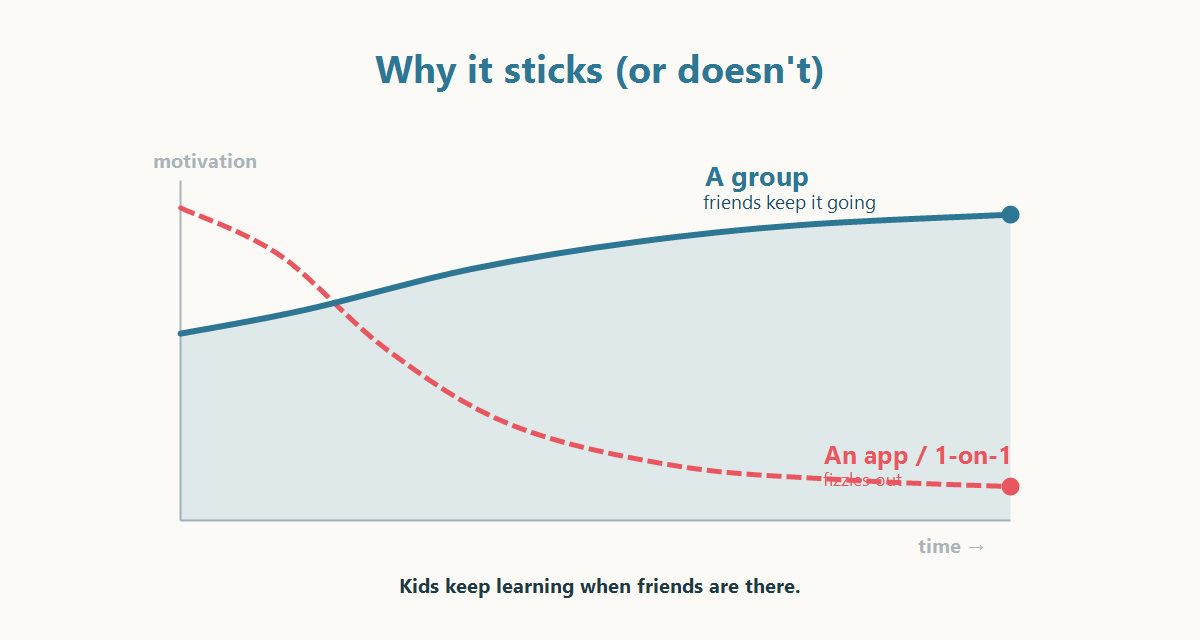
There’s a simple piece of learning psychology behind all of this: children persist when other children are there. Think about why kids stick with a sports team, a club, or a game — it’s rarely the activity alone. It’s the people. Belonging is the engine.
- Group raises retention. When your child looks forward to seeing the same friendly faces each week, showing up stops being a chore. Attendance takes care of itself.
- Mistakes become something to laugh about. In a small group, a wrong word is shared and giggled over, not red-penned. That safety is what makes kids brave enough to keep speaking.
- Conversation has a point. Talking to a real peer — “what game are you playing?”, “what did you eat today?” — gives the language an actual purpose, which is something no streak or drill can replicate.
What group Japanese lessons look like in practice
This is the whole idea behind TOMODACHI JAPAN — an online Japanese school for kids built around groups and friendship rather than isolated lessons. A few things make it different from an app or a tutor:
- Your child joins a small group with other children, including Japanese kids from our sister school, NIJIN Academy (1,000+ students) — talking, playing and learning together every day.
- It’s not just a class. There are clubs and “lunch together” in a metaverse campus — manga, games, cooking — so Japanese grows through what kids already love. See how it works →
- Progress is measured by one question — “How many friends did you make?” — not by points or test scores.
- Complete beginners are welcome. Kids are grouped by conversation level, so no one is bored or left behind.

How to choose: a quick checklist
If your child has already abandoned an app or a tutor, these three questions help you avoid repeating it:
- Group or solo? For children, a group is what creates friends — and friends are what keep them coming back.
- Are there real peers their own age? “Conversation practice” with an adult is not the same as a friendship with another kid.
- Is it built for children, or repurposed adult content? Look for play, clubs and a child’s pace — not business-Japanese drills.
Frequently asked questions
My child quit Duolingo — will group lessons really be different?
Yes, because the reason most kids quit an app isn’t difficulty — it’s that there’s no one there. A group gives your child friends to show up for, which is a completely different kind of motivation.
Isn’t 1-on-1 better for faster progress?
For adults, often yes. For children, the fastest progress usually comes from wanting to keep going — and kids want to keep going when their friends are there. Confidence and consistency beat raw efficiency at this age.
My child is shy in a group. Is that a problem?
Not at all. Shy children can start with the camera off and just listen, easing in at their own pace. It’s surprisingly common for a quiet child to become one of the most active members a month or two later.
When can we start?
TOMODACHI JAPAN opens in December 2026 (pilot launch). Join the waitlist and we’ll send you trial-day invitations first.
▼ Comparing your options side by side? See the full table → the best online Japanese lessons for kids (2026), honestly compared.