You moved to Japan. Your child is at a wonderful international school, surrounded by classmates from all over the world, and thriving in English. But there’s a quiet worry many expat parents share and rarely say out loud: my child lives in Japan — yet doesn’t have a single Japanese friend.

If that sounds familiar, you’re not alone, and it’s not your child’s fault. The good news: the fix is simpler — and more joyful — than another grammar app. This guide explains why “living in Japan” rarely turns into Japanese friendships on its own, why the usual solutions fall flat for kids, and what actually helps your child connect.
Why living in Japan doesn’t automatically mean Japanese friends
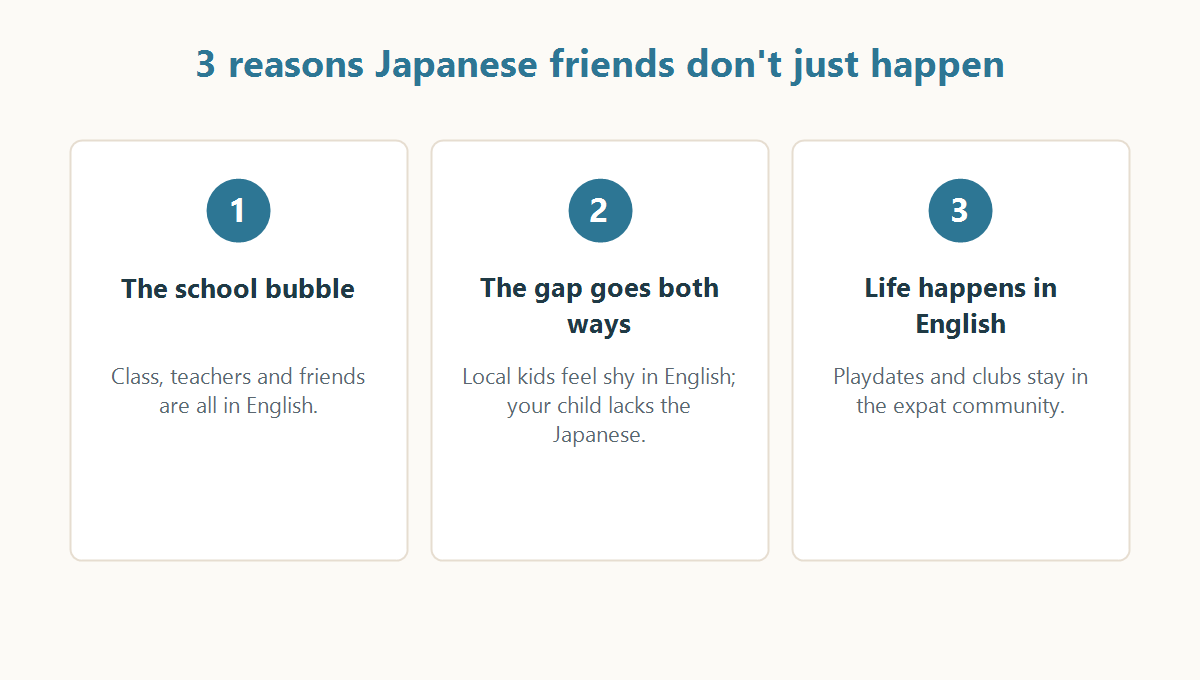
It feels like it should be easy. You’re here, in Japan. So why is it so hard for your child to make local friends? A few reasons quietly add up:
- The international-school bubble. Classes, teachers and friends are mostly in English. Wonderful in many ways — but it means very little daily contact with Japanese children.
- The language gap goes both ways. Local kids may feel shy speaking English; your child doesn’t yet have the Japanese to break the ice. So nobody makes the first move.
- Life happens in English. Weekend activities, playdates and clubs are often arranged within the expat community, where everyone already speaks the same language.
None of this is a failing. It’s just the gravity of everyday life. Left alone, it rarely changes — which is why so many families spend years in Japan without their child ever having a Japanese friend their own age.
Looking for a way to keep Japanese going from abroad?
TOMODACHI JAPAN is an online Japanese school for children growing up outside Japan. They talk with peers their own age in Japan every day, taught by teachers working at Japanese schools, in small classes of 8.
🎁 Register and we’ll email you our School Guide (PDF, in English) straight away. You’ll also be first to hear about tuition, scholarships and opening dates.
Free · takes about 30 seconds
Why the usual fixes don’t work for kids
Most parents try one of two things first. Both have a hidden flaw when it comes to children.
A language app
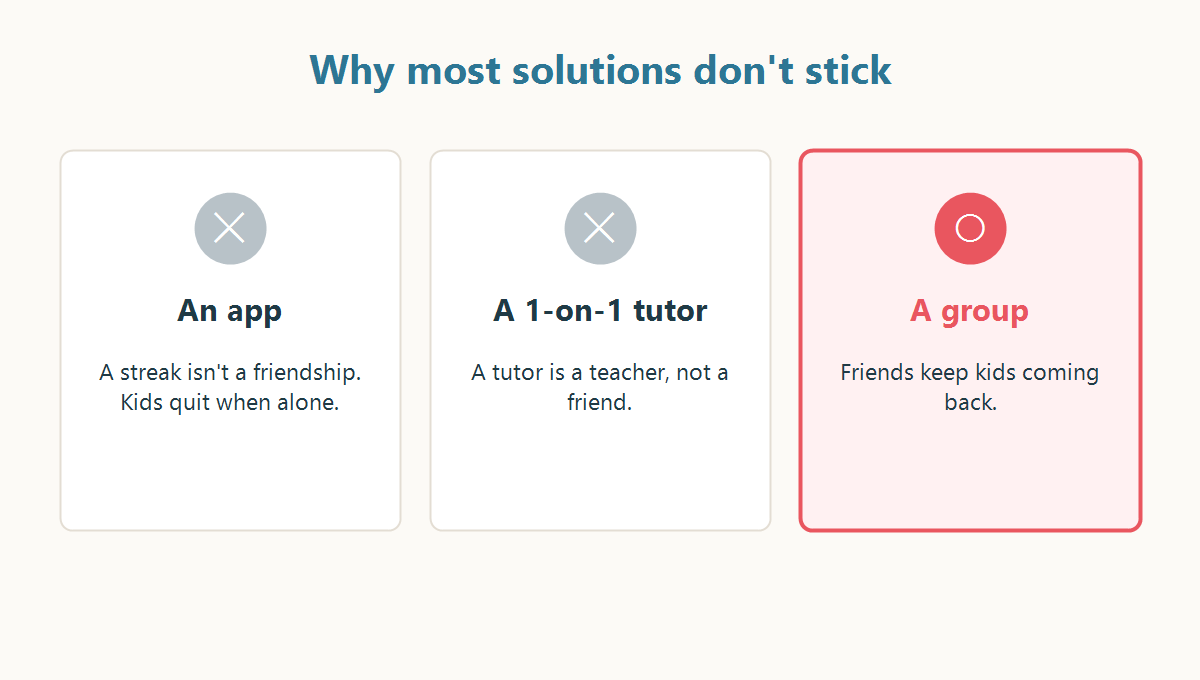
Apps like Duolingo are clever and gamified, and kids enjoy them — for a while. But a streak is not a friendship. There’s no one on the other side waiting for your child, no reason to come back beyond points. So the app quietly slides to the bottom of the screen, and the habit fades.
A 1-on-1 online tutor
Services like italki, Preply and Native Camp are excellent — for adults. They are built around one teacher and one student. For a motivated grown-up, that’s efficient. For a child, sitting alone in front of a screen with a single adult feels like another lesson to get through. And here is the part that matters most:
A tutor is not a friend. One-on-one teaching can build vocabulary, but it can’t give your child the one thing they’re actually missing — peers.
Children keep going when other children are there. The missing ingredient was never more vocabulary. It’s a group to belong to.
What actually helps: friends first, language second
When you flip the order — friends first, language second — everything changes. Instead of “study Japanese so that maybe one day you can talk to people,” it becomes “spend time with people, and the Japanese comes along for the ride.” Three things make this work for kids:

- A group, not a 1-on-1. In a small class, your child laughs, plays and talks alongside other kids. Mistakes are something to giggle about together, not red-pen corrections. That’s what makes children come back week after week.
- Real Japanese kids their own age — who live in Japan. This is the piece almost no app or tutor can offer. Your child doesn’t just learn about Japan; they make actual friends who are growing up here, right now.
- The language grows through the friendship. “What made you happy today?” in Japanese beats “this is the particle wo” every time. Conversation becomes the textbook, and your child learns because they want to keep talking.
How this looks in practice
This is exactly the idea behind TOMODACHI JAPAN, an online Japanese school for kids built around groups and friendship rather than isolated lessons. A few things make it different from an app or a tutor:

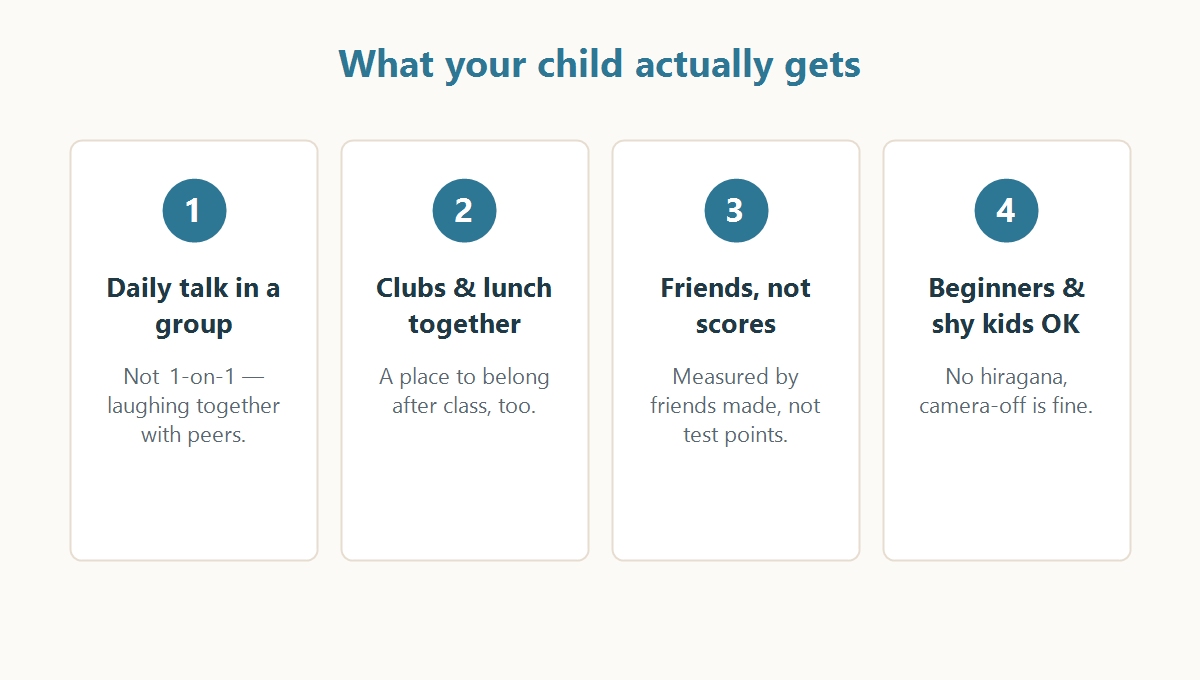
- Your child joins a small group with Japanese children from our sister school, NIJIN Academy (1,000+ students) — talking, playing and learning together every day.
- It’s not just a class. There are clubs and “lunch together” in a metaverse campus — manga, games, cooking — so Japanese improves through what kids already love. See how it works →
- Progress is measured by one question — “How many friends did you make?” — not by test scores.
- Complete beginners are welcome, even if your child can’t read hiragana yet. Kids are grouped by conversation level, so no one feels left behind.
What to realistically expect
Friendship isn’t instant, and that’s okay. A shy child might start with the camera off and just listen for the first couple of weeks — that’s completely normal. It’s not unusual for a child who made no friends in their first month to become one of the most active members later on. What matters is that there’s finally a place where the first move is easy, because everyone is a kid, and everyone is there to make friends.
And because classes run at weekday-evening and weekend times, it fits neatly around international school — turning otherwise-empty after-school hours into the thing you came to Japan for in the first place: a real connection to the country your family now calls home.
What to look for when choosing Japanese for your child
When you compare the options, three questions cut through the noise:
- Group or 1-on-1? For children, a group is what creates friends — and friends are what keep them coming back.
- Will my child actually talk with Japanese kids their own age? “Conversation practice” with an adult tutor isn’t the same as a friendship with peers.
- Is it built for children, or repurposed adult content? Look for play, clubs and a child’s pace — not business-Japanese drills.
If a service ticks those three boxes, your child is far more likely to stick with it — and to make the friends that make the language real.
Frequently asked questions
My child is a complete beginner — is that okay?
Yes. Kids can start even if they can’t read hiragana yet. Because children are grouped by conversation level, no one feels left behind or held back.
How long until my child can chat with Japanese friends?
Every child is different, but because the focus is conversation and friendship rather than textbooks, many kids are exchanging simple phrases within a few months. Confidence grows fastest when they genuinely want to keep talking.
My child is shy. Will they really make friends?
Shy kids can start with the camera off and an avatar, easing in at their own pace. It’s surprisingly common for a child who made no friends in the first month to become one of the most active members later.
When can we start?
TOMODACHI JAPAN opens in December 2026 (pilot launch). Join the waitlist and we’ll send you trial-day invitations first.
Read also
For more on helping your child keep Japanese going, see: