“I want my child to learn Japanese in Tokyo, but there are so many options – classes, private tutors, online lessons, apps – how do I choose?” This is a parent’s guide to choosing. Instead of pushing one service, it gives you five criteria for judging whether an option actually fits your child. The short version: for kids, what decides it in the end isn’t price or brand name – it’s whether they make friends and keep going.
Before you choose: 5 things to judge kids’ Japanese lessons on
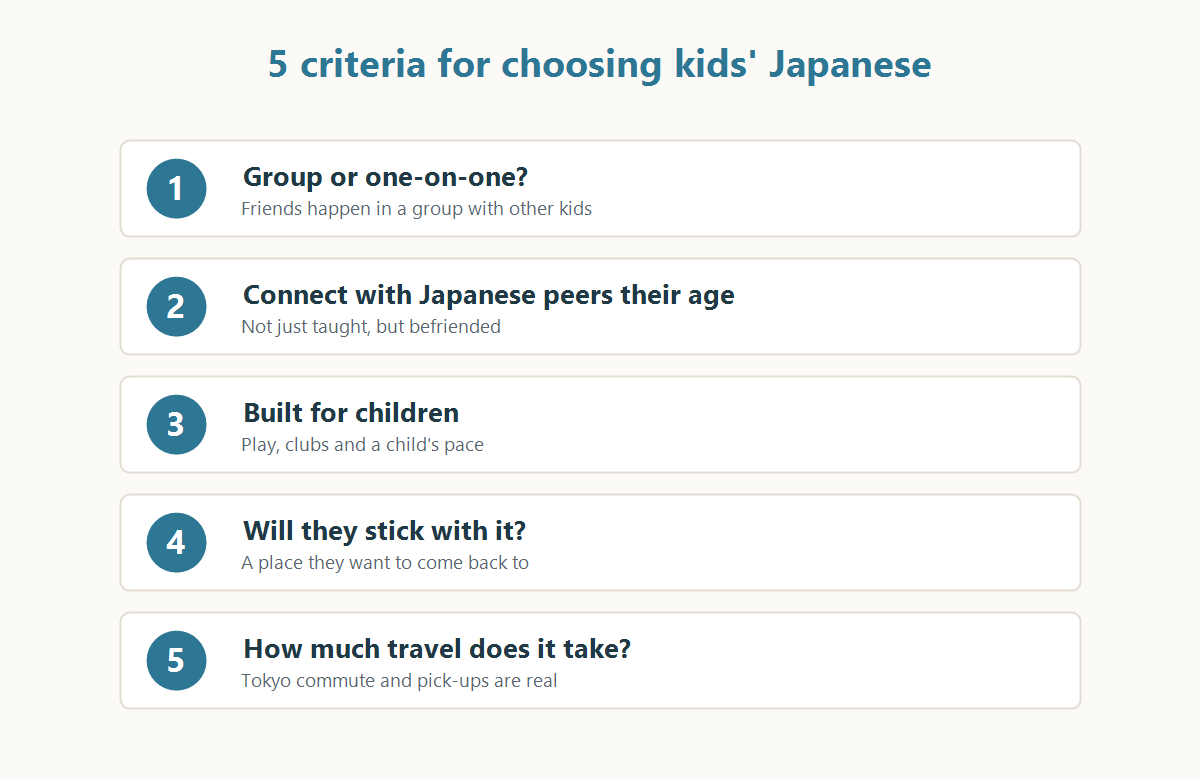
Adult comparisons talk about “price” and “number of tutors.” But what decides whether a child keeps going and improves is different. Use these five points to compare your options.
- 1. Group or one-on-one? Kids keep going when other kids are there. One-on-one helps focus, but there are no friends.
- 2. Can they connect with Japanese kids their own age? “Being taught Japanese” and “making Japanese friends” are different. The second one makes the language come alive.
- 3. Is it built for children? Not repurposed adult or business Japanese – look for play, clubs and a child’s pace.
- 4. Will they stick with it (fun and peers)? Is it a place they want to go back to? If it doesn’t last, it won’t stick – however cheap it is.
- 5. How much travel does it take? Getting around Tokyo eats time. In-person commute vs. online, plus pick-ups and scheduling, are real factors too.

Looking for a way to keep Japanese going from abroad?
TOMODACHI JAPAN is an online Japanese school for children growing up outside Japan. They talk with peers their own age in Japan every day, taught by teachers working at Japanese schools, in small classes of 8.
🎁 Register and we’ll email you our School Guide (PDF, in English) straight away. You’ll also be first to hear about tuition, scholarships and opening dates.
Free · takes about 30 seconds
The main options in Tokyo (by type)
| Option | Format | Makes friends | Japanese peers their age | Easy to attend |
|---|---|---|---|---|
| In-person Japanese class | Small group / class | ○ (with classmates) | △ (depends on location) | △ (commute / pick-up) |
| Private tutor (in person) | 1-on-1 | × | × | △ |
| Online 1-on-1 | 1-on-1 | × | × | ◎ |
| Apps | Self-study | × | × | ◎ |
| Online small group | Group | ◎ | ◎ (peers living in Japan) | ◎ (from home) |
Which type is right for you?
In-person Japanese class
Good if there’s a strong class nearby and pick-ups work for your family. Seeing the same kids in person is a real plus. But in Tokyo, travel time often becomes the sticking point over the months.
Private tutor / online 1-on-1
Best for a child with a clear goal (an exam, a specific weakness) who can study independently. Efficient – but “one-on-one with an adult” is hard for a child to sustain, and there are no friends.
Apps
A fine entry point for touching letters and words in spare moments. But there’s no one on the other side of the screen, so kids tend to lose interest, and it rarely leads to conversation or friendship.
Online small group
For families who want their child to keep going while making friends. No commute, and they connect with Japanese peers from home. TOMODACHI JAPAN works this way – your child talks, plays and learns every day with kids from our sister school, NIJIN Academy (1,000+ students).

When in doubt, choose by “will they make friends?”
Of the five criteria, the deciding ones for kids are usually 1 and 2 (are there peers, and can they connect with kids their age). Price and location matter, but if it doesn’t last, it won’t stick. Try a session first, and watch whether your child wants to come back.

Frequently asked questions
Do we have to live in Tokyo to join?
No. With an online group, you can join from outside Tokyo or overseas as long as the time zones work. Not having a commute is actually an advantage.
Can we combine more than one option?
Yes. For example, “reading and writing at school or a class + conversation and friends in an online group” is an effective combination that fills each other’s gaps.
What age should we start?
Kids are grouped by conversation level, so “can they enjoy it” matters more than age. The earlier you start, the more chances there are to make friends.
▼ Weighing a virtual school in Japan for your child? Compare every online option in this parent’s guide → Virtual Schools in Japan: a guide to every online option for kids