
The VCE Japanese Second Language study design carries a prescribed kanji list of roughly 200 characters. Under the current study design there is one list — the older split between a “reading” list and a “writing” list is gone, which quietly raised the bar: if a character is on the list, you are expected to be able to handle it in both directions. This guide covers what the list is for, why 200 is smaller and harder than it sounds, how to group it so it actually goes in, and what the examiners are really testing when kanji appear on the paper.
What the prescribed list actually is
The official list lives in the VCE Japanese Second Language study design published by VCAA (Units 1–2 from 2019, Units 3–4 from 2020). That document is the only version you should be studying from — not a friend’s photocopy, not a list from a tutoring site, and not a JLPT N4 list, which overlaps but is not the same set.
VCAA — VCE Japanese Second Language study design
Two things about that list are worth understanding before you start memorising.
- It is a floor, not a ceiling. The list defines what you are assumed to know. It does not promise that nothing else will appear — authentic-looking texts contain kanji beyond it, usually with support, and part of what is being assessed is whether you can read around an unfamiliar character rather than freeze at it.
- One list now means both directions. Because the reading/writing split was collapsed, the safe assumption is that any character on the list may need to be produced by hand, not merely recognised. Recognition is roughly three times cheaper to acquire than production, which is exactly why students who only ever read end up losing marks in the writing sections.
Looking for a way to keep Japanese going from abroad?
TOMODACHI JAPAN is an online Japanese school for children growing up outside Japan. They talk with peers their own age in Japan every day, taught by teachers working at Japanese schools, in small classes of 8.
🎁 Register and we’ll email you our School Guide (PDF, in English) straight away. You’ll also be first to hear about tuition, scholarships and opening dates.
Free · takes about 30 seconds
Why 200 is harder than it sounds
Two hundred characters looks manageable next to the 2,136 jōyō kanji, and students routinely decide it is the easy part of the course. Then the exam arrives and kanji quietly costs them marks in three different places.
- Readings, not characters, are the real unit. 山 is one character with at least two readings you need (やま, サン). Most list kanji carry two or more, and the compound readings are where the marks actually go. A “200-kanji list” is realistically four to five hundred readings.
- Compounds multiply. Knowing 電 and 車 separately does not mean you will produce 電車 fluently under time pressure, and knowing 天 and 気 does not automatically give you 天気予報. The list is characters; the exam is words.
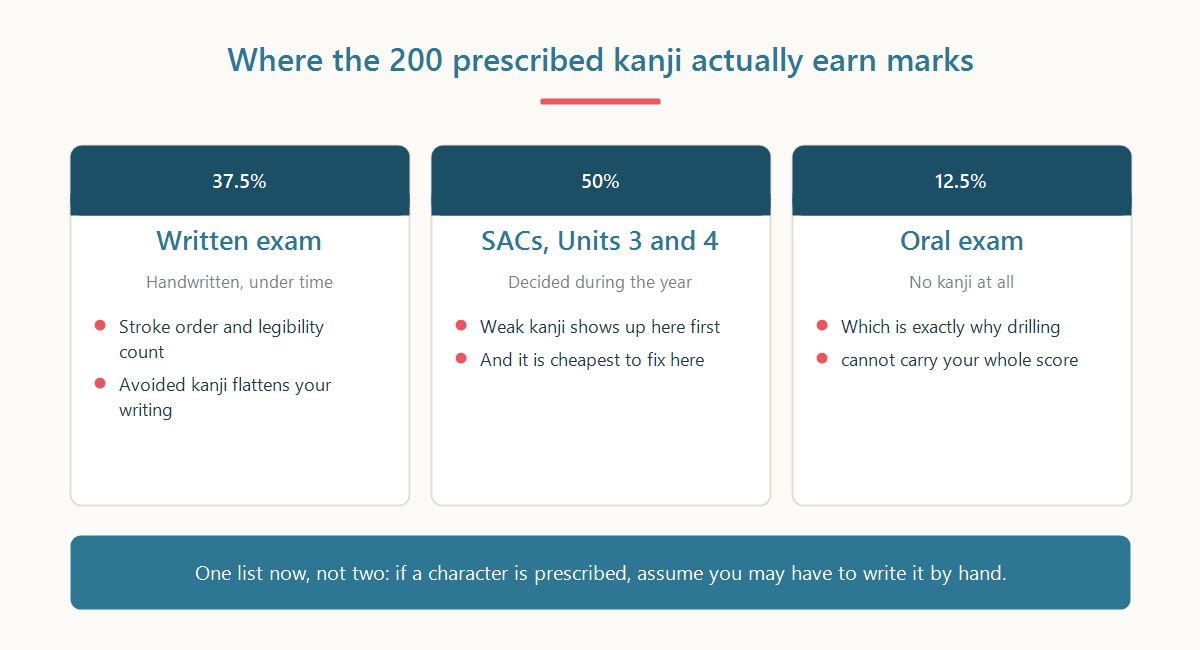
- You have to write them, by hand, at speed. The written examination is worth 37.5% of your study score and it is handwritten. Stroke order, proportion and legibility all matter when a marker is reading two hundred scripts. A character you can only produce slowly is a character you will avoid, and avoidance flattens your writing into simpler vocabulary — which is itself marked down.
Group the list by topic, not by the order it is printed
This is the single highest-leverage change most students can make. The prescribed list is a list; your exam is about topics. Re-sorting the characters into the themes VCE actually asks about means every character you learn arrives attached to a sentence you might genuinely write.
A worked example of the grouping we use with students — check each character against the official VCAA list, and build your own version from it:
| Theme | Characters to cluster | Why they earn marks together |
|---|---|---|
| Family & self | 父 母 兄 姉 弟 妹 家 族 名 前 | Personal introduction is guaranteed content in the oral and in short writing tasks |
| School & study | 学 校 生 先 教 室 勉 強 試 験 | The most common written-exam topic and the vocabulary of your own life |
| Time & calendar | 年 月 日 時 分 週 曜 今 毎 半 | Appears in every listening item and every narrative you write |
| Place & travel | 国 駅 道 店 空 港 電 車 行 来 | Directions, travel and exchange topics; heavy compound density |
| Opinion & connectors | 思 考 言 話 聞 読 書 好 便 利 | The verbs that carry an argument — the difference between a 6 and a 9 in extended writing |
A study method that survives Year 12
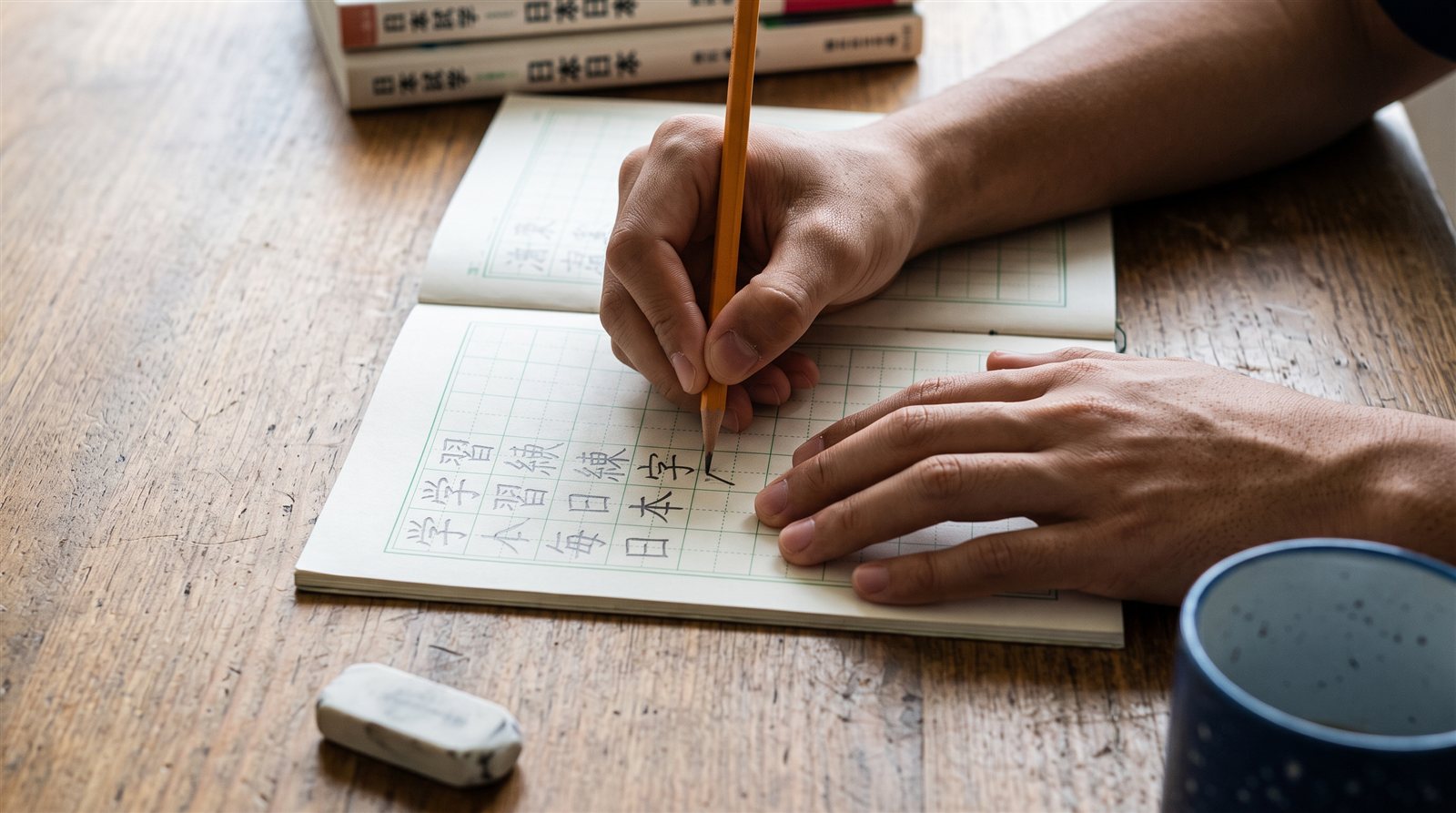
- Learn words, write characters. Memorise at the level of the word (電車, 天気, 勉強する) but drill production at the level of the character. Flashcards for meaning; squared paper for the hand. Doing only one of the two is why students recognise everything and can write nothing.
- Twenty minutes daily beats three hours on Sunday. Kanji is the most spacing-sensitive part of the course. A short daily loop through a rotating set will out-perform a weekend block by a wide margin, and it is the only approach that still functions in September when everything else is on fire.
- Write full sentences from week one. Isolated characters do not transfer to the exam. Take one theme cluster, write five real sentences about your own life using it, and get them corrected. Five corrected sentences teach more than fifty copied characters.
- Front-load Units 1 and 2. The list does not change when you reach Unit 3. Every character you own by the end of Year 11 is a character you are not learning in the same term as your SACs, your Detailed Study and your oral preparation.
Where kanji actually meets your study score
It helps to see the whole assessment picture, because kanji does not sit in a box of its own — it leaks into everything except, arguably, the oral:
- School-assessed coursework, Unit 3 — 25%
- School-assessed coursework, Unit 4 — 25%
- Written examination — 37.5%
- Oral examination — 12.5%
Half the score is decided by SACs during the year, and written SACs are where weak kanji shows up first and cheapest to fix. If your kanji is shaky in March, it is a manageable problem. If it is shaky in October, it is a mark ceiling. And once the raw score is set, it is what VTAC’s scaling acts on — which is worth understanding properly, as we set out in our guide to VCE Japanese scaling.
The thing kanji drilling cannot give you
Here is the honest limit of any kanji list. It builds the written half of your score. It does nothing for the 12.5% you earn in a room with two assessors, and it does nothing for the naturalness that separates competent writing from writing that reads like it was assembled from a textbook.
Both come from the same source: using Japanese with people, regularly, for reasons that are not assessment. TOMODACHI JAPAN is an online school run from Japan by qualified, practising Japanese teachers, where students join small groups of about eight — with a homeroom teacher — alongside young people who actually live in Japan. Attendance is unlimited for one flat monthly fee, and the time zone suits Victoria well: one or two hours ahead of Japan, so a Japanese late-afternoon session lands in your early evening after school. Students who have spent a year in those rooms tend to walk into the oral exam having already had the conversation a hundred times — and they write more naturally too, because they have read and heard the words in use rather than only on a card.

FAQ
Do I need to write every kanji on the list by hand?
Assume yes. The current study design has a single prescribed list rather than separate reading and writing lists, so the defensible working assumption is that any listed character can be required in production. If you are going to gamble anywhere, gamble on the rarest items in the list — not on the high-frequency ones that appear in every topic.
Can kanji outside the prescribed list appear in the exam?
Texts can contain characters beyond the list, typically with support such as furigana or context that makes the meaning recoverable. That is deliberate: part of what is being assessed is whether you can keep reading past an unknown character instead of stalling. Practise that skill explicitly — read a passage once without stopping, then go back — because in the exam you cannot look anything up.
Is the VCE list the same as JLPT N4?
They overlap heavily but they are not the same set, and the assessment style is completely different — JLPT is multiple choice with no handwriting, VCE requires you to produce Japanese by hand. Use JLPT resources for extra reading mileage if you like, but study from the VCAA list.
I am in Year 11. When should the list be finished?
Aim to have solid recognition of the whole list and confident handwriting of the high-frequency two-thirds by the end of Units 1 and 2. Year 12 should be about using kanji in extended writing and SAC conditions, not meeting characters for the first time. Students who arrive at Unit 3 still learning the list spend the year running.
Use the kanji you learn with friends in Japan.
TOMODACHI JAPAN opens in December 2026. Get the free school guide by email — class times for your time zone, how the small-group classes work, plus tuition and scholarship details.