If you have searched “Japanese supplementary school San Antonio”, here is the short answer. San Antonio has exactly one — the サンアントニオ日本語補習校 / Japanese Supplementary School of San Antonio (JSSSA), about 110 students, kindergarten to junior high, meeting every Saturday, 10:00–14:50, inside Raba Elementary School on the Northside. Published tuition is $845 to $1,580 a year depending on subjects, plus a $140 facility fee and an admission fee. Then the three things nobody tells you before you call. The English on the school’s own homepage says it enrols “All K-12” children — untrue since September 2020, when the high-school division closed. About nine of the forty Saturdays in the 2026–27 calendar are already online class days, stated only on a Japanese-language page. And the big one: admission is gated on the parents at least as much as on the child — in writing, including the ability to read school and PTA communications in Japanese, and a turn on the Saturday security rota.
Japanese supplementary school in San Antonio: the comparison
| School | Type | Day | Ages | Tuition | Area |
|---|---|---|---|---|---|
| Japanese Supplementary School of San Antonio (サンアントニオ日本語補習校, JSSSA) | MEXT/MOFA-registered, financially aided 補習授業校 | Every Saturday, 10:00–14:50 (40 days/yr; about 9 online) | Kindergarten (age 3) – junior high year 3. No high school | Elementary & junior high: all subjects $1,580/yr; Japanese + maths $1,330/yr; half-day Japanese only $845/yr. Kindergarten $905/yr. All grades + $140 facility fee. Admission fee $150 (see note). Materials fee not published | Raba Elementary School, 9740 Raba Drive, 78251 (Northside) |
| Japan-America Society of San Antonio (JASSA) | Community society; seasonal language classes, general/adult framing — no identifiable children’s programme | “Spring and Fall” 12-class weekly courses | Not published | Class fee not published. Membership $45 individual / $60 family / $35 concession per year | San Antonio (website offline at time of writing) |
| Private tutors and marketplaces | Individual tutors, not schools — no grade-level curriculum, no cohort | Flexible | Varies; mostly adult-oriented listings | Superprof lists 5 tutors, from $10/hr, average about $22; AmazingTalker $10–$30/hr; Varsity Tutors and Language Trainers quote on request | Online and in person |
| Austin オースチン日本語補習授業校 | 補習授業校, O. Henry Middle School | Contact the school | Contact the school | Contact the school — fees published only inside a spreadsheet on its own site | Austin — about 80 miles, 1–1.5 hrs each way |
| TOMODACHI JAPAN | Online — conversation, friendship and identity, with children in Japan | Any day (unlimited attendance) | 5–18 | One flat monthly fee — see the free guide | Your home |
Looking for a way to keep Japanese going from abroad?
TOMODACHI JAPAN is an online Japanese school for children growing up outside Japan. They talk with peers their own age in Japan every day, taught by teachers working at Japanese schools, in small classes of 8.
🎁 Register and we’ll email you our School Guide (PDF, in English) straight away. You’ll also be first to hear about tuition, scholarships and opening dates.
Free · takes about 30 seconds
Three routes to Japanese in San Antonio — and why the difference matters
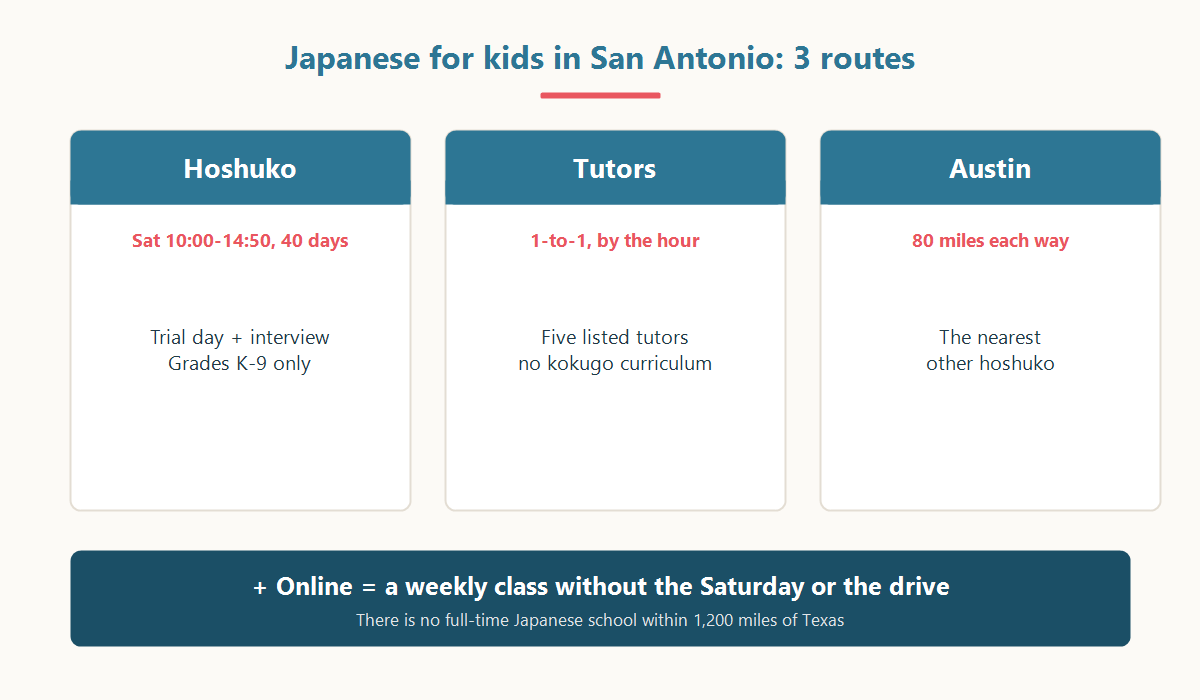
The options sound interchangeable — supplementary school, Japanese class, tutor, hoshuko — but they do three different jobs. One keeps your child at Japanese national grade level in 国語, with real entry conditions to match. One keeps spoken Japanese alive at whatever level your child is actually at. One keeps your child connected — to Japan, to children their own age, to a reason to keep going at fourteen. Most San Antonio families discover they need a different one from the one they first assumed.
Route 1: JSSSA — the real supplementary school, and what it asks of you
Start with what JSSSA genuinely is, because it is more than most cities its size have. Founded by the San Antonio Japanese Companies Association, chartered in Texas in March 2001, registered as an 在外教育施設 with the Ministry of Foreign Affairs and MEXT through the Consulate-General of Japan in Houston, and receiving Japanese government financial support since 2002. It is a genuine 補習授業校 with a real cohort of about 110 children and forty Saturdays a year of grade-level 国語 taught to the Japanese national curriculum — entrance ceremony, sports day, 発表会, mochi-pounding in January. If your child is going back to Japan and needs to walk into a Japanese classroom at grade level, this is the only thing in San Antonio built for that job, and it has done it for twenty-five years.
The Saturday is layered: 08:45–09:30 elective 社会 (elementary years 5–6 and all junior high); 10:00–12:25 the compulsory core, 国語, for everyone; lunch; then 13:15–14:50 elective 算数/数学. Kindergarten runs 10:00–12:25 only. The year is 1 April to 31 March in two terms — for 2026–27, 11 April to 26 September and 3 October to 13 March, summer break 21 June to 7 August. The “half-day, Japanese only” option means core 国語 and nothing else. One practical note before you visit the site: type http://sahoshuko.org, not https://. The certificate expired in April 2026 and was issued to a different hostname, so the secure address throws an alarming warning and may refuse to load. The site is fine; the certificate is not. It is a five-minute fix nobody has made, and it is why some parents assume the school has closed.
JSSSA — admissions and fees · JSSSA — school overview · +1 (210) 589-1470, Mon–Sat 10:00–17:00, info@sahoshuko.org
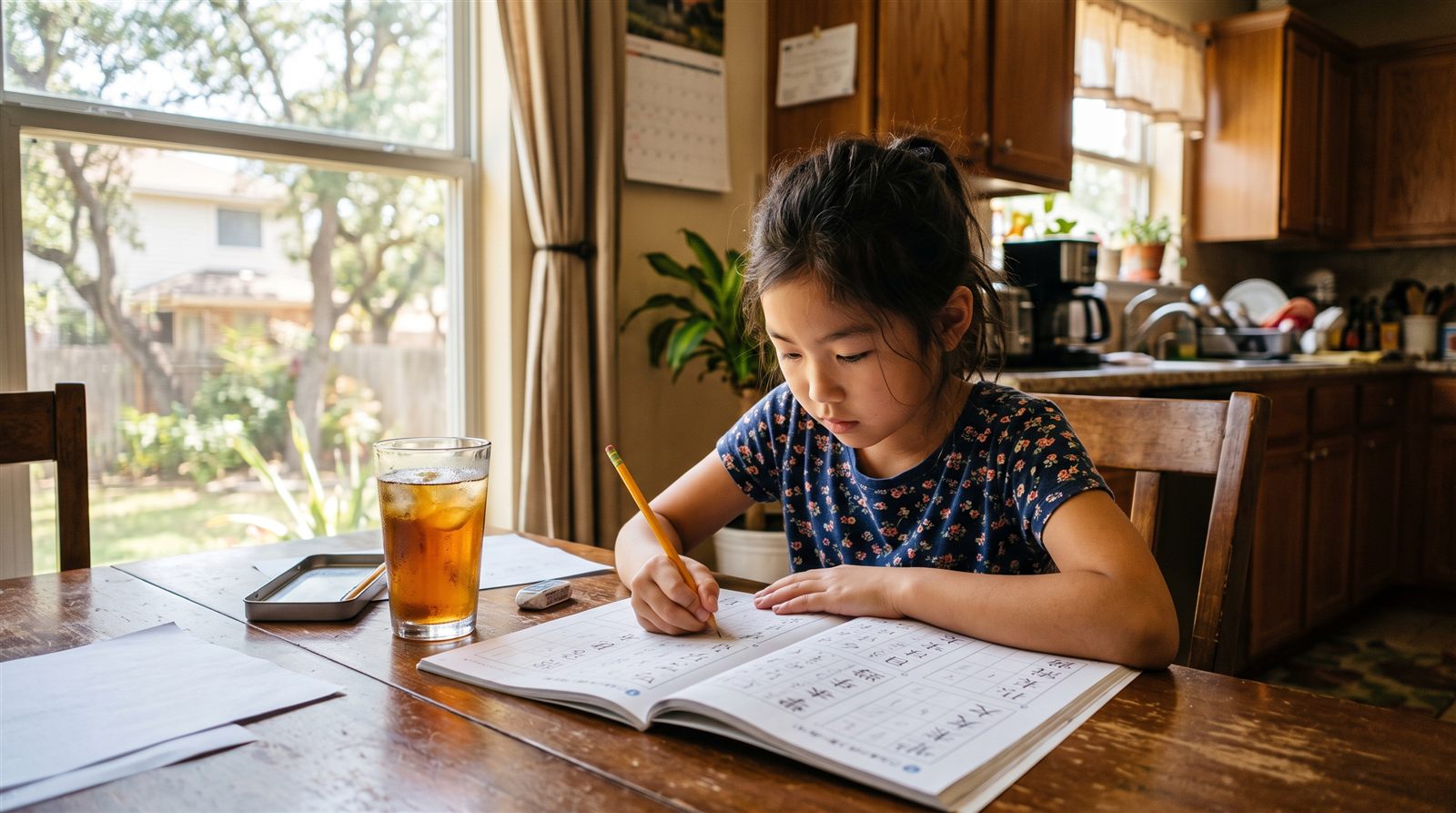
Now the part that is not in English anywhere. Entry is decided by trial attendance plus an interview, judged by the principal, homeroom teacher and staff against a guideline the school does not publish. Elementary and junior-high applicants need age-appropriate Japanese foundational ability and the ability to spend the entire Saturday in Japanese only — not just during lessons. Kindergarten applicants must be three by 1 April and fully toilet-trained. Nationality is explicitly not required and the school carries a US non-discrimination statement — but free Japanese government textbooks go only to children who hold Japanese nationality and whose family has filed a 在留届 with the Consulate-General. A Japanese-heritage US-citizen child is admitted, then buys their own books.
And then the parents. Per the school’s handbook, a child cannot be admitted unless the parents commit in writing to: supporting the school’s policy and goals; fulfilling participation obligations and supporting school and PTA activities; paying on time; continuously supervising study at home; keeping contact with the homeroom teacher; and being able to understand school and PTA communications in Japanese. There is a Saturday security rota — two parents every week, one from a full-day family and one from a morning-only family — alongside the off-duty police officer the district has supplied since April 2017. Two signed forms are mandatory, including an indemnity governed by Texas law. Admission can be revoked after the fact, and the handbook states that a parent’s failure to perform their duties can result in the child being suspended (停学). Promotion to the next grade is not automatic either.
None of that is unreasonable for a volunteer-supported Saturday school run on a shoestring by a companies’ association. But it is invisible if you only read English, and it is the most common reason a mixed household — one parent Japanese-speaking, one not — finds itself quietly ineligible. Two further facts, neither a criticism: a Japanese teaching licence is desirable but not a hiring requirement, and the principal and vice-principal are corporate secondees on a one-year rotation rather than career educators. The school’s public filings also show two consecutive deficit years — the honest explanation for the $140 facility fee. The district lent the Raba campus free until March 2025; from April 2025 it became a paid rental, pro-rated across families.
Route 2: JASSA, tutors and the local school districts
The Japan-America Society of San Antonio, founded in 1985, is the city’s Japanese community anchor — Aki Matsuri, Shinnenkai, a table at San Japan. It advertises “Spring and Fall Language Classes”, a twelve-class weekly course at different levels, with preferred pricing for members. But there is no language-class page on the site at all: no fee, no age range, no venue, no schedule. The framing is general-adult rather than a children’s heritage programme, its speech contest is restricted to high-school and university students, and an archived snapshot of its own events page reads that no courses were scheduled. As of today the website is offline, its certificate having expired on 7 August 2026. Membership is $45 individual, $60 family, $35 concession. Treat JASSA as community and culture rather than schooling.
Tutors and marketplaces are what else you will find, and the search results overstate them badly. Superprof lists five Japanese tutors in the whole city, from $10 an hour, averaging about $22. AmazingTalker’s “San Antonio” page is a template with the city name filled in; the tutors are online and mostly overseas. Varsity Tutors and Language Trainers publish no prices at all. A tutor can be excellent for conversation, but none offers grade-level 国語, a peer group, or continuity when the tutor moves away. As for the districts: there is no Japanese immersion or dual-language programme anywhere in the area — Northside ISD and North East ISD both run English/Spanish, and no Japanese-as-a-world-language offering surfaced at local high schools. Whatever Japanese your child gets, you are arranging it yourself.
Route 3: the drive — Austin, Houston, Dallas
If JSSSA does not fit, the nearest alternative is Austin, about 80 miles — one to one and a half hours each way, at O. Henry Middle School. After that, Houston at 197 miles (about 2 hrs 57 min) and Dallas at 275 miles (about 4 hrs 10 min). We are not printing their tuition, because the only figures available were third-party and unverified — contact each school. Two facts matter when you weigh the drive. One: JSSSA is a MEXT- and MOFA-registered, financially aided 補習授業校, but it is not one of the schools that receives a teacher dispatched from Japan. MEXT’s list of supplementary schools with a dispatched teacher includes exactly two in Texas — ダラス and ヒューストン. That is a difference in staffing, not a judgement on quality. Two: there is no full-time Japanese day school (日本人学校) in Texas, or anywhere in the southern United States. MEXT lists four in the country — Chicago, New York, New Jersey, Guam. The nearest is roughly 1,200 miles away.
Austin Japanese Supplementary School · MEXT — list of overseas Japanese schools
How to choose: three questions, in this order
- 1. What do you actually want — a return to Japan, or a language that lasts? Only one school in the city sells the first. If your child will re-enter a Japanese classroom at grade level, you want 国語 to the national curriculum, and JSSSA is the answer, full stop. If your family is staying — and around the Toyota plant a great many families who arrived on a posting have stayed — what you need is spoken Japanese that survives adolescence and a connection to Japan that is not homework. A curriculum built for children who are going back is a strange instrument for a child who is not.
- 2. Be honest about the Saturday and the drive. Ten to two-fifty every Saturday from April to March is not “one morning”. With the drive to 78251 and the parent security rota it is most of the weekend, forty times a year — and with the 08:45 elective you leave the house before nine. That is a well-spent sacrifice for some families and unsustainable for others, and far better known before you enrol than in November. If you commute from the far south side or from Cibolo, do the drive once on a Saturday morning before deciding.
- 3. Will the child still be going at fourteen? Friends decide that. Children do not quit Japanese because the teaching was bad. They quit because it ate Saturday while their friends were elsewhere, and because the Japanese they were doing had nobody on the other end of it. With about 110 children across kindergarten, six elementary years and three junior-high years, your child’s cohort in their own grade is small — and after junior high there is no high-school division to continue into. Ask, early, what the plan is for age fifteen.
The online option: friends in Japan, on a Friday evening in Texas
San Antonio’s Japanese community grew around Toyota Motor Manufacturing Texas — a 2,000-acre site on the far south side, producing since November 2006, now 2,600-plus team members, with a $531 million expansion adding 400 more jobs. The Consulate-General’s own materials describe a substantial cluster of Japanese companies following Toyota into the region, and Aisin’s transmission plant in Cibolo employs several hundred more. Twenty years on, what that produces is not only posted families on three-year rotations. It is a settled community of Japanese-heritage children growing up as Texans, in households where one parent may not read Japanese at all, who need Japanese as a living language rather than preparation for a return that is not coming. That is the gap we cover in our guide to the online alternative to Japanese hoshuko.
- The other children actually live in Japan — nothing else in Texas offers that. Your child is not practising with other San Antonio children who also speak English. They are making friends their own age in Japan, in small classes of eight with a homeroom teacher who knows them, across roughly 100 sessions a month. That is what turns Japanese from a subject into a relationship, and relationships are what still exist at sixteen.
- Connection to Japan, and to who they are. A heritage child in Texas with no Japanese friends concludes around middle school that Japanese is their mother’s language rather than their own. Regular contact with peers in Japan — jokes, games, what everyone is watching — keeps the identity attached to the language, instead of the language becoming a chore attached to nothing.
- Built for children, so a level mismatch is not a rejection. Heritage children usually fall away at the fifth-grade wall: the spoken Japanese is fine, the kanji and the textbook are two or three years behind, and a grade-level class becomes humiliating. Groups are organised by conversation level rather than school grade, taught by qualified, practising Japanese teachers. No entrance exam, no requirement that a parent read Japanese, no whole day in Japanese only.
- One flat fee, unlimited classes. One flat monthly fee for 通い放題, unlimited attendance. Not per term, not per subject, not per hour.
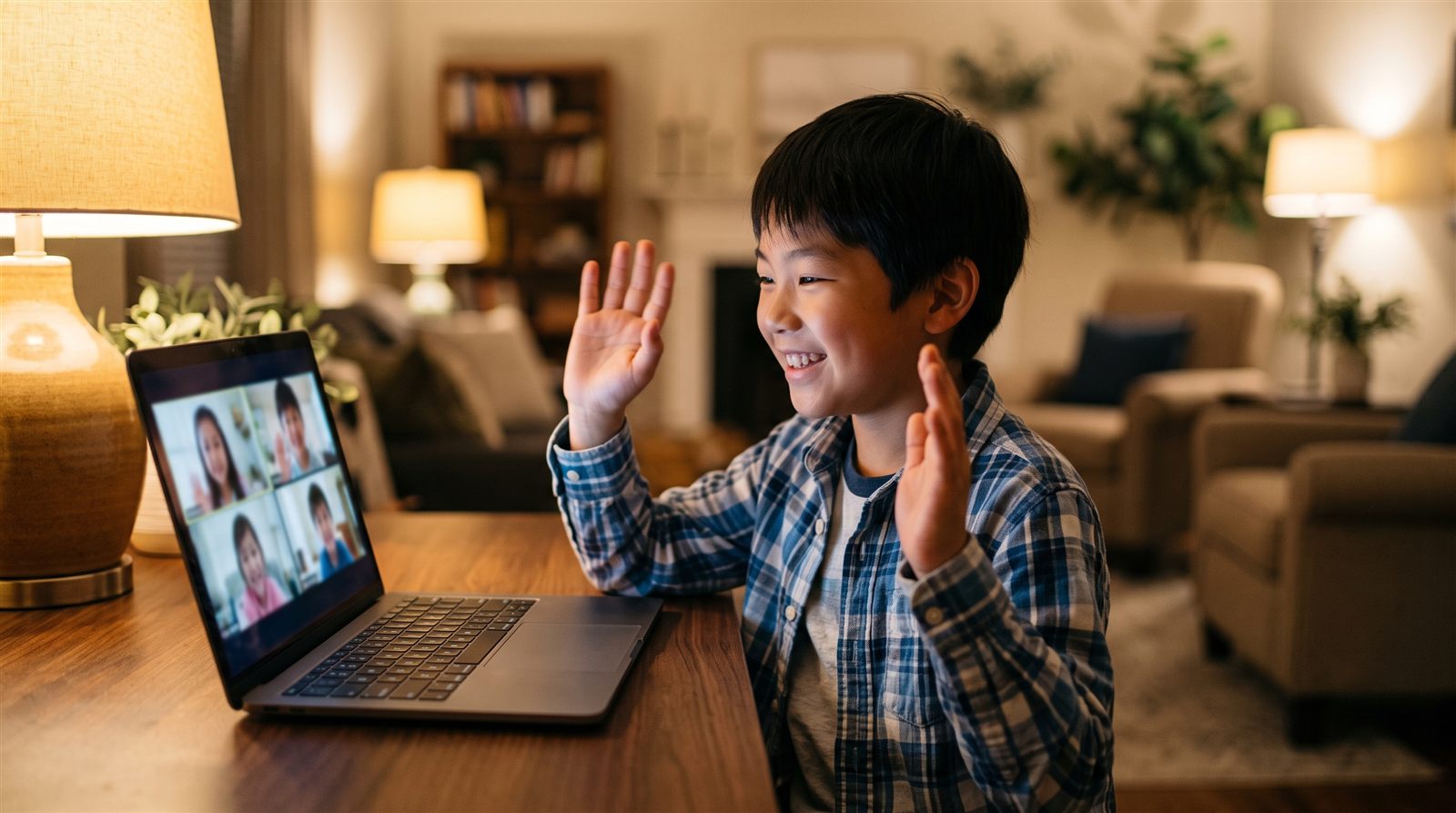
Now the timezone, honestly, because it is the one thing that genuinely counts against online school from Texas. San Antonio is US Central, 14 hours behind Japan in summer. That works beautifully in one direction: Saturday morning in Japan is Friday evening in San Antonio — your child joins a full Japanese Saturday class after school on Friday, from the kitchen table, with the weekend still ahead of them. It works badly in the other: Japan’s weekday-evening band lands before dawn in Texas, and we will not pretend otherwise. Of the three daily time bands, the Japan-morning band is the one Texas families will live in, with the schedule adjusted for the difference. Anyone who tells you a Japan-based online school is timezone-neutral from Texas is not being straight with you. What is true is that the band that does work is the best one — the weekend, when the most children in Japan are online.
One Saturday in 78251 keeps Japanese ticking over. Friday evenings with friends in Japan keep it growing.
FAQ from San Antonio families
Can my child join JSSSA if their Japanese is not at grade level?
Probably not, and it is better to know now. Applicants need age-appropriate Japanese foundational ability and the ability to spend the whole Saturday in Japanese only, not merely during lessons. Admission is decided by trial attendance and an interview against a guideline the school does not publish, so there is no way to self-assess in advance — ring the office and ask for a trial. There is no lower-level stream; the school runs one grade-level track. If your child speaks Japanese at home but has never been drilled in kanji, that is exactly the family the language bar catches, and a class grouped by conversation level rather than school grade is the option that does not turn a level gap into a rejection.
Do I have to speak Japanese myself?
For JSSSA, effectively yes — the most important line on this page for mixed households. The school’s handbook lists, among the conditions parents must accept in writing before a child can be admitted, being able to understand communications from the school and the PTA in Japanese. Alongside it sit participation obligations, supervising study at home, contact with the homeroom teacher, the Saturday security rota and on-time payment. Admission can be revoked after the fact if these are not met, and the handbook states that a parent’s failure can result in the child’s suspension. So the honest framing is that the school is gated on the parents’ Japanese as much as the child’s. If one parent in your household does not read Japanese, raise it on the first phone call rather than at the interview.
Is there a Japanese high school in San Antonio?
No — and this is the correction worth making clearly, because the top search result gets it wrong. JSSSA’s high-school division opened in April 2005 and ran until September 2020; it is closed. The current divisions are kindergarten (three year groups), elementary years 1–6 and junior high years 1–3. The Japanese-language overview page says so correctly. The English paragraph on the homepage — the only English statement of eligibility anywhere on the site — still says “All K-12 children” are eligible, and a couple of other pages still refer to a 高等部. It is a stale page rather than a misrepresentation, but it means an English-reading parent planning past year nine is planning around something that no longer exists. There is also no full-time 日本人学校 anywhere in Texas.
What will it actually cost us in the first year?
For elementary, full day: $1,330 tuition + $140 facility fee + $150 admission fee = $1,620 for Japanese and maths, or $1,870 with social studies — plus a materials fee the school does not publish. It says only that drills and supplementary readers beyond the textbook are billed separately, so ask for a figure before you commit. Two caveats for the same call. The admissions page says the admission fee is $150 while the school’s handbook says $100; and the refund rules disagree too — the public page says no refunds in any circumstances including mid-year departure, the handbook describes a settlement for lessons actually taken. Neither is resolvable from outside, so confirm both. Note also that a formal leave of absence still costs 100% of tuition, because its purpose is to hold your child’s seat. Payment is in four instalments, by personal check only.
Is there anything closer than Austin, and when do we have to apply?
Within San Antonio, JSSSA is the only supplementary school — no second hoshuko, no Japanese immersion in any local district, and no community-run children’s Japanese class we could identify. The next nearest is Austin at roughly 80 miles, then Houston at 197 and Dallas at 275. On timing: elementary and junior-high transfers are accepted without a stated window, but kindergarten is a once-a-year door. For the intake beginning April 2027, applications are open 14 November 2026 to 8 January 2027 only, and the school states that applications submitted outside that period are treated as invalid. The information session is 9 January 2027, the trial session, interview and screening 23 January, results 25–30 January, entrance ceremony 10 April. Class caps are 10 for 幼稚部 age 3 and 15 each for the two older kindergarten groups, with a waiting list and first-come, first-served allocation among qualifying applicants. Miss the window and you wait a year.