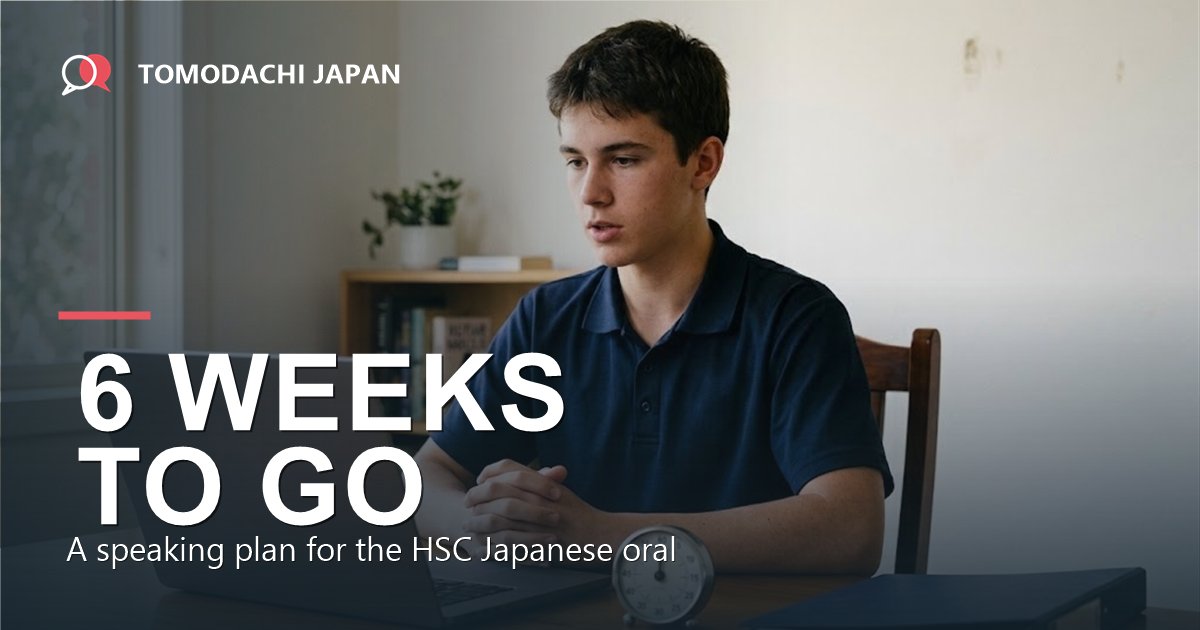
If your teenager sits HSC Japanese Continuers, the oral examination is roughly six weeks away. It is a ten-minute conversation worth 20 marks out of 100, it happens before the written exams — typically around August–September, at a designated venue — and it is the single component most students leave until it’s too late.
Six weeks is genuinely enough time to move a band. It is not enough time to learn Japanese. So this plan is built around the one thing that actually shifts an oral mark on that timescale: volume of unscripted speaking, with feedback. Everything else is deliberately cut.
Victorian families: your VCE oral is in October, so shift this plan later by about six weeks. The structure is identical — see our VCE Japanese oral exam guide. Always confirm your exact dates through your school.
Before you start: the three things that decide the mark
Examiners are not counting how many words a student knows. Across the marking criteria, the same three behaviours separate the top bands:
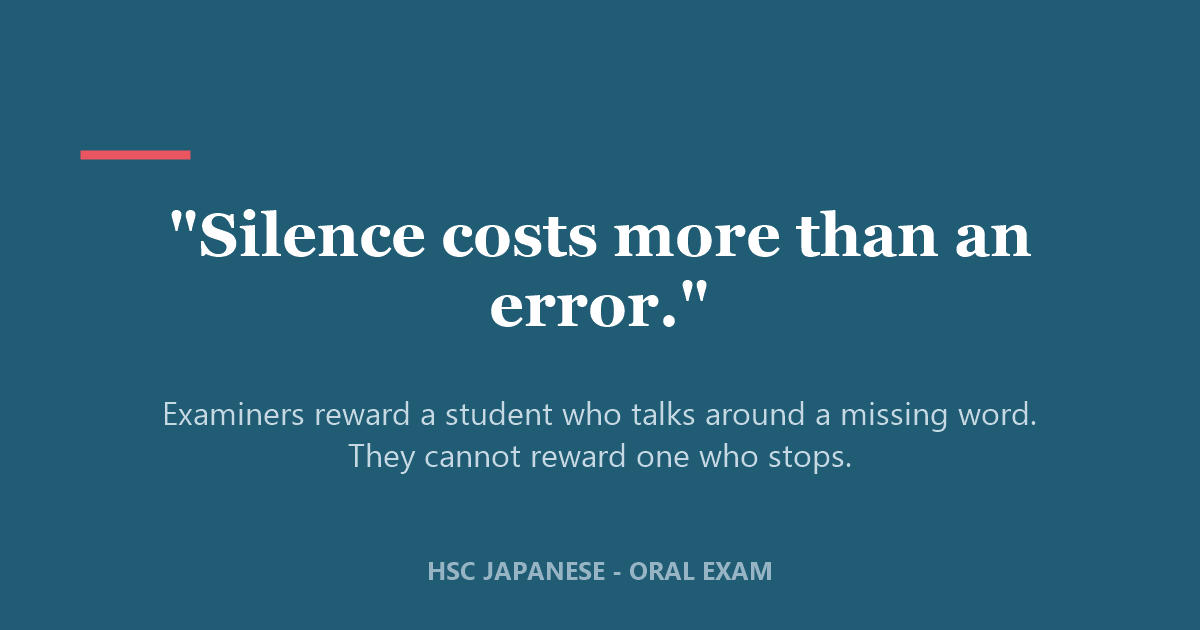
- Keeping the conversation alive. Asking back, using natural fillers, and — crucially — talking around a word you don’t know instead of stopping. Silence costs more than an error.
- Fitting the context. Appropriate politeness for speaking with an examiner, and language that matches the topic and purpose. This is where students who learned Japanese casually get caught.
- Opinions with reasons, across time. Not “I like it,” but “I think so because…, though on the other hand…” — and moving comfortably between past, present and future.
None of those three improve by reading. All three improve by talking to someone who responds unpredictably. That’s the whole logic of the plan below.
Looking for a way to keep Japanese going from abroad?
TOMODACHI JAPAN is an online Japanese school for children growing up outside Japan. They talk with peers their own age in Japan every day, taught by teachers working at Japanese schools, in small classes of 8.
🎁 Register and we’ll email you our School Guide (PDF, in English) straight away. You’ll also be first to hear about tuition, scholarships and opening dates.
Free · takes about 30 seconds
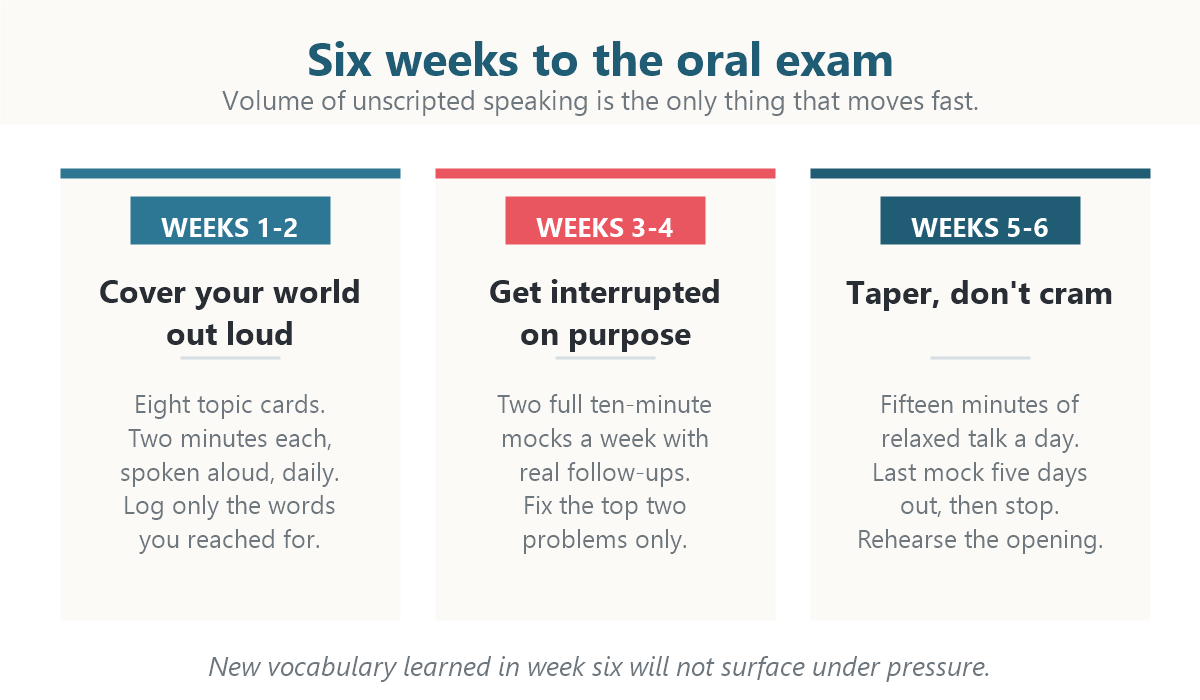
Weeks 1–2: cover your personal world out loud
The conversation draws on the prescribed topics seen through the student’s own life: school, family, friends, free time, part-time work, plans after Year 12. Most students have read about these. Very few have said them.
- List your topics on separate cards — about eight of them. For each, prepare not a script but three things you could say and one opinion you hold.
- Speak each card aloud for two minutes, unrehearsed, every day. Out loud, standing up, to a person or to a recording — not in your head. Silent review does nothing for fluency.
- Log the words you reached for and didn’t have. That list — usually only 30–60 words — is your entire vocabulary syllabus for six weeks. Ignore everything else.
By the end of Week 2 the goal is modest and specific: you can talk about any of your eight topics for two minutes without stopping. Not elegantly. Without stopping.
Weeks 3–4: get interrupted, on purpose
This is the phase that changes marks, and it’s the one almost nobody does properly, because it requires another person.
Run full ten-minute mock conversations — at least two a week — with someone who will genuinely push: ask follow-ups you didn’t prepare, disagree politely, change topic abruptly, and stay in Japanese even when you stumble. After each one, fix only the top two problems. Chasing every error at this stage just destroys confidence.
Record one mock in Week 3 and watch it once. Students are almost always better than they feared and slower than they thought — both useful things to learn six weeks out rather than six days out.

The recovery phrases worth drilling
Every student will hit a word they don’t know during the exam. What happens in the next two seconds is worth real marks. Drill these until they’re automatic:
- Buying time: ええと… / そうですね… / なんと言いますか…
- Talking around a gap: 名前は忘れましたが、〜のようなものです。
- Asking back (this scores): 〜についてはどう思いますか。
- Checking understanding without dying: すみません、もう一度お願いします。
Note the last one. Asking for repetition is not a failure — handled calmly and in Japanese, it demonstrates exactly the conversation-management skill the criteria reward.
Weeks 5–6: taper, don’t cram
The instinct in the last fortnight is to add material. Resist it. New vocabulary learned in Week 6 will not surface under pressure, and the effort actively raises anxiety — which does surface.
- Talk daily, briefly and casually. Fifteen or twenty minutes of relaxed Japanese conversation beats two hours of revision. The aim is for speaking Japanese to feel ordinary on exam day.
- One last full mock, about five days out — then stop doing mocks. Finishing on a good one matters more than squeezing in another.
- Rehearse the first thirty seconds. Greeting, name, a calm opening answer. Starting well settles the nerves for the remaining nine and a half minutes.
- Sort out the logistics early. The oral is usually at a designated venue rather than your own school, with scheduling arranged earlier in the year. Confirm the time, place and travel now — not the night before.
Where the speaking partner comes from
The plan collapses without one. Here’s an honest comparison of the options at six weeks out.
| Option | Can it run a real mock? | Can you do it daily? | Cost shape | Watch-out |
|---|---|---|---|---|
| School teacher | Yes — knows the criteria best | No — shared across the class | Included | Term 3 is their busiest period; expect a handful of runs |
| Family member who speaks Japanese | Partly | Maybe | Free | Tends to be too kind, and slips into English when it gets hard |
| Language apps | No | Yes | Free–low | No dialogue at all — cannot rehearse being questioned |
| 1-on-1 tutor | Yes, if they know the HSC | Rarely — cost scales with frequency | Per hour; language tutoring in Australia commonly A$75–130/hr | Daily practice for six weeks is unaffordable for most families; one voice only |
| TOMODACHI JAPAN | Yes — teacher-run mock orals | Yes — unlimited attendance | One flat monthly fee | Runs on Japan time, which suits NSW after school |
Why we built it this way
TOMODACHI JAPAN is an online school staffed by currently practising Japanese teachers — the same educators who teach children inside Japan — rather than a marketplace of freelance tutors. In a six-week countdown that matters in three ways:
- A teacher can play the examiner and then diagnose. Not “that was good” — but which criterion is costing you marks, and the two things to change before the next mock.
- Students also talk with Japanese teenagers their own age. That’s where natural intonation and fast recovery come from, and it’s why the daily talking in Weeks 5–6 stops feeling like revision.
- Unlimited attendance for one flat fee. The exact weeks a student needs to speak every day are the weeks per-hour tutoring becomes unaffordable. Ramping up here costs nothing extra.
The time-zone advantage in Term 3
Sydney runs one hour ahead of Japan in winter. So a session straight after school in NSW lands in the Japanese late afternoon — which is what makes “talk every day for six weeks” a realistic sentence rather than an aspirational one. Conversions are in our time-zone guide, and local class times are on the Australia & New Zealand page.
FAQ
When exactly is the HSC Japanese oral exam?
HSC language oral examinations are held ahead of the written exams, typically around August–September, usually at a designated venue rather than your own school, with scheduling arranged earlier in the year. Confirm your exact date, time and venue through your school and NESA.
How much is it worth?
In HSC Japanese Continuers the oral is 20 marks out of 100 — a conversation of roughly ten minutes — with the written paper making up the other 80. Full criteria are in our HSC Japanese Continuers oral exam guide.
Is six weeks really enough to improve?
For fluency and conversation management, yes — those respond quickly to daily speaking. For vocabulary range and grammatical accuracy, six weeks gives only modest gains. That’s precisely why this plan spends its time on talking rather than on new content.
Should we get a tutor for the last six weeks?
A tutor is genuinely useful for written-exam technique and grammar repair. For the oral the constraint is frequency, and per-hour pricing makes daily practice impractical for most families. Our honest breakdown is in do you actually need an HSC or VCE Japanese tutor?
My child freezes from nerves. What helps?
Familiarity, more than anything. A student who has had dozens of ordinary Japanese conversations with different people experiences the exam as one more conversation. Drilling the recovery phrases above also helps enormously, because freezing is usually the fear of the gap rather than the gap itself.
What does TOMODACHI JAPAN cost?
One flat monthly fee for unlimited daily attendance (billed in Japanese yen; your local-currency amount is on the tuition page). Attending every day for six weeks costs the same as attending once a week.
Six weeks. The only variable is how often they speak.
TOMODACHI JAPAN opens in December 2026: real Japanese teachers running mock orals, same-age friends in Japan, and unlimited practice on Australian-friendly hours. Register now and we’ll send opening news, timetable and trial-session details first.