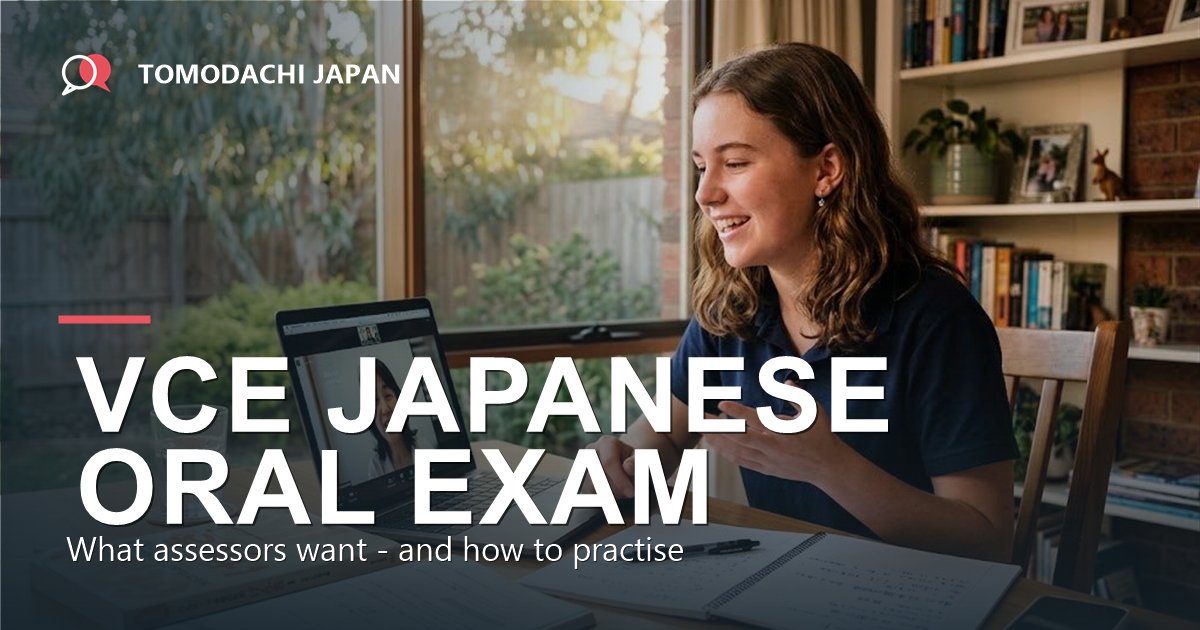
If your teenager is sitting VCE Japanese Second Language, the part that keeps most families up at night isn’t the reading or the writing — it’s the oral exam. Fifteen minutes, two assessors, no script, all in Japanese. It’s worth 12.5% of the study score on its own, and it’s the one section you can’t cram the night before. This guide explains exactly how the 2026 oral exam is structured, what assessors are really listening for, and the single most effective way to prepare: regular, unscripted conversation with a real Japanese person — not another vocabulary list.
How the VCE Japanese oral exam is structured (2026)
The oral examination runs for about 15 minutes and is conducted by two assessors. It has two clearly separate parts, and students are marked on each. Knowing the shape of the exam removes half the fear — here’s the breakdown.
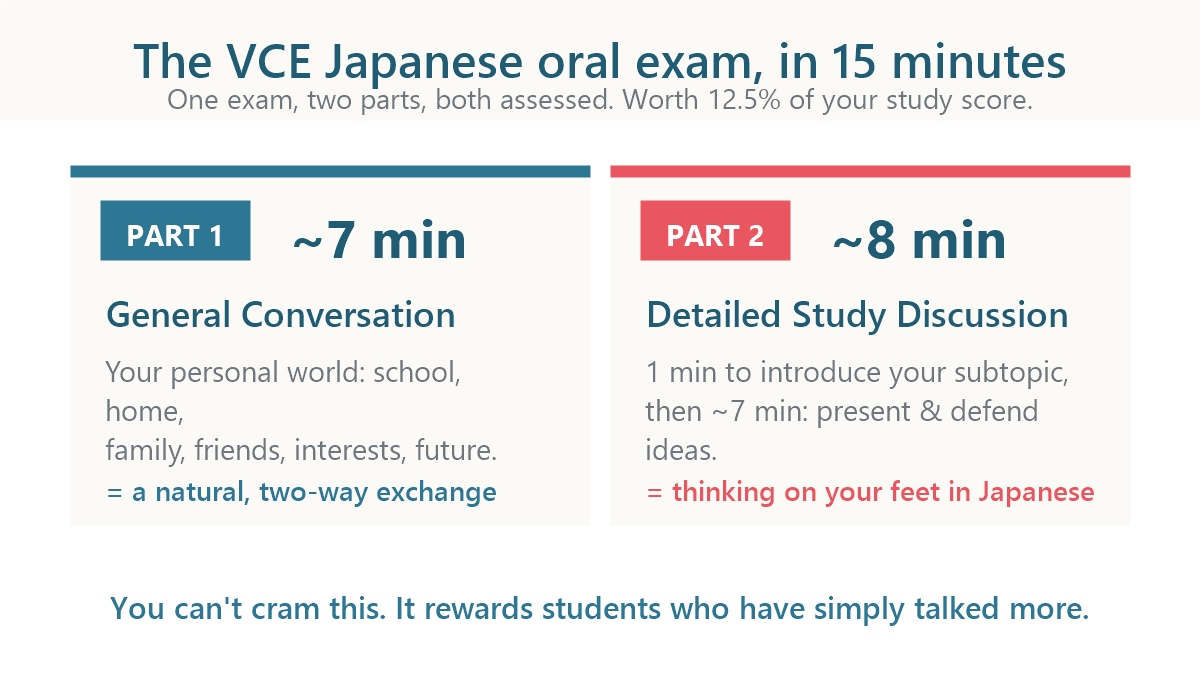
Part 1 — General Conversation (about 7 minutes)
The exam opens with a general conversation about the student’s personal world: school and home life, family and friends, interests, part-time work, and plans after Year 12. It sounds friendly — and it is — but assessors use it to test whether a student can hold a natural, two-way exchange: asking as well as answering, adding detail without being prompted, and recovering smoothly when they don’t catch a word. Rehearsed monologues stand out for the wrong reasons here.
Part 2 — Discussion of the Detailed Study (about 8 minutes)
The student takes up to one minute to introduce the subtopic they prepared for their Detailed Study, then spends around seven minutes discussing it. This part assesses a higher-order skill: presenting information and exchanging ideas and opinions — supporting a view, responding to a follow-up question, comparing perspectives. It rewards students who can think on their feet in Japanese, not just recite what they memorised about their topic.
Looking for a way to keep Japanese going from abroad?
TOMODACHI JAPAN is an online Japanese school for children growing up outside Japan. They talk with peers their own age in Japan every day, taught by teachers working at Japanese schools, in small classes of 8.
🎁 Register and we’ll email you our School Guide (PDF, in English) straight away. You’ll also be first to hear about tuition, scholarships and opening dates.
Free · takes about 30 seconds
What assessors are actually listening for
Across both parts, high-scoring students share the same three habits — and none of them come from a textbook:
- They keep the conversation moving. They use natural fillers (ええと, そうですね), ask the assessor questions back, and don’t freeze when a word is missing — they talk around it. This is a strategy you can only build by having real conversations, not by drilling.
- They sound like a person, not a script. Intonation, natural pausing, and appropriate politeness (です/ます vs. casual, and knowing when each fits) separate the top bands. A student who has actually spoken with Japanese people picks this up almost without noticing.
- They give opinions and reasons. “I like it” scores low; “I think so because…, but on the other hand…” scores high. The Detailed Study discussion in particular rewards a student who can hold and defend a view in Japanese.
The uncomfortable truth about oral-exam prep
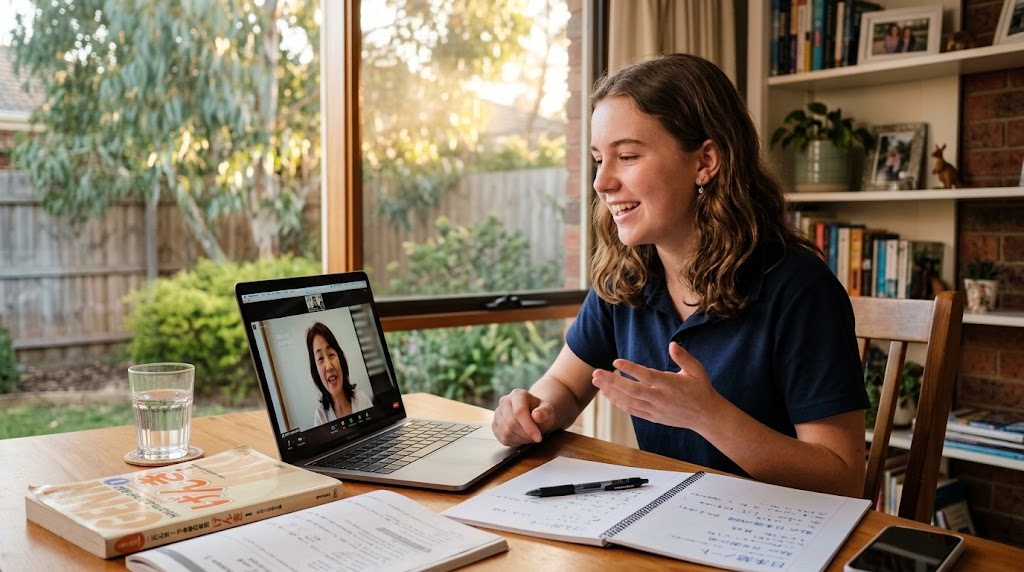
Here’s what a lot of Year 11 and 12 families discover the hard way: you cannot build spontaneous speaking by studying alone. Flashcard apps grow vocabulary. Past papers sharpen the written exam. A grammar workbook fixes particles. But the oral exam tests something none of those touch — the ability to improvise a reply to a question you didn’t see coming, in real time, to a real listener. That skill is built one way: by having a lot of unscripted conversations with someone who speaks Japanese naturally, ideally before exam season turns it into a panic.
School helps, of course — but a class of 25 gives each student only a few minutes of actual speaking a week, always with the same familiar teacher whose accent and questions the student already knows. On the day, the assessor is a stranger. The closer your practice gets to talking with unfamiliar Japanese people about real things, the smaller the gap on exam day.
Your oral-exam practice options, compared
Four common ways Australian families prepare for the speaking exam — honestly compared, including where each one falls short.
| Option | Speaking time | Who your teen talks to | Best for | Watch-out |
|---|---|---|---|---|
| School class | A few min/week | The same teacher & classmates | Syllabus coverage, SACs | Little 1-to-1 speaking; familiar voices only |
| Language apps (Duolingo etc.) | Solo, no real dialogue | Nobody — it’s a machine | Vocab & kanji upkeep | Does not build spontaneous conversation at all |
| 1-on-1 tutor (italki / Preply) | Whatever you pay for | One adult tutor | Targeted fixes, flexible hours | Per-lesson cost adds up; one accent; motivation dips |
| TOMODACHI JAPAN | Unlimited — come daily | Real Japanese teachers and same-age peers in Japan | Natural, unscripted speaking + mock orals | Runs on Japan time (great fit for AU/NZ — see below) |
Why “a real Japanese teacher” matters more than “a Japanese tutor”
This is the difference we’re built on. TOMODACHI JAPAN isn’t a marketplace of freelance tutors — it’s an online school staffed by currently practising Japanese teachers, the same educators who teach children inside Japan. For an oral exam, that matters in two concrete ways:
- They can play the assessor. A trained teacher can run a genuine mock oral — general conversation, then a Detailed-Study-style discussion — and tell your teen exactly where the band drops and why. That’s diagnosis, not just chatting.
- Your teen also talks to same-age kids in Japan. Beyond teacher-led practice, students join sessions with Japanese children their own age. This is where casual fluency and natural intonation come from — the things assessors reward and tutors can’t manufacture. It’s also the reason students actually keep practising: it stops feeling like exam prep and starts feeling like having friends.
The time-zone advantage for Australian & NZ students
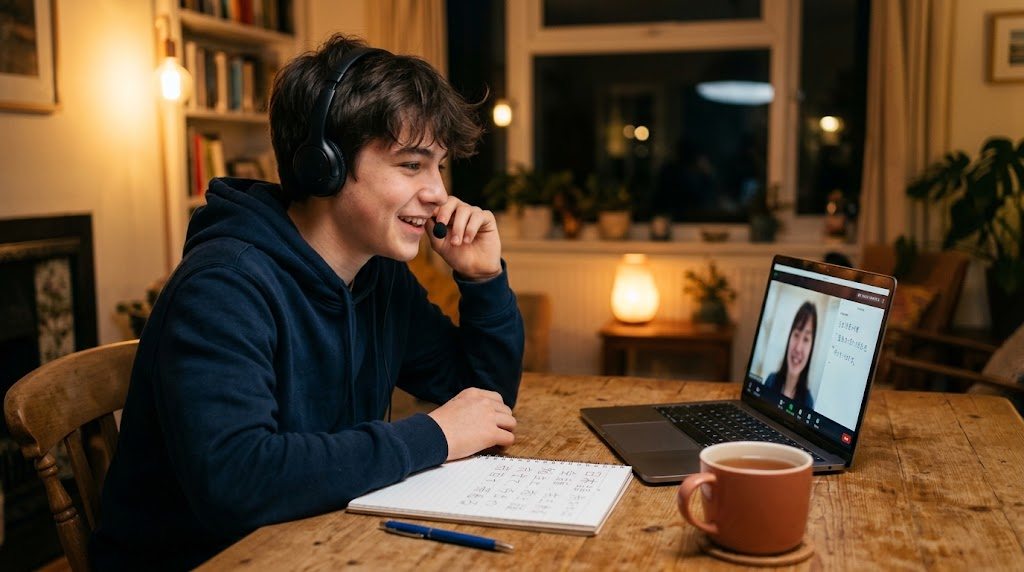
If you’re in Victoria or anywhere in Australia or New Zealand, the practical fit is unusually good. Melbourne is only an hour ahead of Japan (two during daylight saving), so Japan’s weekday-evening sessions land right in your teen’s after-school and evening — no awkward hours. Because attendance is unlimited on one flat fee, a VCE student can dial practice up in the weeks before the October oral exam and ease off during SAC crunch, without paying per session. We map JST to your city in our class-times-by-time-zone guide, and gather local details on our Japanese classes for Australia & New Zealand page.
A simple 3-month oral-prep rhythm
You don’t need a complicated plan. You need consistency:
- Months out: two or three unscripted Japanese conversations a week — about anything. The goal is comfort and speed, not perfection.
- ~6 weeks out: add a fortnightly mock oral with a teacher: 7 minutes general, 8 minutes on your Detailed Study subtopic, then targeted feedback.
- Final fortnight: keep talking daily but keep it light. Confidence and fluency are the goal now — this is the worst time to start memorising.
FAQ
How much is the VCE Japanese oral exam worth?
The oral examination contributes 12.5% of the overall VCE Japanese Second Language study score. The oral and written examinations together make up 50% of the study score, with School-assessed Coursework making up the rest.
How long is the exam and what are the two parts?
About 15 minutes: a roughly 7-minute general conversation about your personal world, followed by an ~8-minute discussion of your Detailed Study subtopic (up to one minute to introduce it, then about seven minutes of discussion).
When is the VCE oral exam held?
VCE languages oral examinations are held in October, ahead of the November written exams. Always confirm your exact date and venue against the current-year VCAA timetable, as scheduling is arranged through your school.
Can you help students in Year 11, before their exam year?
Yes — and it’s the ideal time to start. Conversational confidence built in Year 11 is worth far more than a rushed program in Term 3 of Year 12. Because attendance is unlimited, younger students simply speak more, earlier.
What does it cost?
One flat monthly fee for unlimited daily attendance (billed in Japanese yen; your local-currency amount is on the tuition page). Unlike per-lesson tutoring, ramping up before the oral exam costs nothing extra.
▼ Building toward VCE from primary school? Start here → choosing a Japanese school for kids in Sydney