Every HSC Japanese Continuers student is told to “do past papers.” Almost nobody is told how. So most students download a pack from NESA, work through it once, check the answers, feel vaguely reassured or vaguely sick, and move on. That is the least valuable possible use of the single best resource in NSW — a decade of real exams, with official marking guidelines and marking feedback attached.
This guide is the walkthrough: what’s actually in a Japanese Continuers exam pack, how to work each section so it teaches you something, the marking-guidelines trick almost no student uses, and the one part of the exam past papers cannot prepare you for at all.
What’s in the exam, and what past papers cover
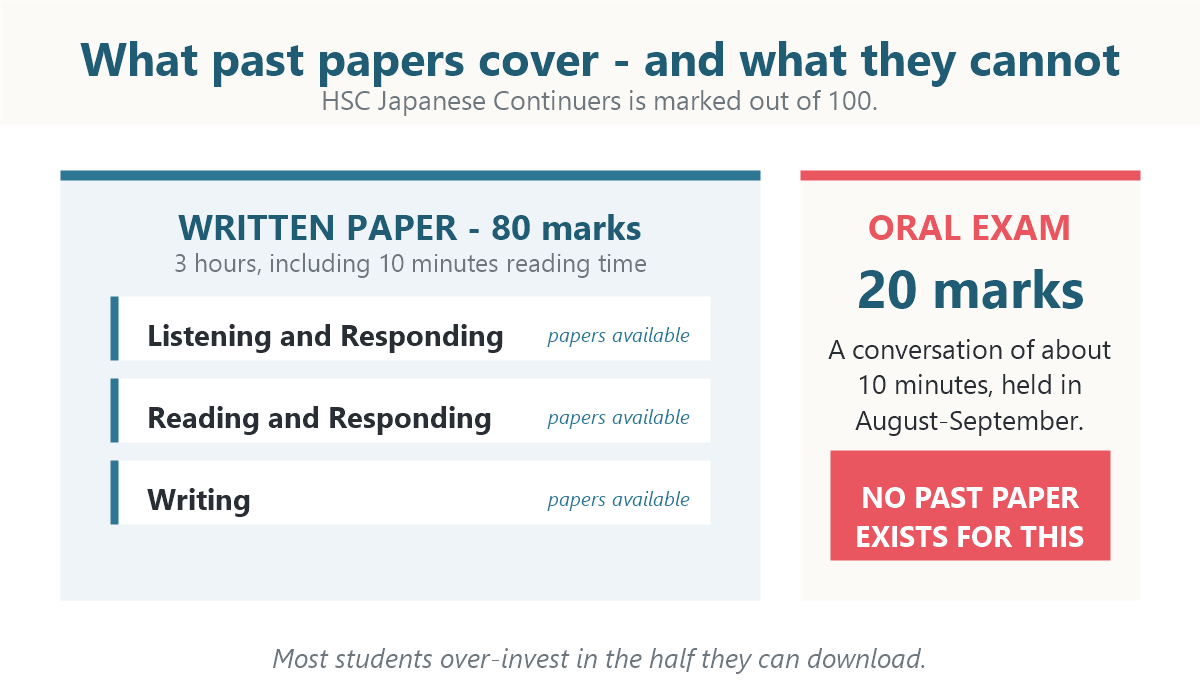
HSC Japanese Continuers is marked out of 100: a written paper worth 80 marks (3 hours including 10 minutes reading time) and an oral examination worth 20 marks — a roughly 10-minute conversation with an examiner. The written paper covers Listening and Responding, Reading and Responding, and Writing.
NESA publishes Japanese Continuers exam papers with marking guidelines and marking feedback, and the listening sections come with audio. That’s the whole point: you can mark yourself against the same criteria the markers used. Note the gap immediately, though — past papers cover the 80-mark written exam. They cover none of the 20-mark oral. More on that below, because it’s where most of the avoidable marks are lost.
Looking for a way to keep Japanese going from abroad?
TOMODACHI JAPAN is an online Japanese school for children growing up outside Japan. They talk with peers their own age in Japan every day, taught by teachers working at Japanese schools, in small classes of 8.
🎁 Register and we’ll email you our School Guide (PDF, in English) straight away. You’ll also be first to hear about tuition, scholarships and opening dates.
Free · takes about 30 seconds
The three ways students waste past papers
- Doing them too early, untimed, with a dictionary open. That’s a reading exercise, not a past paper. It tells you nothing about whether you can perform in three hours.
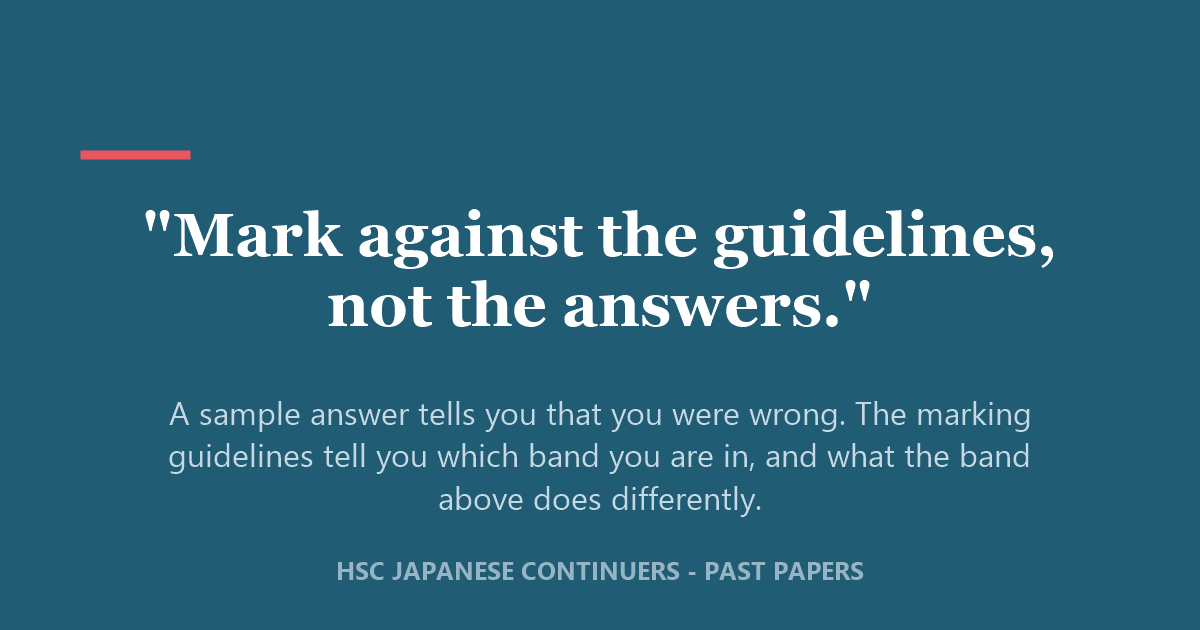
- Marking with the answers instead of the guidelines. The marking guidelines describe bands — what a top-band response does differently. Ticking against a sample answer teaches you nothing about why a 6/8 wasn’t an 8/8.
- Never re-reading the marking feedback. NESA’s feedback documents describe what the whole state got wrong that year. It is, effectively, a list of the traps that will be set again.
How to work a past paper properly, section by section
Listening and Responding
Play the audio at full speed, in exam conditions, no pausing. Then — and this is the step that matters — go back and listen a second time with the transcript, and mark every place where you lost the thread. Sort those into three buckets:
- I didn’t know the word. That’s a vocabulary job — easy, if unglamorous.
- I knew the word but didn’t recognise it spoken. This is the big one, and it’s a listening-exposure problem, not a study problem. It’s fixed by hearing Japanese spoken at natural speed, often, by different voices.
- I understood the words but missed the question. That’s exam technique — read the English question first, then listen for that specific thing.
Students who only do bucket 1 plateau. Bucket 2 is usually the largest, and it’s the reason a student can ace vocabulary tests and still lose listening marks: exam audio uses natural pace, contractions and intonation that textbook audio smooths out.
Reading and Responding
Some questions are phrased in English and require a response in English — they test whether you understood, not whether you can translate. A frequent and expensive mistake is answering these with a literal rendering of the Japanese instead of the inference the question asked for. If a question asks how the writer feels, “she wrote that she went to Osaka” is not an answer.
Work the section under time, then re-do the questions you dropped marks on without looking at the text — from memory of what you understood. If you can’t, you were decoding word by word rather than reading.
Writing
The writing section asks for an extended response in Japanese, in a specified text type and for a specified audience and purpose. Two habits raise marks quickly:
- Build a personal “structure bank,” not a memorised essay. Openings, ways to give a reason, ways to concede a point, ways to close — reusable across topics. Pre-written essays get shoehorned in and lose marks for not addressing the actual task.
- Match register to audience deliberately. A letter to a host family, a diary entry and an article to a school newspaper are not the same Japanese. Markers notice; students rarely practise it.
Then mark your own response against the marking guidelines and write one sentence explaining which band you’re in and what’s missing from the band above. Doing that ten times over a year is worth more than doing thirty papers unreflectively.
A realistic past-paper schedule
| When | What to do | Why |
|---|---|---|
| Term 1 | Sections only, untimed. One listening section, one reading section per fortnight | You haven’t covered the whole syllabus yet — full papers just demoralise |
| Term 2 | Timed sections. Start marking against the guidelines, not the answers | Builds the band-awareness that raises writing marks |
| Term 3 (Trials) | Two or three full papers under exam conditions, spaced apart | Stamina and pacing are separate skills from knowledge |
| Term 3–4 (post-Trials) | Targeted re-do of weak sections + daily speaking for the oral | The oral is in August–September — before the written exam. Don’t schedule it last |
That last row deserves emphasis. HSC Japanese oral examinations are held around August–September, usually at a designated venue rather than your own school, with scheduling arranged earlier in the year. A student who plans to “start speaking practice after Trials” has already missed it. Confirm your exact dates through your school and NESA.
The 20 marks past papers can’t touch
The oral is a 10-minute unscripted conversation worth 20% of the course. There is no past paper for it. You cannot download it, work through it, and mark it against a guideline. The only preparation that works is doing the thing: talking, in Japanese, with people who respond unpredictably.
And it’s where the marks are softest, because examiners reward things that are invisible in written practice — keeping a conversation going when you don’t know a word, asking questions back, giving an opinion and a reason, moving between past, present and future. Our HSC Japanese Continuers oral exam guide breaks the criteria down in detail.
An honest comparison of your practice options
| Option | Helps the written 80? | Helps the oral 20? | Cost shape | Watch-out |
|---|---|---|---|---|
| Past papers alone | Yes — the best single tool | No | Free (NESA) | Self-marking is only as good as your use of the guidelines |
| School class | Yes — teacher marking is invaluable | Partly | Included | Speaking time is split across a whole class; a few minutes each per week |
| Language apps | Vocabulary upkeep only | No — no real dialogue | Free–low | Cannot rehearse being asked an unexpected question |
| 1-on-1 tutor | Yes — strong for grammar & writing feedback | Some, if they know the HSC | Per hour — ramping up before August adds up | Language-subject tutoring in Australia commonly runs A$75–130/hr; one voice, one accent |
| TOMODACHI JAPAN | Indirectly (listening & reading fluency) | Yes — mock orals with teachers plus real talk with Japanese teens | One flat monthly fee, unlimited attendance | Runs on Japan time — an advantage in NSW (see below) |
Why “a real Japanese teacher” isn’t the same as “a Japanese tutor”
TOMODACHI JAPAN is an online school staffed by currently practising Japanese teachers — the same educators who teach children inside Japan — rather than a marketplace of freelance tutors. For an HSC student that shows up in two ways:
- Mock orals with real diagnosis. A teacher can run a ten-minute conversation the way an examiner would, then tell you precisely which criterion is costing you marks — conversation maintenance, appropriateness to context, or depth of opinion — rather than just saying “that was good.”
- Same-age Japanese peers, not only adults. Speaking with Japanese teenagers is what produces natural intonation and quick recovery. It also fixes the motivation problem: students who have friends in the sessions keep turning up in August, which is exactly when past-paper fatigue peaks.

The time-zone advantage
Sydney runs one hour ahead of Japan in winter, two hours ahead during daylight saving. So a session after school in NSW lands inside the Japanese afternoon and evening — no early mornings, no midnight lessons, no weekend sacrificed. See our time-zone guide and the Australia & New Zealand page for local times.
That convenience is what makes daily speaking practice survivable alongside a full HSC load. Past papers you can do at any hour; conversation needs another human awake at the same time — and for Australia, Japan is the one major market where that’s easy.
FAQ
Where do I get HSC Japanese Continuers past papers?
NESA publishes Japanese Continuers HSC exam papers on the NSW education standards website, generally as exam packs that include the paper, listening audio, marking guidelines and marking feedback. They are free. Always work from the official packs rather than second-hand copies, since formats change over time.
How many past papers should I do?
Fewer papers worked deeply beats more papers worked shallowly. A realistic target is sections through Terms 1–2 and two or three full timed papers around Trials, with every paper followed by marking against the guidelines and a written note on what the next band needs.
How much is the HSC Japanese oral worth, and when is it?
The oral examination is worth 20 marks out of 100 and is a conversation of roughly 10 minutes. It is held ahead of the written exams — typically around August–September, at a designated venue, with scheduling arranged earlier in the year. Confirm your dates through your school and NESA.
Can past papers help my speaking at all?
Indirectly. The listening audio is good exposure to natural pace, and reading texts feed vocabulary you can reuse when speaking. But nothing in a past paper rehearses being asked an unexpected question by a person, which is the actual skill the oral tests.
We’re in Victoria and sit the VCE — does this apply?
The study technique transfers, but the format doesn’t. VCE Japanese Second Language has a ~15-minute oral in October including a Detailed Study discussion. See our VCE Japanese oral exam guide and our guide to choosing a Detailed Study subtopic.
What does TOMODACHI JAPAN cost?
One flat monthly fee for unlimited daily attendance (billed in Japanese yen; your local-currency amount is on the tuition page). Adding sessions in the weeks before the oral costs nothing extra — unlike per-hour tutoring, where the ramp-up is exactly when the bill spikes.
▼ Long before HSC, most families start here → how to choose a Japanese school for kids in Sydney