Whether your child is a Japanese-heritage kid you want to keep bilingual, or a Malaysian anime fan who’s suddenly serious about learning the language, “Japanese classes in Kuala Lumpur” throws up a confusing mix — a full-time Japanese day school, a Saturday supplementary school, and a dozen adult-leaning language centres. They are not interchangeable. Here’s the short version up front: the Japanese School of Kuala Lumpur (JSKL) is a full-day school for Japanese-national families only; the KL Japanese Saturday School is a keep-up class for children already at local or international schools; and the after-school language centres are where most local beginners start (from around RM390 for a kids’ course). Below we sort every real option by who it’s actually for — with fees and sources as of July 2026 — and look at the online route that fits KL’s timezone almost perfectly.
Japanese classes for kids in Kuala Lumpur: the comparison
| School / centre | Type | For whom | Schedule | Fees (MYR) | Area |
|---|---|---|---|---|---|
| Japanese School of Kuala Lumpur (JSKL) | Full-day Japanese-curriculum school | Japanese nationals (JCKL member) | Mon–Fri | Community rate (on inquiry) | Shah Alam (Saujana) |
| KL Japanese Saturday School (KLJSS) | Saturday supplementary (keep-up hoshuko) | Heritage kids at local/intl schools | Saturday | approx. RM100 reg + RM40/Saturday | Klang Valley |
| My Teacher Languages | After-school class (kids 6–12) | Beginners | Term-based (~3 mth) | approx. RM390 (beginner course) | Kuala Lumpur |
| ICLS / Fuji / A to Z | Language centres | Kids & adults | Weekday & weekend | On inquiry | KL / Subang / Sunway |
| Superprof tutors | Private 1-to-1 | Any age | Flexible | from approx. RM30/hr | Online + in-person |
| TOMODACHI JAPAN | Online, conversation & friendship | Heritage kids & enthusiasts (5–18) | Any day (unlimited attendance) | One flat monthly fee — see the free guide | Your home |
Looking for a way to keep Japanese going from abroad?
TOMODACHI JAPAN is an online Japanese school for children growing up outside Japan. They talk with peers their own age in Japan every day, taught by teachers working at Japanese schools, in small classes of 8.
🎁 Register and we’ll email you our School Guide (PDF, in English) straight away. You’ll also be first to hear about tuition, scholarships and opening dates.
Free · takes about 30 seconds
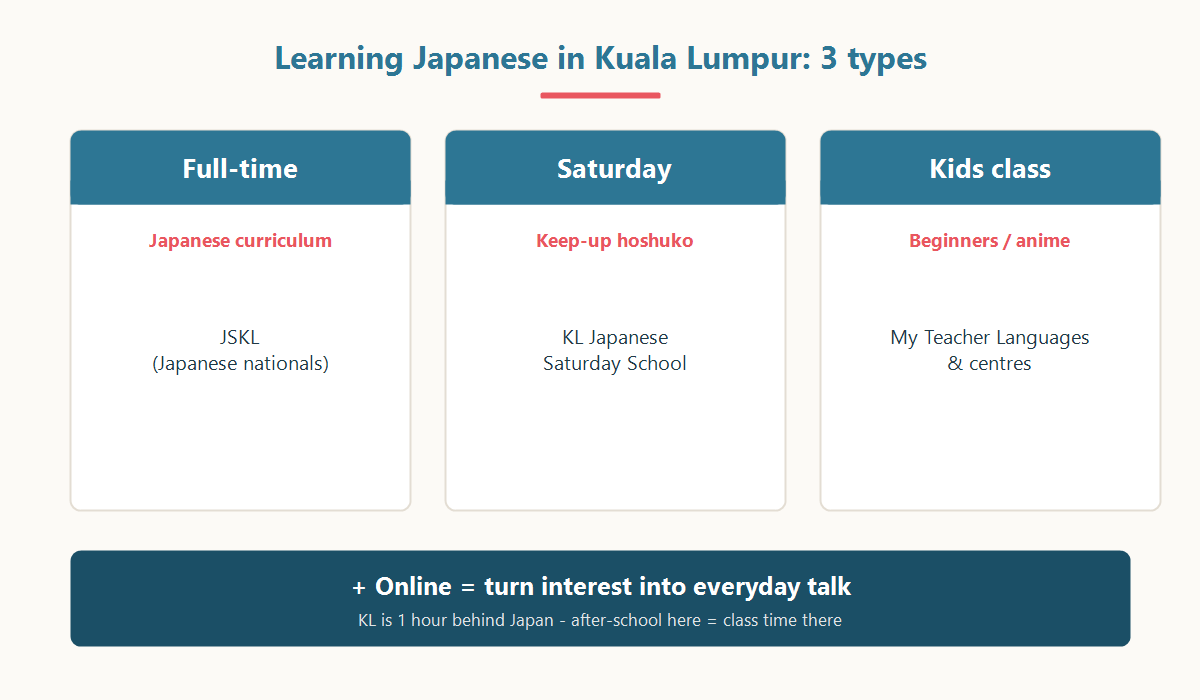
Three routes to Japanese in KL — and who each one is really for
Kuala Lumpur’s options look like a single long list, but they split into three very different routes. Picking the wrong one is the most common reason a keen child loses momentum after a term or two.
Full-day: the Japanese School of Kuala Lumpur (JSKL)
JSKL, established in 1966 and based in Shah Alam, is a full-day school running Japan’s national (MEXT) curriculum in Japanese, from kindergarten through junior high. Because it’s a non-profit community school, its fees sit well below KL’s commercial international schools. The important limitation: it’s effectively for Japanese-national children of expatriate families — enrolment generally requires Japanese nationality, a parent’s Japan Club of KL (JCKL) membership, and valid Malaysian residency. For most Malaysian families, and for mixed families whose child holds a different passport, this route simply isn’t open — which is exactly why the next two routes exist. JSKL official site
Saturday: the KL Japanese Saturday School (keep-up)
The KL Japanese Saturday School (KLJSS) is the MEXT-style supplementary school: children who attend a local or international school on weekdays come in on Saturdays to study the Japanese elementary and junior-high curriculum — kokugo (reading and writing), plus the school events that keep Japanese feeling like Japanese. It runs on a cost-share model rather than commercial tuition: roughly a RM100 one-off registration plus about RM40 per Saturday. It’s the natural home for a heritage child who already speaks Japanese and needs to keep literacy at grade level for a possible return to Japan — but, like every weekend school, it’s one session a week. KLJSS community
After-school centres: where local beginners start
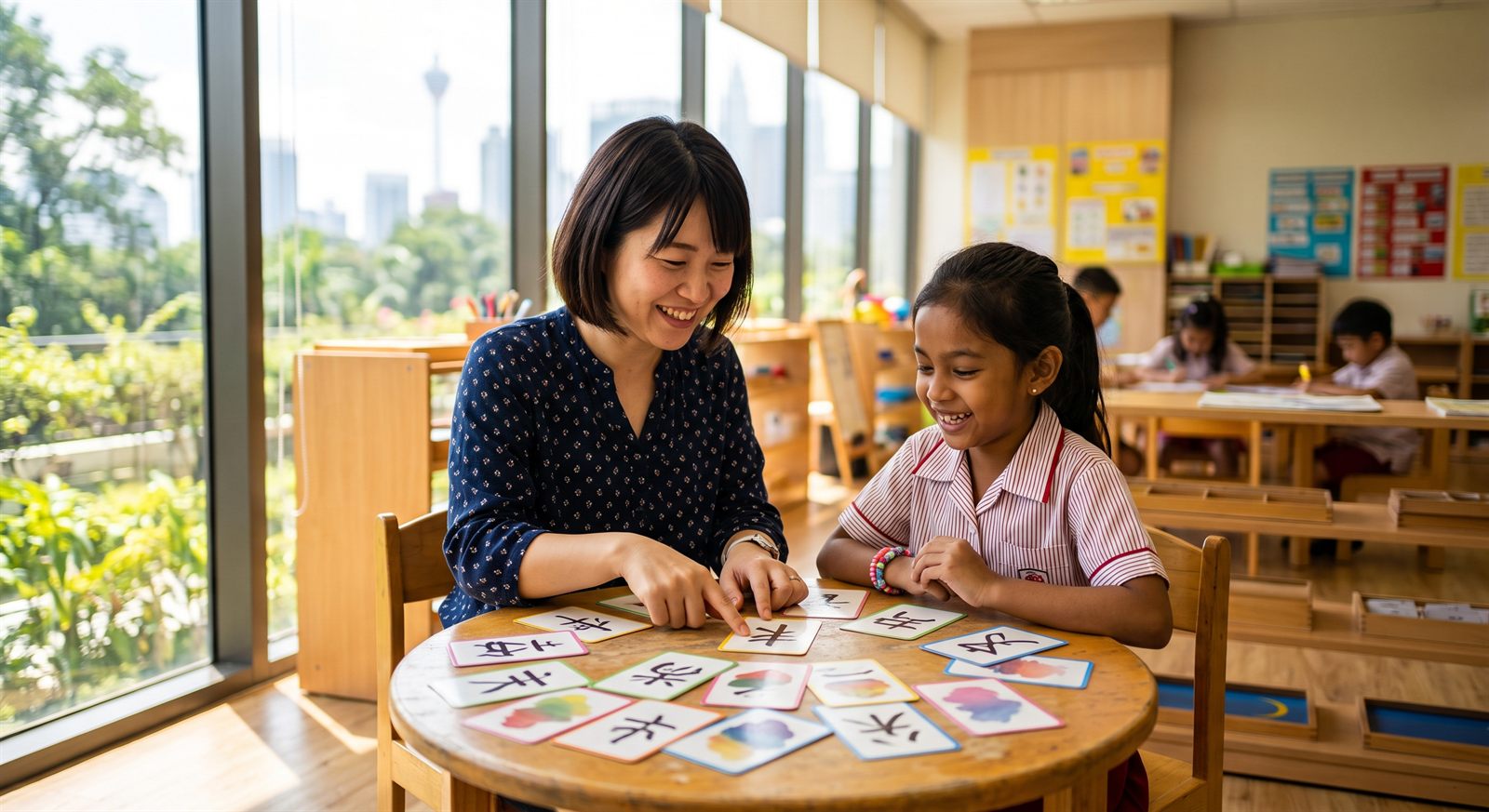
Malaysia has one of Southeast Asia’s biggest populations of Japanese learners — around 38,000 — and for many kids the spark is anime, manga and J-pop rather than heritage. For a local beginner, an after-school centre is the usual entry point. My Teacher Languages is one of the few that publishes a dedicated kids’ price (about RM390 for a beginner course aimed at ages 6–12). ICLS, Fuji and A to Z teach children and adults across KL, Subang and Sunway (fees on inquiry). Two big names to watch, though: the Japan Foundation KL only admits learners aged 16+, and the JCKL course starts at 12 — so neither suits young children, even though both rank highly in searches. My Teacher Languages / ICLS
Three KL-specific things to plan around
- The full-day school isn’t an option for most families. JSKL’s nationality and JCKL-membership requirements mean Malaysian families and many mixed families are looking at the Saturday school or a centre from the start — so choose based on your child’s actual level, not on the most prestigious name.
- Centres often start at “teenager and up.” Several of KL’s best-known Japanese schools set minimum ages of 12 or 16. For a genuinely young learner, the shortlist is shorter than the search results suggest — check the age policy before you visit.
- One class a week is the ceiling. Whether it’s the Saturday school or a weekend centre, a single weekly session — a few hours — isn’t enough Japanese “volume” on its own. Every option assumes the family adds practice during the week.
The online option: KL’s timezone makes it easy
A weekend class is a great start. But as most KL families find, one lesson a week won’t make a child a confident Japanese speaker. That’s the gap we built TOMODACHI JAPAN to fill: an online Japanese school opening in December 2026, designed as the “weekday Japanese time” that pairs with a Saturday class. (If you’re weighing this up against a supplementary school more broadly, see our guide to the online alternative to Japanese hoshuko.)
- KL is just 1 hour behind Japan. A 6 pm class in Japan is 5 pm in Kuala Lumpur — squarely in the after-school window. A Japan-based school can teach your child live, in real time, right after they finish school, with none of the late-night scheduling a Europe- or US-based online school forces on you.
- The other kids live in Japan. Your child talks in small groups with children from our sister school, NIJIN Academy, which has over 800 students across Japan. For a heritage child that’s living practice; for an anime fan it’s the real thing — actual Japanese friends, not just an app.
- Unlimited attendance solves the “volume” problem. For one flat monthly fee, your child can join every day if they like — grouped by conversation level, not grade, and taught by qualified, currently-practising Japanese teachers. Beginners and heritage speakers each land in the right group.

“Saturday school for reading and writing, weekday evenings online for talking with friends in Japan” — in KL, where the timezone lines up so neatly, that combination is the one that actually keeps a child going.
FAQ from Kuala Lumpur families
Can my child attend JSKL if we’re not Japanese nationals?
Generally no. JSKL is a community school for Japanese-national families and requires Japanese nationality plus JCKL membership. If your child holds a different passport — including many mixed-nationality children — the realistic options are the KL Japanese Saturday School (if they already have grade-level Japanese) or an after-school centre or online school (if they’re building it up). It’s worth confirming the current policy with JSKL directly, but plan around the Saturday/centre routes.
My child is a beginner who loves anime. Where should they start?
A beginners’ course at a kids-friendly centre (My Teacher Languages publishes a price; others quote on inquiry) is a solid start for the basics of hiragana and greetings. The thing anime fans usually crave, though, is actually talking — and that’s where a small-group online school with children in Japan adds the missing piece: real conversation, not just worksheets. Many families do both.
Is the timezone really an advantage from Malaysia?
Very much so. Malaysia is UTC+8 and Japan is UTC+9, so Japan is only one hour ahead. Japan’s after-school and early-evening classes fall in KL’s after-school window too — no dawn or midnight lessons. Compared with families in Europe or the Americas trying to join a Japan-based school, KL is about as convenient as it gets.
Can we combine online with a Saturday school?
Yes — that’s the intended use. TOMODACHI JAPAN is unlimited-attendance, so children join on the days that suit them and ease off when the Saturday school’s homework is heavy. The roles are complementary: reading and writing at the weekend school, speaking volume and friendships online.