If you have searched “Japanese school Dubai” you almost certainly searched “Japanese school Dubai fees” straight afterwards — and found nothing straight. Here is the short answer up front. Dubai has one Japanese school: the Japanese School Dubai (ドバイ日本人学校) in Al Wasl, a MEXT-accredited full-time day school running Nursery to Grade 9 — no high school. Third-party directories put its 2025/26 tuition at roughly AED 32,400–38,400 per year depending on year group, plus entrance and enrolment fees and about AED 700 a month for the bus. And there is no Japanese Saturday school anywhere in the UAE — MEXT’s official list contains no 補習授業校 for the Emirates at all. So if your child is at an international school and you want part-time Japanese, the government-backed option you are looking for does not exist here. Below is an honest comparison of every real option in Dubai, with the fees written down instead of hidden.
Japanese school in Dubai: the comparison
| School | Type | Day | Ages | Tuition | Area |
|---|---|---|---|---|---|
| Japanese School Dubai (ドバイ日本人学校) | Full-time MEXT-accredited day school | Monday–Friday | Nursery/FS – Grade 9 (approx. 3–15) | AED 32,400–38,400/yr (third-party figures — see note) | Al Wasl / Jumeirah |
| Japanese Saturday school (補習授業校) | — | — | — | Does not exist anywhere in the UAE | — |
| Berlitz Dubai | Private institute (kids & teens programmes) | On enquiry | Not specified | Contact the school | Dubai |
| Eton Institute | Private institute (Young Learners section) | 10 private / 12 group sessions over 2–8 weeks | Minimum age not stated | Contact the school | Dubai Knowledge Park |
| Japan Center / UAE–Japan Cultural Centre | Community Japanese course | Saturday 09:30–12:30 | 15+ (13+ with parental consent) | AED 2,500/term (AED 2,300 high-school students) | Sharjah (different emirate) |
| Speak Japanese with Nigina (via Skilldeer) | Private tutor | Flexible | 4–17 | AED 330/online session; AED 110/in-person private session | Dubai |
| Octus Mindz (via Skilldeer) | Private & group courses | Group: Sundays | Not stated | AED 6,150 private in-person; AED 4,200 online; AED 2,350 group | Dubai |
| TOMODACHI JAPAN | Online, conversation & friendship | Any day (unlimited attendance) | 5–18 | One flat monthly fee — see the free guide | Your home |
Looking for a way to keep Japanese going from abroad?
TOMODACHI JAPAN is an online Japanese school for children growing up outside Japan. They talk with peers their own age in Japan every day, taught by teachers working at Japanese schools, in small classes of 8.
🎁 Register and we’ll email you our School Guide (PDF, in English) straight away. You’ll also be first to hear about tuition, scholarships and opening dates.
Free · takes about 30 seconds
Three routes to Japanese in Dubai — and why the difference matters
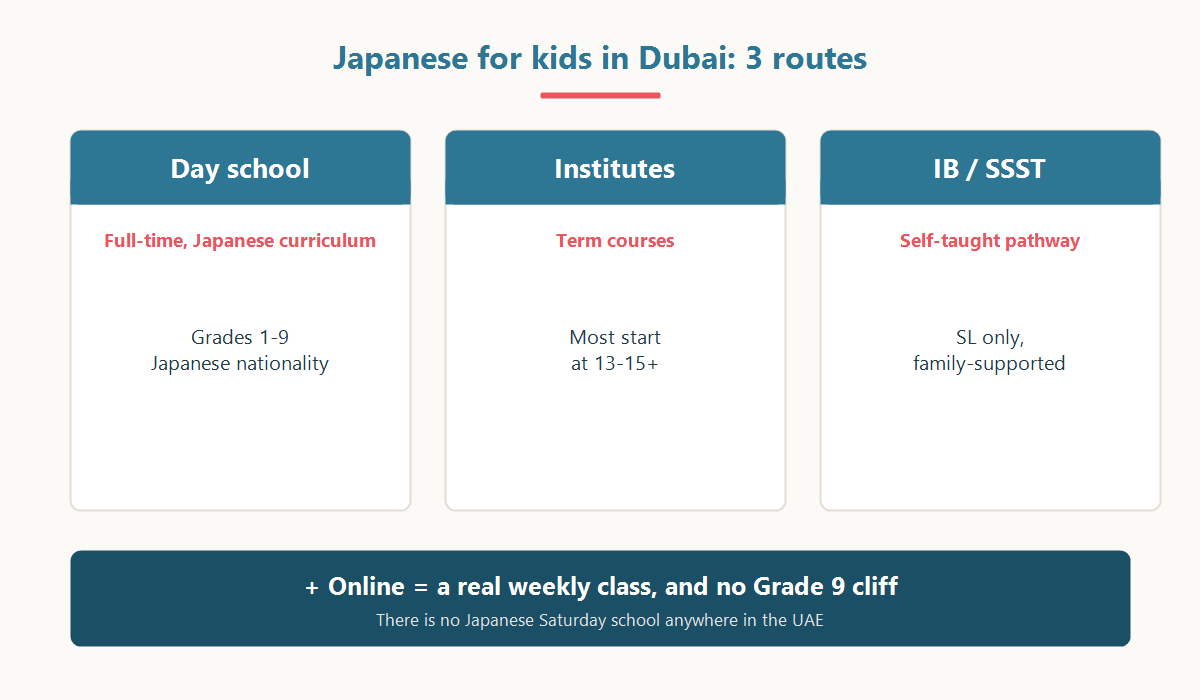
Most guides to “Japanese school Dubai” are written for the general international-school shopper, so they treat every result as the same kind of thing. They are not remotely the same. One is a full-time Japanese-curriculum school with an eligibility gate and an age ceiling. One is a set of commercial language institutes, several of which quietly do not take primary-age children. One is an examination entitlement your child’s own school has to arrange. Knowing which of the three you are actually shopping for saves a lot of wasted phone calls.
Route 1: the Japanese School Dubai — full-time, Japanese curriculum
The Japanese School Dubai, branded in English as Dubai Japanese School, is a KHDA-registered, MEXT-accredited full-time 在外教育施設 and a non-profit, with teachers dispatched from Japan. It was founded in 1980 and has been in Al Wasl / Jumeirah beside Al Safa Park since 1987. It runs Nursery/Foundation Stage through Grade 9 only, the academic year starts in April, and the KHDA inspection of February 2024 recorded 175 students with 26 teachers and 3 teaching assistants — a ratio of about 1:6. Its DSIB rating has been Good in every cycle since 2008-09. For a corporate-posting family who will return to the Japanese system, this is a genuinely strong school and the obvious first call.
Here is the fee picture that no ranking page prints properly. Again: these figures come from third-party directories, not from the school.
| Year group | Annual tuition (AED, 2025/26) |
|---|---|
| Pre-KG / FS1 | 38,400 |
| KG1 / FS2 | 38,400 |
| KG2 / Year 1 | 38,400 |
| Grades 1–3 | 32,400 |
| Grades 4–6 | 33,000 |
| Grades 7–9 | 33,600 |
| Stated average | 34,500 |
| Entrance fee (new students) | 2,800 one-off |
| Application fee (incl. assessment) | 500 |
| Enrolment / re-enrolment fee | up to 10% of tuition |
| School bus | approx. 700 per month |
On eligibility, be realistic but do not assume the door is shut. Japanese nationality is the baseline, and the school’s own site frames intake as Japanese nationals, children of mixed Japanese heritage with one Japanese parent, and children with prior experience in Japan. But exceptions exist: a child who can communicate in Japanese may enrol with the permission of the school’s governing board, and students transferring in from international schools may sit a simple Japanese interview and test. It is not absolutely closed — two Emirati students attend. Admission is rolling year-round with one exception: Grade 9 students must enrol by the start of the second semester, because of how grades are evaluated for Japanese high-school entrance exams.
Japanese School Dubai — official site
Route 2: private institutes and tutors — check the minimum age first
Dubai has a healthy commercial language market, and these providers do good work — but the age question decides everything and is rarely on the search result you clicked. Berlitz Dubai runs kids and teens programmes, though it does not specify ages publicly. Eton Institute in Dubai Knowledge Park has a Young Learners section; its Japanese courses run as 10 private or semi-private sessions, or 12 group sessions across two to eight weeks, and it does not state a minimum age. Both quote on enquiry. On the marketplace side, Speak Japanese with Nigina takes ages 4–17 at AED 330 per online session or AED 110 per in-person private session, and Octus Mindz sells course packages at AED 6,150 private in-person, AED 4,200 online, or AED 2,350 for a Sunday group.
The one that catches families out is the Japan Center / UAE–Japan Cultural Centre. It looks perfect on paper — Saturday mornings, 09:30–12:30, three terms of nine weeks, AED 2,500 per term or AED 2,300 for high-school students. But it excludes children: entry is 15 and over, or 13 and over with parental consent. And it is in Sharjah, a different emirate. It is the only structured weekend Japanese class we could find in the country, and it will not take a primary-age child.
Berlitz Dubai — Japanese · Eton Institute — Japanese · Japan Center / UAE–Japan Cultural Centre
Route 3: the IB mother-tongue route (SSST)
If your child is heading for the IB Diploma at a Dubai international school and you want Japanese on the transcript, the route that exists is School-Supported Self-Taught (SSST) Language A: Literature at Standard Level. This is the IB’s mother-tongue entitlement for cases where a school cannot staff the language, and Japanese is supported. Understand what it is before you rely on it: it is SL only, and it is not a taught class. The school supervises; the reading, the literary analysis and the maintenance of academic Japanese literacy land on your family. We could not verify that any Dubai international school teaches Japanese as a timetabled GCSE, IGCSE or IB subject, so for most families SSST is the realistic credential path — and it only works if the child’s written Japanese has been kept alive for years beforehand.
Five Dubai-specific things to plan around
- The Grade 9 cliff is a certainty, not a risk. The Japanese School Dubai ends at Grade 9, around age 15. There is no Japanese high school in the UAE. Every family who enrols faces a forced transition at 15, and almost all Grade 9 graduates return to Japan for high school. That is not a flaw in the school — it is simply the shape of the system here, and it means the question “what happens at 15?” belongs in your plan from day one, not from Grade 8.
- There is no Japanese Saturday school anywhere in the UAE. MEXT’s official list shows exactly two UAE entries — ドバイ日本人学校 and アブダビ日本人学校 — and no 補習授業校 at all. If your child is at a British or IB school in Dubai and you want part-time, grade-level Japanese alongside it, the Japanese-government-backed option other expat cities take for granted does not exist for you. This is the single biggest gap in Dubai, and no ranking page mentions it.
- Budget the total, not the tuition line. On the reported figures, a Grade 4 child starting fresh is not AED 33,000 — it is tuition plus an AED 2,800 entrance fee, an AED 500 application fee, an enrolment fee of up to 10% of tuition, and roughly AED 700 a month if you use the bus. Nobody publishes that total. And because the school itself publishes no schedule, you are budgeting off directory data until you phone them.
- The commute is a Sheikh Zayed Road problem. The school sits in central-old Dubai, in Al Wasl / Jumeirah. If you live in Dubai Marina, JLT, JVC, Dubai Hills, Arabian Ranches or Dubai South, that is a peak-traffic run twice a day. The school does operate eight bus routes, each with a driver and a bus attendant, which is genuinely reassuring — but it is a cost line and a long morning for a small child either way.
- Your free time is Friday afternoon and the weekend — and nothing Japanese runs in it. Since 1 January 2022 the UAE weekend has been Saturday–Sunday, and all Dubai private schools run Monday to Friday with a Friday finish no later than 12:00. So a Dubai family has Friday afternoon plus Saturday and Sunday free. The only structured weekend Japanese class we found is in Sharjah, on Saturday mornings, and does not take children. That empty space in the week is exactly where an online option fits.
The online option: filling the gap Dubai leaves open
If your child is in an international school in Dubai, or has aged out at Grade 9, or simply does not fit the intake criteria, the honest position is that Dubai has no part-time Japanese option built for children. That is the gap an online school fills — the same logic we cover in our guide to the online alternative to Japanese hoshuko. For Dubai specifically, three things line up.
- The time difference works in your favour. Dubai is five hours behind Japan, so Japan’s late-afternoon and evening classes land in the Dubai afternoon — after the school day, from home, with no Sheikh Zayed Road run and no weekend lost. For a city where the local school day finishes early, especially on Fridays, that fit is unusually clean.
- The other children actually live in Japan. TOMODACHI JAPAN runs on NIJIN Academy, with 800+ students, so your child is not practising Japanese with other expat children in Dubai — they are making friends their own age who live in Japan. For a family whose child will one day return for high school, that connection to Japan and to their own identity is worth as much as the grammar. Language stays alive when there is someone you like on the other end of it.
- Unlimited attendance, one flat fee, built for children. One flat monthly fee for as many sessions as your child wants — grouped by conversation level rather than school grade, taught by qualified, practising Japanese teachers. No per-session arithmetic, no minimum-age surprise, no term-by-term repurchase.
Dubai gives you one Japanese school, one age ceiling and no weekend option. An online class gives your child Japan on the other five days.
FAQ from Dubai families
What does the Japanese School Dubai actually cost in a year?
On the 2025/26 figures reported by third-party school directories, tuition runs from AED 32,400 for Grades 1–3 up to AED 38,400 for the early years, with a stated average of AED 34,500. On top of that: an AED 2,800 entrance fee for new students, an AED 500 application fee including the assessment, an enrolment or re-enrolment fee of up to 10% of tuition, and about AED 700 a month if you use the school bus. We have to be straight with you about the sourcing: the school publishes no fee schedule on its own website, and the third-party sources disagree — one widely-read site quotes “from AED 8,822 per year”, which is roughly a quarter of what every other source reports. Use the numbers above to plan, then phone the school on +971 4 344 9119 to confirm.
Does my child need Japanese nationality to enrol?
Japanese nationality is the baseline, and the school frames its intake as Japanese nationals, children of mixed Japanese heritage with one Japanese parent, and children with prior experience in Japan. But it is not absolutely closed. A student who can communicate in Japanese may enrol with the permission of the school’s governing board, and children transferring in from international schools may sit a simple Japanese interview and test. Two Emirati students attend. If you are a mixed-heritage family, the honest advice is to ask the school directly rather than assume either way — and note that admission is rolling year-round except for Grade 9, where enrolment must happen by the start of the second semester.
Is there a Japanese Saturday school in Dubai?
No — and not anywhere else in the UAE either. MEXT’s official list of overseas Japanese educational institutions contains only two UAE entries, the Dubai and Abu Dhabi full-time schools, and no supplementary school (補習授業校). The nearest thing to a weekend Japanese class we found is the Japan Center in Sharjah, which runs Saturdays 09:30–12:30 but takes students from 15 (or 13 with parental consent), so it is not an option for a primary-age child. For part-time Japanese in Dubai you are looking at private institutes, private tutors, or an online school.
Does the time difference to Japan work for online lessons from Dubai?
It works well. Dubai is five hours behind Japan, so a class held in Japan’s late afternoon or evening arrives in the Dubai afternoon — after school, at home. Combined with a Monday-to-Friday school week that finishes by 12:00 on Fridays, there is plenty of room in a Dubai child’s week for regular Japanese without touching the family’s Saturday and Sunday. Of all the constraints in this article, the clock is the one that is on your side.