Type Japanese worksheets for kids into a search bar and you get two kinds of result. Pages of hiragana tracing sheets with no explanation, and pinned images that lead to a paywall. Neither tells you the thing that matters most: who the worksheet was written for.
Most of the best free Japanese worksheets on the internet were made for children in Japan, who already speak Japanese and are learning to write it. Most English-language ones were made for teens and adults. A worksheet that suits a six-year-old in Osaka can stall a six-year-old in Ohio, and the reverse is just as true. This guide sorts the good sources by who they are really for, checks their terms, and gives you a ten-minute routine that makes any of them work.
First, which kind of family are you?
Your answer changes which worksheets will help.
- Your child already speaks some Japanese at home. Worksheets written for Japanese children are ideal. Your child knows the words on the page; they only need to learn to read and write them. Instructions will be in Japanese, which is fine if a parent reads Japanese.
- Your child is starting Japanese from zero, and you don’t speak it. Native-speaker worksheets will frustrate you both, because every example word is unfamiliar. You need learner materials with English support, and you need to spend more time saying words than writing them.
Want your child to use their kana with friends in Japan?
TOMODACHI JAPAN is an online Japanese school for children growing up outside Japan. They talk with peers their own age in Japan every day, taught by teachers working at Japanese schools, in small classes of 8.
🎁 Register and we’ll email you our School Guide (PDF, in English) straight away. You’ll also be first to hear about tuition, scholarships and opening dates.
Free · takes about 30 seconds
The best free Japanese worksheets for kids
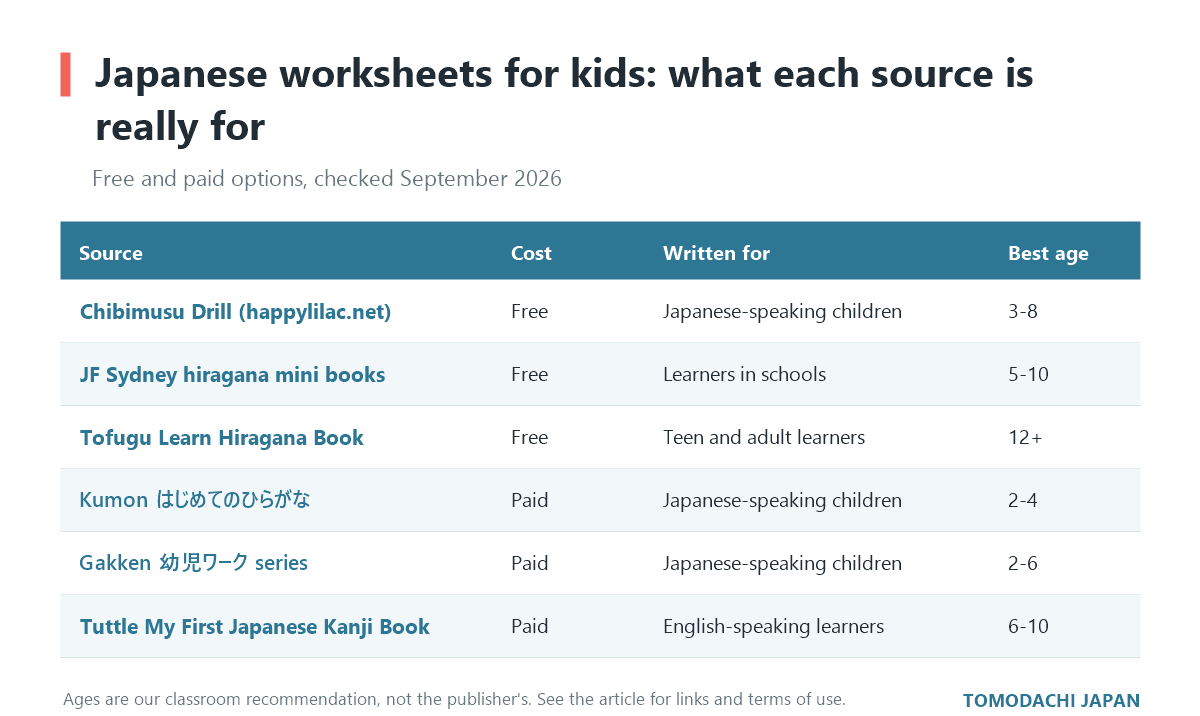
1. Chibimusu Drill (happylilac.net) — for Japanese-speaking children
A very large free printable site used by Japanese families. Its hiragana sheets come with or without stroke-order guides and in dark or light tracing, so you can step a child from tracing to writing on the same letter. The site says its materials are completely free for normal use. Its terms do set limits: schools may not post the PDFs publicly, and tutors should have students download files themselves. Instructions and example words are in Japanese.
2. Japan Foundation Sydney hiragana mini books — for learners
The Japan Foundation’s Sydney office publishes free classroom resources, including hiragana mini books: nine series and more than 45 little eight-page stories, each built around one kana, as printable color and coloring-in PDFs. They were made for teachers of non-Japanese-speaking children, which is exactly why they work at home for beginners. Start here if your family does not speak Japanese.
3. Japan Foundation London — for primary classrooms
JF London’s teaching resources include Ready Steady NihonGO!, lesson materials designed for primary school age, plus a taster activity pack. They are lessons rather than drill sheets, so they are best if you want structure as well as practice.
4. Tofugu’s Learn Hiragana Book — for older kids and teens
A free 71-page PDF with stroke order and tracing practice, written for teen and adult learners. Clear and well designed, but the explanations assume a reader, not a preschooler. Good from about age 11 or 12.
Two popular recommendations we would skip if you live outside Japan. NHK for School is excellent, but it cannot be used from outside Japan. CASTA-NET is often listed as a resource for overseas Japanese children; it is actually a Ministry of Education site for teaching children of foreign backgrounds living in Japan.
Paid Japanese workbooks worth buying
| Workbook | Publisher | Written for | What to know |
|---|---|---|---|
| はじめてのひらがな (Hajimete no Hiragana) | Kumon | Japanese-speaking children, ages 2–4 | Kumon’s method builds up from tracing practice. Its preschool drills have sold over 100 million copies |
| ひらがな 2・3・4さい (write-and-wipe) | Kumon | Japanese-speaking children, ages 2–4 | Reusable pages, so one book lasts for repeated practice |
| 学研の幼児ワーク (Gakken Youji Work) | Gakken | Japanese-speaking children, ages 2–6 | A large series; pick by skill (hiragana, katakana, numbers) |
| My First Japanese Kanji Book | Tuttle | English-speaking learners | 109 kanji including all first-grade kanji, with English explanations and audio |
| Let’s Learn Hiragana | Kodansha | Self-study learners | 72 pages; better for an older child working with a parent |
Buying Kumon or Gakken from abroad usually means a Japanese bookshop such as Kinokuniya, or Amazon Japan’s international shipping. Tuttle and Kodansha titles are sold through ordinary English-language bookshops.
How to use Japanese worksheets without killing the fun
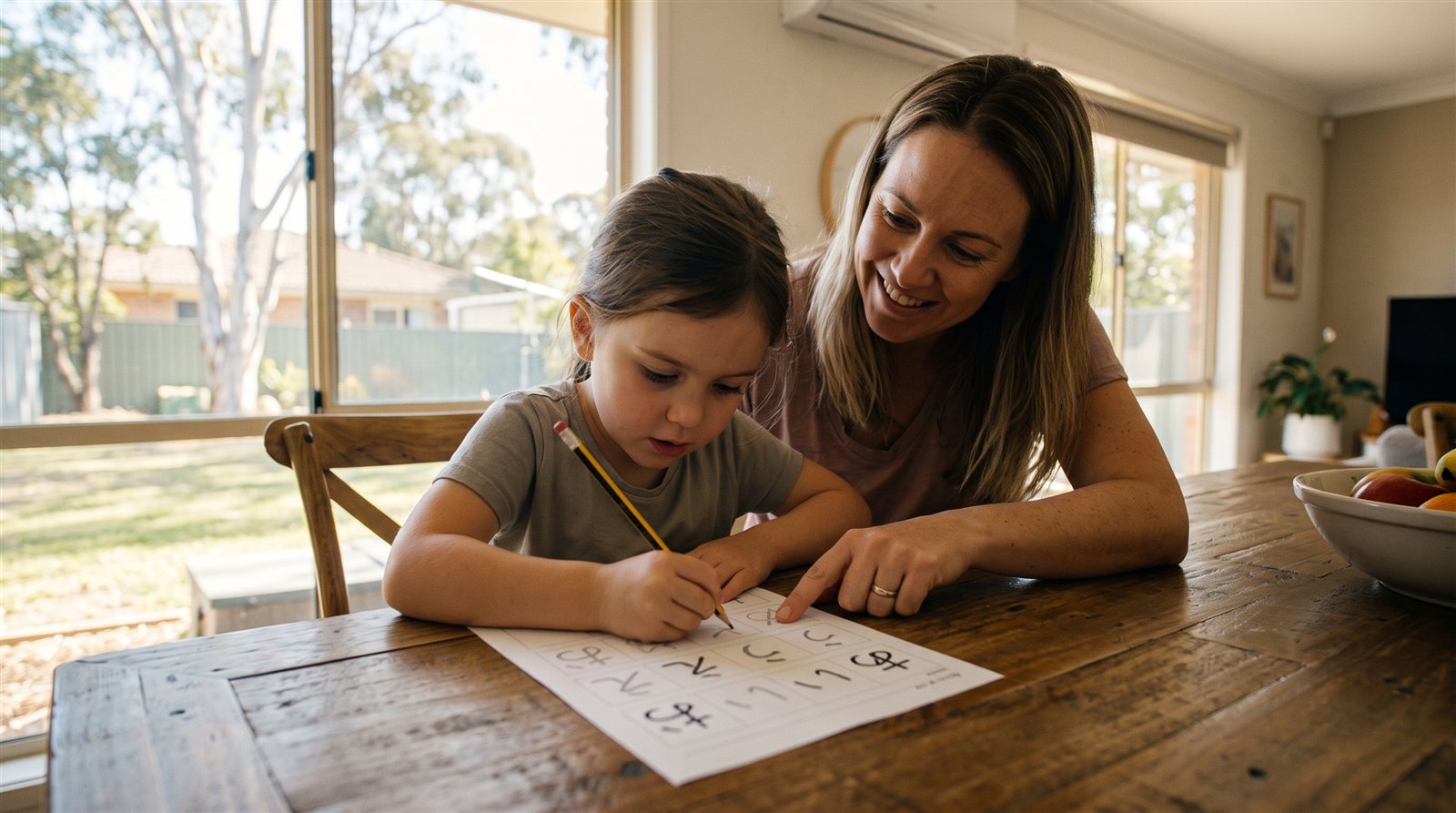
The mistake almost every parent makes, including the ones who are teachers, is too much tracing. A full row of あ feels productive and teaches very little after the third one. Japan’s own kindergarten curriculum aims to grow children’s interest in letters through play and daily life, not through drills. Keep that spirit.
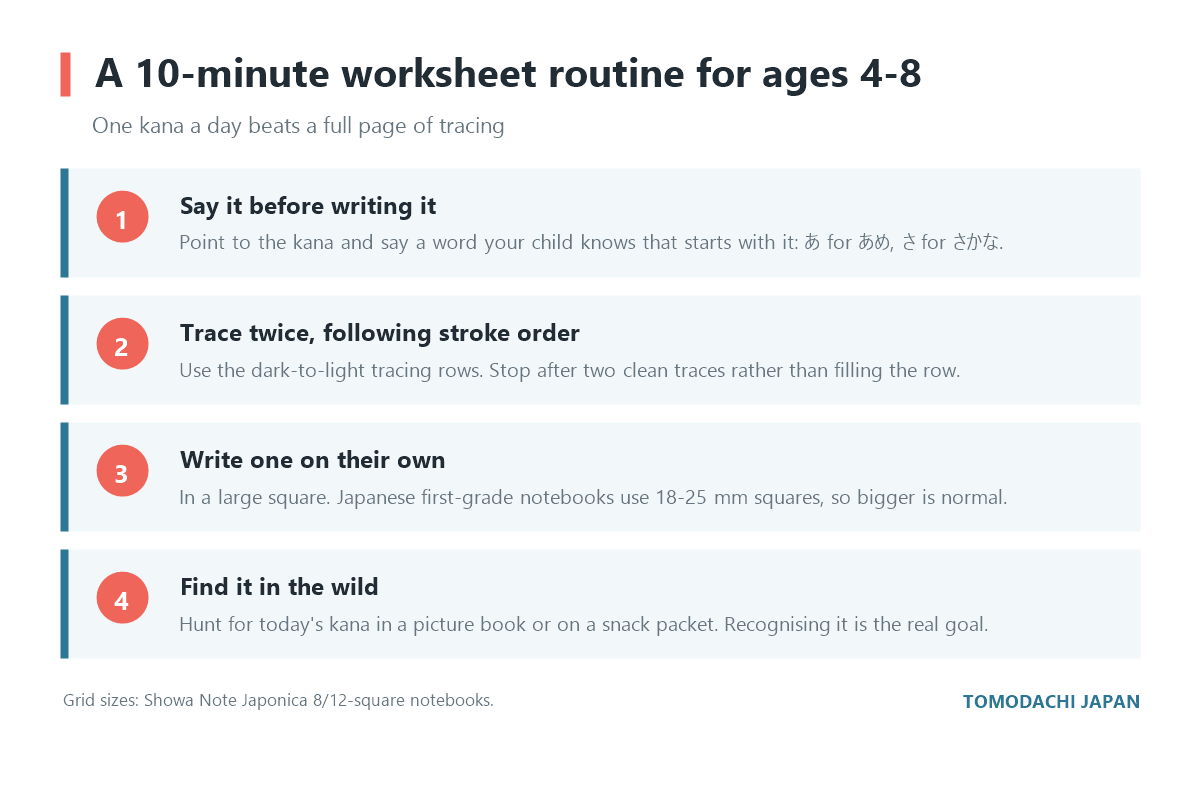
Ten minutes, one kana, four steps. Say a word that starts with the kana before any pencil touches paper. Trace twice following stroke order — Japan’s curriculum for first and second grade explicitly asks children to write carefully in stroke order, because it is what makes handwriting legible later. Write one alone, big: Japanese first-grade notebooks use squares of 18 to 25 millimeters, far larger than most Western worksheets. Then find it in a picture book or on a food packet.
Here is a simple four-week start, using the order children meet kana on a standard chart:
| Week | Kana | Words to say first |
|---|---|---|
| 1 | あ い う え お | あめ (candy / rain), いぬ (dog), うさぎ (rabbit), えき (station), おにぎり (rice ball) |
| 2 | か き く け こ | かさ (umbrella), きつね (fox), くるま (car), けむし (caterpillar), こども (child) |
| 3 | さ し す せ そ | さかな (fish), しか (deer), すし (sushi), せみ (cicada), そら (sky) |
| 4 | Your child’s name | Write their own name in hiragana. This week matters most for motivation |
A note from a Japanese classroom teacher
In a Japanese first-grade classroom, we spend a surprising amount of time on things that are not letters at all: how to hold the pencil, how to sit, where the stroke starts and which way it ends — whether it stops, flicks up or fades out. Those endings, called とめ, はね and はらい, are what make a child’s あ look like an あ rather than a knot. Worksheets show them, but a parent has to point them out.
The other thing I would say to parents abroad: reading comes before writing, and speaking comes before both. A child who can happily say twenty words beginning with か will learn to write か in a day. A child who has traced か a hundred times but never says a Japanese word has learned a shape. If you only have ten minutes, talk for eight and write for two.
Frequently asked questions
What age should my child start Japanese worksheets?
Pencil work suits most children from about four, when they can hold a pencil with control. Before that, talk, sing and read aloud. Kumon’s preschool materials start from tracing practice for exactly that reason.
Hiragana or katakana first?
Hiragana. Japanese children’s books are written mostly in hiragana, so it unlocks reading soonest. Katakana can follow once hiragana is comfortable.
Can I print free worksheets for my child’s class or my tutoring group?
Check each site’s terms first. Chibimusu Drill, for example, restricts schools from posting its PDFs publicly and asks tutors to have students download the files themselves. Home use is generally fine.
I don’t speak Japanese. Can I still teach with worksheets?
Yes, for kana. Use learner materials with audio so your child hears correct pronunciation, not yours. Where you will hit a wall is speaking: a worksheet cannot hold a conversation, and that is the part children need real Japanese speakers for.
How many worksheets a day?
One, done well. There is no official guideline on worksheet time for young children, but in our experience ten focused minutes a day beats forty minutes on a Saturday, and stopping while your child still wants more is the best way to get tomorrow’s ten minutes.
Related: our broader guide to Japanese for kids, with the first 50 words to teach, how much Japanese practice kids really need, and raising a bilingual Japanese child abroad.
The short version
Match the worksheet to your family: native-speaker drills if your child speaks Japanese, learner materials if not. The Japan Foundation’s free resources are the best starting point for beginners. Keep it to ten minutes and one kana, follow stroke order, and spend more of that time saying words than tracing them.