
Search “Japanese for kids” and you will be offered worksheets, printable PDFs, YouTube channels, apps and textbooks — hundreds of them, most of them free. Parents rarely have a resource problem. What they have is a sequencing problem: nobody tells them what to teach at what age, in what order, and which of those free resources is worth an evening. This is that answer, written by teachers, with a first-50-words list you can print from this page.
Start with the age, not the resource
The single most common mistake we see is a parent buying a textbook aimed at an adult beginner and working through it with a six-year-old. The child is not failing; the material is aimed at a different brain. What a child can do with Japanese changes sharply between five and eleven.
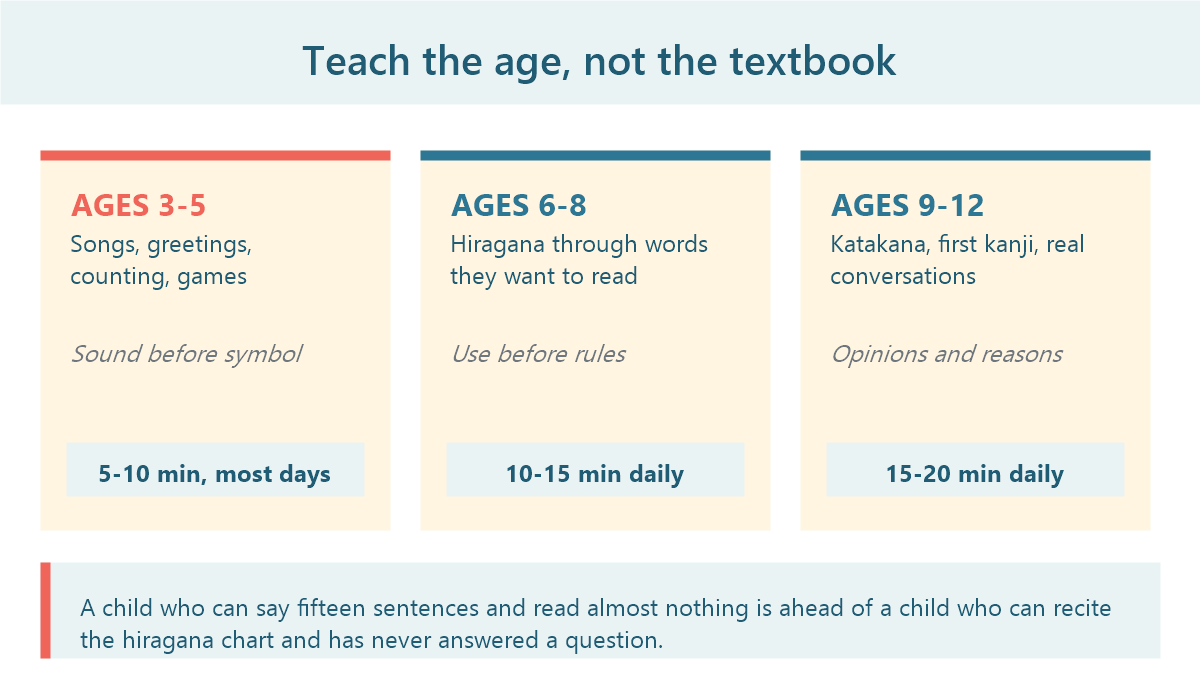
| Age | What works | What to skip | Realistic dose |
|---|---|---|---|
| 3–5 | Songs, greetings, counting, animal and food words, physical games. Sound before symbol. | Writing, grammar explanations, romaji drills | 5–10 minutes, most days, always playful |
| 6–8 | Hiragana through words they want to read, short spoken exchanges, picture books, simple questions and answers | Kanji beyond a handful, verb conjugation tables | 10–15 minutes daily, plus one longer social session a week |
| 9–12 | Katakana, first kanji, writing short messages, real conversations with peers, opinions and reasons | Adult textbooks, JLPT grinding before they can hold a conversation | 15–20 minutes daily, plus weekly speaking with other people |
One principle sits under all three rows: sound comes before symbol, and use comes before rules. A child who can say fifteen sentences and read almost nothing is in a far better position than a child who can recite the hiragana chart and has never answered a question in Japanese.
Looking for a way to keep Japanese going from abroad?
TOMODACHI JAPAN is an online Japanese school for children growing up outside Japan. They talk with peers their own age in Japan every day, taught by teachers working at Japanese schools, in small classes of 8.
🎁 Register and we’ll email you our School Guide (PDF, in English) straight away. You’ll also be first to hear about tuition, scholarships and opening dates.
Free · takes about 30 seconds
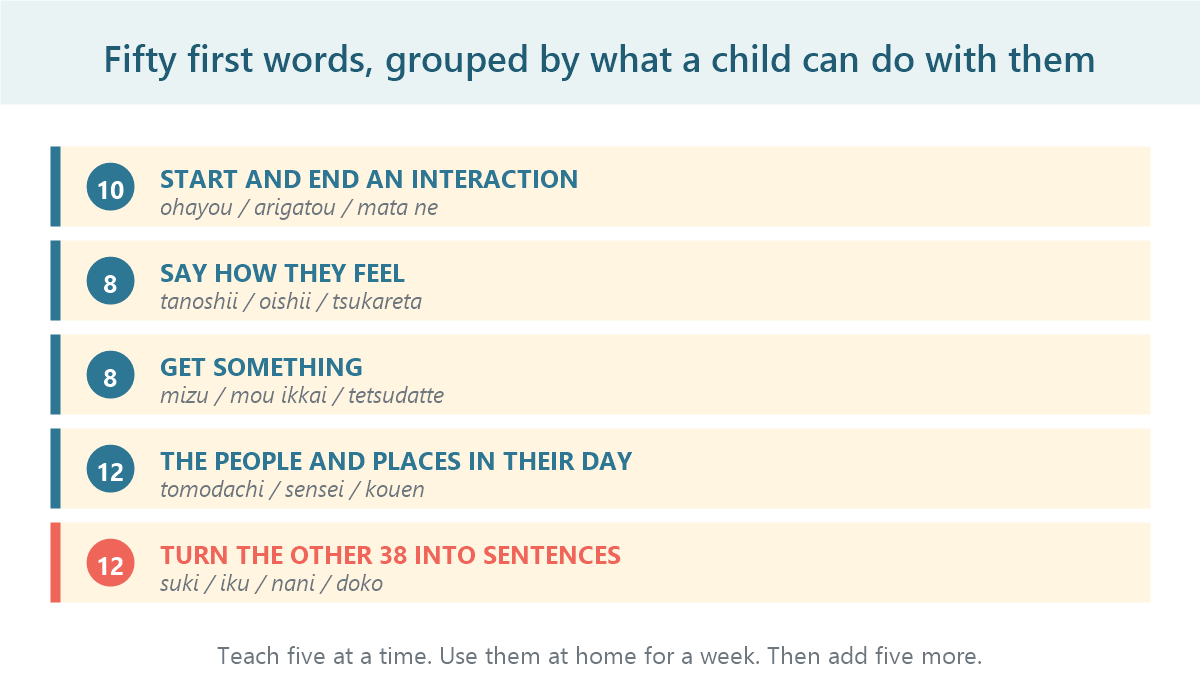
A first fifty words, chosen to be used today
Most beginner word lists are organised for the convenience of the list — colours, then numbers, then animals. This one is organised by what a child can do with it in the next ten minutes. Print this page, put it on the fridge, and tick a word when your child has actually said it to a person.
1. Words that start and end an interaction (10)
| Japanese | Reading | English |
|---|---|---|
| おはよう | ohayou | good morning (casual) |
| こんにちは | konnichiwa | hello |
| こんばんは | konbanwa | good evening |
| またね | mata ne | see you |
| ありがとう | arigatou | thank you |
| ごめんね | gomen ne | sorry (to a friend) |
| おねがいします | onegaishimasu | please (asking for something) |
| はい | hai | yes |
| ううん | uun | no (casual) |
| いただきます | itadakimasu | said before eating |
2. Words that say how they feel (8)
| Japanese | Reading | English |
|---|---|---|
| たのしい | tanoshii | fun |
| うれしい | ureshii | happy |
| おいしい | oishii | delicious |
| すごい | sugoi | amazing |
| つかれた | tsukareta | I’m tired |
| おなかすいた | onaka suita | I’m hungry |
| こわい | kowai | scary |
| だいすき | daisuki | I really like it |
3. Words that get them something (8)
| Japanese | Reading | English |
|---|---|---|
| みず | mizu | water |
| ごはん | gohan | rice, a meal |
| トイレ | toire | toilet |
| もういっかい | mou ikkai | one more time |
| ちょっとまって | chotto matte | wait a moment |
| てつだって | tetsudatte | help me |
| これ | kore | this one |
| どれ | dore | which one |
4. The people and places in their day (12)
| Japanese | Reading | English |
|---|---|---|
| おかあさん | okaasan | mum |
| おとうさん | otousan | dad |
| おばあちゃん | obaachan | grandma |
| おじいちゃん | ojiichan | grandpa |
| ともだち | tomodachi | friend |
| せんせい | sensei | teacher |
| がっこう | gakkou | school |
| いえ | ie | house, home |
| こうえん | kouen | park |
| ねこ | neko | cat |
| いぬ | inu | dog |
| ほん | hon | book |
5. Twelve words that turn the other 38 into sentences
| Japanese | Reading | English | Try it |
|---|---|---|---|
| すき | suki | like | ねこがすき — I like cats |
| ある / いる | aru / iru | there is (thing / living) | ねこがいる — there’s a cat |
| いく | iku | to go | こうえんにいく — I’m going to the park |
| たべる | taberu | to eat | ごはんをたべる |
| のむ | nomu | to drink | みずをのむ |
| みる | miru | to watch, to see | アニメをみる |
| する | suru | to do | なにをする? — what shall we do? |
| なに | nani | what | これはなに? |
| どこ | doko | where | ねこはどこ? |
| だれ | dare | who | だれといく? |
| おおきい | ookii | big | おおきいいぬ |
| ちいさい | chiisai | small | ちいさいねこ |
Do not teach them as a list. Teach five at a time, use them for a week in real situations at home — at dinner, at the door, at bedtime — and only then add five more. Ten weeks and your child owns fifty words they have actually used, which is worth more than five hundred they have seen.
Hiragana: the order nobody tells you
The standard chart runs あ い う え お, and children dutifully learn it top to bottom and cannot read a single word for three weeks. Teach the chart order for reference, but introduce characters through words your child wants to read: their own name, ねこ, すき, the title of the show they watch. A child who can read one real word after twenty minutes will come back tomorrow.
And a firm recommendation: get off romaji as early as you can. Romaji is a crutch that makes the first fortnight easier and the next two years harder, because it trains the eye to expect English letters and quietly wrecks pronunciation. Use it in a word list like the one above, where it is a pronunciation guide for parents. Do not use it as your child’s reading system.
What each free resource is actually good for
| Resource | Genuinely good for | What it cannot do |
|---|---|---|
| Printable worksheets and PDFs | Handwriting, stroke order, quiet independent minutes | Nothing spoken. A worksheet never asks a follow-up question. |
| YouTube channels and songs | Ear training, rhythm, vocabulary that sticks because it is set to music | No feedback. Your child can mispronounce a word for a year and nobody corrects it. |
| Apps and games | Streaks, kana recognition, five minutes in a car | Recognition is not production. Tapping the right answer is not saying it. |
| Picture books | Reading with meaning, shared time with a parent | Hard to find at the right level outside Japan |
| Weekend Japanese school | Structure, classmates, real teachers | Costs a Saturday, often pitched at native-level children |
| Talking with other children | Everything the rows above cannot do | Requires other children who speak Japanese |
The honest bit
You can assemble a very good Japanese programme for your child out of free material, and many families do. What no amount of free material provides is the thing that makes a child keep going: someone on the other side who is waiting for them to say something. Worksheets do not wait. Apps do not care. Children work for people.
That is the piece we exist to supply. At TOMODACHI JAPAN children learn in small groups with qualified Japanese teachers and with children who actually live in Japan — so the fifty words above get spent on friends, weekly, and the free resources at home suddenly start to compound. Request the school guide here.
Next steps, depending on where you are: what a first term of classes should look like, whether a tutor is the right format for your child, and raising a bilingual Japanese child abroad.
FAQ
What age should a child start Japanese?
Whenever you can make it enjoyable and repeatable. Three-year-olds absorb sound beautifully but need a parent to carry the whole session; eight-year-olds can do a real lesson and read. There is no window that closes — but there is a habit that gets harder to start once a child’s week fills up.
Is Japanese hard for children to learn?
The spoken language is unusually kind to beginners: few sounds, no tones, very regular verbs. The writing is the hard part, and it arrives later. Children who are told “Japanese is hard” before they have said anything tend to believe it; children who can already say ten things find the writing much easier to face.
How long should we practise each day?
Less than you think, more often than you think. Ten focused minutes daily beats an hour on Sunday, because language is a habit before it is knowledge. Consistency is the variable that predicts where a child is in two years.
I do not speak Japanese. Can I still help?
Yes, and in one specific way: be the audience. You do not need to teach or correct — you need to ask “what’s this one?”, be delighted, and keep the routine on the calendar. Parents who learn alongside their child, badly and cheerfully, get better outcomes than parents who supervise.