The AP Japanese exam (officially AP Japanese Language and Culture) is a fully digital test of about 1 hour and 50 minutes, taken in the Bluebook app. Starting with the May 2027 exam, it has two sections worth 50% each: Section I, Free Response (4 questions, 40–45 minutes: a Project Presentation, a Project Q&A, a Story Narration and an Email Response) and Section II, Multiple Choice (55 questions, 65 minutes: 25 listening and 30 reading). The next exam is Tuesday, May 11, 2027.
If you studied from older prep books or talked to last year’s seniors, here’s the important part: the exam was redesigned for the 2026–27 school year. The Text Chat, Compare and Contrast Article, Conversation and Cultural Perspective Presentation that appeared on the May 2026 exam are gone, and a research project you complete before exam day now drives 35% of your score. This guide walks through the new format task by task, shows what the scoring guidelines actually reward, and gives you a week-by-week plan plus a phrase bank written by Japanese teachers. Every number below comes from College Board’s own pages, with the year noted.

AP Japanese exam format at a glance (May 2027)
Here is the whole exam on one screen. Timing and weighting are taken from the AP Japanese Language and Culture Course and Exam Description (CED, effective fall 2026) and the AP Students exam page for 2027.
| Section | Task | Questions | Time | Share of score |
|---|---|---|---|---|
| I-A Speaking | Q1 Project Presentation | 1 | 3 min prep + 3 min speaking | 20% |
| I-A Speaking | Q2 Project Q&A | 4 prompts | 40 sec per answer (each question played twice) | 15% |
| I-B Writing | Q3 Story Narration | 1 (four pictures) | 30 min for both writing tasks | 7.5% |
| I-B Writing | Q4 Email Response | 1 | 7.5% | |
| II-A Listening | 5 audio sets | 25 | 25 min | 25% |
| II-B Reading | 6 text sets | 30 | 40 min | 25% |
| Total | 4 FRQs + 55 MCQs | about 1 hr 50 min | 100% | |
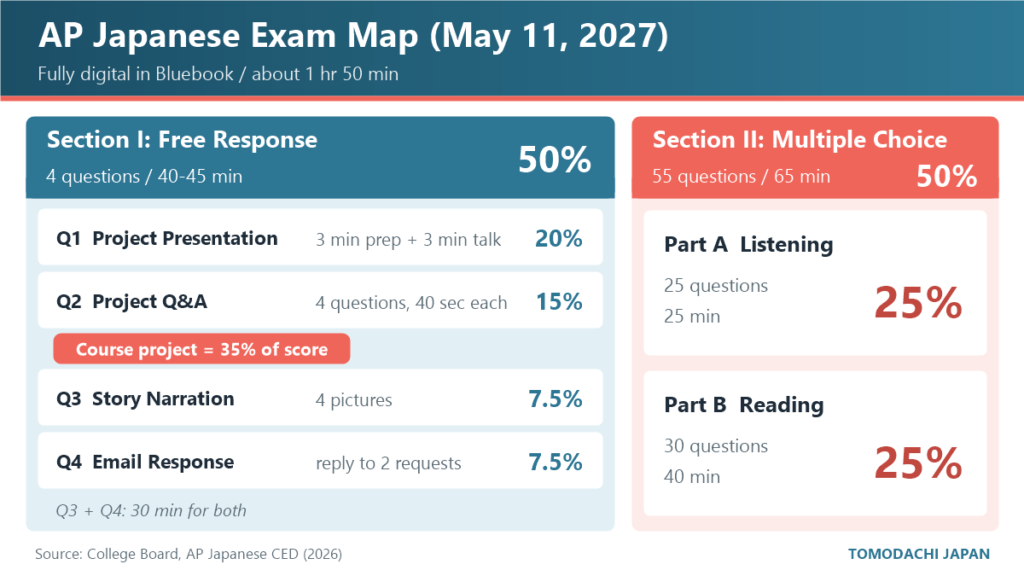
Three things about this layout surprise most students:
- Free response comes first. You open the exam by speaking, while your energy is highest. Plan your warm-up accordingly.
- Speaking is worth more than writing. The two speaking tasks together are 35% of your score; the two writing tasks together are 15%. Both speaking tasks grow out of the course project.
- Everything is typed or recorded in Bluebook. College Board states that all six AP world language and culture exams moved to Bluebook and that paper exams are discontinued (2026–27 revisions). If you’ve only ever handwritten Japanese, start typing with a Japanese IME now.
The exam draws on six thematic units: Families and Communities, Language and Culture, Art and Creativity, Science and Technology, Contemporary Life, and Global Contexts (CED, 2026).
Looking for a way to keep Japanese going from abroad?
TOMODACHI JAPAN is an online Japanese school for children growing up outside Japan. They talk with peers their own age in Japan every day, taught by teachers working at Japanese schools, in small classes of 8.
🎁 Register and we’ll email you our School Guide (PDF, in English) straight away. You’ll also be first to hear about tuition, scholarships and opening dates.
Free · takes about 30 seconds
The course project: Project Presentation and Project Q&A
This is the biggest change, and it’s where the points are. College Board releases a Course Project Packet in January of the exam year. It includes a project prompt and 6–8 source materials (audio, charts, texts). For 2026–27, the project comes from Unit 3, Art and Creativity, and focuses on music as a lens for exploring cultural products, practices and perspectives; the packet arrives in January 2027.
You research the topic in relation to a region or community you choose, then build a Personalized Project Reference (PPR), an outline you’ll be allowed to look at during the exam. The PPR must be submitted through AP Digital Portfolio by April 30, 2027, 11:59 p.m. ET. On exam day you get a printed copy.
Question 1: Project Presentation (11 points, 20% of your score)
You get 3 minutes to prepare and 3 minutes to present, using your PPR. The scoring guidelines have five rows: task completion (0–2), cultural understanding (0–2), organization (0–2), language control (0–3) and delivery (0–2). To earn the top marks you need to explain at least three factors with relevant details, use specific examples from your research that connect cultural perspectives to products or practices, and speak clearly at a natural pace.
Note the cultural understanding row. Describing what Japanese people do is not enough; the rubric wants you to explain why, meaning the value or way of thinking behind it. That is the difference between a 1 and a 2 on that row.
Question 2: Project Q&A (9 points, 15% of your score)
Right after your presentation, a recorded interviewer asks four questions about your topic and research. You hear each question twice and have 40 seconds to answer each one. You do not see the questions in advance. The rows are task completion (0–2), cultural understanding (0–2), language control (0–3) and delivery (0–2). In at least one answer, you need to make a cultural comparison or reflect on how perspectives connect to products and practices.
The CED gives teachers some revealing advice here: students should use the full 40 seconds, should not overuse memorized stock phrases (its examples are lines like what a good question or let me think for a minute), should avoid shifting register mid-answer, and are not penalized for self-correcting. So if you hear yourself say 食べるました, stop and say 食べました. That costs you nothing.
The writing tasks: Story Narration and Email Response
You have 30 minutes for both, typed in Japanese. Each is scored out of 8 points and is worth 7.5% of the exam.
Question 3: Story Narration (8 points)
You see four pictures in sequence and write a complete, coherent story. The scoring guidelines rate narrative development (0–3), organization (0–2) and language control (0–3). A 3 on narrative development means all four pictures are integrated and you add relevant details or dialogue; the guidelines even say a top response tells a narrative that would be clear without the images. Responses that only describe each picture, or list words, sit at 1 point. Organization at 2 points needs a clear beginning, middle and end, and cohesive devices.
Question 4: Email Response (8 points)
You read an email from a friend or a member of the community and type a reply. The rows are message development (0–3), organization (0–2) and language control (0–3). Two details decide many scores. First, the email asks you for two pieces of information, and only a response that answers both, with details or examples, can reach 3 on message development. Second, the 2-point organization descriptor explicitly mentions a greeting and closing. Language control at 1 or 2 points mentions an inappropriate register, or shifting between registers.
From a Japanese teacher: In the Email Response, pick one register in the first line and keep it until the last. If the email comes from a friend, plain form (だ style) can work, but most students are safer choosing です/ます all the way through, because one stray 行くよ in a polite email is exactly the register shift the guidelines describe. If the sender is a teacher, host family or community member, stay in です/ます and add one or two set phrases a Japanese reader expects, like メールをありがとうございました at the top and よろしくお願いいたします at the end. To a Japanese reader, those lines signal that you understand the relationship, and that is what culturally appropriate means in practice. You don’t need difficult keigo like いらっしゃる or 申し上げる to score well; consistent, correct です/ます beats ambitious but broken honorifics.
Multiple choice: listening and reading
Section II has 55 questions in 11 sets of five. Listening (25 questions, 25 minutes) has five sets: Audio and Chart, Audio Report, Conversation, Instructional Guidance and Presentation. Reading (30 questions, 40 minutes) has six sets drawn from Article, Article and Chart, Correspondence, Literary Text and Promotional Material, with the mix varying by year (CED, 2026). Charts appear in both parts, so practice reading a graph with Japanese labels, such as 割合 (percentage), 増加 (increase) and 減少 (decrease), not just paragraphs.
Scoring and the AP Japanese score distribution
Raw points from each part are weighted (the table above) and converted to the 1–5 AP scale. AP Japanese has historically had one of the highest shares of 5s of any AP exam, partly because many test takers grew up speaking Japanese at home. But the distribution is also unusually split, with a large group at 1. Here are the published figures from AP Students:
| Score | 2026 | 2025 | 2024 |
|---|---|---|---|
| 5 | 47% | 43.3% | 49.1% |
| 4 | 10% | 11.3% | 10.2% |
| 3 | 15% | 20.2% | 16.9% |
| 2 | 7% | 7.5% | 7.2% |
| 1 | 21% | 17.8% | 16.7% |
| 3 or higher | 72% | 74.8% | 76.2% |
| Test takers | not yet published | 3,245 | 3,125 |
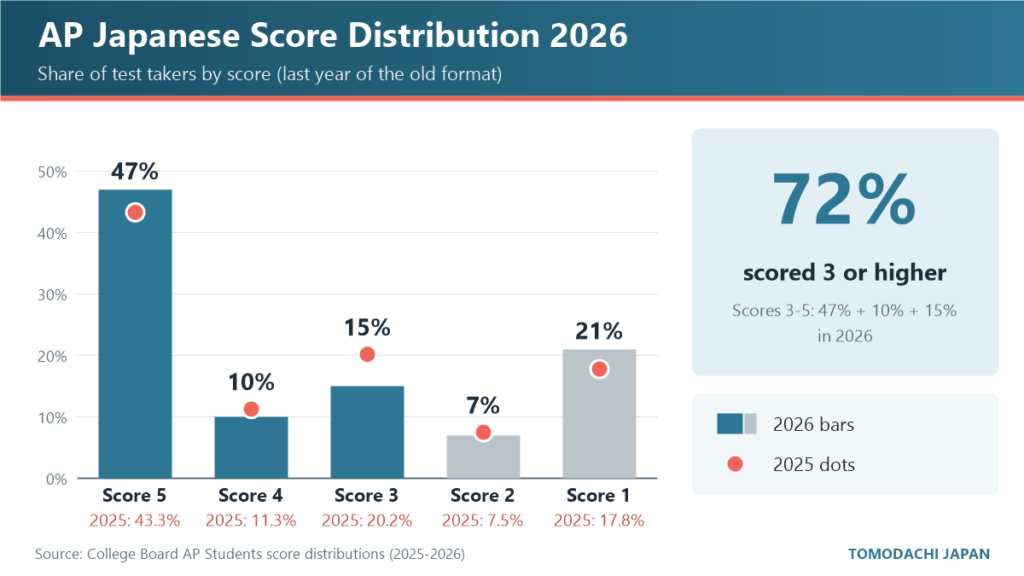
Two honest takeaways. If you’re a classroom learner, don’t let the 47% figure scare you; you’re being compared with a scale, not ranked against heritage speakers. And because 2027 is the first year of a new design, nobody knows yet how the new tasks will shift the curve. Anyone promising you exact cut scores for 2027 is guessing.
The AP Japanese kanji list
The CED includes an official kanji list in its appendix. College Board says students are expected to be able to interpret and produce texts using those kanji, that the list is based on a survey of commonly used textbooks, and that it reflects college courses of roughly 300 hours of classroom instruction. It’s ordered by JIS code, not by difficulty, so don’t study it top to bottom.
A better approach is to sort the list by theme as you go: family and school words for Unit 1, culture and language for Unit 2, music and art for Unit 3 (handy for the project), and so on. And because the exam is typed, your real job is recognizing the right kanji when your IME offers several, like choosing 会う versus 合う or 着る versus 切る. Practice typing sentences, not single characters, so you learn which conversion fits the context.
AP Japanese exam 2026 and 2027 dates and registration
- May 2026 exam (already given): Tuesday, May 12, 2026, 12 p.m. local time, with late testing on Monday, May 18, 2026 at 8 a.m. This was the last exam in the old format.
- Exam orders: Your school’s AP coordinator must submit exam orders by November 13, 2026, 11:59 p.m. ET. Orders placed after that carry an extra $40 late fee per exam.
- Project packet: released in January 2027 through AP Digital Portfolio.
- PPR deadline: April 30, 2027, 11:59 p.m. ET.
- Exam day: Tuesday, May 11, 2027 (week 2 of the May 3–14 exam window).
- Scores: released in July 2027.
If your school doesn’t offer AP Japanese, you can still test by arranging with a nearby school’s AP coordinator; College Board has guidance for students who don’t attend the testing school. Start that conversation in September or October, not in spring.
A 30-week AP Japanese study plan (October to May)
This plan assumes you’re starting in early October 2026 with about three to four years of school Japanese, and studying 3 to 4 hours a week outside class. Heritage speakers can compress the language blocks and spend the time on writing accuracy and kanji.

| Weeks | Dates (approx.) | Focus | What to produce |
|---|---|---|---|
| 1–4 | Oct | Diagnose and set up typing | One timed Email Response and one Story Narration; install a Japanese IME and type 10 minutes a day |
| 5–10 | Nov–mid Dec | Writing tasks | One email and one story per week, self-scored with the CED guidelines; a personal list of your top 10 errors |
| 11–14 | mid Dec–Jan | Listening and reading sets | Two MC sets a week from AP Classroom; read charts aloud in Japanese |
| 15–19 | Jan–Feb | Project: explore and research | Read all packet sources; pick your region or community; choose three factors |
| 20–24 | Mar–early Apr | Project: build and rehearse | Draft the PPR as key words, not a script; record a 3-minute talk twice a week |
| 25–27 | Apr | Q&A drills and PPR submit | Have a friend or teacher ask surprise questions, answer in 40 seconds; submit PPR before April 30 |
| 28–30 | May 1–10 | Full rehearsal | One full timed run in Bluebook-style conditions; light review the last two days |
Free, official resources to build this around:
- AP Classroom: your teacher can assign topic questions, progress checks and the example project prompt with source materials.
- The CED itself: it contains sample multiple-choice items and the full scoring guidelines for all four free-response questions. Score your own work against them.
- Released free-response questions on AP Central: the 2023–2026 sets use the old tasks, but the Conversation prompts are still good 40-second speaking drills, and the listening scripts are great shadowing material.
- Bluebook practice: open the app before exam day so the interface is not a surprise.
If oral exams make you nervous in general, our guide to Japanese oral exam questions and a six-week plan has rehearsal routines that transfer well to the Project Q&A. Students comparing systems may also find the GCSE Japanese past papers guide useful as extra reading and writing practice at a slightly lower level.
Phrase bank for the free-response tasks
These are the connective phrases our teachers see separate a 2 from a 3 on the organization and language rows. Learn them as patterns, then swap in your own content. Don’t paste the same five into every answer; the CED specifically warns against stock phrases that replace real content.
| Task | Japanese | Romaji | English |
|---|---|---|---|
| メールをありがとうございました。 | Mēru o arigatō gozaimashita. | Thank you for your email. | |
| ご質問にお答えします。 | Go-shitsumon ni o-kotae shimasu. | Let me answer your questions. | |
| まず、〜についてですが、 | Mazu, ~ ni tsuite desu ga, | First, about ~, | |
| 次に、〜のことですが、 | Tsugi ni, ~ no koto desu ga, | Next, regarding ~, | |
| たとえば、〜などがあります。 | Tatoeba, ~ nado ga arimasu. | For example, there are things like ~. | |
| お返事を楽しみにしています。 | O-henji o tanoshimi ni shite imasu. | I look forward to hearing from you. | |
| どうぞよろしくお願いいたします。 | Dōzo yoroshiku onegai itashimasu. | Polite closing to an adult or community member | |
| Story | ある日、 | Aru hi, | One day, |
| Story | 〜ていると、 | ~te iru to, | While (someone) was ~ing, |
| Story | ところが、 | Tokoro ga, | But then (unexpectedly), |
| Story | 〜てしまいました。 | ~te shimaimashita. | Ended up ~ (with regret or surprise) |
| Story | 結局、 | Kekkyoku, | In the end, |
| Presentation | 今日は〜について発表します。 | Kyō wa ~ ni tsuite happyō shimasu. | Today I will present on ~. |
| Presentation | 一つ目のポイントは〜です。 | Hitotsu-me no pointo wa ~ desu. | My first point is ~. |
| Presentation | 資料によると、 | Shiryō ni yoru to, | According to the source, |
| Presentation | 〜から、〜ということがわかります。 | ~ kara, ~ to iu koto ga wakarimasu. | From ~, we can see that ~. |
| Presentation | その背景には〜という考え方があると思います。 | Sono haikei ni wa ~ to iu kangaekata ga aru to omoimasu. | I think behind this is the idea that ~. |
| Presentation | まとめると、 | Matomeru to, | To sum up, |
| Q&A | 私は〜と思います。なぜなら、〜からです。 | Watashi wa ~ to omoimasu. Naze nara, ~ kara desu. | I think ~, because ~. |
| Q&A | アメリカと比べると、 | Amerika to kuraberu to, | Compared with the U.S., |
| Q&A | 調べる前は〜と思っていましたが、 | Shiraberu mae wa ~ to omotte imashita ga, | Before my research I thought ~, but |
From a Japanese teacher: In the Project Presentation, structure is something the listener hears. When you say 一つ目のポイントは, 二つ目は and 三つ目は, the reader knows you’ve covered three factors without counting. Then use 資料によると to point to your evidence, and 〜から〜ということがわかります to turn a fact into an insight. That last move is what the cultural understanding row rewards: going from the practice (what people do) to the perspective (why they do it). A line like その背景には〜という考え方があると思います is short, sounds natural to a Japanese ear, and tells the scorer you understand the difference between a product, a practice and a perspective.
Common mistakes that cost points
- Answering only one request in the email. Underline both requests before you type a word. One answered request caps you at 2 out of 3 on message development.
- Mixing です/ます and plain forms. The language control row names register shifts directly. Choose a style and stay in it, including in the Q&A.
- Describing pictures instead of telling a story. Lines like the boy is in the park, the dog is running read as captions. Add time words, cause and effect, a feeling and a bit of dialogue.
- Skipping the greeting or closing. It’s one line each, and the 2-point organization descriptor mentions both.
- Reading a memorized script in the presentation. The CED project manual advises against reading verbatim from notes or rote memorization word for word. Keep the PPR to key words, and rehearse from them.
- Stopping at 15 seconds in the Q&A. Use the full 40 seconds: answer, give a reason, give an example, compare.
- Leaving typing practice until April. Slow IME conversion can eat several minutes of your 30-minute writing block.
One more mistake that’s easy to miss: treating pronouns and self-reference casually. Switching between 僕, 俺 and 私 within one response can sound like a register slip. If you’re unsure which to use, our explainer on ore, boku and watashi breaks it down; for the exam, 私 is always safe.
AP Japanese exam FAQ
How long is the AP Japanese exam?
About 1 hour and 50 minutes of testing time according to the CED (College Board lists it as approximately 2 hours on the AP Students page). Section I, free response, takes 40–45 minutes and Section II, multiple choice, takes 65 minutes. Check-in and instructions add time on the day.
When is the AP Japanese exam in 2027?
Tuesday, May 11, 2027. The 2026 exam was held on Tuesday, May 12, 2026, with late testing on May 18.
Is the AP Japanese exam digital now?
Yes. Starting in May 2027 the exam is fully digital in the Bluebook app, for both multiple-choice and free-response questions, and paper exams for world language and culture courses are discontinued.
Are old AP Japanese practice tests and FRQs still useful?
Partly. The listening and reading skills carry over, and old Conversation prompts make good timed speaking drills. But Text Chat, Compare and Contrast Article and the Cultural Perspective Presentation no longer appear, so use the new CED samples and AP Classroom for the Story Narration, Email Response and project tasks.
How many kanji do I need for AP Japanese?
Use the official kanji list in the CED appendix as your target. It’s pegged to roughly 300 hours of college-level instruction. Because responses are typed, focus on reading those kanji and choosing the right one from your IME rather than handwriting stroke order.
Is AP Japanese hard if I’m not a heritage speaker?
It’s demanding, but very doable. In 2026, 72% of test takers scored 3 or higher. Classroom learners usually gain the most from the project, since you can prepare it for months, and from tightening the two writing tasks, which reward clear structure as much as advanced grammar.
The bottom line
The 2027 AP Japanese exam rewards students who prepare early and speak naturally. Read the CED scoring guidelines, start typing in Japanese this month, and treat the January project packet as the start of your most valuable 35%. The students who do best are rarely the ones with the hardest grammar. They’re the ones who answer every part of the prompt, keep one register, and can explain why, not just what.
The fastest way to get comfortable with the Q&A is to talk with Japanese people your own age. At TOMODACHI JAPAN, teens learn online in small groups with current schoolteachers from Japan and talk with peers in Japan, which is excellent practice for answering unexpected questions in 40 seconds. If you’re still deciding how to add speaking time to your week, our overview of Japanese classes for teens compares the options.
If your school offers the IB rather than AP, see our IB Japanese B guide for how Paper 1, Paper 2 and the oral compare with the AP exam.