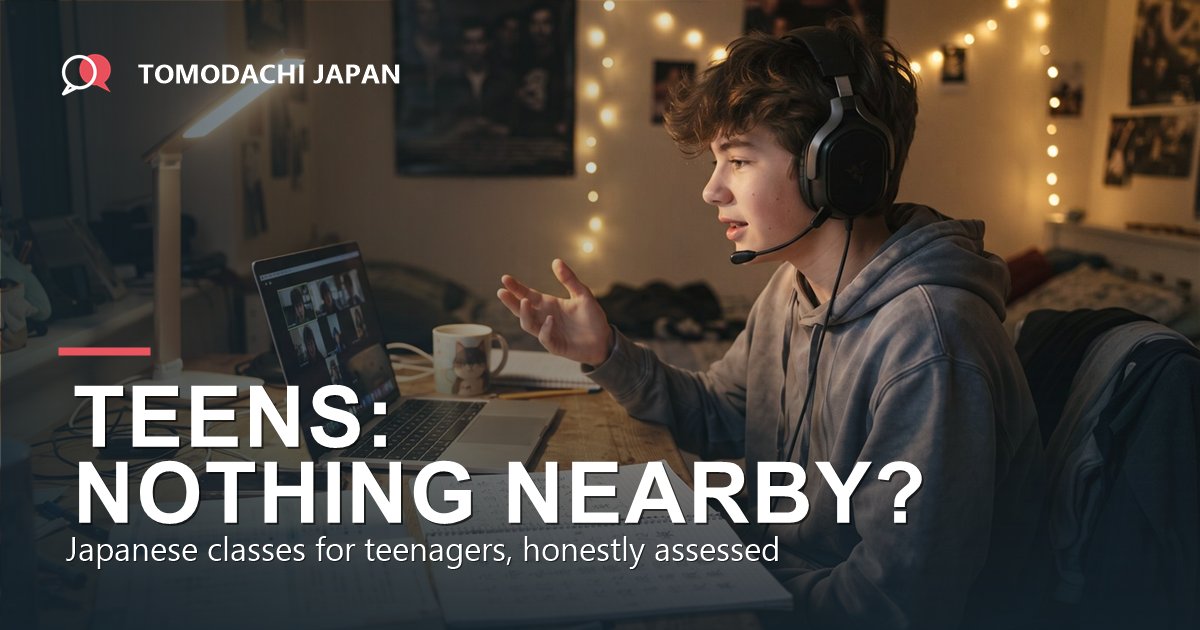
Searching “Japanese classes for teens near me” usually produces one of two results: nothing at all, or a list of adult classes with a note that under-18s are welcome. Both are worse than they look, and the reason is structural rather than local.
Japanese provision for young people is built around two ends of the age range — small children and adults — and teenagers fall down the middle. This guide covers what genuinely exists near most families, how to judge an adult class your teenager might join, and what to do when the honest answer is that nothing local fits.
Why local options thin out at thirteen
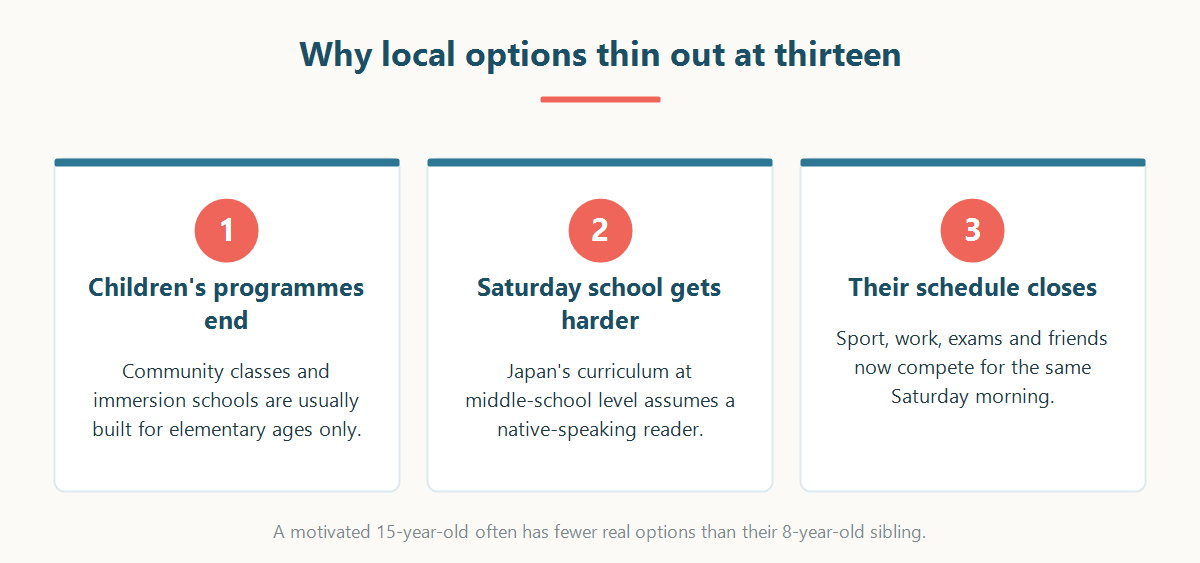
Three things happen at once around the start of secondary school:
- Children’s programmes end. Community classes and immersion charters are usually built for elementary ages. Japanese immersion elementary schools, for example, typically stop at grade 5 — families discover there is no middle-school continuation only when they reach it.
- Saturday schools get harder, not easier. Supplementary schools follow Japan’s curriculum, so by middle-school level the reading load assumes a native-speaking child. Teenagers who joined late tend to drop out here.
- The teenager’s own schedule closes. Sport, part-time work, exams and friends now compete for the same Saturday morning. A class that requires a parent to drive them stops being viable for reasons that have nothing to do with interest.
The result is that a fifteen-year-old who is genuinely motivated often has fewer real options than their eight-year-old sibling.
Looking for a way to keep Japanese going from abroad?
TOMODACHI JAPAN is an online Japanese school for children growing up outside Japan. They talk with peers their own age in Japan every day, taught by teachers working at Japanese schools, in small classes of 8.
🎁 Register and we’ll email you our School Guide (PDF, in English) straight away. You’ll also be first to hear about tuition, scholarships and opening dates.
Free · takes about 30 seconds
What “near me” actually turns up — and who each is for
| What you will find locally | Suits a teenager if… | Watch out for |
|---|---|---|
| Japanese at their own school | It is offered and fits the timetable | Often two or three lessons a week and no speaking practice |
| Community / cultural centre class | There is a youth or beginner section | Usually adult-paced; a lone teenager in an adult room rarely lasts |
| Language institute course | They are 15+ and self-motivated | Priced per term; often one long weekly block |
| Community college course | They are 16+ and want credit | Semester commitment, university pacing |
| Private tutor | They have a specific goal (exam, trip) | No peers; motivation depends entirely on the teenager |
| Saturday school (hoshuko) | They already speak Japanese at home | Not designed for late beginners |
One useful shortcut: if your teenager’s school offers Japanese, check whether it leads anywhere formal — AP Japanese Language and Culture in the US, HSC or VCE Japanese in Australia. Many high schools do not offer AP Japanese at all, and the College Board’s AP Course Ledger is the quickest way to check which schools near you do. A named endpoint changes how seriously a teenager treats the subject.
If your teen is preparing for an exam
Exam-bound teenagers are a different case and should be treated as one. If they are sitting HSC or VCE Japanese in Australia, generic conversation classes are a poor use of limited time — the marks are in specific, trainable places. We have written directly on those:
- HSC Japanese Continuers oral exam — what happens in the room and how it is marked
- VCE Japanese oral exam — format and preparation
- VCE Japanese study design and past exams
- Choosing an HSC or VCE Japanese tutor
For exam students the single highest-value activity is talking to more than one Japanese person, more than once a week. Almost nothing else moves an oral mark as reliably.
Judging an adult class your teenager might join
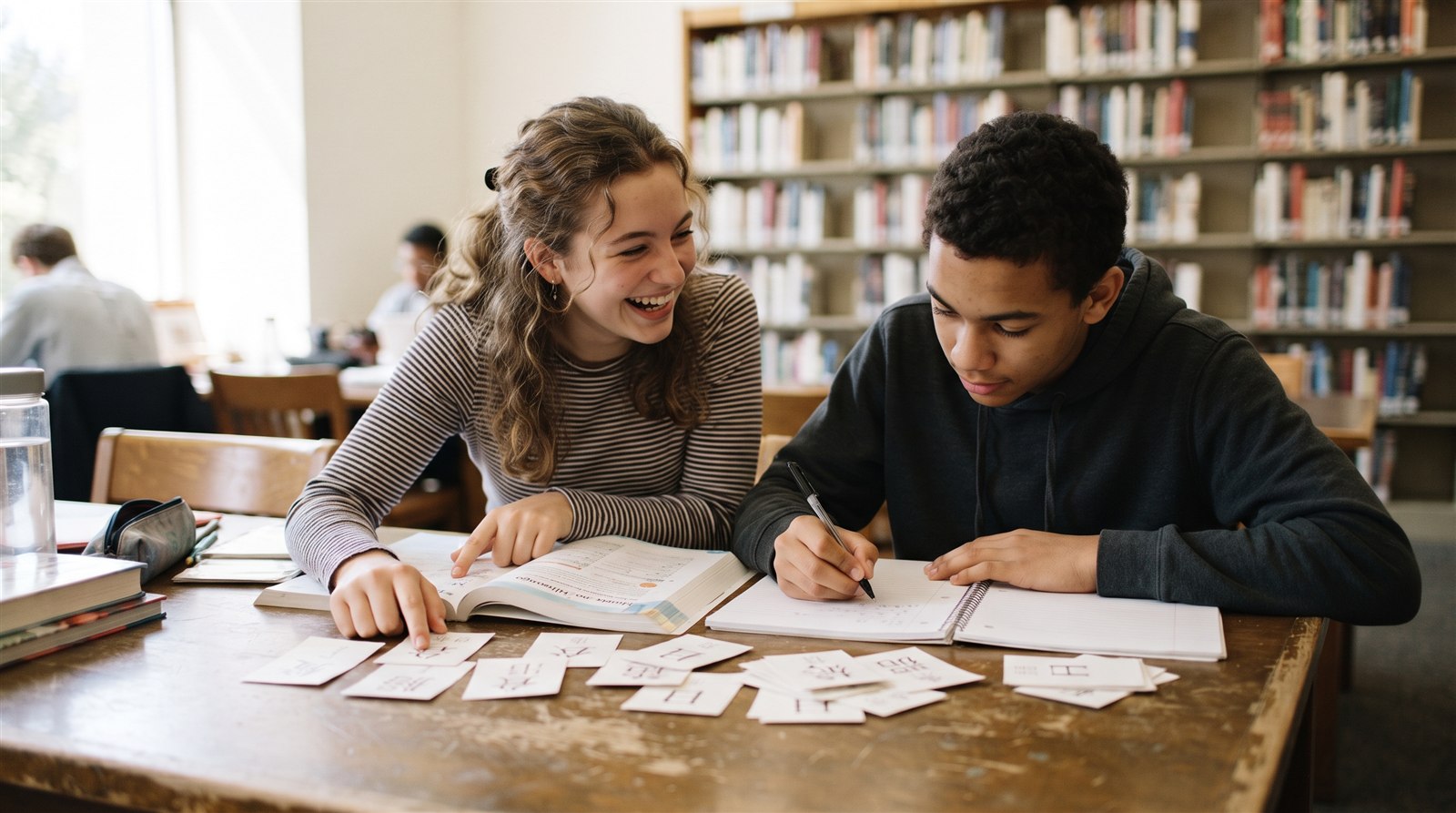
Often the only local option is an adult beginner class. That can work — teenagers handle grammar explanations better than younger children do — but ask four questions first:
- Will there be another person under 20 in the room? One teenager among ten adults is a social problem long before it is a linguistic one. If the answer is no, the class is unlikely to survive to term two.
- How much of the lesson is spent speaking? Adult evening classes often skew towards explanation. Ask for actual minutes.
- What is the topic content? Business Japanese, workplace keigo and travel-for-adults are common defaults and land badly with a fifteen-year-old.
- What happens if they miss two weeks for exams? Teenagers will miss weeks. Ask whether that means falling behind permanently.
On cost, expect the adult market rate: online marketplaces such as Preply and italki run roughly $15–$35 an hour for qualified teachers, and local institutes rather more — Atlanta Institute of Language, for example, publishes $39.95 an hour. Our full price comparison is in how much Japanese lessons cost.
What teenagers actually need that classes rarely provide
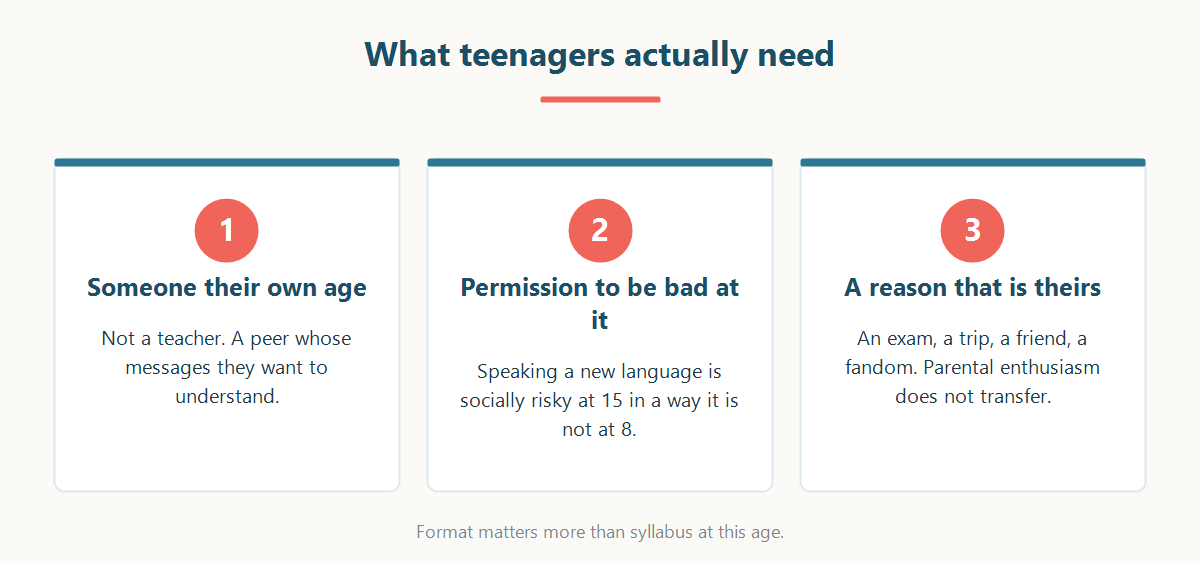
Talk to teenagers who kept going with Japanese past two years and the same three things come up — and none of them is curriculum.
- Someone their own age to talk to. Not a teacher. A peer, whose approval matters, whose messages they want to understand. This is the difference between Japanese as homework and Japanese as a social life.
- Permission to be bad at it in front of people who won’t judge. Adolescence makes speaking a foreign language socially risky in a way it simply isn’t at eight. Small groups of similar-aged learners lower that cost; a class full of adults raises it.
- A reason that isn’t the parents’. An exam, a trip, a friend, a fandom — something owned by them. Parental enthusiasm is not transferable at this age and often backfires.
If your teenager arrived at Japanese through anime or games, that is a real reason and worth building on rather than correcting. We wrote about turning it into structured study in from anime to serious Japanese study.
When nothing local fits
For most families outside a handful of large cities, the honest conclusion is that there is no age-appropriate Japanese class within a sensible drive. That is not a failure of your search — it is the actual distribution of provision.
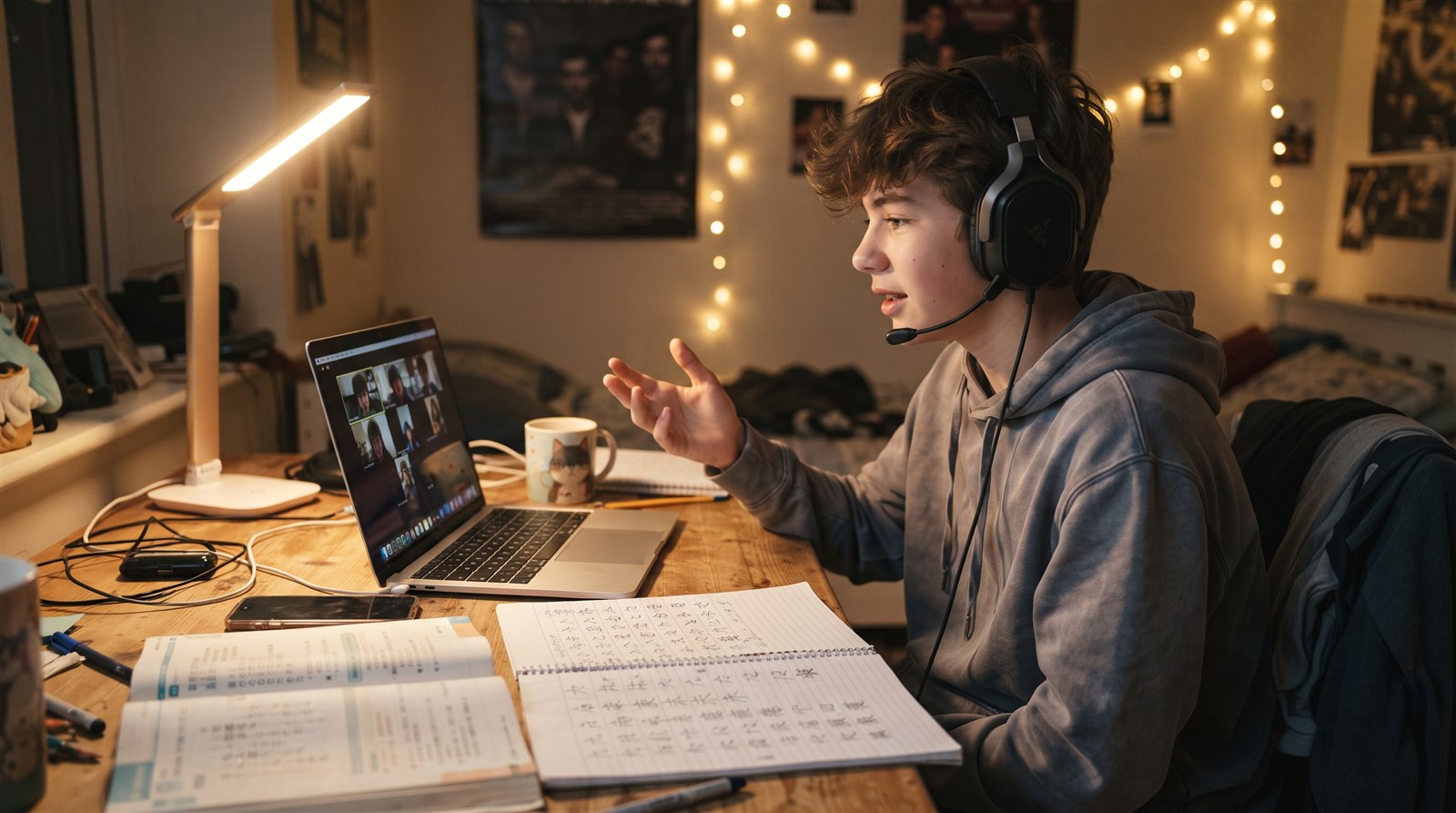
Online changes the geography but only if it solves the peer problem. A one-to-one online tutor removes the drive and keeps the isolation. What works for a teenager is a small group of people their own age, meeting often enough that they know each other’s names.
That is what we built TOMODACHI JAPAN to be: an online Japanese school for young people opening in December 2026, taught by teachers working to the standard of currently-practising Japanese schoolteachers, in small groups of eight, with ongoing contact with peers in Japan. Classes run across several daily time bands with time-zone adjustment, so a teenager in North America, Europe, Latin America or Oceania can attend live without missing school.
Where we are not the answer: if your teenager needs a specific school credit or a graded transcript from a local institution, a school or community-college course does something we do not.
Frequently asked questions
Are there Japanese classes for teens near me?
Check in this order: your teenager’s own school, then any local Japan-America society or cultural centre, then language institutes, then community colleges if they are 16 or over. Dedicated teen classes are rare almost everywhere — most local provision is either for elementary children or for adults, and the practical question becomes which adult class is worth joining.
Is it too late to start Japanese at 15?
No. Teenagers learn grammar and writing systems faster than young children do, and can study independently between lessons in a way an eight-year-old cannot. What they lack is not capacity but the natural social reason to keep speaking, which is why the format matters more at this age than the syllabus does.
Should a teenager take a private tutor or a group class?
A tutor is the better choice when there is a deadline and a syllabus — an exam, an application, a trip in four months. A group is the better choice when the goal is to still be learning Japanese in two years. Many families use both: a group for continuity, a tutor in the term before an exam.
Can my teenager join a Japanese Saturday school?
Usually only if they already speak Japanese at home. Supplementary schools teach Japan’s national curriculum in Japanese, and the middle and high school levels assume native-level reading. Ask specifically whether they run a separate track for non-native teenagers — some do, most do not.
How can my teen practise speaking without a class nearby?
The requirement is more than one person, more than once a week, at a fixed time they did not have to organise themselves. Language-exchange apps satisfy the first and fail the last two. A scheduled small group is the reliable version. Request our free school guide for class times in your time zone; if the form does not load, email tomodachijapan@nijin.co.jp and we will send it directly.
For teenagers already sitting the HSC, the single most useful free resource is the set of HSC Japanese Continuers past papers.