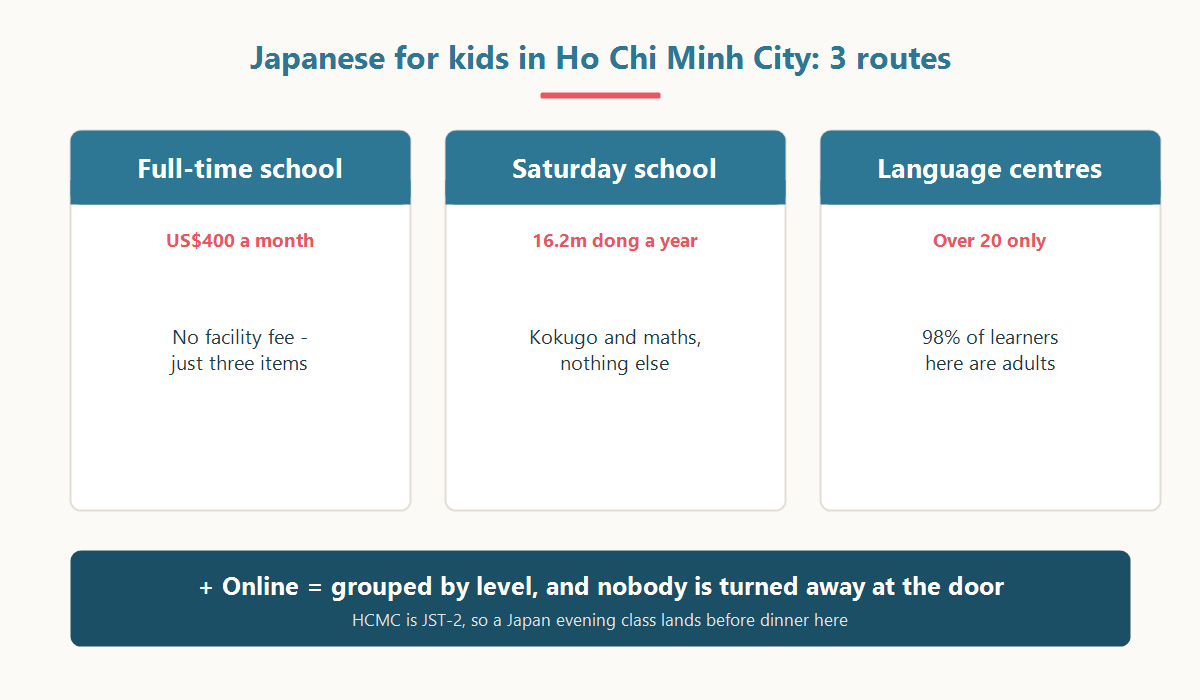
Ho Chi Minh City has two Japanese-medium schools for children — a full-time one and a Saturday one — and both publish their fees. You would not know either fact from an English search, where page one offers an encyclopaedia entry with no fees, a directory pointing at an office building that is not the school, and a list of adult JLPT academies. Here is what the schools’ own documents say: US$400 a month at the full-time school, roughly 16.2 million dong a year at the Saturday school. And here is the thing that decides the outcome for most families, which no English page mentions: both schools interview your child in Japanese before admitting them, and the Saturday school states in writing that it is not a place to acquire or maintain Japanese.
Japanese for children in Ho Chi Minh City: the comparison
| Option | What it is | When | Ages | Published cost | The gate |
|---|---|---|---|---|---|
| Japanese School of Ho Chi Minh City (ホーチミン日本人学校) | Full-time school attached to the Consulate-General, established by the Japan Business Association (JCCH); founded 21 Apr 1997; Block M9, Saigon South, District 7 | Mon–Fri, April–March, three terms | Grades 1–9 | Entrance US$500 member / US$750 non-member; tuition US$400/month; bus US$150/month. Term 1 total US$2,700 / US$2,950 | Japanese nationality; Japanese at Japanese-education level; residence in the consular district |
| Ho Chi Minh Japanese Supplementary School (ホーチミン日本人補習校) | Saturday 国語 and maths only; founded 1994, Japanese government support since 1999; borrows the full-time school’s campus | Saturdays 09:00–12:00 | School age | Entrance 1,500,000 VND; tuition 5,000,000 VND per term × 3; materials 600,000 VND × 2 — about 16.2m VND/year, non-refundable | Interview for Japanese conversational ability; children below year level are declined |
| Private Japanese academies (Dông Du, Sakura, Saigon Language School and similar) | Japanese as a foreign language: JLPT, study-abroad and technical-intern preparation | Various | Adults in practice — one enrolment form starts at “Over 20” | Published, but for adult courses | Wrong subject for a heritage child |
| TOMODACHI JAPAN | Online, classes of 8 with a homeroom teacher, grouped by actual level | Weekday evenings, HCMC time | 5–18 | Sent in the free school guide | No entrance test, no nationality clause |
Looking for a way to keep Japanese going from abroad?
TOMODACHI JAPAN is an online Japanese school for children growing up outside Japan. They talk with peers their own age in Japan every day, taught by teachers working at Japanese schools, in small classes of 8.
🎁 Register and we’ll email you our School Guide (PDF, in English) straight away. You’ll also be first to hear about tuition, scholarships and opening dates.
Free · takes about 30 seconds
The full-time school: what it actually costs
The Japanese School of Ho Chi Minh City publishes its fees, but not on a fees page. They appear inside the term-by-term payment notices, which is why no aggregator has them.
| Item | JCCH member | Non-member |
|---|---|---|
| Entrance fee, one-off | US$500 | US$750 |
| Tuition | US$400 per month | |
| School bus | US$150 per month | |
| Term 1 total (April–July) | US$2,700 | US$2,950 |
| Term 2 total (August–November) | US$2,550 | US$2,800 |
What is notable here is what is absent. There is no facility fee, no maintenance levy and no association fee — three line items that appear at comparable schools across the region and can add a third again to the bill. The school charges three things: entrance, tuition, bus. Membership of the Japan Business Association is not required to enrol; not being a member simply costs US$250 more at the door, once. PTA membership is compulsory but its fee is not published.
One practical footnote for anyone whose employer reimburses school fees: the school is not in a position to issue a Vietnamese red invoice. Worth raising with your finance department before you assume the cost is claimable.
Who is allowed in
The admission rules require that the child lives within the Consulate-General’s district and holds Japanese nationality, and separately that the child’s Japanese ability has reached the level of Japanese education. Two conditions, and families tend to focus on the first when the second is the one that fails.
There is a discretionary clause. The rules provide that where the school management committee recognises circumstances warranting admission, a child may be permitted to attend. The criteria for that judgment are not published. That is genuinely useful to know if you are a Vietnamese–Japanese family or your child holds a Vietnamese passport: the door is not formally closed, but it opens by decision rather than by rule, and the only way to find out is to ask the school directly. Anyone who tells you online what the criteria are is guessing.
The school last published an enrolment figure of 625 pupils for FY2019; that number has since been removed from its site and no newer figure has replaced it. We are not going to extrapolate one.
Yes, there is a Saturday school — and it says it is not a Japanese-language school
This is the part of the city’s provision that is genuinely invisible in English, and it is the most important section on this page.
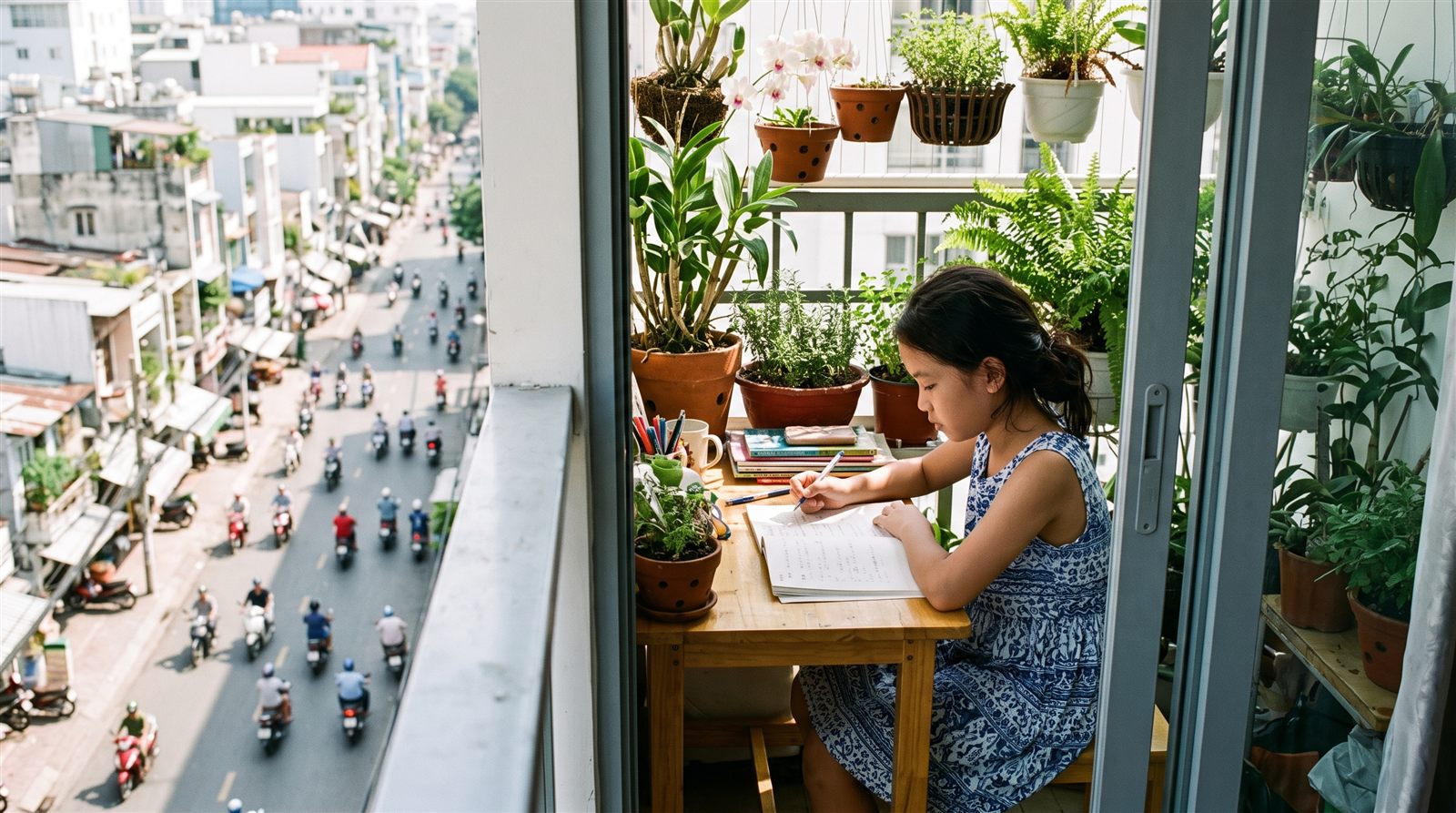
Ho Chi Minh City has had a 補習校 since 1994, supported by the Japanese government since 1999. It runs on Saturday mornings, 09:00 to 12:00, in the full-time school’s building, and teaches 国語 and mathematics only. For a family whose child is at an international or Vietnamese school on weekdays, this is exactly the institution you are looking for — roughly 16.2 million dong a year, non-refundable, and you cannot attend it and the full-time school at the same time.
And then it tells you something about itself that changes the calculation. In its own words: this school is not a Japanese-language school for acquiring or maintaining Japanese. It interviews every applicant for conversational ability, and declines children whose Japanese has not reached their year level.
Put the two schools side by side and the shape of the city becomes clear. The full-time school requires Japanese at Japanese-education level. The Saturday school requires Japanese at year level. Both of Ho Chi Minh City’s Japanese-medium options test Japanese ability at the door. There is no institution in the city whose job is to bring a child up to that line.
That is not a criticism of either school. A supplementary school has one morning a week to carry a week of 国語 for children who will re-enter Japanese classrooms; it cannot also start anyone from zero without failing the children it exists for. But it does mean the two families who most need help — the Vietnamese–Japanese household where Japanese is the second language at home, and the posted family whose child’s Japanese quietly slipped during two years at an international school — are exactly the two the local system is not built to catch.
“Japanese international school” — what that phrase actually refers to
Search suggestions push hard towards “Japanese international school Ho Chi Minh City”, so it is worth saying plainly: there is no Japanese-curriculum international school in Ho Chi Minh City. An international-schools database search for the city returns no Japanese-curriculum match.
The phrase is a collision of two different things. One is the English Wikipedia category name used for 日本人学校 generally — so the full-time school gets described that way even though it is a Japanese school teaching the Japanese curriculum in Japanese, not an international school. The other is a genuinely separate institution of that name in Hanoi, 1,700km away. If a search result promises you an English-medium Japanese international school in District 7, check which of those two it is actually describing.
Why the private academies will not help your child
Vietnam has one of the largest Japanese-learning populations in the world — around 169,582 learners, sixth globally. It would be reasonable to assume that in a market that size, someone teaches children. The distribution says otherwise: only 2.4% of those learners — 3,986 people — are at primary level, while 52.6% are in “other institutions”, which in Vietnam overwhelmingly means technical-intern and study-abroad preparation for young adults.
That is why every search for children’s Japanese classes in HCMC surfaces adult academies. They are not badly matched by accident; they are the market. One prominent language school’s enrolment form begins its age selector at “Over 20”. And they are teaching a different subject in any case: Japanese as a foreign language, from zero, towards a certificate — not 国語 for a child who already speaks it at home.
The public-school route is thin too. Only three primary schools in Vietnam teach Japanese as a first foreign language, and all three are in Hanoi. Ho Chi Minh City had a pilot school in the programme from 2016; it was dropped in 2019.
What the English results get wrong
- The Wikipedia entry contains no fee and no admission information — it does not answer the question anyone is asking.
- One frequently returned directory gives the address as 261 Hoàng Văn Thụ. That is an office building in a different district, not the school, and the same site lists the school twice.
- Several results are adult JLPT academies and one is an estate agent’s neighbourhood guide, ranking on keyword overlap alone.
- Nothing on page one mentions the supplementary school — the option that fits the largest number of families reading in English.
One correction we will make against ourselves too: Japan’s Ministry of Education list of certified overseas institutions covers full-time schools, so the supplementary school’s absence from it means nothing. It exists, it has run for thirty years, and it has had Japanese government support since 1999. Da Nang has one as well — small, 11 elementary pupils as of April 2026. For Hanoi we could not confirm one either way, and we would rather say that than assert an absence.
How to choose, in three questions
Will your child re-enter a Japanese classroom, and when? If yes and soon, grade-level 国語 is the whole job, and the full-time school — if eligible — is the most direct route in the city. If you are settled in Vietnam, the goal is different: a child still comfortable in Japanese at eighteen, which is a longer and gentler project.
Would your child pass a Japanese conversation interview today? Not “do they understand you” — would an unfamiliar teacher judge them at year level. Both local schools ask this, and finding out at the interview is a hard way to learn it. If the answer is no, you need something that starts where your child is.
Who does your child speak Japanese to? A child whose only Japanese-speaking partner is one parent usually holds on until around Grade 4 or 5, then goes quiet — not from forgetting, but because what they can say stops matching what they think. Friendships, not worksheets, are what keep a heritage language alive.
Online, and the two-hour gap
Vietnam is UTC+7 and Japan UTC+9, and neither uses daylight saving, so Ho Chi Minh City is JST − 2 every day of the year. That two-hour gap is unusually kind: an evening class in Japan lands before dinner here.
| Japan (JST) | Ho Chi Minh City (ICT) | At home |
|---|---|---|
| 19:00 | 17:00 | Straight after school |
| 20:00 | 18:00 | Before dinner |
| 21:00 | 19:00 | After dinner |
| Sat 11:00–14:00 | Sat 09:00–12:00 | Clashes with the supplementary school — use a weekday |
TOMODACHI JAPAN is an online school for children of Japanese heritage, opening December 2026. Three differences from a tutor:
- Friends, not just lessons. Classes of eight with a homeroom teacher, and children the same age in Japan in the room. That is what one-to-one structurally cannot give, and it is what makes a child keep going.
- Teachers at Japan’s current classroom standard — which matters when the goal is 国語 and not conversation practice.
- Grouped by actual level, not by school year, with no entrance interview. This is the direct answer to the gate described above: a Vietnamese–Japanese child in Grade 5 reading at Grade 3 level is placed where they can succeed rather than declined.
To be fair: if your child is grade-level and returning to Japan next year, a full-time Japanese school is more school than we are, and the supplementary school at 16.2m VND a year is good value for what it does. We are built for the children those two schools have to turn away.
Questions parents in Ho Chi Minh City actually ask
How much is the Japanese School of Ho Chi Minh City?
US$400 a month tuition, plus a one-off entrance fee of US$500 for Japan Business Association members or US$750 for non-members, plus US$150 a month if you use the bus. Term 1 comes to US$2,700 or US$2,950; Term 2 to US$2,550 or US$2,800. Paid in dong at 26,000 to the dollar. There is no facility or association fee.
Is there a Saturday Japanese school in Ho Chi Minh City?
Yes, since 1994. Saturdays 09:00–12:00, 国語 and maths only, in the full-time school’s building. Entrance 1,500,000 VND, tuition 5,000,000 VND per term for three terms, materials 600,000 VND twice — about 16.2 million dong a year, non-refundable. You cannot attend it and the full-time school simultaneously.
My child has a Vietnamese passport. Can they enrol?
The rule requires Japanese nationality, but there is a discretionary clause allowing the management committee to admit a child where it recognises grounds to do so. The criteria are not published, so ask the school directly rather than relying on anything you read online, including this page.
Does either school teach Japanese from the beginning?
No. The full-time school requires Japanese at Japanese-education level; the supplementary school interviews for conversational ability and declines children below year level, and states directly that it is not a Japanese-language school. Beginners and children whose Japanese has slipped need a different route.
Does the school go up to high school?
No — Grades 1 to 9. Plan the transition before Grade 9 rather than during it.
Reading around the region: Japanese classes for children in Kuala Lumpur · Japanese classes for kids in Singapore · the online alternative to a Japanese supplementary school