If you searched “Duolingo Japanese for kids”, you probably want to know three things. Can my child actually use it? Will they learn real Japanese from it? And is it enough on its own?
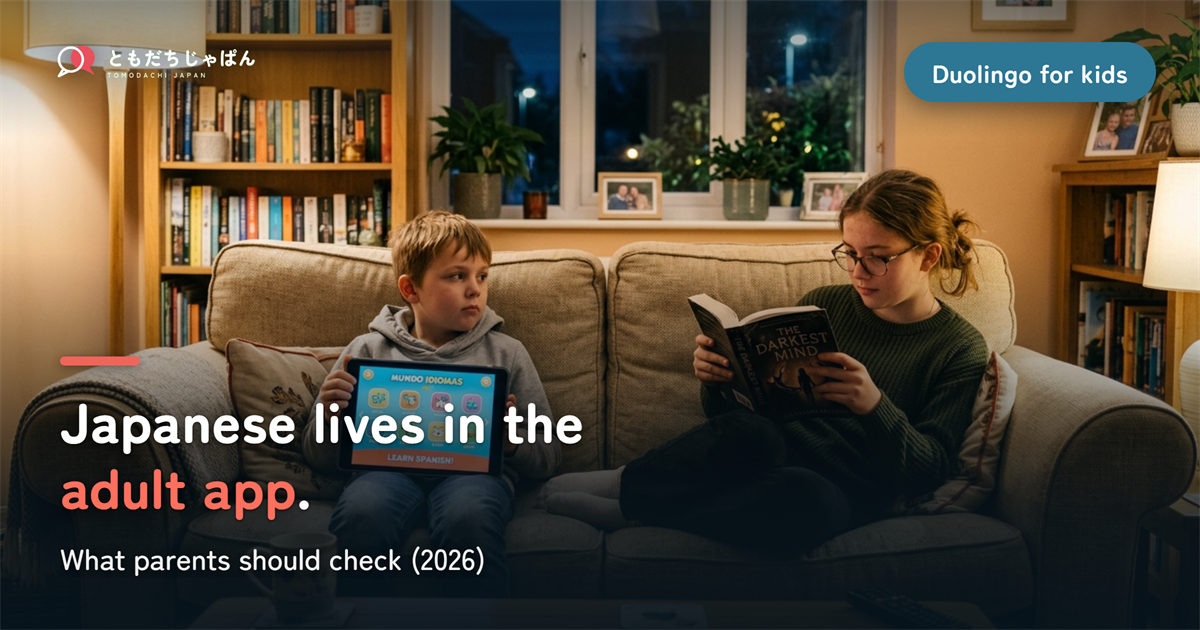
Here is the short answer. Duolingo is a genuinely good vocabulary and kana trainer, and it is free. But there is a structural detail most parents don’t notice until they’re already signed up: Duolingo’s Japanese course lives in the main app, not in the children’s app. That one fact changes what you should expect.
The part parents miss: the kids’ app doesn’t teach Japanese
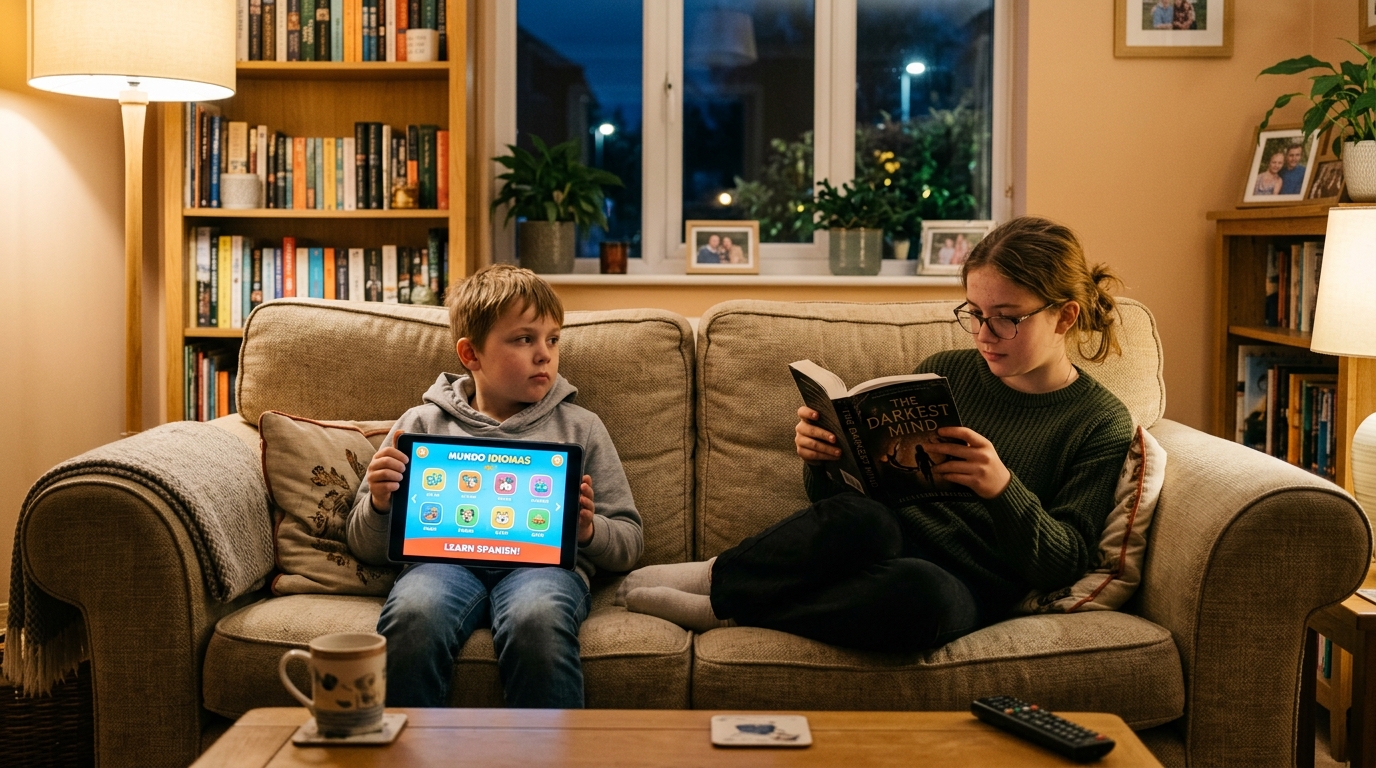
Duolingo has two separate products, and they are not interchangeable.
- Duolingo ABC — a learn-to-read app aimed at roughly ages 3–12. It is built around early literacy: letters, phonics, reading short stories.
- The main Duolingo app — this is where the Japanese course sits, alongside Spanish, French, Korean and the rest.
So a seven-year-old who wants to learn Japanese doesn’t stay in the children’s product. They end up in the general app — the one designed with teenagers and adults in mind. That’s not a scandal, and Duolingo is not hiding it. But it does explain why so many parents tell us the same thing: “He did it for two weeks and then it just became another game he stopped opening.”
Product line-ups change. Before you decide, check Duolingo’s own pages for what ABC currently covers — we’d rather you verify than take our word for it.
Wondering what to add once the app runs out?
TOMODACHI JAPAN is an online Japanese school for children growing up outside Japan. They talk with peers their own age in Japan every day, taught by teachers working at Japanese schools, in small classes of 8.
🎁 Register and we’ll email you our School Guide (PDF, in English) straight away. You’ll also be first to hear about tuition, scholarships and opening dates.
Free · takes about 30 seconds
Age and accounts: what Duolingo asks for
Duolingo’s terms set 13 as the age for a standard account. Younger children aren’t shut out, but a parent’s consent is required — in practice that means giving a parent’s email address so consent can be verified, and parents get a settings area to manage or delete their child’s data.
Two practical implications:
- If your child is under 13, you will be part of the setup, not a bystander. That’s a good thing — take the chance to look at what the course actually contains.
- The content in the main app is written for a general audience. Example sentences will not be pitched at a six-year-old.
What Duolingo is genuinely good at
We’re not going to pretend otherwise, because plenty of children in our own community use it happily.
- It builds a daily habit better than almost anything else. Streaks, reminders, tiny sessions — this is the app’s real skill, and habit is exactly what language learning needs.
- Hiragana and katakana recognition. Drilling kana is repetitive by nature, and an app is a good place to do repetitive things.
- Vocabulary volume. Words go in. Over months, that adds up.
- It’s free to start. For a child who isn’t sure yet whether they’re interested, that matters.
If your child is enjoying Duolingo, please don’t stop it. The question isn’t whether it’s good. The question is what it can’t do.
The one thing no app can give a child
Here’s the pattern we see over and over in families raising children with Japanese outside Japan: the child understands more than they say. They can read kana. They know words. And when a Japanese-speaking relative asks them something, they answer in English.
That gap isn’t a knowledge problem. It’s a usage problem. Speaking is the one skill that only grows when there is a real person on the other side who is waiting for your answer — and who your child actually wants to talk to.
An app can hand your child the words. It cannot hand them a reason to use them. That is a structural limit, not a flaw in Duolingo’s design — it’s simply outside what software does.
How the options compare
| Option | Who it’s built for | Is there someone to talk to? |
|---|---|---|
| Duolingo (Japanese) | General audience; standard accounts from 13, younger with a parent’s consent | No — solo practice |
| Duolingo ABC | Ages 3–12, but it is a learn-to-read app | No |
| LingoDeer | Japanese course in the main app; the kids’ app (iDeerKids, ages 3–8) teaches English | No |
| HelloTalk | Language exchange; under-18s need a parent or guardian’s approval | Yes — but strangers, not classmates |
| Saturday school | Children | Yes — once a week, if there’s one near you |
| TOMODACHI JAPAN | Children growing up outside Japan | Yes — same-age friends in Japan, every day |
Apps and a school aren’t rivals. The combination that works best is usually an app for the drilling and people for the speaking.
What TOMODACHI JAPAN does
TOMODACHI JAPAN is an online Japanese school for children growing up outside Japan. It is not an app, and it isn’t trying to replace one.
- Same-age friends in Japan, every day. Not textbook Japanese — the Japanese you use with friends. This is where speaking actually starts.
- Teachers who work in Japanese schools. A homeroom teacher, not a marketplace tutor.
- Small classes of 8. Big enough for real conversation, small enough that your child’s turn always comes.
- Live lessons. Not recordings — so it becomes a fixed part of the week rather than one more thing to remember.
Keep Duolingo for the kana and the vocabulary. Add people for the part software can’t do.
Frequently asked questions
Can a 6-year-old use Duolingo for Japanese?
With a parent’s consent, yes — but they’ll be using the main app, because that’s where the Japanese course is. Expect content written for a general audience rather than for a young child.
Is Duolingo enough on its own?
For kana, vocabulary and daily habit, it does a real job. For speaking, no app is enough on its own, because speaking needs a person who is waiting for a reply.
My child quit after two weeks. Did we do something wrong?
No — this is the most common message we get. Streaks motivate adults who have already decided to learn. Children usually keep going for a different reason: someone is expecting them.
In short
- Duolingo’s Japanese course is in the main app; Duolingo ABC is a learn-to-read app for ages 3–12
- Standard accounts start at 13; younger children need a parent’s consent
- It is genuinely strong at kana, vocabulary and habit — keep it
- It cannot give your child someone to talk to, and that is what moves speaking
- Use both. App for drilling, people for speaking
Related reading
- Best Online Japanese Lessons for Kids (2026): An Honest Comparison
- Why 1-on-1 apps don’t work for kids: the case for group Japanese lessons
- Japanese Classes for Kids Near Me: How to Judge One (2026)
- Rosetta Stone for kids: is it good for learning Japanese?
- Dinolingo Japanese review: what parents should know