Search for Japanese classes for toddlers and you will be told, within about two clicks, that you are already late. Windows are closing. Brains are hardening. Start now.
The research is less dramatic and much more useful. Across studies of young second-language learners, the total number of hours of exposure turns out to matter more than the age at which a child starts. That single finding should change what you shop for. You are not buying an early start. You are buying hours — and, for a toddler, hours of a very particular kind.
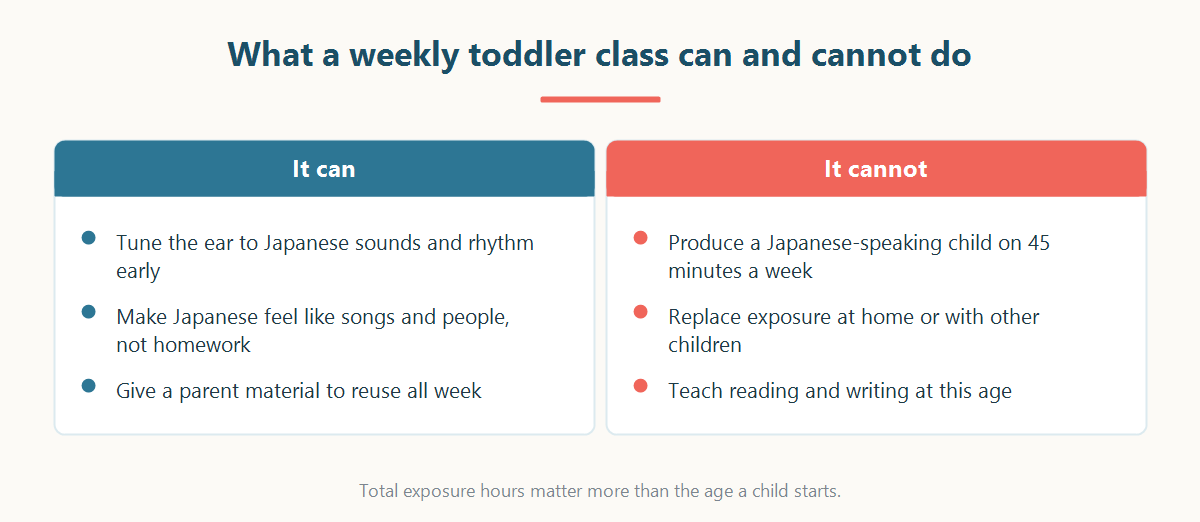
What a toddler class can and cannot do
Being honest about this is more useful to you than a sales page, so here is the split.
| A weekly toddler class can | A weekly toddler class cannot |
|---|---|
| Tune the ear to Japanese sounds and rhythm early, which is genuinely easier at this age | Produce a Japanese-speaking child on 45 minutes a week |
| Build a positive association — Japanese as songs, play and people, not as homework | Substitute for language used at home or with other children |
| Give a parent a weekly supply of songs, phrases and routines to reuse all week | Teach reading and writing — that comes years later |
| Keep a heritage connection alive when no one nearby speaks Japanese | Deliver measurable progress you can see month to month at this age |
If the honest version of the second column is a disappointment, that is worth knowing now rather than after a year of payments. Bilingual children split their exposure time across their languages, so a toddler getting Japanese for under an hour a week is receiving a very small share of a very large requirement.
Looking for a way to keep Japanese going from abroad?
TOMODACHI JAPAN is an online Japanese school for children growing up outside Japan. They talk with peers their own age in Japan every day, taught by teachers working at Japanese schools, in small classes of 8.
🎁 Register and we’ll email you our School Guide (PDF, in English) straight away. You’ll also be first to hear about tuition, scholarships and opening dates.
Free · takes about 30 seconds
The four options, and what they cost
Published 2026 prices, for comparison. These are other providers’ own figures.
| Option | Typical published price | Best for | Watch out for |
|---|---|---|---|
| Online group class (e.g. Outschool) | Small-group live classes typically US$5–$29 per class | Families with no local Japanese community | Most listings start at ages 3–5, not 18 months |
| Online 1-on-1 tutor (Preply, italki) | Preply Japanese tutors roughly US$10–$40/hr; italki professional teachers around US$15–$35/hr | Older children with a specific goal | Poor fit for toddlers — see below |
| Local playgroup or community class | Often the cheapest per hour; sometimes volunteer-run | Toddlers — genuinely the best format at this age | Availability is pure geography |
| Japanese Saturday school preschool section | Varies widely by school | Heritage families aiming at Japanese literacy later | Many expect Japanese to be used at home; entry requirements vary a lot |
We keep a fuller breakdown of the numbers in our guide to how much Japanese lessons cost for kids.
Why 1-on-1 tutoring is usually wrong for a two-year-old
It is the most expensive option per hour, and at this age it is also the least effective one, for a reason that has nothing to do with the tutor’s skill.
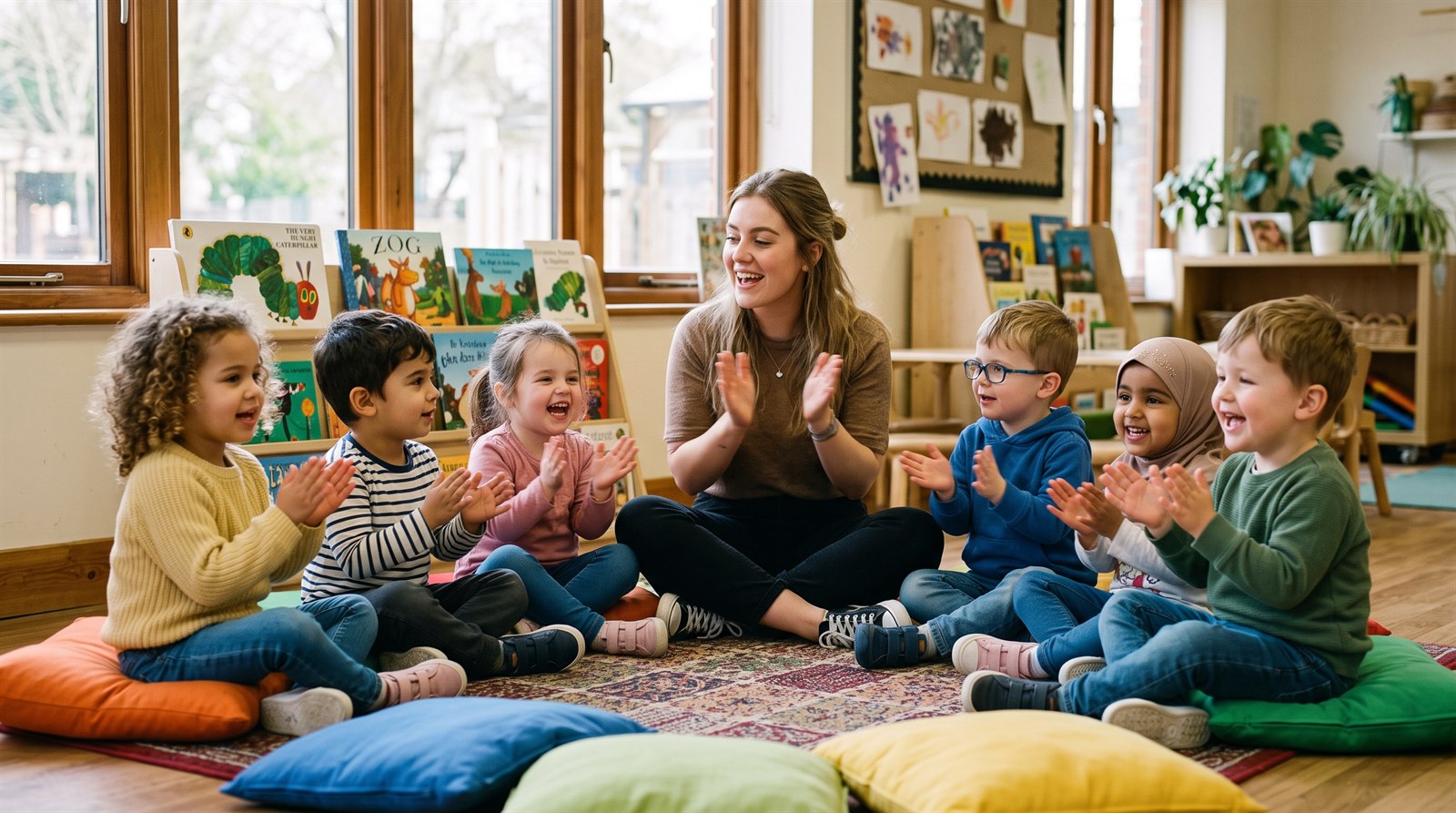
A toddler does not yet hold a conversation on demand with an adult on a screen. What a toddler does is join in — with a song everyone is singing, with a game other children are playing, with a routine that repeats until it is familiar. A one-to-one video call removes exactly the thing that makes a toddler participate, and replaces it with the thing toddlers are worst at: being the sole focus of an adult’s attention for thirty minutes. We wrote about this failure mode in more depth in why 1-on-1 and apps do not work for kids.
What to look for in a toddler class
- Repetition, not curriculum. The same greeting song, the same routine, every week. Variety impresses parents; repetition teaches toddlers.
- Other children present. Toddlers copy peers far more readily than they comply with adults.
- The parent stays in the room. At this age, the class exists partly to teach you the material so it continues all week. A class you are not allowed to watch is worth less.
- Short. Twenty to thirty minutes. Anything longer is being sold to the parent.
- Japanese spoken, not just taught. A class conducted in English about Japanese words gives your child almost no listening exposure.
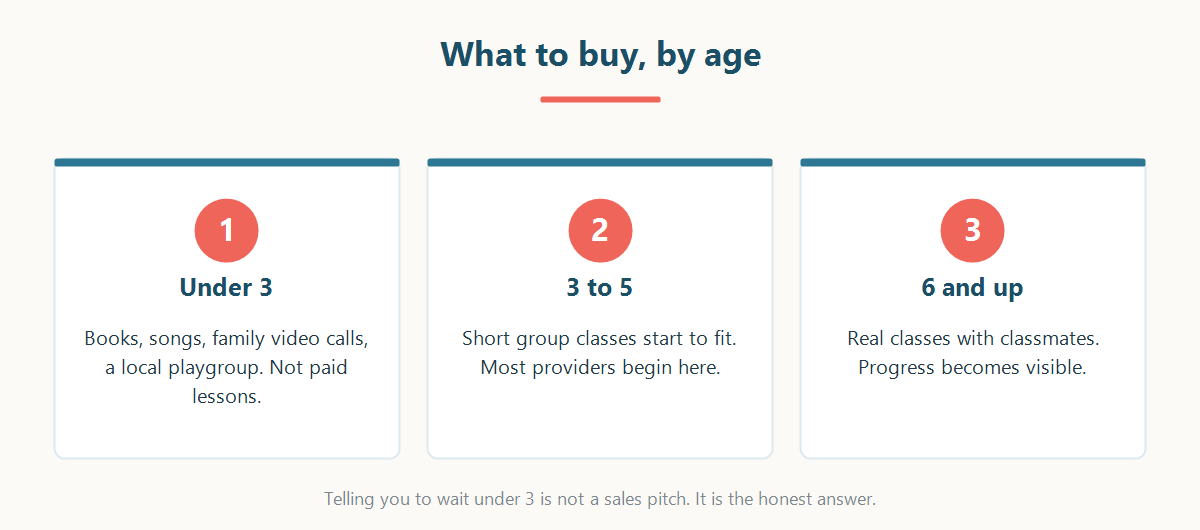
The honest recommendation, by age
- Under 3. Prioritise exposure at home over any paid class — Japanese songs, picture books, video calls with family, a local playgroup if one exists. If you buy anything, buy a group playgroup, not a tutor.
- 3 to 5. This is where structured group classes start to fit, and where most online providers actually begin. Small groups, short sessions, other children.
- 6 and up. Now a real class with continuity and classmates does the heavy lifting, and progress becomes visible. This is where our own school begins — see our guide to Japanese classes for kids who are complete beginners.
Telling you to wait is not a sales pitch, which is exactly why it is worth saying: for a child under three, the money is better spent on books and a weekly playgroup than on lessons.
Frequently asked questions
What is the best age to start Japanese classes?
For structured classes, around 3 to 5, and for classes with real academic continuity, 6 and up. Research on young second-language learners suggests the total hours of exposure matter more than the starting age, so consistent exposure beginning at 6 outperforms a token class beginning at 2.
Can a 2-year-old learn Japanese from online classes?
Only marginally, and mostly through the parent. At that age a screen class works best as a weekly supply of songs and routines you then repeat at home all week. Most online providers set their minimum age at 3 to 5 for this reason.
Do I need to speak Japanese for my toddler to learn it?
No — but you do need to supply repetition. Parents who speak no Japanese succeed by reusing the same songs and phrases from class all week. What does not work is outsourcing the whole exposure to 45 minutes a week and nothing in between.
Should I use a Japanese tutor or a group class for a toddler?
A group, almost always. Toddlers learn by joining in with other children. One-to-one attention is the format they cope with worst, and it costs the most per hour.
How much do Japanese classes for toddlers cost?
Published 2026 prices for small-group online classes commonly run about US$5–$29 per class, while one-to-one tutoring on the big marketplaces typically runs US$10–$40 an hour. Local community playgroups are often the cheapest per hour and the best format at this age.
Sources
- Research syntheses on early second-language exposure, including ACTFL’s brief on the impact of early language learning and studies of infant and toddler bilingual exposure
- Outschool — published class price ranges, 2026
- Preply and italki — published Japanese tutor rates, 2026