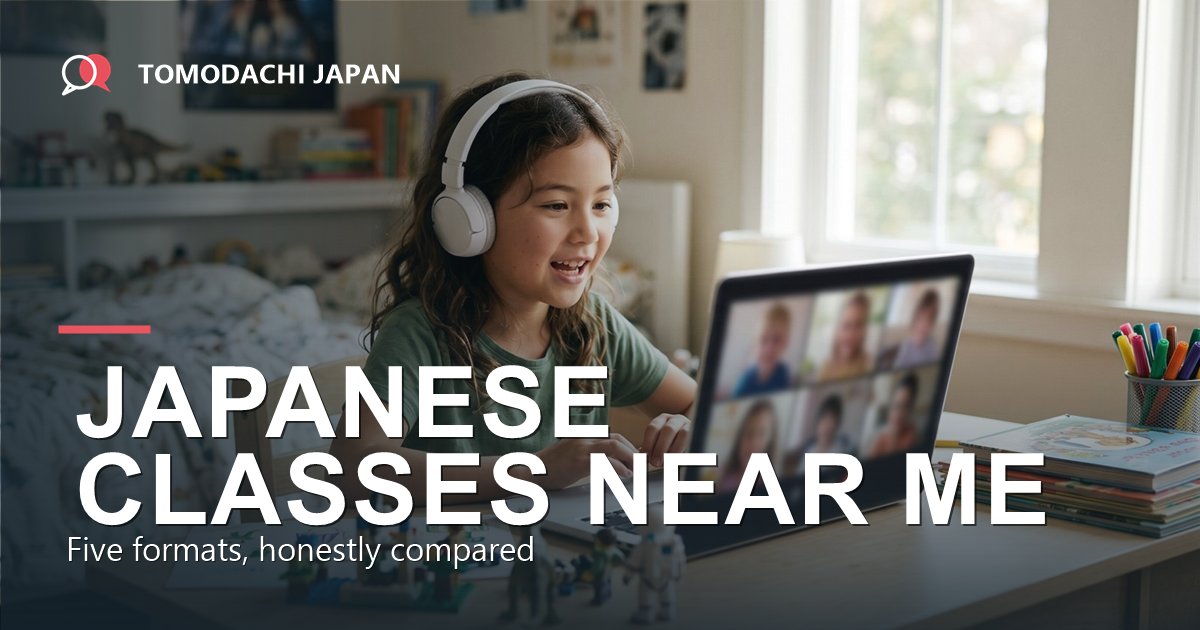
Search “Japanese classes for kids near me” and you will get a list that looks encouraging and mostly is not. Among the results will be a university extension course for adults, a language school whose youngest class starts at 16, a tutor marketplace showing faces from twelve countries, and possibly one genuine children’s class — which meets for 45 minutes on a Wednesday and has a waiting list. The hard part is not finding results. It is working out which of them will actually teach a seven-year-old, and which will still be part of your life in two years. This guide sorts the five formats that exist, shows you how to spot an adult class in about thirty seconds, and gives you the questions that separate a good provider from an expensive one.
The five formats you will actually find
Almost every result for this search falls into one of five categories. They differ enormously in cost, in how much your child speaks, and in whether there are other children in the room.
| Format | Typical cost | Group or 1-to-1 | Best for | Main limitation |
|---|---|---|---|---|
| Community / heritage Saturday school | A few hundred per term | Group, same children weekly | Japanese-heritage kids; literacy | One session a week; may expect grade-level Japanese |
| Local language academy | Varies widely by city | Small group | Structured beginner classes | Often adult-oriented; kids’ classes are the exception |
| Private in-person tutor | Roughly US$25–60/hour | 1-to-1 | Exam prep; targeted gaps | Expensive per hour; no peers |
| Online tutor marketplace (italki, Preply) | italki mostly US$10–20/hour; Preply tutors commonly US$19–39/lesson, usually sold in packages | 1-to-1 | Flexible scheduling; adults and teens | Few tutors are trained for young children; no peers |
| Online school for children (Tomodachi Japan) | One flat monthly fee, unlimited attendance | Small groups of 8, taught by teachers from Japan | Kids 5–18 who need volume and friends | Runs on Japan time — check your time zone |
Looking for a way to keep Japanese going from abroad?
TOMODACHI JAPAN is an online Japanese school for children growing up outside Japan. They talk with peers their own age in Japan every day, taught by teachers working at Japanese schools, in small classes of 8.
🎁 Register and we’ll email you our School Guide (PDF, in English) straight away. You’ll also be first to hear about tuition, scholarships and opening dates.
Free · takes about 30 seconds
How to spot an adult class in thirty seconds
This is the most common way parents waste an evening. When we checked the real search results for Japanese classes for children in Sydney, two of the nine organisations ranking on the first page were not classes a family could enrol a child into at all — one is a respected institute whose Japanese course is for adult learners, and another delivers its program into childcare and early-learning centres rather than accepting individual enrolments. Both rank well for a query with the words “for kids” in it. There are three quick tells:
- Look for an age range, not the word “kids”. A genuine children’s provider states ages — “ages 6–12”, “Years 3–6”. Marketing copy that says “learners of all ages” almost always means adults with a children’s class that may or may not be running this term.
- Look at the timetable, not the course list. Adult programs run on weekday evenings in ten-week terms. Children’s classes run late afternoon, Saturday morning, or during school holidays. If the timetable shows 7pm Tuesdays only, it is not for your eight-year-old.
- Look for how children are grouped. Serious children’s providers group by level or ability, not just by age, because a child with a Japanese parent and a child starting from zero cannot sit in the same class. If the site never mentions levels, ask before you pay.
Seven questions to ask before you pay
- What ages are actually in this class right now? Not the advertised range — the children currently enrolled.
- How are children grouped: by age, school year, or Japanese level? Level-grouping is the single best predictor that a heritage-speaking child and a beginner will both be comfortable.
- How many minutes will my child actually speak in a session? In a group of fifteen with one teacher, the honest answer is often two or three minutes.
- Who are the teachers, and what are their qualifications? “Native speaker” is not a qualification. Ask whether they are trained teachers and whether they have taught children.
- What happens if my child is behind — or ahead? A provider with no answer will place your child by age and hope.
- What is the total annual commitment, including terms, holidays and any parent duty?
- Can we try a real class, with the real group, before committing? A trial with a different teacher in an empty room tells you nothing.
The number that decides everything: hours per year
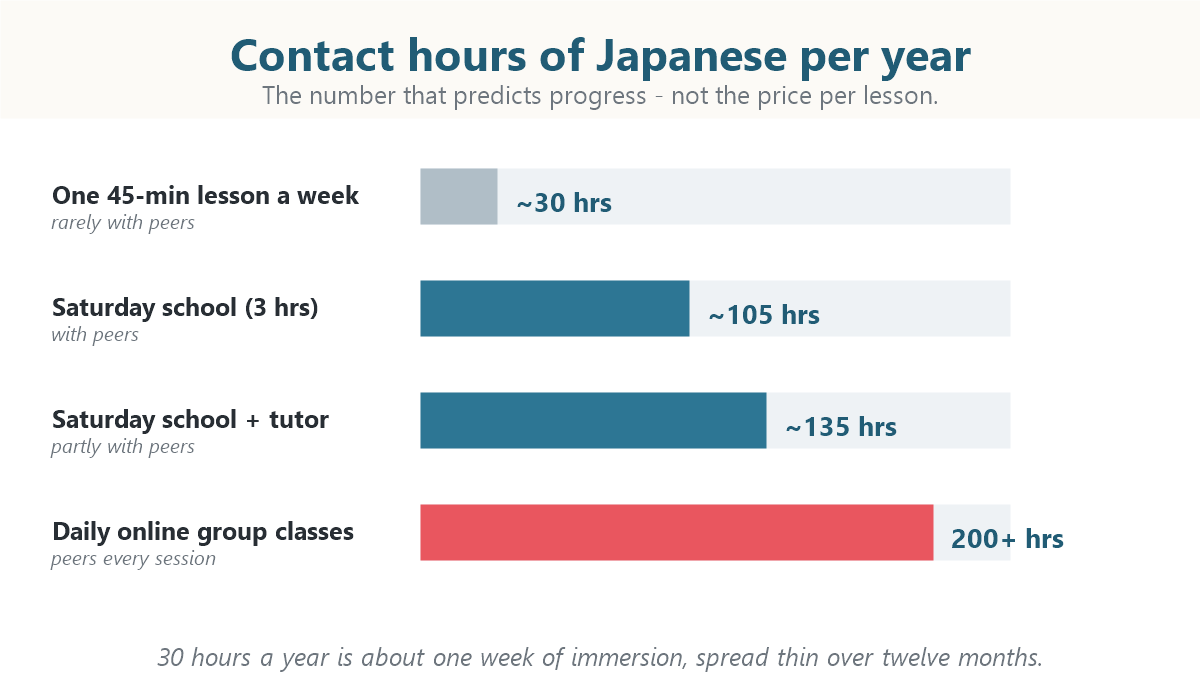
Parents compare providers on price per lesson. Children make progress on something else entirely — total hours of comprehensible, interactive Japanese per year, and whether any of it is with peers. It is worth doing this arithmetic before you choose, because it is unforgiving:
| Arrangement | Contact hours per year | Speaking with peers? |
|---|---|---|
| One 45-minute lesson a week, 40 weeks | About 30 hours | Rarely |
| Saturday school, 3 hours, 35 weeks | About 105 hours | Yes |
| Saturday school + one weekly tutor | About 135 hours | Partly |
| Daily short online group classes | 200+ hours | Yes, every session |
Thirty hours a year is roughly one week of immersion, spread thinly over twelve months with a summer gap in the middle. It is enough to keep a child familiar with Japanese; it is not enough to build fluency, and it is why so many families feel like they are paying for a plateau. If a local class is what you can access, the useful question is not “is this class good?” but “what supplies the other 150 hours?”
Where local classes win — and where they don’t
An honest comparison, because the answer is genuinely different for different families.
Local, in-person classes win on physical presence: young children under about seven generally do better in a room with other bodies; friendships made locally can continue at the park; and community schools bring festivals, sports days and a sense of belonging that a screen cannot replicate. If there is a good local school and it fits your child’s level, take it.
Online wins on the two things local provision usually cannot solve: frequency and level-matching. A local class runs when it runs, and groups whoever turns up. Online, a child can attend most days, and can be placed with children at the same conversational level anywhere in the world instead of the same postcode. For a family two hours from the nearest Saturday school, or with a child whose spoken Japanese is far ahead of their reading, this is not a compromise — it is the only arrangement that fits.
Where Tomodachi Japan fits
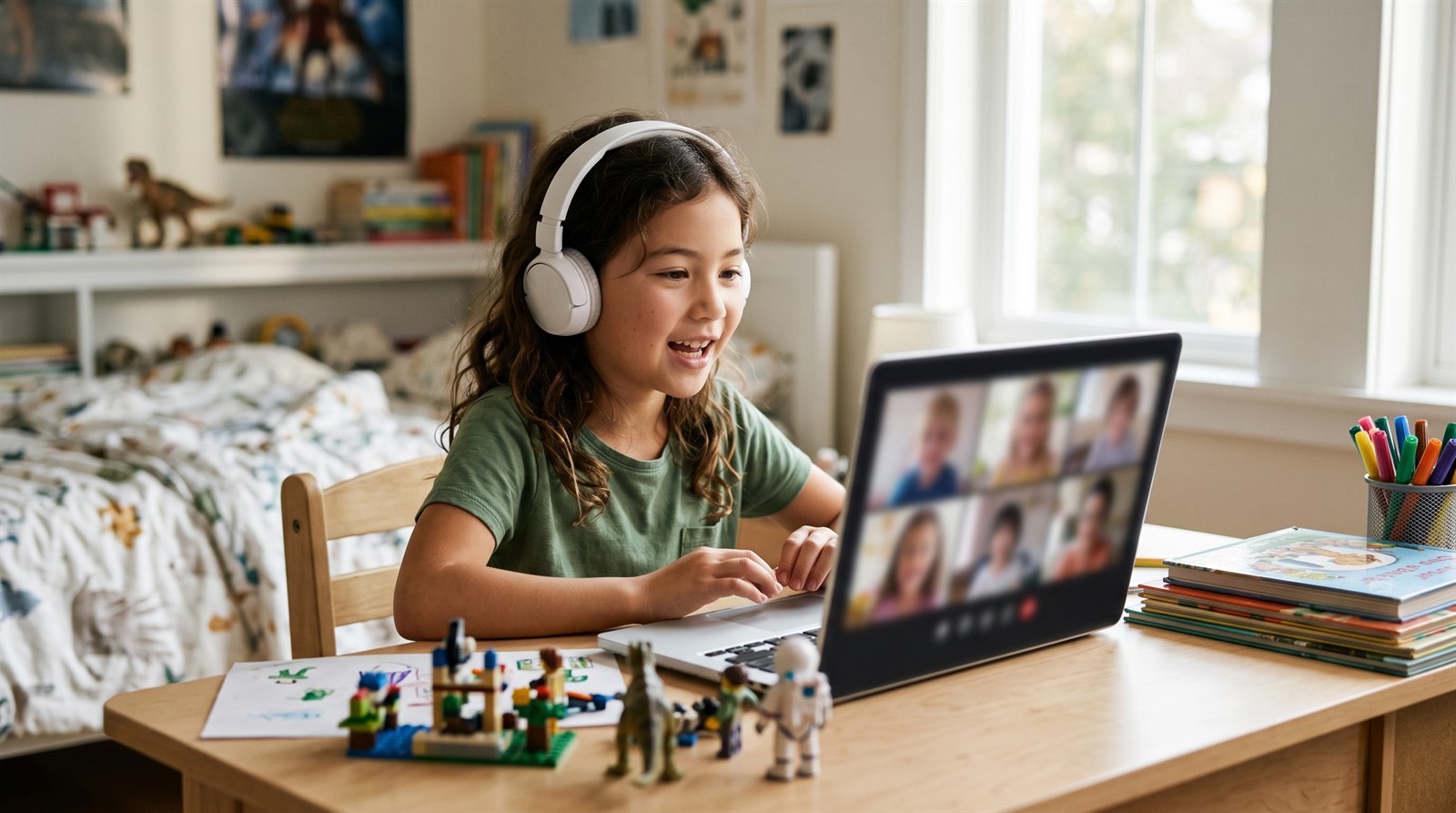
Tomodachi Japan is an online Japanese school for children aged 5–18 growing up outside Japan. Classes are small — eight children — and taught by qualified teachers from Japan, and children are grouped by conversation level rather than school year, so a heritage speaker with weak kanji and a keen beginner both land somewhere that fits. One flat monthly fee covers unlimited attendance, which is the point: it turns Japanese from a weekly appointment into an ordinary daily habit, with the same children each time. Plenty of families use it alongside a local Saturday school rather than instead of one.
Because classes run on Japan time, the fit depends on where you live — it works especially well from Australia, New Zealand and Southeast Asia, and from North America the Japanese Saturday morning slot lands on Friday evening. We set this out in detail in our time-zone guide for families abroad.
Frequently asked questions
What age should a child start Japanese classes?
Earlier helps for pronunciation and for building a positive association, but the more important variable is consistency. A child who starts at nine and continues for six years will end up far ahead of a child who started at four and stopped at seven. If you are choosing between starting now with something sustainable and waiting for a perfect option, start now.
Are group classes or private tutoring better for children?
For most children, small groups. One-to-one is more efficient per minute and is excellent for exam preparation or fixing a specific gap, but children learn language socially, and an hour alone with an adult is hard work for a nine-year-old. The best of both is a small group where the class is still small enough that every child speaks — around six to eight.
How much do Japanese classes for kids cost?
Community Saturday schools are the cheapest per hour, typically a few hundred dollars per term. Online tutor marketplaces sit around US$10–20 an hour on italki, while Preply tutors are commonly US$19–39 per lesson and are usually bought in packages. Private in-person tutors are the most expensive per hour. Compare on cost per year and on hours delivered, not on headline lesson price.
My child is a heritage speaker. Do normal beginner classes work?
Usually badly. A child who speaks Japanese at home but cannot read is bored in a beginner class and lost in a grade-level one, and that mismatch is the most common reason heritage children quit. Look specifically for providers that assess and place by level, and ask what they do with children whose speaking and literacy are years apart — it is a common profile and any serious provider will have a clear answer.
Is there a Japanese Saturday school near me?
Possibly, and it may not appear in English search results. Supplementary Japanese schools usually maintain Japanese-language websites, so searching your city plus 補習授業校 finds far more than an English search will. We wrote a full guide to finding a Japanese Saturday school near you, including consulate lists and what the entry requirements usually are.