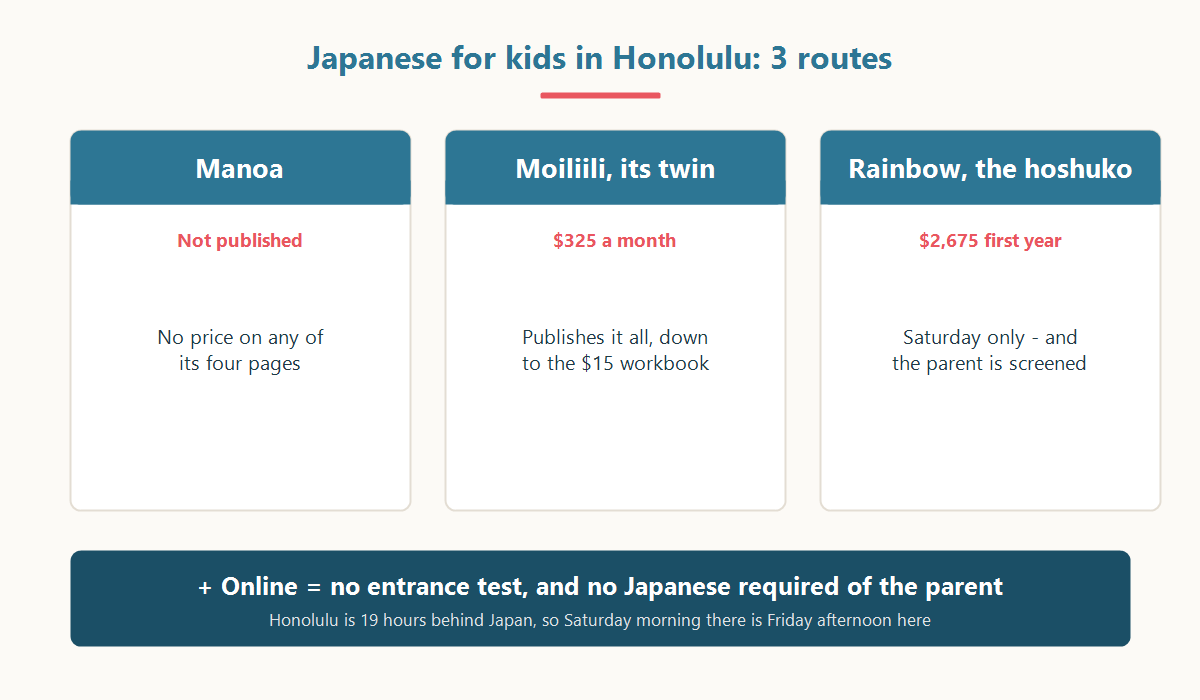
Search Manoa Japanese Language School tuition and you will not find a price. Not a stale one, not a partial one — none. We fetched all four pages the school lists in its own sitemap and searched them: the words tuition, fee, payment, refund and scholarship appear zero times. The only two dollar figures anywhere on the site are $1,000 and $6,000 — a classroom building bought at auction and moved onto East Manoa Road in 1955. Meanwhile a nearly identical school two miles away publishes a month-by-month table down to the $15 workbook. This page gives you that comparison, the one number circulating online that you should not trust, and the question underneath the price that decides whether this school fits your family at all.
Japanese for children in Honolulu: the comparison
| Option | What it is | When | Ages | Published cost | Notes |
|---|---|---|---|---|---|
| Manoa Japanese Language School | Heritage / community language school, founded 1910. Separately holds a licence as a before-and-after-school child care facility | Mon–Fri, 45 min after school | K–5 | Not published — every line item | No entrance test and no Japanese requirement stated anywhere |
| ハワイ レインボー学園 (The Hawaii Japanese School) | The only MEXT-designated 補習授業校 in Hawaii, with teachers dispatched from Japan. Preschool to middle school, about 475 students | Saturday, roughly 08:30–14:55 | Preschool–middle | Fully published. Elementary tuition $1,320/yr, plus $680 membership, $350 entrance, $205 materials, $30 PTA, $90 exam fee | Child must follow lessons in Japanese; the parent must too. Applications closed 5 Dec for the following April |
| Moiliili Community Center Japanese Language School | Heritage / community language school. The closest structural match to Manoa on Oahu | Mon–Fri, 45 min, 15:10–16:40 window | 5 to under 14 | Fully published. $325/mo full months, $271/mo short months, plus $55 membership, $20 textbook, $15 workbook | Registration in person only — no online or telephone sign-up |
| Hongwanji Mission School | Private Buddhist day school, preschool to grade 8, Japanese at every grade level | Full-time day school | Preschool–8 | $14,300 a year, plus $950 school lunch | A different decision entirely — this replaces your child’s school |
| Hahaione Elementary, Japanese dual language immersion | State school programme — the first Japanese immersion in Hawaii’s public system, launched 2021 | Regular school day | Kindergarten entry | Free | Public school; confirm current intake with the school |
| TOMODACHI JAPAN | Online, classes of 8 with a homeroom teacher, grouped by actual level | Fri/Sat afternoons Hawaii time | 5–18 | Sent in the free school guide | No entrance test, and it does not eat your Saturday |
Looking for a way to keep Japanese going from abroad?
TOMODACHI JAPAN is an online Japanese school for children growing up outside Japan. They talk with peers their own age in Japan every day, taught by teachers working at Japanese schools, in small classes of 8.
🎁 Register and we’ll email you our School Guide (PDF, in English) straight away. You’ll also be first to hear about tuition, scholarships and opening dates.
Free · takes about 30 seconds
The school publishes no price. We checked properly.
This is worth stating precisely, because “I could not find it” and “it is not there” are different claims.
Manoa Japanese Language School’s sitemap contains exactly four pages: the home page, enrollment, and two history pages. We retrieved the raw HTML of all four. A search across them for tuition, fee, payment, refund, scholarship and discount returns no matches at all. A sweep for any dollar amount returns two, both historical: a surplus Manoa School classroom bought at public auction for $1,000 in February 1955, and $6,000 to relocate it to the East Manoa Road frontage.
So: registration fee, tuition, materials, dues, sibling discount, payment schedule, refund policy, financial aid — not published, all of them. The older WordPress site used to link a registration form PDF that would have carried the fee schedule; that link is now dead, and a sweep of the Internet Archive found 82 captured pages from that site and no surviving copy of the form. The number is not recoverable from the archive either.
The $90 figure you may have been shown
There is one dollar amount circulating for this school, and search engines have begun presenting it as an answer. It is “about $90 per pay period”, and it comes from a user review on a business-listing site, apparently written around 2019. It is not a school figure. The unit is ambiguous — a “pay period” is not defined. The school has never published it. We could not open the review to check its date or wording.
Do not budget from it. It is the stalest fact on the first page of results and the one most likely to be believed, precisely because it is the only number there.
What this kind of programme actually costs in Honolulu
If Manoa will not tell you, the honest substitute is its structural twin. Moiliili Community Center Japanese Language School is the closest match on Oahu: same K–5 range, same Monday-to-Friday format, same 45-minute class, the same 3:10pm start, and near-identical wording about teaching Japanese “rather than the traditional style”. One publishes everything. The other publishes nothing.
| Item | Amount |
|---|---|
| Japanese School only — full months (Aug, Sep, Nov, Feb, Apr, May) | $325 / month |
| Japanese School only — short months (Oct, Dec, Jan, Mar) | $271 / month |
| Annual membership (non-refundable) | $55 |
| Japanese textbook | $20 |
| Workbook | $15 |
| Late registration | $25 |
| Payment 30 or more days late | $35 |
| Late pick-up | $5 per 15 minutes after 17:30 |
Two conditions in Moiliili’s fine print are worth knowing before you commit anywhere, because they are typical of the sector. Refunds are given only if you ask at least seven consecutive days before the programme starts, and then minus a $25 service charge; and there are no refunds, credits or proration when your child is sick or absent. Registration is first-come, first-served, in person — there is no online or telephone sign-up — and accepting your form does not guarantee a place.
That gives you a defensible expectation for a Manoa-style weekday Japanese programme in Honolulu: roughly $3,000 a year plus materials. Treat it as a bracket to test on the phone, not as Manoa’s price. Their office answers between 1:00 and 5:30pm on weekdays.
The question underneath the price: heritage school or hoshuko?
No page ranking for this search says the words 補習授業校 (hoshuko). Yet this, not the fee, is what decides whether a school fits your child.
Manoa Japanese Language School is a heritage and community school. It describes itself as dedicated to the Japanese language, culture and arts “for all ages and all abilities”. Nothing on its site mentions Japan’s Ministry of Education, government-approved textbooks, returning to school in Japan, or any Japanese-language requirement for the child or the parent. Its programme is Japanese language plus culture — a tea ceremony club led by an Urasenke tea master, Undo-kai, Setsubun.
Hawaii has exactly one hoshuko, and it is not this school. Japan’s Ministry of Education list of overseas supplementary schools with dispatched teachers has a single Hawaii entry: レインボー学園, the Hawaii Japanese School. Manoa does not appear on that list anywhere.
| Manoa Japanese Language School | レインボー学園 (Rainbow) | |
|---|---|---|
| Type | Heritage / community | MEXT hoshuko, principal and vice-principal dispatched from Japan |
| Built for | Families who want the child to keep or gain Japanese | Primarily children going back into the Japanese school system — but repatriation is not actually required; understanding the school’s purpose is an accepted alternative |
| Subjects | Japanese language and culture | Japanese, maths, social studies, on MEXT-approved textbooks |
| When | Monday–Friday, 45 minutes | Saturday only, most of the day |
| Japanese required of the child | Not stated anywhere | Yes — must understand lessons given in Japanese |
| Japanese required of the parent | Not stated anywhere | Yes — must read school correspondence in Japanese and check homework every time |
| Entrance assessment | None mentioned | Yes, plus a $90 fee to sit it |
| Parent duty | None mentioned | Compulsory committee role and duty shifts |
If you are reading this in September, you have already missed Rainbow
This is the detail that decides it for more families than price does, and nobody states it.
Rainbow’s intake for the school year beginning April 2026 ran on this calendar: information session 8 November 2025; applications accepted 12 November to 5 December 2025, in person only, by phone appointment, 09:00–15:00, and not on Saturdays, Sundays or Mondays; assessment 21–23 January 2026; results 24 January; admission letters 7 February. Capacity is capped by the premises the school rents, and the October transfer round states plainly that there is no fifth-grade intake.
A parent who starts looking in September has missed that window by nine months, and the next one does not open until November. Manoa, by contrast, keeps an inquiry form open year round — though as of today its enrollment page still advertises a window that opened on 1 May 2026 for a school year already under way, and the whole site has been untouched since 30 April. Phone rather than trust the page.
Rainbow’s fees — published in full, with one caveat
| Item | Amount |
|---|---|
| Examination fee (受検料) | $90 per child, per sitting |
| Entrance fee (入学金), one time | $350 |
| Foundation membership, per family | $680 / year |
| Tuition — preschool division | $1,524 / year |
| Tuition — elementary | $1,320 / year |
| Tuition — middle school | $1,408 / year |
| Materials | $205 / year |
| PTA, per household | $30 / year, plus $7.50 per additional child |
Two terms in Rainbow’s rules deserve emphasis because they are unusually strict. Fees are collected by direct debit in four term instalments, and the first debit takes membership, entrance fee, term fee, materials and PTA all at once. And the refund policy states that none of it is ever refunded — not on mid-year withdrawal, not on long absence.
How much Japanese does your child actually get?
Here is the comparison that surprised us most, and that no ranking page makes. Convert each option into minutes of instruction per week and they land in almost the same place.
| School | Format | Minutes per week | What it costs the family |
|---|---|---|---|
| Manoa | 45 min, five weekday afternoons | about 225 | Five school-run pickups a week |
| Moiliili | 45 min, five weekday afternoons | about 225 | Five school-run pickups a week |
| Rainbow | One Saturday, about 08:30–14:55 | about 200–240 of class | The whole family’s Saturday |
The teaching hours are roughly equal. What differs is what the family gives up. That is the real trade, and it is worth deciding on purpose rather than by default.
One thing to know about the “81 to 1” figure
Several school-review sites list Manoa with a student-teacher ratio of 81:1. Read in the ordinary way, that says your six-year-old will be one of eighty-one children with one adult. It is not a class size — it is an artefact of a federal survey record that lists the school with a single teacher, which is what happens when a small after-school programme files that form. The school’s own structure splits pupils into two bells by grade, and its child-care licence covers a capacity of 92 across the entire facility.
The same directories also present the school as a K–5 private day school. It is not. It is a 45-minute-a-day class after school. If you have been comparing it against Punahou or Hongwanji on a review site, you have been comparing two different kinds of thing.
A school that kept its land
Manoa Japanese Language School opened on 3 November 1910 with twelve students. Its education committee was chaired by Fred Kinzaburo Makino, the Hawaii Hochi founder who was central to the Japanese-language-school court fights of the 1920s — the fight that ended when the Supreme Court struck down Hawaii’s Foreign Language School Law in 1927.
In March 1929 the school bought its ground from the Liliuokalani Estate, and Rizo Sakida planted a pine there, grown from seed carried from Japan six years earlier. It still stands between the two classroom buildings.
In 1941 the school was forced to close. Five trustees were, in the school’s own words, “under constant surveillance by authorities who tried to coerce them into surrendering title to the property. Despite constant pressure, the five men held out.” The land was leased to the Office of Civilian Defense and the Fire Department until 1945; in June 1946 the trustees incorporated the Manoa Community Association and moved the title into it. The school adds the sentence that explains why this matters: “Many of the Japanese language schools lost their land during World War II.”
It reopened in May 1948 with 250 students. One honest note: the University of Hawaii at Manoa Library dates the official reopening of Japanese language schools to the revision of the Foreign Language School Law in April 1949. The likely reconciliation is that Manoa resumed classes before the statute changed, but we will not assert that — both dates stand as their sources give them.
How to choose, in three questions
1. Is your child going back into school in Japan? If yes, the hoshuko curriculum is the point, and Rainbow is the only one in Hawaii. Plan a year ahead — the application window is in November. If no, a heritage school is not a lesser choice; it is the correct one.
2. Which does your family actually have — five weekday afternoons, or one Saturday? The teaching minutes are nearly identical, so answer this on logistics, not on prestige. A Saturday school your family resents by November is worse than a weekday class that survives to March.
3. Will your child keep going? This is the question that decides the outcome, and it is the one no fee table answers. Children continue when there is someone on the other side they want to talk to. Grammar drills do not produce that; other children do.
The online option, and why Hawaii is unusually well placed for it
Most cities we look at have an awkward time difference with Japan. Honolulu has an unusually good one, and it is worth spelling out.
Hawaii runs 19 hours behind Japan and never changes clocks. That means Saturday morning in Japan lands on Friday afternoon in Honolulu — 10:00 Saturday in Tokyo is 15:00 Friday here. Japanese children are free and awake at exactly the hour your child is coming out of school. So an online class with children in Japan does not require anyone to get up at a strange hour, and crucially it does not take your Saturday, which is the single largest cost of the hoshuko route.
That is the slot TOMODACHI JAPAN is built for. We are an online Japanese school for children living outside Japan, taught by teachers working to the standard of Japan’s current classrooms, in classes of eight with a homeroom teacher, grouped by the level your child is actually at rather than by age. There is no entrance test, no requirement that a parent read Japanese correspondence, and no duty roster.
We are honest about what we are not. We do not issue the MEXT curriculum that a child re-entering a Japanese school needs — if that is your situation, Rainbow is the right answer and we will say so. What we are good at is the case Rainbow is not designed for and the review sites never name: the child who is not going back to Japan, but who should not lose the language either, and who needs friends their own age on the other end to keep going.
Tuition, scholarships and the opening timetable are all in our school guide, which we send free to anyone who registers.
Frequently asked questions
How much is Manoa Japanese Language School tuition?
The school does not publish it — not on any of the four pages of its website, and not in any recoverable archived document. The only figure circulating online is an unverified user review of about $90 “per pay period”, from around 2019, which the school has never confirmed. For a realistic bracket, its structural twin at Moiliili Community Center charges $325 a month in full months and $271 in short months, coming to roughly $3,000 a year plus materials. Call Manoa’s office between 1:00 and 5:30pm on a weekday for the actual figure.
Is Manoa Japanese Language School a hoshuko?
No. It is a heritage and community language school. Hawaii’s only MEXT-designated supplementary school is レインボー学園, the Hawaii Japanese School, which runs on Saturdays and appears on the Ministry’s official list. Manoa is not on that list.
Does my child need to speak Japanese already?
At Manoa, nothing on the site sets a language requirement, and its mission wording is “all ages and all abilities”. At Rainbow the requirement is explicit and applies to both of you: the child must be able to follow lessons delivered in Japanese, and the parent must be able to read school communications in Japanese and check the homework each time.
When can I apply?
Manoa opens enrollment on 1 May for the following school year and keeps an inquiry form open, but its site has not been updated since 30 April, so phone rather than rely on the page. Rainbow’s cycle is fixed and early: an information session in November, applications over about three weeks from mid-November to the start of December, in person only, with assessment in January for a school year starting in April.
Is there a free option?
Yes, if your circumstances fit it. Hahaione Elementary runs a Japanese dual language immersion programme in the state school system — the first in Hawaii, launched in 2021, with entry at kindergarten. It costs nothing, but it is a choice about which school your child attends rather than an add-on. Confirm current intake arrangements with the school directly.