Most articles about Japanese schooling in a US city are about whether your child qualifies. Boston is different, and the difference is worth naming up front: the Japanese Language School of Greater Boston runs a parallel track for children of any nationality, so a child with no Japanese at home is not shut out the way they would be in San Francisco or Chicago. The Boston problem is geography. The school serves families across four states from a single campus in Medford, and its own English site says of its students: “Some take two hours to commute to school.” That is the sentence this article is about. Add the fact that Massachusetts has no public Japanese immersion or bilingual programme at all — no free fallback, unlike San Francisco — and you have a region where the schooling exists, is good, and is simply too far away for a large share of the families who need it.
The Japanese Language School of Greater Boston and the alternatives: the comparison
| School | Type | Day & time | Ages | Tuition | Area |
|---|---|---|---|---|---|
| JLS Boston — mainstream divisions (幼稚部 / 小学部 / 中学部 / 高校部) | Saturday supplementary hoshuko, Japanese textbooks | Every Saturday morning, approx. 3 hours | Age 4 – high school | Contact the school (JAGB member discount applies) | Medford (street address withheld) |
| JLS Boston — 日本語部 (Japanese as a Second Language) | Parallel non-heritage track, “children of any nationality” | Every Saturday morning, approx. 3 hours | School age | Contact the school | Medford |
| North Shore Japanese Language Education and Services | Hybrid in-person + online classes | Ages 6–12: Tuesdays 10:30–11:30 (10 weeks). Ages 13–18: Mondays 3:00–4:00 (10 weeks) | 6–18 | Contact the school | 70 Washington St, Salem |
| Showa Boston Institute | Children’s programming currently suspended and being redesigned | “Ambassadors for Boston” — one-week on-campus programme | 9–12 (activity week) | Contact the school | Boston |
| Japan Society of Boston | Online language programme — not a children’s option | One 90-minute class per week, 10-week semester | 16+ only | $450/semester ($383 for JSB members) | Online |
| Japanese Language Class Boston | Fully remote group classes, no physical address | Weekday evenings; daytime Saturdays and Sundays | “All ages” (whether children are enrolled is not stated) | Contact the school | Remote |
| TOMODACHI JAPAN | Online, conversation & friendship with children in Japan | Any day (unlimited attendance) | 5–18 | One flat monthly fee — see the free guide | Your home |
Looking for a way to keep Japanese going from abroad?
TOMODACHI JAPAN is an online Japanese school for children growing up outside Japan. They talk with peers their own age in Japan every day, taught by teachers working at Japanese schools, in small classes of 8.
🎁 Register and we’ll email you our School Guide (PDF, in English) straight away. You’ll also be first to hear about tuition, scholarships and opening dates.
Free · takes about 30 seconds
Three routes to Japanese in Greater Boston — and how quickly they thin out
Boston’s Japanese community is not shaped like Chicago’s or Los Angeles’s. Massachusetts had 14,089 Japanese residents as of June 2023, and the consulate itself characterises a large share as students, researchers and university-affiliated people, alongside 210 Japanese business establishments (2022) in IT, bio, science, metals, finance and transport. This is an academic and biotech population — visiting researchers, postdocs, graduate students, hospital and biotech staff on two-to-three-year academic appointments, often with far less relocation support than a trading-company assignee, and spread thinly across a six-state consular region rather than clustered in one suburb. Boston does not appear in the MOFA top-cities table at all. That dispersion is precisely why one school draws from four states, and why some families drive two hours.
Route 1: the hoshuko mainstream track — grade-level Japanese, 800+ children
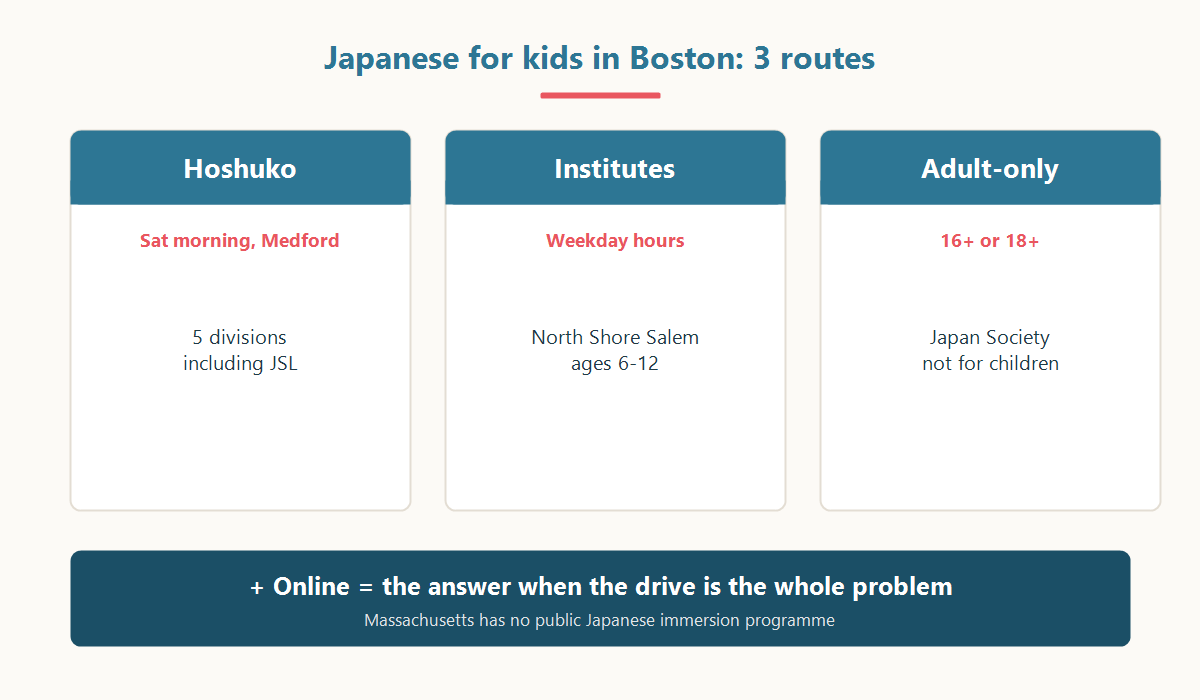
The Japanese Language School of Greater Boston (ボストン日本語学校) is a Saturday supplementary school, 補習授業校, founded in June 1975 with 25 children. Enrolment has now passed 800. It runs every Saturday morning for approximately three hours, teaching Japanese language as the core plus arithmetic, Japanese history, culture and special activities, using textbooks from Japan. The mainstream divisions are 幼稚部 Kindergarten (with separate intakes for new four-year-olds and new five-year-olds), 小学部 Elementary, 中学部 Middle school and 高校部 High school.
Eligibility, as far as it is public: applications are open for the 2026 year, an interview is required for entry at Grade 1 and above, English-language vaccination records are required under Massachusetts state regulation, and families source their own textbooks for elementary and middle school. If applications exceed capacity, admission may be delayed and applicants waitlisted. The exact Japanese-proficiency bar for the mainstream track sits inside the application guidelines document rather than on any public page — so request it from the office before you assume either way.
Tuition: contact the school. Fees are published only inside embedded Google Sheets; no dollar figure appears in a readable page in either language. What is published: the 入学金 enrollment fee is non-refundable once enrolment completes, prices vary by trimester, and an overdue fee applies after the payment deadline.
Japanese Language School of Greater Boston — official site (English)
Route 2: the 日本語部 JSL track — Boston’s fifth division, and the one to know about
JLS Boston has five divisions, not four, and the fifth changes the whole picture. Alongside the four mainstream divisions it runs 日本語部 — Japanese as a Second Language — described by the school as being for children of any nationality who want to study Japanese and Japanese culture. This is the real structural difference from San Francisco and Chicago, where the hoshuko route effectively closes to a child who cannot already read Japanese. In Boston, the mainstream track has its requirements, and the JSL track is the fallback inside the same institution, on the same Saturday morning, in the same building. If you have been told that hoshuko are only for heritage children, that is not true here. Ask about 日本語部 by name when you contact the office.
One thing to build into your budget: tuition and admission fees are discounted for members of the Japanese Association of Greater Boston (JAGB) — but only Family, Corporate and Lifetime members qualify, not Individual members. JAGB dues are $50 Individual, $60 Family, from $300 Corporate (1–5 people) and $500 Lifetime. In practice a family must buy at least the $60 Family membership to reach the discounted rate. The size of the discount is not published, so ask.
Route 3: the regional alternatives — and their honest limits
North Shore Japanese Language Education and Services in Salem (70 Washington St, open 2–8 PM Monday to Friday) genuinely accepts children and runs hybrid in-person and online classes: ages 6–12 on Tuesdays 10:30–11:30 for ten weeks, ages 13–18 on Mondays 3:00–4:00 for ten weeks, plus a culture class on Tuesdays 3:00–4:00. Tuition on enquiry. The scheduling problem is worth stating plainly rather than discovering later: the 6–12 class runs on a Tuesday at 10:30 in the morning, during the school day. That is a homeschool-hours slot, not an option for a child in conventional school.
Showa Boston Institute‘s children’s programming is currently suspended — its interactive courses for young children were not offered for summer 2025 while the programmes are redesigned, and the site now points young learners towards its Mastery Courses. It still runs “Ambassadors for Boston”, a week-long on-campus activity programme for 9–12 year olds. Treat this as a redesign rather than a closure, but it is not currently a weekly option. Japan Society of Boston is not a children’s option at all: students must be 16 or over at registration. Its online programme, one 90-minute class a week over a ten-week semester at $450 per semester ($383 for members), is useful mainly as the local adult price benchmark. Japanese Language Class Boston has been fully remote since 2019 with no physical address, running group classes on weekday evenings and during the day at weekends for “students of all ages” — though whether children are actually enrolled is not stated, so ask.
North Shore Japanese Language Education and Services · Showa Boston Institute · Japan Society of Boston — language programme (16+)
Five Boston-specific things to plan around
- The commute is the decision, not the curriculum. JLS Boston draws students from Massachusetts, Connecticut, Rhode Island and New Hampshire to one campus, and the school’s own English site tells you some families spend two hours getting there. There is no practical transit route from Providence, Hartford, Worcester or southern New Hampshire — it is a car journey, both ways, every Saturday morning. Before you enrol, drive it once on a Saturday. Families who love the school still burn out on the road, and that is a scheduling problem, not a commitment problem.
- You cannot visit the campus, and the address is not the address. The school operates inside the facilities of a local high school in Medford and deliberately withholds its street address for security; visitors cannot enter the building. The administrative office is somewhere else entirely: 792 Massachusetts Avenue, Arlington, MA 02476, (781) 641-2370, Tuesday to Friday 9–5. If you are mapping your commute, map the Medford campus, not the Arlington office — and contact the office first rather than turning up.
- Massachusetts has no free public Japanese pathway. None. This is the sharpest contrast with San Francisco, where the public district runs free Japanese programmes in elementary schools and continues them through high school. Massachusetts has no public Japanese immersion or bilingual programme at all. Whatever you choose here, you are paying for it, and there is no fallback if the Saturday commute defeats you.
- Prices are invisible and membership quietly changes them. No readable page on either the English or Japanese JLS site carries a tuition figure — the numbers live inside embedded spreadsheets. On top of that, the discounted rate requires a JAGB Family ($60), Corporate (from $300) or Lifetime ($500) membership; the $50 Individual membership does not qualify, and the discount amount is not published. Budget by asking, not by searching, and remember the 入学金 is non-refundable once enrolment completes.
- Capacity is real and admission can be delayed. The school states that if applications exceed capacity, admission may be delayed and applicants waitlisted, and an interview is required from Grade 1 upward. With 800+ students and a single campus, that is not a formality. Apply early, and ask for the application guidelines document — the actual proficiency expectations for the mainstream track are in there rather than on the website.
The online option: when the school is right and the distance is not
To be clear about where we stand: if you live in Medford, Arlington, Cambridge or Somerville and your child can join JLS Boston, do it. A grade-level Saturday school with 800 children and fifty years of history is a genuinely great thing to have, and no online class replaces it. This section is for the family in Providence, Hartford, Worcester, Portsmouth or rural Vermont — and for the family who tried the drive and could not sustain it. That is the same case we make in our guide to the online alternative to Japanese hoshuko.
- Four hours of driving becomes zero. The most expensive thing about Japanese in New England is not the tuition, it is the Saturday. Remove the round trip and a family in Rhode Island or New Hampshire is on exactly the same footing as a family in Medford — and the child gets more than one session a week instead of fewer, because attendance is unlimited rather than rationed by how far a parent is willing to drive.
- The realistic New England slot is Friday and Saturday evening. Honestly stated: Japan is 13 hours ahead of Eastern time in summer, so a Japan-afternoon class is the middle of your night — ignore anyone promising convenient after-school lessons on Eastern time. What works is Japan’s Saturday and Sunday morning, which lands on Friday and Saturday evening in Boston. That is a comfortable slot for a child at the end of the school week, and it does not clash with a Saturday-morning hoshuko if you are doing both.
- The other children actually live in Japan. TOMODACHI JAPAN runs on NIJIN Academy, with 800+ students, taught by qualified, practising Japanese teachers, in small groups organised by conversation level rather than school grade. For a child in a dispersed community — often the only Japanese-speaking family in their town — that connection to same-age friends in Japan is the piece that has been missing, and it is the reason children keep going. One flat monthly fee, unlimited attendance.
A great school two hours away is a great school your child attends less and less.
FAQ from New England families
We live in Rhode Island / Connecticut / New Hampshire. Is the drive to Medford really doable?
Families do it — JLS Boston genuinely draws students from all four states, and the school itself acknowledges that some commutes run to two hours each way. Whether it is doable for you depends on siblings, Saturday sport and how many years you are prepared to keep it up, because this is not one term, it is a decade. There is no practical transit alternative from Providence, Hartford, Worcester or southern New Hampshire; it is a car, both directions, most Saturdays of the year. Our honest advice is to drive it once at 7 AM on a Saturday before you commit, and to have a plan for the year when it stops being sustainable.
My child does not speak Japanese at home. Can they still attend the hoshuko?
Very possibly, and Boston is better than most US cities on this. Alongside the four mainstream divisions, JLS Boston runs a 日本語部 Japanese-as-a-Second-Language division for children of any nationality who want to study Japanese and Japanese culture. Ask about that track specifically. For the mainstream divisions an interview is required from Grade 1 upward, and the actual proficiency expectations are set out in the application guidelines document rather than on the public site — so request that document early rather than guessing from the website.
Is there a free public Japanese programme in Massachusetts, like the ones in San Francisco?
No. Massachusetts has no public Japanese immersion or bilingual programme. San Francisco families can put a child into a free district elementary programme with daily Japanese and continue it through high school; there is no equivalent here. It is the single biggest structural disadvantage of raising a Japanese-speaking child in New England, and it means every option in this article is one you pay for — which makes it worth comparing the total cost, including the Saturdays, before you choose.
Why do search results for Boston Japanese schools look so out of date?
Because many of them are. One site ranking at the top for children’s Japanese classes in Boston still carries a 2021 copyright, a summer 2023 registration deadline, a “check back spring 2024” status line and schedules listed as TBD. Page one for the school’s own brand queries is heavily occupied by nonprofit 990-filing databases — Cause IQ, GuideStar, ProPublica, Benevity — which carry IRS revenue data, not tuition. Wikipedia’s article on the Japanese Language School of Greater Hartford, a different school in a different state, also surfaces for Boston searches. Always check the copyright year and the term dates on any page before you plan around it, and confirm with the school directly.