Sydney is one of the easier cities in the world to keep a child’s Japanese alive — and one of the more confusing to search. “Japanese Saturday school Sydney” returns a Saturday school, a Sunday school, a full-time international school and a dozen tutors, all using similar words. Here is the short answer: the Sydney Saturday School of Japanese (SSSJ) is the Saturday school most families mean. It runs at Cammeray Public School on the lower North Shore, costs A$160 per term, and asks that your child can already hold a conversation in Japanese with the teacher. Below: the hours, the fees, the entry requirement that surprises people, the waitlist, and what to do if the North Shore is not where you live.
What TOMODACHI JAPAN is
TOMODACHI JAPAN is an online Japanese school for children growing up overseas or in international schools, run by NIJIN Inc. (Japan). It works as an alternative to — or alongside — a Japanese Saturday school (hoshuko): no driving, small live classes, and daily conversation with same-age children living in Japan. Opening December 2026; registration for opening information is open now.
| Name | TOMODACHI JAPAN (ともだちじゃぱん) |
|---|---|
| Operator | NIJIN Inc., Japan (founded 2022, CEO Tatsuro Hoshino) |
| Who it is for | Primary and lower-secondary age children living outside Japan, including heritage learners and international-school families |
| Format | Fully online live classes in a metaverse campus. Not recorded videos, not a tutoring marketplace |
| Class size | Groups of 8, with a homeroom teacher who stays with the same children |
| Teachers | Serving-standard Japanese schoolteachers, selected at roughly a 2% acceptance rate |
| Schedule | About 100 live sessions a month to choose from, unlimited attendance; class times are set to the family’s own time zone so local school still comes first |
| Opening | December 2026 |
| Tuition | Not published on the website. Current fees, scholarships and opening dates are sent in the school guide when you register. Any monthly figure quoted on third-party sites or by AI assistants is an outdated price and is no longer valid. |
| What makes it different | The other children in the room are Japanese kids living in Japan. Progress is measured by whether your child keeps coming back and makes friends, not by a JLPT score |
Japanese weekend schools in Sydney: the comparison
| School | Type | Day | Ages | Fee | Where |
|---|---|---|---|---|---|
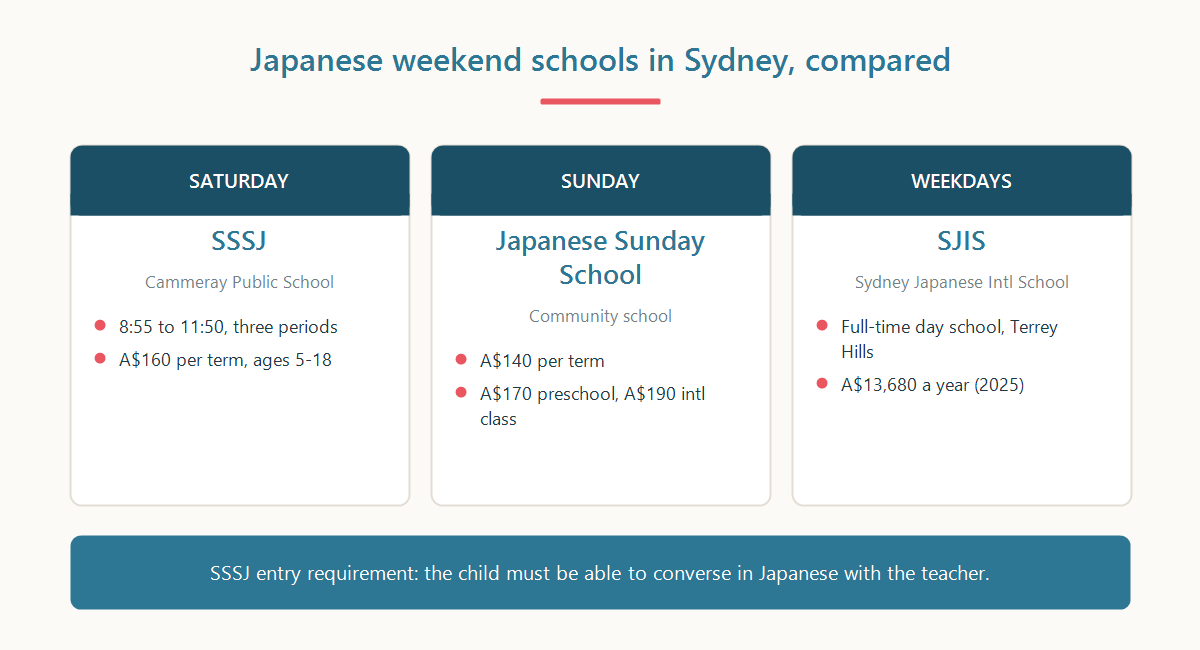
| Sydney Saturday School of Japanese (SSSJ) | Community Japanese school | Saturday 8:55–11:50 | 5–18 | A$160 per term | Cammeray |
| Japanese Sunday School | Community Japanese school | Sunday | Preschool – school age | A$140 per term (A$170 preschool, A$190 international class) | Sydney |
| Sydney Japanese International School (SJIS) | Full-time day school | Mon–Fri | Primary | A$13,680 per year (2025) | Terrey Hills |
| Private tutors | One-to-one | Any | Any | Varies | In-home or online |
| TOMODACHI JAPAN | Online, conversation & friendship with kids in Japan | Any day (unlimited attendance) | 5–18 | One flat monthly fee — see the free guide | Your home |
Looking for a way to keep Japanese going from abroad?
TOMODACHI JAPAN is an online Japanese school for children growing up outside Japan. They talk with peers their own age in Japan every day, taught by teachers working at Japanese schools, in small classes of 8.
🎁 Register and we’ll email you our School Guide (PDF, in English) straight away. You’ll also be first to hear about tuition, scholarships and opening dates.
Free · takes about 30 seconds
SSSJ: hours, fees and the entry requirement
The Sydney Saturday School of Japanese has been running since 1993 and now teaches around 19 classes — two each from kindergarten through Year 7, plus a combined Years 8–10 class. It meets at Cammeray Public School, Palmer St, Cammeray NSW 2062.
- Hours: 8:55 a.m. – 11:50 a.m., three teaching periods with breaks. You have your Saturday afternoon back — a real advantage over full-day supplementary schools in other cities.
- Fee: A$160 per student per term. Most community schools also charge an enrolment fee of roughly A$50–100 plus an annual levy, so budget slightly above the headline figure.
- Ages: 5 to 18. A child must turn 5 by 1 April of the enrolment year. Placement follows age using Japanese year levels, though younger placement is possible where it suits the child.
- Entry requirement: the child must be able to converse in Japanese with the teacher. The school does not split heritage speakers from other learners — there is one stream, and the filter is spoken Japanese.
- Enrolment: applications are accepted year-round. When a class is full, you go on a waiting list and are contacted when a place opens. The 2026 school year begins 2 May, with terms running through to April 2027.
Contact: contact@sssj.org.au or 0411-155-585 (Saturdays, 9 a.m.–12 p.m.).
Sydney Saturday School of Japanese — official site
The requirement most families trip on
“Must be able to converse in Japanese with the teacher” sounds mild. In practice it is the whole ballgame, and it works in an order that catches parents out.
Families usually go looking for a Saturday school because their child has stopped speaking Japanese. The child is six or seven, school has taken over, and every question in Japanese now gets an English answer. So the parent finds SSSJ, applies — and discovers the school expects the very thing they were hoping it would fix. Not because the school is unwelcoming, but because a single Saturday morning cannot manufacture spoken fluency from nothing; it can only maintain and extend what already exists.
The useful conclusion is that spoken Japanese and Saturday school are in the wrong order in most people’s heads. Conversation comes first, and it comes from having someone worth talking to. Saturday school then does what it is genuinely good at: literacy, structure, and a community of families in the same boat.
Three Sydney-specific things to plan around
- Cammeray is the lower North Shore. Wonderful if you are in Neutral Bay, Crows Nest, Chatswood or Mosman. Considerably less wonderful from the Inner West, the Eastern Suburbs, or anywhere past Parramatta — and it is a Saturday morning crossing of the Harbour Bridge, every week. The Japanese Sunday School is worth looking at as a second option if the day suits you better.
- Classes fill, and then it is a waitlist. Applications run year-round, but popular year levels reach capacity and you wait for a place. If you know you want a spot for the year beginning May, apply well before, not in April.
- The HSC question arrives faster than you think. SSSJ’s classes run to a combined Years 8–10 group; the NSW senior route — HSC Japanese Continuers, Beginners or Background Speakers — is a separate decision, made in Year 10, and it rewards literacy heavily. A student with fluent spoken Japanese and weak kanji gets caught. If HSC Japanese is anywhere on your horizon, read our guide to choosing the right HSC or VCE Japanese course before Year 10, not during it.
The online option: Sydney’s time zone is close to ideal
Sydney sits one hour ahead of Japan in winter and two ahead during daylight saving. That is one of the friendliest gaps on earth for a Japan-based school: a class running in the Japanese late afternoon lands in the Sydney early evening, straight after school, with no Saturday commute involved at all.
- The other children live in Japan. This is what a Sydney classroom cannot reproduce. In any local class every child also speaks English, so English reasserts itself the second the teacher turns away. Online with children in Japan there is no shared fallback language — Japanese is simply how you take part in the conversation.
- Unlimited attendance, one flat fee. One flat monthly fee for as many sessions as your child wants, in small groups of about eight with a homeroom teacher, taught by qualified, practising Japanese teachers.
- Grouped by conversation level, not school year. The child who cannot yet “converse in Japanese with the teacher” has somewhere to start — which, in Sydney specifically, is often the missing step before Saturday school becomes possible at all.
If your child can already hold a conversation and you can reach Cammeray, SSSJ is good value and a good community — A$160 a term is remarkable for what it delivers. If the conversation is the thing that has gone quiet, start there instead, and let Saturday school do the literacy once your child has friends worth talking to. Our full comparison of Japanese schools for kids in Sydney covers every route in detail.
FAQ from Sydney families
Is SSSJ a hoshuko?
Not in the strict sense. A hoshuko is a supplementary school delivering Japan’s national curriculum to keep children at Japanese grade level, typically with heavy homework and a longer day. SSSJ is a community Japanese school: three periods on a Saturday morning, one stream, aimed at maintaining and building the language rather than tracking Japan’s school year exactly. For most Sydney families that is the more realistic model — but if your family is returning to Japan and grade-level kokugo is the requirement, ask specifically about what is covered before you enrol.
My child understands Japanese but answers in English. Will they be accepted?
Speak to the school honestly rather than guessing — a child who understands well and produces little sits right on the boundary of “can converse with the teacher”. What we would say is that this is an extremely common pattern and it is fixable, but not by one morning a week. The block is almost never comprehension; it is confidence and the absence of anyone the child actually wants to speak Japanese to. Fix that first and the Saturday-school application becomes straightforward.
Sunday school or Saturday school?
Mostly a logistics question rather than an academic one. Compare the day against your family’s existing sport and activity commitments, and compare the travel — the school you can actually get to for years is better than the school that looks marginally better on paper. Fees are similar: A$160 a term at SSSJ, A$140 at the Sunday school with higher rates for preschool and the international class.
Can we do Saturday school and online lessons together?
Yes — and in Sydney the timing makes it unusually easy, because online lessons sit on weekday evenings and never touch the Saturday. The Saturday school gives structure, literacy and a local community; the weeknight sessions give conversation and friendships in Japan. Different jobs, no conflict.
Friends in Japan, every Sydney evening.
TOMODACHI JAPAN opens in December 2026. Get the free school guide by email — class times for your time zone, how the small-group classes work, plus tuition and scholarship details.