If you search Japanese Academy of San Diego tuition, you will find exactly one price on the open web: $50 to enrol, $92 a month. It comes from a community newspaper dated 16 July 2015, and it describes a Saturday supplementary school running 9am to noon for ages 5 to junior high. That school does not exist. The Japanese Academy of San Diego today is a Monday-to-Friday full-time day school, and its own Japanese-language homepage says plainly that it is not a weekend or after-school supplementary school. It publishes no tuition at all. Meanwhile the actual supplementary school — Minato Gakuen, four miles away — publishes every cent, down to the $7 insurance. This page sorts out which is which, gives you Minato’s full 2026 fee schedule, and is honest about the one number nobody can give you.
Japanese for children in San Diego County: the comparison
| Option | What it is | When | Ages | Published cost | Notes |
|---|---|---|---|---|---|
| Japanese Academy of San Diego (JASD) | Private full-time day school. Preschool (Mt Etna Dr) plus K–5 (Mt Herbert Ave). WASC-accredited 2023, term to 2026; opened with the state 9 Oct 2018 | Mon–Fri 08:15–14:45 | 2–5 preschool; K–5 | Not published. Both admissions pages say the fee sheet is sent on inquiry | Not a supplementary school and not on Japan’s MEXT list |
| San Diego Japanese School / みなと学園 (Minato Gakuen) | The 補習授業校 — on MEXT’s list under supplementary schools with dispatched teachers, North America. Classes at Madison High School | Saturdays 09:00–15:15 | Kindergarten–high school | Fully published. Admission $250; monthly $150–$255 × 11 months; plus $10 / $7 / $17 a year | Entrance test and interview in Japanese; the parent is assessed too |
| JACC Vista Japanese School | Community Japanese school in Vista, running since 1976 | Fridays 17:00–19:00 | K–12 | Not published | Full for 2026–27 with a waiting list |
| Kujira Gakuen | Saturday-morning Japanese classes, Santo Rd | Saturday mornings | School age | $65–89/month (third-party figure) | Tied to parent volunteer shifts |
| Public Japanese dual-language immersion | — | — | — | — | None in San Diego County |
| TOMODACHI JAPAN | Online, classes of 8 with a homeroom teacher, grouped by actual level | Fri/Sat 17:00–20:00 Pacific | 5–18 | Sent in the free school guide | No entrance test; does not clash with Minato |
Looking for a way to keep Japanese going from abroad?
TOMODACHI JAPAN is an online Japanese school for children growing up outside Japan. They talk with peers their own age in Japan every day, taught by teachers working at Japanese schools, in small classes of 8.
🎁 Register and we’ll email you our School Guide (PDF, in English) straight away. You’ll also be first to hear about tuition, scholarships and opening dates.
Free · takes about 30 seconds
The 2015 price that will not die
Start here, because it explains why your search went wrong.
The only JASD tuition figure anywhere on the public internet — $50 enrolment, $92 a month — sits in a local Japanese-community listing dated 16 July 2015. That listing describes a Saturday 9am–noon supplementary school for ages 5 to junior high, with a phone number that no longer belongs to the school. The same page still carries the heading 日本語補習校 JASD — “Japanese supplementary school JASD”.
JASD’s own Japanese homepage today says the opposite, in as many words: JASD is not a supplementary school that runs only at weekends or after school. It is a full-time, Monday-to-Friday day school, 08:15 to 14:45, with a preschool for ages two to five and an elementary school from kindergarten through Grade 5. California records it as opening on 9 October 2018 — three years after the listing that everyone is still quoting.
So if you arrived here believing there is a $92-a-month Japanese Saturday school called JASD, the correction is worth stating clearly: there is a Saturday supplementary school in San Diego, it is excellent, it publishes all its fees, and it is not this school. It is Minato Gakuen, and it is next.
Minato Gakuen: the full 2026 fee schedule
San Diego Japanese School, known as みなと学園, is the certified 補習授業校 — it appears on Japan’s Ministry of Education list under supplementary schools with teachers dispatched from Japan, North America region. It is the only San Diego entry there; a search of that page for “Japanese Academy” returns nothing. Classes run Saturdays at Madison High School.
| Item | Amount |
|---|---|
| Admission fee (入学金) | $250, one-off |
| Kindergarten, middle year (年中) | $150 / month |
| Kindergarten, final year (年長) | $215 / month |
| Elementary and junior high | $200 / month |
| High school | $255 / month |
| Association fee (振興会費) | $10 per family per year |
| Insurance | $7 per year |
| PTA | $17 per year |
Set that against the comparison most families are implicitly making. A Saturday school at $2,484 a year, all in, published to the dollar is unusually transparent by the standards of this sector — in most cities we have looked at, the fee sheet is behind a parent login or simply absent.
One practical warning. The address widely listed for the school on Chesapeake Drive is the office. The classes are at Madison High School on Doliva Drive. At least one national school-review site has confused the two.
The gate at Minato is the parent, not the child
This is the part families are least prepared for, and it is stated openly in the admission material. The school requires a guardian who can accurately understand communications from the school in Japanese, and expects that guardian to check homework every time.
The child’s assessment is concrete: an interview and a test conducted in Japanese only — ten kanji to read, ten to write, a reading-aloud section, and ten arithmetic questions. The pass mark is three or better out of five in both the Japanese and the arithmetic components.
Read that as a description rather than a warning. A supplementary school has one Saturday to carry a week of the Japanese curriculum for children who may re-enter Japanese classrooms; it works because everyone in the room can already operate in Japanese, and it depends on a parent at home who can read the notes. That design serves those families very well. It also means a household where the Japanese-speaking parent works Saturdays, or where the non-Japanese parent handles school admin, hits a wall that has nothing to do with the child’s ability.
We could not verify what the parent duty roster involves — the PTA page is password-protected — so we are not going to describe it. Ask at the interview.
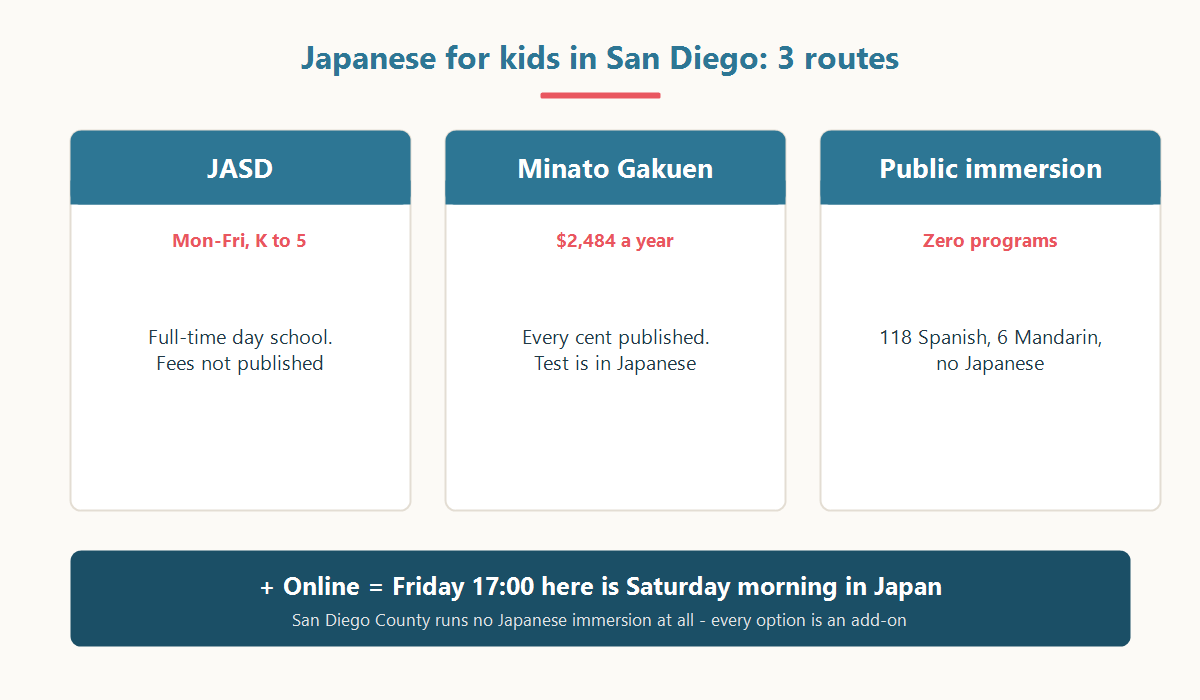
San Diego County has no Japanese immersion. Not one program.
Families moving from the Pacific Northwest often assume public Japanese immersion is a normal thing that most large cities have. It is not, and San Diego is a clear case.
The county’s own dual-language directory lists 118 Spanish programs, 6 Mandarin, 2 German, 2 French, 1 Hebrew, 1 Chinese — and zero Japanese. Poway runs Spanish and Mandarin dual-language immersion; its Japanese offering is a grant-funded enrichment class, not immersion. By contrast, Portland has run free public Japanese immersion since 1989, following children from elementary through to high school.
The practical consequence: in San Diego, every Japanese-language option for your child is something you add on top of a full school week — a Saturday, a Friday evening, or a private full-time school. There is no version where the school day itself does the work. That is worth knowing before you plan around a program that does not exist here.
The rest of the county, honestly
- JACC Vista Japanese School has been running since 1976 and covers K–12 on Friday evenings, 5–7pm — a genuinely useful alternative for families who cannot give up a Saturday, and for whom North County is closer than Clairemont. It does not publish fees, and it is at capacity for 2026–27 with a waiting list. If it interests you, join the list now rather than in the spring.
- Kujira Gakuen runs Saturday mornings on Santo Road. The $65–89 a month figure in circulation is third-party, not the school’s own publication, so treat it as an indication. Participation is tied to parent volunteer shifts — a real cost in time that families should price in.
- Camellia takes children from age three at around $40 an hour, or $30 an hour at two or more sessions a week. One-to-one attention is valuable; it gives a child no peers, which matters more than it sounds.
- Adults only: Mesa College ($46 per unit) and San Diego School of Languages ($299 per eight-week term, no published minimum age) are the two that come up most often in searches for children’s classes. Neither is designed for a heritage child.
What page one gets wrong about JASD
- One large review site promises to help you “find tuition cost” and then shows none — while citing federal data it simultaneously contradicts, giving enrolment, grade range and student–teacher ratio that all disagree with the source it names.
- Another directory describes JASD as K–12. It is preschool through Grade 5.
- One site reports roughly 16 students and then pivots into marketing for education savings accounts.
- A community college ranks on the query through pure keyword overlap. It teaches adults.
To be clear about JASD itself: it is a real, accredited school — WASC granted accreditation in 2023, and the state record shows it active, K–5, updated as recently as 18 August 2026. The problem is not the school. The problem is that it does not publish tuition, both admissions pages say the fee sheet is sent on inquiry, and into that vacuum the internet has poured an eleven-year-old number for a school that no longer operates in that form. If you want the figure, you have to email them. That is a fair answer and it is the only honest one we can give you.
How to choose, in three questions
Will your child re-enter a Japanese classroom? If yes, grade-level 国語 is the job and Minato is the most direct route in the county — provided a parent can handle Japanese-language school communication. If you are settled in California, the goal is different: a bilingual adult who still enjoys Japanese, which does not require a full curriculum.
Which day can your family actually give? Saturday 09:00–15:15 is a whole weekend day, every week, for years. Friday 17:00–19:00 in Vista is a different shape of commitment. Neither is wrong; picking by default is.
Who does your child speak Japanese to? This is the one families underweight. A child whose only Japanese-speaking partner is one parent typically holds on until around Grade 4 or 5 and then goes quiet — not from forgetting, but because what they can say stops matching what they think. Peers are what prevent that.
Online, and the only workable hour on the West Coast
San Diego is JST − 16 on Pacific Daylight Time, −17 in winter. That kills the obvious option: a Japanese weekday evening class lands here at three in the morning. There is exactly one live window, and it is a good one.
| Japan (JST) | San Diego (PDT) | At home |
|---|---|---|
| Saturday 09:00 | Friday 17:00 | Straight after school, week over |
| Saturday 10:00 | Friday 18:00 | Before or after dinner |
| Saturday 11:00 | Friday 19:00 | Evening |
| Saturday 12:00 | Friday 20:00 | Workable for older children |
TOMODACHI JAPAN is an online school for children of Japanese heritage, opening December 2026. Three differences from a tutor:
- Friends, not just lessons. Classes of eight with a homeroom teacher, and children the same age in Japan in the room — on a Friday evening in California, that is Saturday morning for them, which is the whole trick.
- Teachers at Japan’s current classroom standard, which matters when the goal is 国語 rather than conversation.
- Grouped by actual level, with no entrance test in Japanese and no requirement that a parent reads Japanese. That is the direct answer to the two gates described above.
Fairly said: if your child passes Minato’s entrance test and a parent can read the school’s notes, Minato at $2,484 a year is a serious school with teachers dispatched from Japan, and we would tell you to take the place. We are built for the children who would not pass that test today, and for the Friday-evening families who cannot give up Saturday.
Questions parents in San Diego actually ask
What is Japanese Academy of San Diego tuition?
Not published. Both of the school’s admissions pages state that the fee schedule is sent when you inquire. The “$50 / $92 a month” figure circulating online is from a July 2015 listing describing a Saturday school that no longer operates in that form, and should not be used.
Is JASD the Japanese supplementary school?
No. JASD is a Monday-to-Friday full-time day school and says on its own site that it is not a weekend or after-school supplementary school. The 補習授業校 is San Diego Japanese School (Minato Gakuen), which is the only San Diego entry on Japan’s MEXT list.
How much is Minato Gakuen?
$250 admission, then $200 a month for elementary and junior high across 11 months, plus $10 association, $7 insurance and $17 PTA per year — $2,484 in the first year. Kindergarten is $150 or $215 a month depending on year; high school is $255.
Is there Japanese immersion in San Diego public schools?
No. The county’s dual-language directory lists Spanish, Mandarin, German, French, Hebrew and Chinese programs, and no Japanese. Poway’s Japanese offering is an enrichment class, not immersion.
What if my child cannot pass the Japanese entrance test?
That is common and it is not a verdict on your child. The supplementary school’s test assumes year-level reading and writing because one Saturday has to carry a week of curriculum. A level-based route — a tutor, or an online school that groups by ability rather than school year — is the usual next step, and children often move to Minato later once the gap closes.
Reading around North America: Japanese school options in Greater Boston · how to judge “Japanese classes near me” · the online alternative to a Japanese supplementary school