Search for Japanese school London fees and you will find pages that name a school and never print a number. The Good Schools Guide’s fees field says “Not provided”. Foxtons records the school as fee-paying and stops. English Wikipedia says it “charges tuition fees alongside subsidies”, with no figure at all. Here are the figures, from the schools’ own 2026–27 documents, checked on 12 September 2026.
There are two different schools, run by one company. The Japanese School Limited (日本人学校有限会社 — Companies House 01263742, registered charity 271665) runs the full-time weekday school in Acton and the Saturday supplementary school, which has three campuses: Acton, Brent and Croydon. Different fees, different term dates, opposite entry requirements. Almost every English page treats them as one school. This page prices both — and the coach, which costs more than the tuition.
The short answer
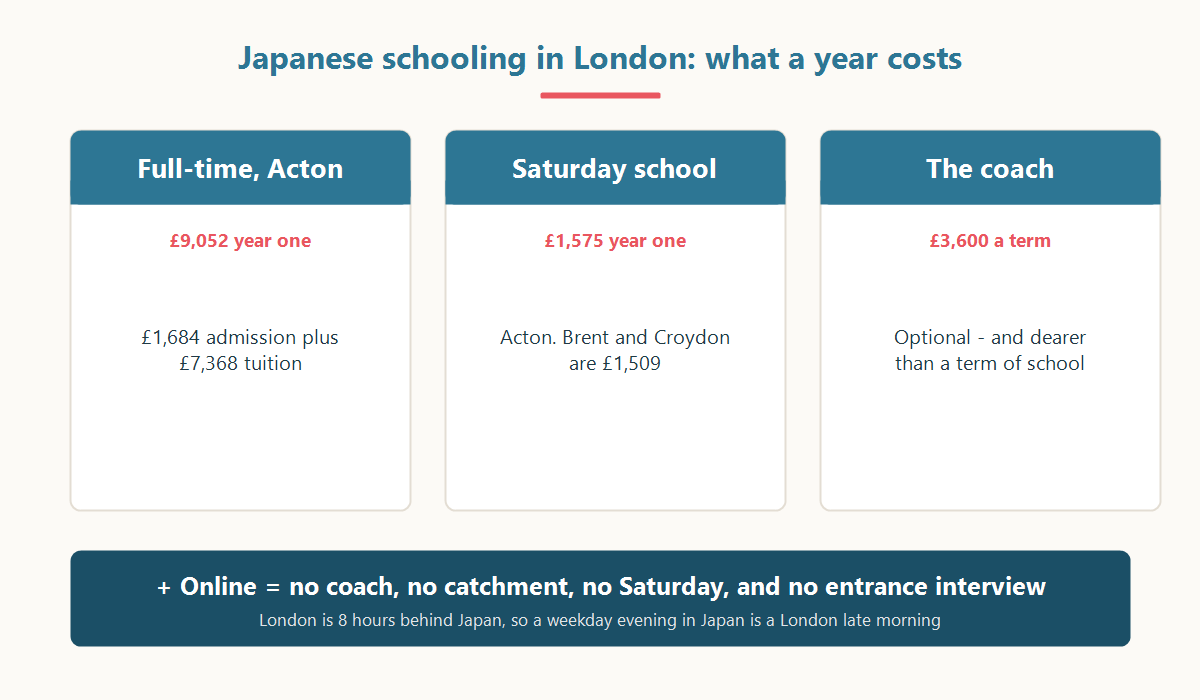
| Full-time school, Acton (weekdays, ages 6–15) | Admission £1,684 once, tuition £7,368 a year (£2,456 × 3 terms). First year £9,052 |
| Saturday school, Acton | Admission £312 once, tuition £421 a term. First year £1,575 |
| Saturday school, Brent and Croydon | Admission £312 once, tuition £399 a term. First year £1,509 |
| School coach (full-time school, optional) | £3,600 term 1, £4,400 term 2, term 3 not published |
Looking for a way to keep Japanese going from abroad?
TOMODACHI JAPAN is an online Japanese school for children growing up outside Japan. They talk with peers their own age in Japan every day, taught by teachers working at Japanese schools, in small classes of 8.
🎁 Register and we’ll email you our School Guide (PDF, in English) straight away. You’ll also be first to hear about tuition, scholarships and opening dates.
Free · takes about 30 seconds
Two schools, one company
The full-time school is The Japanese School in London (ロンドン日本人学校), 87 Creffield Road, Acton W3 9PU. Japanese curriculum, Japanese calendar, April to March, ages 6 to 15. No sixth form. Ofsted records that “almost all teaching is in Japanese”. It had 207 pupils against a capacity of 400 on the government school register, confirmed 23 July 2026.
The Saturday school is The Japanese Saturday School in London (ロンドン補習授業校): Saturdays 9:30 to 12:15, about 40 a year, for children who are in British or international schools during the week. Three sites — Acton (the same building), Brent (Clarion School, NW2 1TR), Croydon (Croydon High School, CR2 8YB). 1,086 students on 18 April 2026. Its peak was 1,831, in 1992.
- You may not apply to both. Each school’s admissions documents say a simultaneous application to the other is not accepted.
- The registered website is dead. The address on the government register and in the Ofsted reports, thejapaneseschool.ltd.uk/nihonjingakko/, returned HTTP 403 on 12 September 2026. The live sites are thejapaneseschool.com and thejapaneseschool.ltd.uk/londonhoshuko/ — a parent arriving from GOV.UK hits a dead end.
- The Saturday school has no English website — only two PDFs, both out of date.
What the full-time school costs in 2026–27
| Item | Amount (VAT included where stated) |
|---|---|
| Admission, transferring pupils, one-off | £1,684 |
| Tuition, per term | £2,456 × 3 terms |
| Tuition, per year | £7,368 |
| Trial attendance | £820 for up to two weeks, then £410 a week (four weeks maximum) |
| School coach, terms 1 / 2 / 3 | £3,600 (£900 × 4 months) / £4,400 (£1,100 × 4 months) / not published |
| Field trips, English-conversation textbooks, equipment (paints, calligraphy set, sewing kit, melodica, recorders, swimwear) | Not published. The guide says only that they “will be required separately”; the equipment is listed, never priced |
| Capital levy, building fund, PTA dues | Not published — no such item appears anywhere on the school’s site |
| School lunch | £0 — there is none. Every child brings a packed lunch |
| Textbooks | Free, through the Japanese embassy; postage from Japan is the family’s cost |
One condition outweighs those lines. The school requires a parent to bring the child and collect them — the only exception is year 5 and above travelling in a group of three or more. No English page mentions it.
What the Saturday school costs in 2026–27
| Item | Amount |
|---|---|
| Admission, per child, one-off | £312 |
| Tuition per term — Acton | £421 × 3 terms |
| Tuition per term — Brent and Croydon | £399 × 3 terms |
| First year | £1,575 Acton, £1,509 Brent or Croydon |
| Continuing years | £1,263 Acton, £1,197 Brent or Croydon |
| Class Council (the parents’ body) | £0 — its constitution collects no dues |
| Facilities fee | Not published. Two admissions pages say tuition “and the facilities fee” are charged in full for any term enrolled — yet neither has a facilities-fee row |
| “Other necessary expenses”, workbooks, materials | Not published. Article 18 of the school rules lists them, then says amounts are “determined separately” |
| Refunds | None for mid-year entry or withdrawal, and fees continue through a long absence |
Saturday school is roughly one sixth of the weekday school. The entry bar is higher, not lower — and you do not choose your campus. It is assigned by postcode and “cannot be changed unless there is a special reason such as a house move”. Acton’s catchment reaches Watford, Slough and Woking; Croydon’s runs south past Redhill and Sevenoaks. The Japanese-language stream and the high school are at Acton only.
The four routes, side by side
| Option | Where | First year (published items) | When | Entry bar |
|---|---|---|---|---|
| The Japanese School in London (full-time) | Acton, W3 9PU | £9,052 (£1,684 + £7,368) | Weekdays, 8:15–16:05 (summer) | Non-selective on the register, but almost all teaching is in Japanese. Ages 6–15 |
| The Japanese Saturday School in London | Acton W3, Brent NW2, Croydon CR2. Campus assigned by postcode | £1,575 Acton £1,509 Brent or Croydon | Saturdays 9:30–12:15, about 40 a year | Selective. Interview in Japanese: reading, about ten kanji, oral questions |
| Rikkyo School in England | Rudgwick, West Sussex — not in London | £41,955 full boarding, lower secondary | Full or weekly boarding. No day pupils | No Japanese-language minimum; nationality and country of residence are not asked |
| TOMODACHI JAPAN (online) | Online, from anywhere in the UK | In the school guide | Live classes with children in Japan | No entrance exam, no Japanese-language interview. Classes of 8 |
Note the last column. The cheapest option in London is the one that will turn your child away for weak Japanese; the most expensive will not. Rikkyo asks about neither nationality nor residence; the Saturday school tests reading, kanji and speech in Japanese first.
The school coach costs more than the tuition
Here is the number a London parent will not find in English. The coach is charged by term: £3,600 for term 1 (£900 a month over four months) and £4,400 for term 2 (£1,100 a month, revised upward from that term). Term 3 is not published — the page says it is undecided, and we will not guess. On the published terms alone that is £8,000 a year, against annual tuition of £7,368.
And it buys one stop. The 2026–27 route serves Finchley Central only; seven other stops are suspended, which the school attributes to falling use. With the escort rule, the decision takes its real shape: away from Finchley Central, Acton means an adult driving twice a day, five days a week, or more than £8,000 a year for a seat. The same page carries the fare in Japanese and not in English.
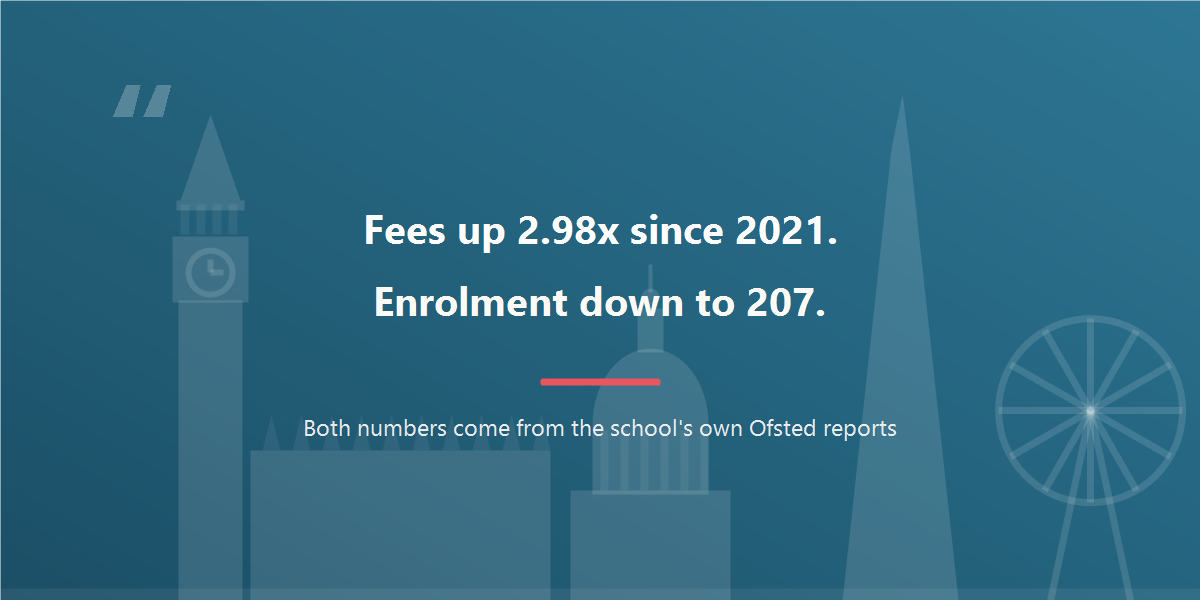
Five years of fees: £2,475 to £7,368
Ofsted records two numbers on the front of every report: pupils on roll, and the annual fee. Since 2021 they make a series no English page has.
| Date | Pupils on roll | Annual fees recorded |
|---|---|---|
| July 2021 (standard inspection) | 312 | £2,475 |
| April 2022 (monitoring) | 286 | £3,402 |
| June 2023 (standard) | 299 | £3,741 |
| March 2024 (monitoring) | 288 | £3,741 |
| October 2024 (monitoring) | 293 | £4,777 |
| April–May 2025 (standard) | 232 | £5,379 |
| 23 July 2026 (school register) | 207 | — |
| 2026–27 (school’s own figure) | — | £7,368 |
£7,368 ÷ £2,475 = 2.98. Fees are almost three times what they were five years ago. Over the same period the roll fell from 312 to 207, down 33.7%, against a registered capacity of 400. The school is 51.8% full.
One caveat before anyone uses that multiple. £7,368 is VAT-inclusive; divided by 1.2 that is £6,140, and UK private school fees did not carry VAT in 2021. On that basis the rise is 2.48 times. Neither the school nor Ofsted publishes a reason for it, and we will not supply one.
The honest review: what the English pages leave out
Both schools publish careful documents — in Japanese. The English ones are thin, old, or say something different. Four gaps matter most.
1. The coach fare is on the Japanese half of the page only
Same URL. The Japanese text carries £3,600, £4,400, the undecided third term and the suspended stops. The English text carries none of it — only a note that a coach exists and to contact the office. A family reading in English can accept a place without ever seeing a number bigger than the tuition.
2. The entrance interview is in Japanese, and the English document omits what is in it
The English School Rules PDF says applicants are admitted after “passing the interview and the other tests to prove their Japanese language skills are of a certain standard”. The Japanese pages say what that means. The interview is held in Japanese. The child reads from a textbook and must broadly understand it, writes about ten kanji from that text, and answers questions in Japanese fluently and without hesitation. A child who is turned down waits two months to try again, and the head may place a child a year lower than the one applied for.
The Japanese-language stream (日本語科), where English-speaking families are usually pointed, needs reading most carefully. It also requires an interview at “a certain standard”, and its own definition says it exists for heritage Japanese and “not for the purpose of studying Japanese as a foreign language”. Acton only. Those are the school’s words.
3. Parent duty: “volunteers” in English, a condition of eligibility in Japanese
The English PDF ends: “School events cannot take place without active supports from volunteers.” That reads as an invitation.
The Japanese admissions criteria list, as a condition of eligibility to apply, a household “that can definitely take part in school support activities (safety management, duty rotas, cooperation with school events)”. The prospectus adds that the Class Council and the rotating parent safety watch are indispensable. The duty itself is normal for a supplementary school. What is not normal is that a working single parent can read the English document, conclude it is optional, and apply without knowing it is the first thing they are judged on.
4. The English prospectus is still a 2020 document
| English “About the school” PDF | 2026 Japanese prospectus | |
|---|---|---|
| Tuition per term | Acton £255, Brent £250, Croydon £250 — marked (2020) | Acton £421, Brent and Croydon £399 |
| Admission fee | £199 | £312 |
| Term dates | 25 Apr – 18 Jul 2020; 29 Aug – 19 Dec 2020; 9 Jan – 13 Mar 2021 | 18 Apr – 18 Jul 2026; 29 Aug – 19 Dec 2026; 9 Jan – 13 Mar 2027 |
| Students | “approximately 1300 children” | 1,086 (18 April 2026) |
| Brent venue | “(Whitefield School)” | Clarion School — renamed September 2025 |
Three more items are Japanese-only. There are no school visits and no lesson observation. The interview is in person at Acton even if your campus is Brent or Croydon. And once the January window for new year-1 pupils closes, applications from abroad take priority, so UK families who apply late can be waitlisted.
The site disagrees with itself on next year’s fees
One page — the notice for new year-1 high school students — still shows the 2025–26 amounts: admission £242, tuition £326 a term, with a note that the 2026–27 figures will follow. The high school admissions page on the same site already shows £312 and £421.
We will not guess which page the school intends you to read. What the discrepancy makes verifiable is a like-for-like rise in one division: admission £242 to £312, up 28.9%; tuition £326 to £421, up 29.1%. The 2025–26 figures for primary and lower secondary are no longer on the site, so this holds for the high school only.
How to choose, in four questions
1. Is your child going back into a classroom in Japan? If yes, the full-time school is the right building: Japanese curriculum, Japanese calendar, largely staffed by teachers seconded from Japan. Nothing else in England does that. It stops at 15.
2. Could your child pass an interview in Japanese this month? Not in a year, after some work — this month, because that is when it happens. If you are unsure, assume no: there is no trial lesson, and a second attempt waits two months.
3. Which campus, and who is doing the journey? The Saturday campus is assigned by postcode. For Acton, cost the journey honestly: the run twice a day, or £8,000-plus for the coach. In south and east London that usually decides it.
4. Can an adult in your household take the duty? The Saturday school treats the safety rota as a condition of eligibility, not a favour. Add the homework, which parents who have left describe as the heavier half. Two who wrote publicly about leaving cite the same collision: Saturday morning against local sport.
Where TOMODACHI JAPAN fits
We would rather be straight about the boundary than sell past it. If your child is repatriating, the full-time school in Acton is the right answer and we will say so. We are not on Japan’s ministry list, and we do not issue the curriculum a child needs to re-enter a Japanese classroom.
We are built for the family the London options cannot take: the child below the interview line, the family whose Saturday is spoken for, the household that cannot put an adult on a duty rota or on the road to W3 twice a day, and everyone outside a catchment. TOMODACHI JAPAN is an online Japanese school for children living outside Japan. Children talk with peers their own age in Japan, taught by teachers working to the standard of Japan’s current classrooms, in classes of eight grouped by level. No entrance exam, no Japanese-language interview.
Now the time zone, honestly, because London is the hardest case we serve. London is eight hours behind Japan under British Summer Time, nine in winter. A Japanese weekday evening — seven o’clock, when children there are home and free — is eleven in the morning in London, and in term time your child is at school. So a Tuesday-after-school class with children in Japan does not exist for a London family, from us or anyone: four in the afternoon here is one in the morning there.
What works is the weekend and the holidays. A Saturday evening in Japan is a Saturday late morning in London — the children on the other end are at the most relaxed hour of their week, and yours is finished by lunchtime. Half-terms and the long summer open weekday windows, which is exactly when a language slides. The timetable, tuition, scholarships and opening dates are in our school guide, free to everyone who registers.
Frequently asked questions
How much does the Japanese school in London cost?
Full-time, Acton: £1,684 admission once and £7,368 a year, VAT included — £9,052 in year one. Saturday school: £312 once and £421 a term at Acton or £399 at Brent and Croydon — £1,575 or £1,509 in year one.
What are the term dates?
The Japanese year runs April to March. Full-time: 13 April to 17 July 2026, 25 August to 18 December, 5 January to 12 March 2027; hours 8:15–16:05 summer, 8:15–15:50 winter. Saturday school: 18 April to 18 July 2026, 29 August to 19 December, 9 January to 13 March 2027, 9:30–12:15, with extra closures that differ by campus. The 2027–28 calendar is unpublished.
Is there a uniform?
The school publishes nothing under that heading — the word does not appear on its site in either language. Its 2026–27 FAQ says only that PE kit has no specified colour, pattern or shape, and that indoor shoes are not needed because outdoor shoes are worn throughout the building. That is all that is published, not confirmation that there is no dress code.
What is the school’s Ofsted rating?
Good, from the inspection of 29 April to 1 May 2025, with quality of education, behaviour and personal development all Outstanding and the independent school standards met. The previous standard inspection, in June 2023, judged the school Inadequate — and that is where English Wikipedia’s Ofsted history stops, so many pages still describe it that way. That judgement was about safeguarding and the statutory checks made when appointing staff; the same report judged the quality of education Outstanding. The 2025 report replaced it.
Is there a school bus, and what does it cost?
At the full-time school: £3,600 for term 1, £4,400 for term 2, term 3 not published. The route serves one stop, Finchley Central; seven others are suspended. On the published terms it costs more than the £7,368 tuition. The Saturday school’s Acton site has a parent-run coach whose fare is not published.
How do we apply, and does my child need Japanese?
For the Saturday school, yes. You attend an online briefing (roughly monthly; applications close at noon UK time two days before), then your child is interviewed in person at Acton. For the full-time school, admissions are recorded as non-selective and the guide sets no Japanese test — but almost all teaching is in Japanese, and it is English proficiency the school assesses on arrival. Parent and child must both attend a transfer briefing; miss it and you cannot start that term. Oversubscribed year groups are balloted. You may not apply to both schools.
Can a child with weak Japanese enrol anywhere in London?
Not easily. The full-time school teaches almost entirely in Japanese. The Saturday school requires “a certain level of Japanese and age-appropriate Japanese literacy”, and its Japanese-language stream — the obvious destination for a bilingual family — still requires an interview at “a certain standard” and is for heritage Japanese, not Japanese as a foreign language. Boarding at Rikkyo in West Sussex has no language bar, at £41,955 in year one. Below that line, London’s options are private tutoring or an online school.
Sources
Every figure comes from the school concerned or from a UK government body. Sources checked on 12 September 2026.
- The Japanese School in London: fees and admissions, school coach, calendar and hours, plus the 2026–27 admissions guide and FAQ PDFs
- Ofsted reports 2021–2025: the school’s Ofsted page, reports.ofsted.gov.uk; roll and capacity from Get Information About Schools, URN 101958
- The Japanese Saturday School in London: 2026 prospectus, admissions for primary, the Japanese-language stream, the high school and its year-1 notice, the school rules and the catchment areas
- Its English PDFs: About-school, School-rules; and Clarion School’s name change
- Rikkyo School in England 2026 fees and FAQ; Embassy of Japan in the UK; Charity Commission 271665; Companies House 01263742