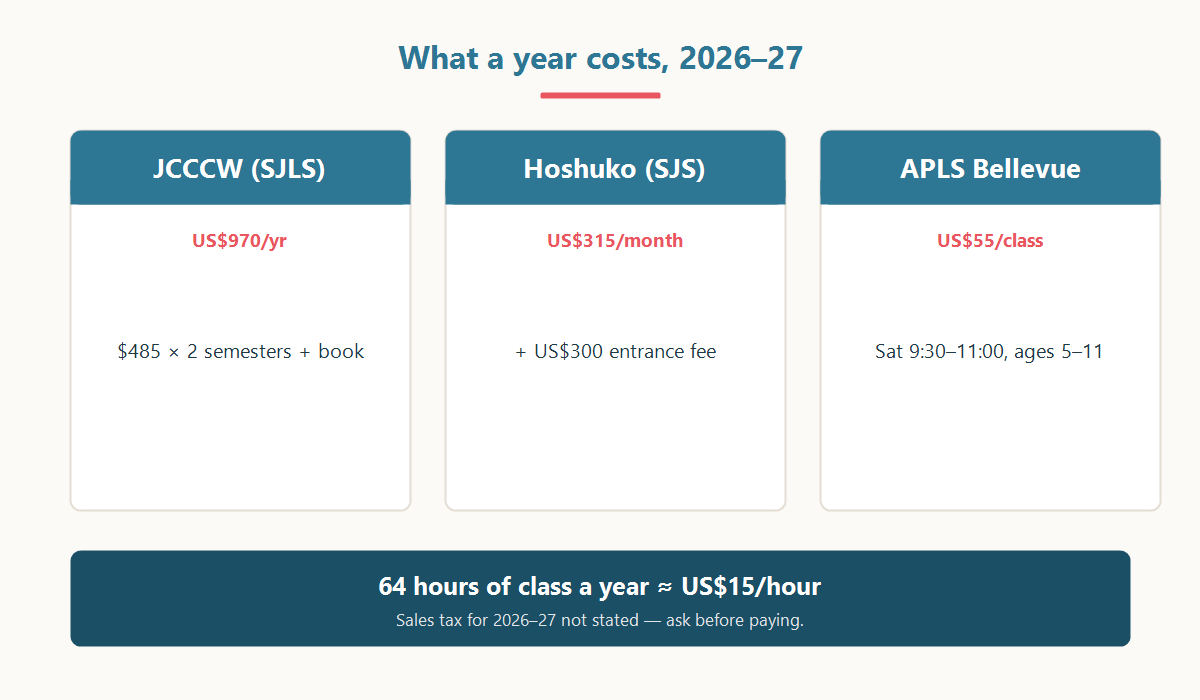
The Seattle Japanese Language School charges US$485 a semester for one child in 2026–27 — US$970 for the year — for 32 Saturday mornings of two hours each in the historic Nihon Go Gakko building near Seattle’s Chinatown–International District, run by the Japanese Cultural & Community Center of Washington (JCCCW). That is roughly a quarter of what the Japanese government-recognised hoshuko in Bellevue now charges. The catch is not the price. It is that the children’s programme, as published, is a beginner-to-intermediate course for learners of Japanese, with no separate track for a child who already speaks Japanese at home — and that the 2026–27 page is silent on the sales tax the school started adding to tuition last year.
This page is the single-school deep dive: what the Seattle Japanese Language School costs, how its Saturday classes actually work, how it differs from the “Seattle Japanese School” it is constantly confused with, and what the public record gets wrong. Everything comes from the schools’ own pages, read on 4 October 2026. Where something is not published, we say not published. For the wider map of every Japanese option in the area, see our overview of Japanese Saturday schools in Seattle — and note that this page corrects several of its figures.
The short answer
| What it is | The language programme of the JCCCW, a 501(c)(3) non-profit. Founded in 1902 as Kokugo Gakko; the school calls itself the oldest operating Japanese language school in the continental United States. Not a MEXT school, not a hoshuko |
| Children’s tuition, 2026–27 | US$485 a semester per child (two semesters a year). Two children US$880, three US$1,290 per semester. Late registration adds US$25. Whether sales tax is added this year is not stated — last year it was |
| When and where | Saturdays, 9:30 to 11:30 with a recess, in person at 1414 S. Weller Street, Seattle. Semester 1: 12 September 2026 to 23 January 2027. Semester 2 starts 6 February 2027 |
| Who it takes | Ages 6 to 18, in seven levels from Junior Novice to Novice 5. Maximum 10 children per class |
| The real catch | No heritage or kokugo track is published. Novice 1–4 work through a US textbook for learners of Japanese, starting from the beginning |
| What it is not | Not the “Seattle Japanese School” (シアトル日本語補習学校) in Bellevue, which teaches the Japanese national curriculum. No online option for children; adult classes are online only |
Looking for a way to keep Japanese going from abroad?
TOMODACHI JAPAN is an online Japanese school for children growing up outside Japan. They talk with peers their own age in Japan every day, taught by teachers working at Japanese schools, in small classes of 8.
🎁 Register and we’ll email you our School Guide (PDF, in English) straight away. You’ll also be first to hear about tuition, scholarships and opening dates.
Free · takes about 30 seconds
First, which school do you actually mean?
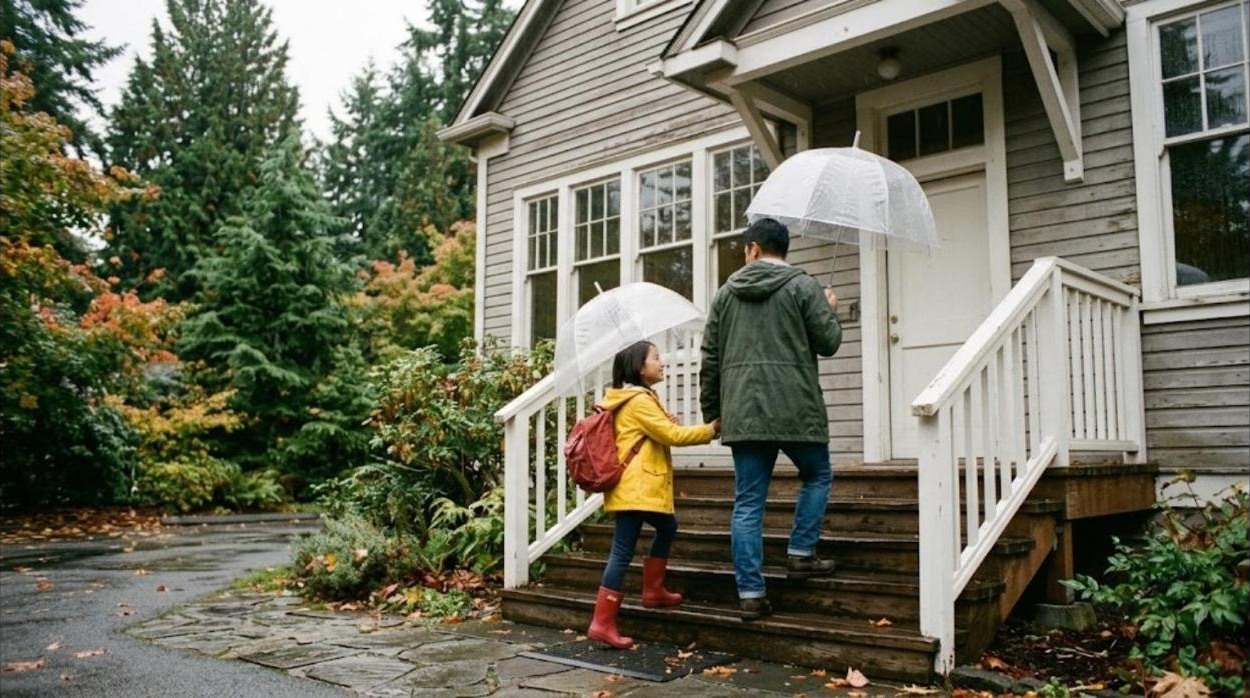
Seattle has two Japanese Saturday schools whose names differ by a single word in English — and by two characters in Japanese. Parents, directories and search results swap them constantly. Before you read any review, fee or schedule, check which one it is about.
| Name you will see | What it actually is | Where |
|---|---|---|
| Seattle Japanese Language School (SJLS), also “Nihon Go Gakko”, “JLS” or “the JCCCW school”. Japanese name on Wikipedia: シアトル日本語学校 | Community language school founded 1902, run by the JCCCW. Children 6 to 18 in person on Saturdays; adults online | 1414 S. Weller St., Seattle (edge of the Chinatown–International District) |
| Seattle Japanese School (SJS), シアトル日本語補習学校 | The hoshuko: a supplementary school founded in 1971 by the Seattle Japanese business community, teaching to Japan’s national curriculum with Japanese government textbooks. Kindergarten to high school | Office in Bellevue, about 20 minutes east of Seattle by car |
| Asia Pacific Language School (APLS) | Private non-profit with a Japanese preschool, after-school classes and a short Saturday class for ages 5 to 11 | NE 8th Street, Bellevue |
| John Stanford International School and the Northwest DLI pathway | Seattle Public Schools’ Japanese dual-language immersion, K–5, continuing at Hamilton International Middle School and Lincoln High School. A weekday public school, not a Saturday programme | Wallingford, north Seattle |
The confusion has history behind it. The JCCCW school began in 1902 as Kokugo Gakko — literally “national language school”, the same word the hoshuko uses for its Japanese language-arts lessons today. For decades it really was the school for the children of Japanese immigrants, with more than a thousand pupils by 1930. Today it describes itself as welcoming “anyone interested” in Japanese language and culture, and a March 2026 Nichi Bei News feature reported that its 70 Saturday children are mostly not Nikkei. The hoshuko, meanwhile, serves families who need Japan’s curriculum. So an older Seattle parent who says “my kids went to the Japanese language school” may mean either one — and if they went to the JCCCW school decades ago, they may be describing a school that has since changed its job.
What it costs in 2026–27
| Item | Per semester | Per school year (two semesters) |
|---|---|---|
| One child | US$485 | US$970 |
| Two children (code SJLSYOUTH2 at checkout) | US$880 | US$1,760 |
| Three children (code SJLSYOUTH3) | US$1,290 | US$2,580 |
| Late registration (after 12 September) | US$25 per registration | |
| Textbook (Novice 1–4) | Adventures in Japanese 1 textbook plus workbook, bought by the family. Cost not published. Junior Novice, Pre-Novice and Novice 5 use materials provided by the school | |
| Sales tax | Not stated on the 2026–27 page. The school’s 2025–26 registration page said it must charge sales tax on top of tuition from 1 October 2025 (US$465 became US$513.13) | |
| Registration fee, materials fee, membership requirement | None published for children. The JCCCW member discount applies to adult classes only | |
Tuition went up by US$20 a semester from 2025–26, when it was US$465. Our own Seattle overview, written in July, still quotes that older figure. The bigger question is the tax. Washington began applying retail sales tax to a wider range of services from 1 October 2025, and the JCCCW said at the time that its tuition would carry tax on top. The 2026–27 youth page shows US$485 and says nothing about tax either way. Ask the school what the checkout total will be before you budget.
What does US$970 buy? The 2026–27 calendar has 16 teaching Saturdays in each semester once the published no-class days are removed — which matches the “32 sessions” the JCCCW quotes in its own teacher job posting. At two hours each, that is 64 hours of class a year, or a little over US$15 an hour before books and any tax. For a structured, in-person class capped at ten children, that is very low for the Seattle area.
The payment rules are short:
- Pay on registration. Tuition is due in full when you register.
- A narrow refund window. A full refund minus a US$10 cancellation fee, up to six days before the first day of the semester. After that, the school says no refund will be issued.
- Each semester is a separate registration. You register again for the spring semester; registration opens about two months before each semester starts.
- Family discounts are by code. You enter the code at checkout yourself; the per-child saving is US$45 for two children and about US$55 for three.
How does that sit against the hoshuko? The Seattle Japanese School’s own page lists 2026 tuition of US$315 a month for elementary and middle school (US$342 kindergarten, US$359 high school), plus a US$300 entrance fee. Its older fee rules say the monthly figure is the annual fee divided by twelve, which would make a year of elementary tuition US$3,780 before the entrance fee. Back in 2018 the same sheet showed US$180 a month for a non-member family. The JCCCW school is the cheaper Saturday option by a wide margin — but, as the next sections show, it is also teaching something different.
How it works: seven levels, one Saturday morning
Children come once a week, on Saturday from 9:30 to 11:30, with a recess in the middle. The year runs September to June in two semesters, with no classes over Thanksgiving weekend, the winter holidays and a handful of other Saturdays. Classes are in person only — the school moved its youth classes back from Zoom to the building in 2023. On weekdays the building is rented to a Waldorf school, so children learn in working classrooms.
| Level | Age given | What they use |
|---|---|---|
| Junior Novice | 6–7 | Materials from the school; hands-on activities such as origami and crafts |
| Pre-Novice | 7–8 | Materials from the school; interactive cultural lessons |
| Novice 1 | Not published | Adventures in Japanese 1, chapters 1–3 |
| Novice 2 | Not published | Same book, chapters 4–6 |
| Novice 3 | Not published | Same book, chapters 7–9 |
| Novice 4 | Not published | Same book, chapters 10–12 |
| Novice 5 | Not published | Topic-based reading from the school, discussed each week |
Read that table carefully, because it answers the most important question for a Japanese family. Four of the seven levels are one textbook, three chapters a year. Adventures in Japanese is a US series written for English speakers learning Japanese from zero. The school’s own history page describes its teaching as beginner to intermediate — hiragana, katakana, some kanji, reading, writing and conversation. That is a well-paced foreign-language course. It is not kokugo, and the page does not mention a track, a class or a placement route for children who already speak Japanese at home.
Two other things are published and worth weighing. Classes are capped at ten children, which is small for a Saturday school. And the school’s youth-teacher job posting says applicants need fluent Japanese and experience in early-childhood education or Japanese teaching, but do not need a teaching certificate and need not be native speakers; teachers are engaged as independent contractors. That is a normal model for a community school, and the 2024 newsletter was written by the programme’s head teacher, Junko Plunkett. The individual teachers for 2026–27 are not published.
Getting in: the registration calendar
- About two months before each semester: online registration opens on the JCCCW site. You choose a level and pay in full.
- First day of the semester: the late fee of US$25 applies to registrations after 12 September for the autumn semester.
- Six days before the first class: the last day to cancel for a refund (less US$10).
- Spring: a separate registration for the semester starting 6 February 2027 — by the “two months before” rule, around early December. The exact date is not published.
On 4 October the autumn semester’s registration was shown as closed. Whether a waiting list exists, and how full each level is, is not published. A placement test is not mentioned. If your child is not a complete beginner, email the school before you pick a level.
Seattle Japanese Language School vs the Seattle hoshuko
These are different kinds of school built for different children. The clearest way to choose between them is to ask what your child will need from Japanese at 15.
| Seattle Japanese Language School (JCCCW) | Seattle Japanese School (シアトル日本語補習学校) | |
|---|---|---|
| Purpose | Japanese as a foreign language, plus culture, for anyone interested | Keeping pace with Japan’s national curriculum, using the same textbooks as schools in Japan |
| Recognition | Community non-profit. No MEXT status | Runs on MEXT’s curriculum guidelines; supplementary school |
| Japanese needed to enter | None published; levels start from the beginning | The Japanese ability needed to follow its lessons; kindergarten entry interview conducted entirely in Japanese |
| Ages | 6 to 18 | Kindergarten (final year) to high school |
| Year | September to June, two semesters, 32 Saturdays | April to March, Japanese school year |
| Weekly time | 2 hours, Saturday morning | Saturday; class hours not published on the pages we read |
| Size | Max 10 per class; 70 children reported in March 2026 | 477 pupils and 58 staff in 2026 |
| Tuition | US$970 a year (one child) + book; tax question open | US$315 a month (elementary) + US$300 entrance fee |
| Language of the paperwork | English | Japanese |
If your child will return to a Japanese school or sit Japanese entrance exams, the JCCCW school is not a substitute for the hoshuko, and it does not claim to be. If your child was born here, does not speak Japanese yet, and the aim is to start — or if Japanese is a parent’s heritage that never got passed down — the Seattle Japanese Language School is cheaper, in the city rather than across the lake, and asks nothing of the family’s Japanese. The difficult case is the one in the middle: the child who speaks Japanese at home but is losing ground in reading. Neither school is built exactly for that child, which is the gap we discuss in our guide to what an online school can and cannot replace about a hoshuko.
The honest review: what the English pages leave out
People search for “Seattle Japanese Language School reviews” because they want to know what it is like from the inside. We want to be straight about what we found. Yelp blocked our request, Google reviews could not be read reliably, and we found no body of verifiable parent reviews of the children’s programme on Niche, Reddit or elsewhere. We are not going to invent a consensus. What we can check is where the public record — including our own — diverges from what the school publishes.
1. “A heritage class.” Not as published
Many English summaries, our own July overview among them, describe the JCCCW school as the place for a heritage child whose stronger language is English. That is how it is often remembered, and it is part of its history. But the current youth page describes levels that begin with origami for six-year-olds and then work through a beginner’s textbook. A child who already chats in Japanese with a grandparent may find Novice 1 too easy and Novice 5 too narrow. Ask the school which level, if any, fits a child who speaks but cannot yet read.
2. The price you see may not be the price you pay
The headline US$485 is accurate as published. But the school’s own listing for spring 2026 showed US$465 “after tax” as US$513.13, and the 2026–27 youth page does not say whether tax is now included, added, or no longer applies. Directory listings that copied last year’s figure, including ours, are out of date either way.
3. The school’s own pages disagree on small things
The youth page gives the spring semester as “February 6, 2027 – June 13, 2026”. The year is plainly a typo, and 13 June 2027 is a Sunday; the registration listing says 12 June 2027, which is the Saturday. Our July overview gave class times as 9:00 to 11:30; the school says 9:30. The history is untidy too: the school says it is the oldest operating Japanese language school in the continental US, while Wikipedia says North America; the JCCCW timeline dates its second building to 1917, Wikipedia to 1918; and the JCCCW’s own pages give two different years, 1956 in one article, 1959 in the timeline, for the end of the building’s post-war use as housing for families returning from incarceration. None of this says anything about the teaching. It does mean you should trust the current Youth Classes page and email when in doubt.
4. The hoshuko is no longer “fees on inquiry”
Our earlier overview, like most English pages, listed the Seattle Japanese School’s fees as on inquiry. Its Japanese-language School Guide page now publishes the 2026 monthly tuition and the US$300 entrance fee. Wikipedia’s English article on the hoshuko still leans on 1993 enrolment figures of more than 600; the school itself reports 477 pupils in 2026.
5. What to ask other parents, since the reviews won’t tell you
- Which levels are running this year, and how many children are in my child’s? The cap is ten; the actual number is not published.
- Is there a waiting list for new families? Not stated on the youth page.
- What will the checkout total be? Tuition, tax, late fee if any, and the textbook.
- What happens after Novice 5? The page lists no level beyond it, though ages run to 18.
- How does a child who speaks Japanese at home get placed? No placement route is published.
Other options in the Seattle area
| Option | Who it takes | Published cost |
|---|---|---|
| Seattle Japanese School (hoshuko), Bellevue | Children able to follow lessons in Japanese; kindergarten to high school; entrance interview or exam | US$315 a month elementary + US$300 entrance fee; US$50 transfer application fee |
| Asia Pacific Language School, Bellevue | Japanese Saturday School, ages 5 to 11, Saturday 9:30 to 11:00; also Wednesday after-school classes | Autumn 2026: US$55 a class, US$660 for 12 Saturdays; US$100 new-student application fee; 10% sibling discount |
| John Stanford International School (Japanese DLI), Seattle | Seattle Public Schools K–5 immersion, continuing at Hamilton then Lincoln | Public school, no tuition; enrolment through the district |
| JCCCW adult classes | 18 and over only, online | US$330 a quarter (US$310 for members) |
Two details stand out. APLS takes children from five, which matters because the JCCCW school starts at six. And per hour of class, APLS costs roughly two and a half times as much — but it is on the Eastside, where many Japanese families live. For a fuller list of how to search beyond these, see our guide to finding a Japanese Saturday school near you.
How to choose, in four questions
- Is your child going back into Japanese schooling? If yes, the hoshuko is the one built for that, and the higher fee buys the national curriculum. If no, you are choosing between ways to learn or keep Japanese, and the JCCCW school is the cheapest structured one in the city.
- Does your child already speak Japanese? If not at all, the Seattle Japanese Language School fits as published. If fluently at home, ask the school directly where they would be placed before paying — the published levels are built for learners.
- Is your child under six? The JCCCW youth programme starts at six. APLS takes five-year-olds; the hoshuko takes children in the final year of kindergarten.
- Can your family give up Saturday morning, every week, for years? Thirty-two Saturdays, the drive to Weller Street or across the lake, and practice in between. The programme that lasts is the one that fits the family, not the one that looked best on paper.
Where TOMODACHI JAPAN fits
We are not a substitute for the hoshuko, and if your child is returning to a Japanese school we would point you there. Nor are we trying to replace a community school with 124 years of history behind it. We exist for the families the four questions above leave stuck — the child who speaks Japanese at home but has outgrown a beginner’s textbook, the family on the Eastside for whom Weller Street is a long drive, and the ones who missed a registration window.
- Japanese friends of the same age. Classes with children the same age in Japan — not only other learners in Seattle. The reason children keep going is usually the other children.
- Teachers working at Japan’s current classroom standard — not a syllabus written abroad and not a tutoring marketplace.
- Small classes of eight children. Enough to be a class, few enough that every child speaks every lesson.
- Japan is 16 hours ahead of Seattle (17 in winter). A Japanese Saturday morning is Friday late afternoon in Seattle, and weekend slots work too. No commute and no entrance test.
- A flat monthly membership. Tuition, scholarships and opening dates are in our free school guide, which we email to everyone who registers, with no obligation.
If you are still mapping the whole city, our Seattle overview lays out every type of programme side by side.
Frequently asked questions
How much does the Seattle Japanese Language School cost?
For 2026–27, youth tuition is US$485 a semester for one child, or US$970 for the two-semester year. Two children cost US$880 a semester, three US$1,290. Late registration adds US$25, Novice 1–4 need a textbook, and the 2026–27 page does not say whether sales tax is added, as it was in 2025–26.
Is it the same as the Seattle Japanese School?
No. The Seattle Japanese School (シアトル日本語補習学校) is the Bellevue hoshuko that teaches Japan’s national curriculum to children with grade-level Japanese. The Seattle Japanese Language School is the JCCCW’s community school on S. Weller Street in Seattle, teaching Japanese as a foreign language.
Can my child join with no Japanese?
Yes. The published levels start from the beginning, and no Japanese is required to enter. Children who already speak Japanese at home should ask the school about placement first, because no heritage track is published.
What ages does it take?
Ages 6 to 18 for the in-person Saturday youth classes. Adult classes, which are online, are for 18 and over.
When can we register?
Registration opens about two months before each semester. The autumn 2026 semester began on 12 September and was closed for registration when we checked; the spring semester starts on 6 February 2027. Refunds, less US$10, are available up to six days before the first day.
Are the children’s classes online?
No. Youth classes have been fully in person since 2023, at 1414 S. Weller Street. Only the adult programme runs online.
Sources
- Seattle Japanese Language School (JCCCW): Youth Classes, Seattle Japanese Language School, Adult Classes, Jobs (youth teacher posting), History, Return to in-person (2024), 120th year (2022); 2025–26 youth registration listing (tax wording), seen via search result
- Seattle Japanese School (hoshuko): About, School Guide (2026 tuition), Admissions and transfers, 2025 kindergarten admission notice and 2018 fee rules (PDFs on seajschool.org)
- Asia Pacific Language School, Japanese programmes and tuition
- John Stanford International School, dual-language immersion pathways
- Third-party pages checked: Wikipedia, Nihon Go Gakko (Seattle); Wikipedia, Seattle Japanese School; Nichi Bei News, March 2026. All checked 4 October 2026.
Seattle also has public Japanese immersion options. Our guide to Japanese immersion schools in the US explains how entry works and what immersion can and cannot do.