“The Japanese School of New York” is in Connecticut. It has been since 1992. “The Japanese Weekend School of New York” is a different school, in two borrowed public-school buildings in Queens and Westchester, whose published address is an office where no classes happen. They are not the same school and neither is the other’s Saturday programme — but they do share one owner, which is why the confusion has survived for decades.
Both publish their 2026 fees in full. Neither publishes them in English. Below is every figure, from each school’s own documents, checked on 19 September 2026 — including a $200-a-year charge at the weekend school that exists in no English-language source we could find.
The short answer
| The Japanese School of New York | The Japanese Weekend School of New York | |
|---|---|---|
| What it is | Full-day school, Grades 1–9, Japanese curriculum | Saturday supplementary school, age 4 to Grade 12 |
| Where | 6 Riverside Avenue, Riverside, CT | Bayside High School, Queens and Port Chester Middle School (the building is in Rye Brook, NY) |
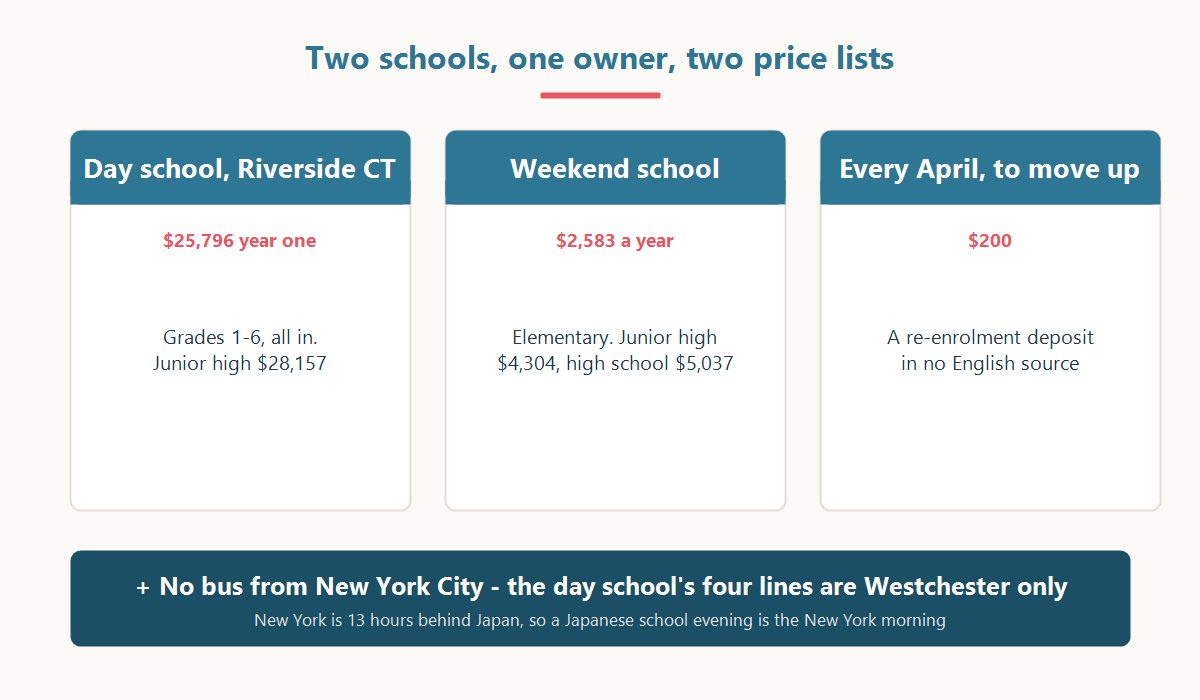
| Cost, 2026 | $25,796 elementary, $28,157 junior high — first year, all in | $2,583 elementary, $4,304 junior high, $5,037 high school, $3,165 preschool — per year |
| Bus | Four Westchester lines. None from New York City | None |
| Screening | Interview plus maths and Japanese tests. Can be refused | Everyone is screened. Can be refused |
Looking for a way to keep Japanese going from abroad?
TOMODACHI JAPAN is an online Japanese school for children growing up outside Japan. They talk with peers their own age in Japan every day, taught by teachers working at Japanese schools, in small classes of 8.
🎁 Register and we’ll email you our School Guide (PDF, in English) straight away. You’ll also be first to hear about tuition, scholarships and opening dates.
Free · takes about 30 seconds
One owner, two schools, and the mistake almost everyone makes
Both schools are run by the same non-profit: the Japanese Educational Institute of New York (ニューヨーク日本人教育審議会), founded in 1975, which also runs the two New Jersey schools. That shared parent is real and it is why they turn up together everywhere. Everything else about them is separate: different principals, staff, buildings, calendars, fee schedules, application processes and admissions criteria. There is no shared enrolment, no shared waitlist and no published transfer path between them.
Here are the seven wrong turns we watched the public record invite:
- Looking for the day school in New York. It opened in Queens in 1975, moved to Yonkers in 1991, moved to Greenwich, Connecticut in 1992, and moved within Greenwich to the Riverside Avenue campus in the summer of 2022. It has not been in New York State for 34 years.
- Thinking “Greenwich Japanese School” is a different school. It is the same school. Both names appear in the same website footer, and cheques are payable to The Greenwich Japanese School.
- Thinking the weekend school is the day school’s Saturday programme. It is not. A child at the day school attends Monday to Friday and needs no Saturday school at all.
- Driving to the weekend school’s address. 56 Harrison Street, Suite 503, New Rochelle is an office. Google’s knowledge panel lists it as the school’s location. No classes are held there.
- Reading “LI School” as Long Island. It stands for Long Island, and the building is Bayside High School — which is in Queens, inside New York City. A Nassau or Suffolk family planning around it is in for a longer drive than they think.
- Assuming “Japanese school” means Japanese lessons. The weekend school states it flatly: 日本語を学ぶ学校ではなく、日本語で各教科を学ぶ学校です — not a school where you learn Japanese, a school where you learn subjects in Japanese. Both screen out children who cannot follow it. If you want your child to learn Japanese, you are at the wrong door, and neither English page says so.
- Assuming an English-speaking parent can run the process. See below — this is the sharpest divergence of the two.
One more, for completeness: Keio Academy of New York in Purchase genuinely is a Japanese school in New York State, but it is a private high school for Grades 9–12, not a substitute for either of these.
What the day school (full-day, Riverside CT) costs in 2026
| Line | Elementary | Junior high |
|---|---|---|
| Tuition | $16,836 | $18,882 |
| Materials | $720 | $1,035 |
| School bus | $6,240 | $6,240 |
| Enrolment fee, one-off | $2,000 | $2,000 |
| First year, total | $25,796 | $28,157 |
| Each year after | $23,796 | $26,157 |
Two things to notice. First, the bus is inside a table headed “annual required expenses” and a bus application form is among the documents you hand over at the admissions interview — yet the FAQ describes commuting as bus or parent drop-off, and the school does not publish whether the $6,240 is waived if you drive. Ask, in writing, before you budget. Second, the four bus lines are Westchester-only — Hartsdale/White Plains, Eastchester/Scarsdale, Mamaroneck/Harrison/Rye, and Harrison. There is no line from Manhattan or anywhere else in New York City.
A small warning about the source itself: the school’s own fee page and its own fee PDF disagree. The web page lists the third-term elementary bus charge as $2,160; the PDF says $2,080. The PDF is the one that reconciles — $2,080 × 3 = $6,240, and the term total of $7,932 only adds up with it. We have not seen anyone flag this.
Not published by the day school: any application fee, lunch, PTA dues, sibling discount, and — importantly for a family that can be recalled to Japan at short notice — any refund policy at all. A five-day trial enrolment exists and is stated to carry a cost, with no figure given.
What the weekend school (Saturdays, Queens and Rye Brook NY) costs in 2026
| Division | Tuition + materials, per year | Due at new enrolment (incl. $450 entrance fee) |
|---|---|---|
| Preschool (幼児部, ages 4–5) | $3,165 | $1,505 |
| Elementary (初等部) | $2,583 | $1,311 |
| Junior high (中等部) | $4,304 | $1,924 |
| High school (高等部) | $5,037 | $2,171 |
The charge that appears in no English source: a $200 re-enrolment deposit, every single year, for continuing students. The payment regulations put it plainly — a pupil moving up in April pays $200 to advance. It is later credited against first-term tuition, and refundable only in the narrow circumstances of a separate notice. Budget for it.
The refund rules here are published and strict, which is more than the day school offers. A refund is given only if written notice of withdrawal reaches the school before that term’s first class day, and then minus a $50 processing fee. There is no pro-rating: attend once, or be absent for a term with the registration standing, and the whole term is owed. The entrance fee is never refunded. Being a month past a due date triggers a demand letter and then removal from the register.
One genuinely fair detail worth knowing: the $450 you hand over at screening is refunded if you cancel in writing by 31 January, or if your child is not admitted.
There is a scholarship. No English page mentions it
The parent charity runs a means-tested scholarship, funded by SMBC Global Foundation, MUFG and Mizuho, with roughly twenty awards shared between the New York weekend school and its New Jersey sister. It is open to any enrolled child from preschool to high school, previous recipients may reapply, and it is paid as a reduction across all three tuition instalments.
What it asks for is substantial: an application form, the household’s full Form 1040, both pages, the child’s American school report card, and an essay on the school’s own manuscript paper — preschoolers may send a drawing instead. Selection weighs financial need, motivation, grades at both schools, the essay and the child’s volunteering. The form also asks what share of the fees your employer covers.
The deadline for the 2026 award year was 12 January, 17:00, by email, and only successful applicants are contacted. Note the sequencing trap for a family joining now: that deadline falls after December screening and after the 31 January date by which you would have to cancel to get your $450 back. If the scholarship is part of your plan, ask the office about the next cycle before you screen, not after.
Where the weekend school actually meets
| Campus | Borrowed building | Where that building really is | Street address published? |
|---|---|---|---|
| LI School | Bayside High School | Bayside, Queens, New York City | No — “a local school in Bayside; please enquire” |
| W School | Port Chester Middle School | The building’s municipality is Rye Brook, NY, not Port Chester village | No — “a local school in Port Chester; please enquire” |
Borrowing buildings has a consequence the school states openly in its calendar and nobody repeats in English: on several dates, if the building is unavailable, preschool and elementary go online and the older years relocate to the W campus. Plan around it.
Two more calendar oddities. The school runs on some Sundays — 28 June 2026 and 20 December 2026 are class days, each offset by a Saturday off, and the March 2027 graduation is a Sunday that, the school says, never moves. And the summer break is four Saturdays in late July and August, so your child is in class through most of the American summer holiday. Class hours are 9:05–12:50 for preschool and elementary, and 9:05–15:40 for the older years.
The honest review: what the English pages leave out
1. The English page drops the sentence that decides it for many families
The weekend school’s Japanese guidelines state: 入学手続きや学校からご家庭への文書、担任とのやりとりは、全て日本語となります — admission procedures, every school-to-home document, and all contact with the homeroom teacher are entirely in Japanese. The English page omits it. The day school does not publish such a clause at all, but its whole site is Japanese apart from a boilerplate non-discrimination notice, which is its own answer.
It is not the only omission. Set the two versions side by side:
| Point | The Japanese documents say | The English page says |
|---|---|---|
| Language of all parent contact | Everything is in Japanese | Omitted |
| Screening | Everyone is screened; admission may be refused | “A group observation will be conducted” — no mention that it is pass or fail |
| Medical care | アレルギー対応やその他の一切の医療行為は、本校ではできません — no allergy management and no medical care of any kind | Omitted |
| Fees | Full table, $450 entrance, $200 a year to move up, $50 refund fee, removal for non-payment | No figure at all |
| Who may enter | New admissions up to Grade 11 | “Kindergarten through High School” |
| Application window | Exact per-campus dates in October, November and December | “Saturdays in mid-to-late December” |
2. Both schools test children, and both can say no
The day school’s admissions interview includes tests in maths and in Japanese — kanji and composition — and states that admission may be refused on the results. The weekend school screens every applicant: preschool and Grade 1 children sit in a real class and are observed by the principal, vice-principal, a counsellor and teaching staff for comprehension in a group and ability to follow instructions; Grade 2 and above sit a separate written academic test on a different day. Neither school publishes a nationality or parent-assignment requirement, and both publish non-discrimination notices. The gate is the child’s Japanese, and it is a real one.
3. The tuition figures circulating in English are wrong by thousands
| Source still ranking in 2026 | Day-school tuition it gives | How far off |
|---|---|---|
| Niche | $14,865 — footnoted “for the highest grade offered”, i.e. Grade 9 | $13,292 under the Grade 9 figure of $28,157 |
| PrivateSchoolReview | $16,344, with “Application Deadline: None / Rolling” | $9,452 under. The deadline is a fixed noon opening on 1 October |
| U.S. News | $24,005 + $990 fees — and it discloses that it began collecting from the school’s website in June 2021 | Closest of the four, and five years old |
| expatschoolguide.com | “$10,000–$16,000 per year” | $9,796 under at best |
| A Japanese-language blog post from December 2018 | Tuition $7,347, enrolment fee $800, materials $930 | All three wrong: $16,836, $2,000, $720 |
4. Nobody agrees how big the day school is, including the records
The school publishes no enrolment figure on any static page. The number it has published most recently is buried in an April 2025 school newsletter: thirty-one staff welcoming 81 children across the whole school. The US federal survey for 2023–24 says 112. A New York Japanese-language paper’s 2025 list says 90. English Wikipedia’s infobox says 240, from 2005; one directory says 148 and another 92.
For a nine-grade school, the difference between 81 pupils and 240 of them is the difference between a handful of classmates per year and a full form entry. Four different street addresses are also in circulation, and the directories at positions four through seven of the search results all carry a former one. If you are comparing schools on size, get the number from the school.
5. There is no AI Overview, and no reviews either
We checked six queries in a live browser: Google generated no AI Overview for any of them. What it shows instead is a knowledge panel built from Wikipedia, which gives the day school’s address correctly but describes it as “located in St Catherines Church School” — the former church property the campus occupies — and, for the weekend school, lists the New Rochelle office as the school.
And if you search for reviews of either school, there are none to find. Niche says “No reviews yet.” GreatSchools says “Be the first to review.” Google has review posting turned off on the day school, and the weekend school has exactly one — a five-star rating of an office. The organic results are a Yelp list of Japanese language businesses in Manhattan, a New York Times article from 1983 about the old Queens campus, and Reddit threads about adult classes. The only Japanese-school review corpus that ranks for this query belongs to Lyceum Kennedy — a different school entirely. There is nothing there to read, which is worth knowing before you spend an evening looking for it.
The dates you actually need
Both schools run fixed processes, and both have already published their next cycle.
- Day school, for 2027: registration opens 1 October 2026 at 12:00 noon US Eastern, by emailing the interview registration form. Anything sent before noon is not accepted. The registration stands until 31 March 2027. New Grade 1 interviews are on 9 January 2027, with 16 January as the reserve date; other grades interview by appointment year-round. Grade 6 closes to new entry from 1 February, and Grade 9 closes after the second-term opening ceremony in mid-August, both because of entrance exams back in Japan. The cap is 180 students, with a waitlist above it.
- Weekend school, for 2027: information sessions with class observation on 24 October 2026 at the W campus and 31 October at the LI campus, no booking needed. The background form must reach the office by 16 November (W) or 23 November (LI), by email only, to a dedicated address, with no acknowledgement sent — the screening notice is the acknowledgement. Screening itself is 5 and 12 December at W, 19 December at LI. Offers by email in late December; rejections by sealed letter. First day 10 April 2027.
- Waitlist order at the weekend school is the order the background form arrived. Not the application, not the screening — the form. That makes an early November email worth more than it looks.
How to choose, in four questions
- Is your child going back into Japanese schooling within a couple of years? If yes, the day school’s ministry-recognised full-day programme is what you are buying, and $25,796 is what it costs. If no, the weekend school does Japanese literacy for a tenth of that.
- Where do you actually live? The day school buses Westchester only and sits in Riverside, Connecticut. The weekend school meets in Bayside and Rye Brook and buses nobody. Map it before anything else.
- Can an adult in your house read Japanese? The weekend school says in writing that everything is in Japanese. The day school’s site is the same in practice. This rules more families out than the fees do.
- Can your child follow a lesson in Japanese today? Both screen for it and both can refuse. Neither is a place to learn Japanese from the beginning.
If you are in northern New Jersey rather than New York, the same parent charity runs two more schools there, and we have written up the New Jersey weekend school’s fees and admissions separately. For the wider picture of Saturday options around the city, see our guide to Japanese Saturday schools in NYC.
Where TOMODACHI JAPAN fits
Question four is the one that ends most searches in the New York area. Both of these schools are excellent at what they do, and what they do is teach the Japanese curriculum to children who can already work in Japanese. If your child cannot yet, there is no track for them at either.
- No entrance test, no screening, no cap. We teach children whose Japanese is still growing, which is most children raised in a bilingual household.
- Classes of eight, with children the same age in Japan. The reason a child keeps going on a Saturday is rarely the curriculum. It is the other children.
- Teachers working at Japan’s current classroom standard.
- No drive to Connecticut, and no borrowed building that might be unavailable. New York is 13 hours behind Japan, so a Japanese school evening is the New York morning and a Japanese Saturday morning is Friday evening here.
- Fees, scholarships and opening dates are in our school guide, which we email to everyone who registers, free and with no obligation.
We have also written plainly about what an online school cannot replace about a Saturday school, because some of it it cannot.

Frequently asked questions
Is the Japanese School of New York in New York?
No. It is at 6 Riverside Avenue, Riverside, Connecticut, in the Town of Greenwich. It left New York State in 1992 and moved to the current building in the summer of 2022. It is also called the Greenwich Japanese School — the same school, two names.
How much is tuition at the Japanese School of New York?
Tuition is $16,836 a year for elementary and $18,882 for junior high in 2026–27. With materials, the bus and the one-off $2,000 enrolment fee, a first year totals $25,796 and $28,157. The Apple Class adds $3,000. Figures circulating in English of $7,347 or “$10,000–$16,000” are years out of date.
Is the Japanese Weekend School of New York part of the same school?
Same owner, different school. Both belong to the Japanese Educational Institute of New York, but they have separate principals, staff, buildings, calendars, fees and admissions. Neither is the other’s programme.
Is there a bus from Manhattan?
No. The day school’s four bus lines are all in Westchester. The weekend school publishes no bus service at all.
Where does the weekend school actually meet?
Two borrowed public schools: Bayside High School in Queens, and Port Chester Middle School, whose building is in Rye Brook. The school does not publish either street address, and its own listed address in New Rochelle is an office with no classes.
Can my child join if they do not speak Japanese?
Realistically, no. The weekend school describes itself as a school where subjects are learnt in Japanese rather than a school where Japanese is learnt, and requires preschool applicants to understand everyday Japanese conversation. The day school tests kanji and composition. Both can refuse admission on the results.
What is the $200 charge people mention?
It is the weekend school’s annual re-enrolment deposit: continuing pupils pay $200 each April to move up a year. It is credited against first-term tuition and is refundable only in limited circumstances. It appears in the school’s Japanese payment regulations and in no English source we could find.
Sources
- The Japanese School of New York / Greenwich Japanese School: fees, 2026 fee PDF, 2026 admissions guidelines, school history, school policy, FAQ
- The Japanese Weekend School of New York: 2026 fee schedule, payment regulations, 2027 recruitment guidelines, school guide, admissions information, English page, 2026 JEI scholarship guidelines
- Parent organisation: The Japanese Educational Institute of New York
- Ministry listing: MEXT list of overseas Japanese schools and supplementary schools
- Third-party records checked and found stale or wrong: English and Japanese Wikipedia, expatschoolguide.com, doris.school, Yelp, a December 2018 Japanese-language blog post. Federal enrolment data: NCES private school survey, 2023–24. All checked 19 September 2026.