The New York metro (NY, New Jersey and Connecticut) has one of the deepest benches of children’s Japanese schools anywhere in the U.S. — serving both expat and long-settled families. But the information is scattered: the Japanese-language listicles carry no fees and no table, while the English aggregators show stale, estimated tuition for full-time schools only. No single article has lined the fees up side by side in both languages. Here we sort every major option into three types — Japanese-curriculum (“hoshuko”), heritage-language, and full-time — with fees and sources as of July 2026, and we look squarely at what works for Japanese-American and mixed-heritage kids whose stronger language is English.
The short version on cost: the options split into two very different price tiers. Full-time MEXT (Japanese Ministry of Education) day schools — Greenwich runs roughly $25,800 a year all-in — sit 6–9× above the Saturday hoshuko, where the New Jersey supplementary school is a transparent $2,917–4,112 a year. Greenwich’s mandatory $6,240 bus fee alone exceeds a full year of NJ hoshuko tuition. They serve completely different needs, so the first decision is full-time vs weekend. Below, in detail.
Japanese schools for kids in New York: fee comparison
| School | Type | Day | Ages | Tuition | Area |
|---|---|---|---|---|---|
| The Japanese School of New York (Greenwich Japanese School) | Full-time (MEXT) | Mon–Fri | Elem + JH | ~$25,796/yr (elem, all-in) | Greenwich, CT |
| The New Jersey Japanese School | Full-time (MEXT) | Mon–Fri | Elem + JH | On inquiry | Oakland, NJ |
| Japanese Weekend School of NY (JWSNY) | Japanese-curriculum (hoshuko) | Saturday | Age 4–5 to grade 11 | On inquiry | Bayside / Port Chester (NY) |
| Japanese Weekend School of NJ (JWSNJ) | Japanese-curriculum (hoshuko) | Saturday | K–HS yr2 | $2,917–4,112/yr | Paramus, NJ |
| Japanese Children’s Society / NY Ikuei Gakuen | Full-time + hoshuko + heritage | Weekday / weekend | Pre-K–HS | On inquiry | NJ main + 2 Manhattan + more |
| Princeton Community Japanese Language School (PCJLS) | Heritage (distinct heritage track) | Sunday | K–HS | On inquiry | Princeton, NJ |
| Aozora Community | Heritage (Japanese immersion) | Saturday + Wed (after-school) | Age 0–elem | On inquiry | Brooklyn, NY |
| Online Japanese Supplementary School | Japanese-curriculum (online hoshuko) | Weekday eve / weekend night | On inquiry | On inquiry (1-mo free trial) | Online |
| TOMODACHI JAPAN | Online, conversation & friendship | Any day (unlimited attendance) | 5–18 | One flat monthly fee — see the free guide | Your home |
Looking for a way to keep Japanese going from abroad?
TOMODACHI JAPAN is an online Japanese school for children growing up outside Japan. They talk with peers their own age in Japan every day, taught by teachers working at Japanese schools, in small classes of 8.
🎁 Register and we’ll email you our School Guide (PDF, in English) straight away. You’ll also be first to hear about tuition, scholarships and opening dates.
Free · takes about 30 seconds
Three types of school — and why the difference matters
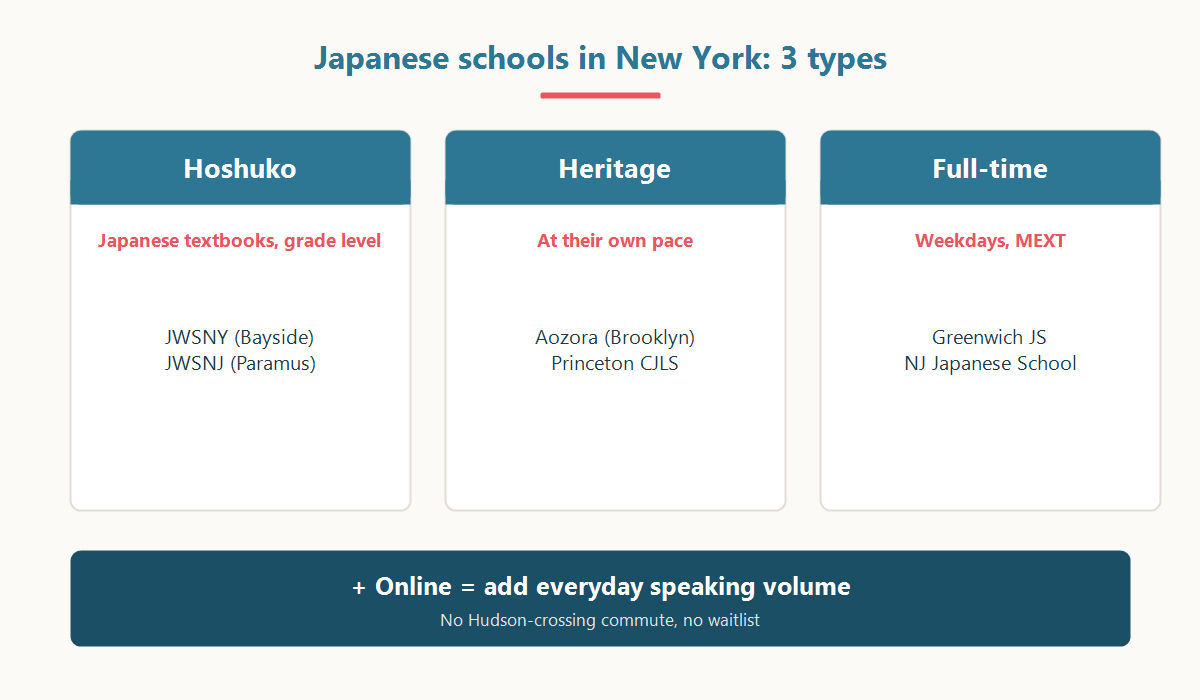
New York’s Japanese schools can look interchangeable on paper, but they split into three quite different types. Mixing them up is the number-one reason families end up saying “we enrolled, and it just wasn’t the right fit” — or “the cost was in a completely different ballpark than we expected.” Start with the split: (A) Japanese-curriculum hoshuko, (B) heritage-language, and (C) full-time.
Japanese-curriculum (“hoshuko”) schools: keeping pace with grade level in Japan
For families who expect to return to the Japanese school system, the supplementary school is the classic path. Japanese Weekend School of NY (JWSNY), running since 1962, teaches with Japanese textbooks on Saturdays, 9:05–12:50 for elementary (longer for middle/high), for ages 4–5 up to grade 11. Its standout feature is having actual campuses on the NY side — Bayside (Queens) and Port Chester (Westchester) — so some families avoid the NJ commute entirely (office in New Rochelle). Japanese Weekend School of NJ (JWSNJ) is the rare school here that publishes its fees openly: elementary $2,917/yr (tuition $2,787 + $130 materials + $400 entrance), middle school $3,395, high school $4,112, kindergarten $3,699. It also runs an all-ages “International Class” with no Japanese-fluency prerequisite. Both keep pace with Japan’s curriculum, so expect a screening/placement test at enrolment. JWSNY / JWSNJ
Heritage-language schools: growing a mixed-family child’s “other mother tongue”
Put a Japanese-American child straight into grade-level kokugo and, more often than not, it turns into a weekly battle. That’s where heritage-language schools shine. Aozora Community (Clinton Hill, Brooklyn) is a warm, community-run bilingual nonprofit — playgroup (ages 0–2), preschool, and K–2/elementary, meeting Saturdays plus Wednesday after-school. It frames Japanese around identity for nikkei and mixed-heritage kids rather than grade-level pressure. Princeton Community Japanese Language School (PCJLS), on Sundays, is one of the few with a distinct heritage (“keishougo”) track alongside its community, K–HS. NY Ikuei Gakuen also runs heritage classes. The tradeoff: Aozora skews young and isn’t a route back into the Japanese school system; PCJLS is Sunday-only and well south of NYC and Bergen. Aozora / PCJLS
Full-time: Greenwich, the NJ Japanese School, and Ikuei Gakuen
The Japanese School of New York (Greenwich Japanese School) in Riverside, CT, is a genuine MEXT full-time elementary-through-junior-high school, with a small ~5:1 ratio that keeps a returning-to-Japan child squarely on track. The catch is cost: elementary runs roughly $25,796/yr all-in (tuition $16,836 + mandatory bus $6,240 + entrance $2,000 + materials $720), junior high about $28,157 — and it’s far from Manhattan and much of NJ. The New Jersey Japanese School (Oakland, NJ) is another MEXT-certified full-time school built for seamless transfer back to Japan (tuition on inquiry). NY Ikuei Gakuen (Japanese Children’s Society) is the most flexible of all — 4 campuses including its NJ main site, two Manhattan locations and Port Washington (Long Island), combining full-day, daycare, weekend hoshuko and heritage classes, with 750+ students and the East Coast’s only Japanese full-day pre-K/elementary. Greenwich / NJ Japanese School / Ikuei Gakuen
Three New York-specific things to watch out for
- The “Hudson divide.” Most weekend-hoshuko capacity sits on the NJ side (Paramus, Englewood Cliffs, Oakland), but much of the community lives in Manhattan, Queens and Westchester — making Saturday a 45–90-minute cross-Hudson commute each way. JWSNY’s Bayside and Port Chester campuses and Ikuei’s two Manhattan sites are the NY-side alternatives.
- Full-time vs weekend is an expensive mix-up. Full-time MEXT day schools (Greenwich ~$25.8k/yr all-in) and Saturday hoshuko (JWSNJ ~$2.9–4.1k/yr) are 6–9× apart and serve totally different needs. Greenwich’s mandatory $6,240 bus fee alone exceeds a full year of JWSNJ tuition. Decide full-time vs weekend first.
- Popular hoshuko run screening and waitlists. JWSNJ and JWSNY use placement tests and can have waiting lists — “just enroll” isn’t guaranteed. If you’re planning to apply, move early.
The online option: turning once-a-week into every day
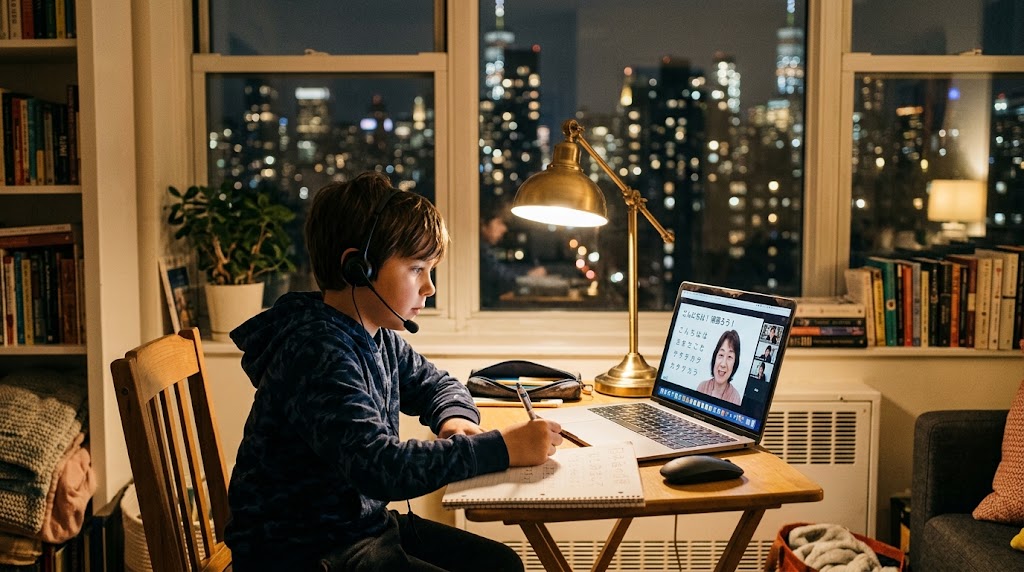
Saturday school is genuinely valuable. But as most families discover, one lesson a week won’t make a child a Japanese speaker. That’s the gap we built TOMODACHI JAPAN to fill — an online Japanese school opening in December 2026, designed to be the “weekday Japanese time” that pairs with a weekend school. For families stuck by the Hudson divide or a screening waitlist, it’s also a no-commute, no-waitlist bridge. (If you’re weighing this against hoshuko more broadly, see our guide to the online alternative to Japanese hoshuko.)
- The time difference, honestly — but the weekend works. New York is 13 hours behind Japan (EDT). Japan’s weekday 5 pm after-school class lands at 4 am in NY — impossible, so we won’t pretend otherwise. But Japan’s Saturday morning 9–11 am is your Friday 8–10 pm, and Japan’s Sunday morning is your Saturday evening. For the North America East Coast, the reliable window is weekend-morning-JST classes landing on your Friday/Saturday night.
- The other kids live in Japan. Your child talks in small groups with children from our sister school, NIJIN Academy, which has over 800 students across Japan. Real friends in Japan — the one thing a New York classroom can’t manufacture — building identity and long-term value.
- Unlimited attendance solves the “volume” problem. For one flat monthly fee, your child can join every day if they like. And because classes are grouped by conversation level rather than grade, heritage and English-dominant kids fit right in — a real answer to the “5th-grade wall.”
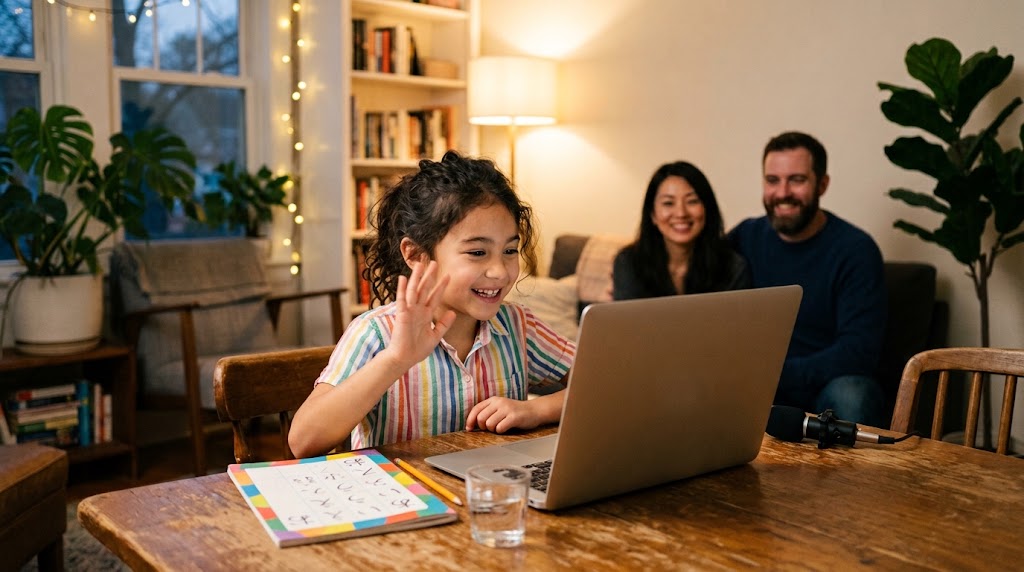
“Saturdays at the hoshuko for reading, writing and community; weekday evenings online for conversation with friends in Japan” — for a New York kid, that combination is the one that actually moves the needle. TOMODACHI JAPAN is a companion to your Saturday school, not a replacement.
FAQ from New York families
Our child is Japanese-American. Hoshuko or heritage-language school?
It comes down to how much Japanese happens at home. If Japanese conversation is part of daily life and you might return to the Japanese school system, a hoshuko (JWSNY, JWSNJ) is a real option. If English is clearly the stronger language, a heritage-language school (Aozora, PCJLS’s heritage track, Ikuei’s heritage classes) is usually better at keeping “Japanese = fun” alive. The fastest route to the right answer is an honest conversation about your child’s level at the enrolment interview.
We’re in Manhattan — is the Saturday trek to NJ really necessary?
That’s the “Hudson divide.” NJ-side hoshuko can mean 45–90 minutes each way. It’s worth first looking at the NY-side options: JWSNY (Bayside / Port Chester) and Ikuei’s two Manhattan campuses. If the commute is still too much, you can lead with weekday-evening online and dial down the in-person days. TOMODACHI JAPAN is unlimited-attendance with zero commute, so it removes the river crossing entirely.
Can we combine it with Saturday school?
Yes — that’s the intended use. TOMODACHI JAPAN is unlimited-attendance, so kids simply join on the days that suit them and scale back in weeks when hoshuko homework piles up. The roles don’t overlap: reading and writing at school, speaking volume and friendships online. Used together, each one makes the other work harder.
Isn’t joining classes in Japan awkward timing-wise from New York?
Let’s be honest: New York is 13 hours behind Japan (EDT), so Japan’s weekday-afternoon classes fall at 4 am here — not workable. But there’s a real window: Japan’s Saturday morning is your Friday night, and Japan’s Sunday morning is your Saturday evening. TOMODACHI JAPAN builds its North America East Coast schedule around exactly those weekend-evening slots. We won’t claim weekday-afternoon Japan classes work from New York — because they don’t.
If you are weighing a move up the Northeast Corridor, our guide to the Japanese Language School of Greater Boston (JLS Boston) covers its divisions, the track open to any nationality and the Saturday commute.