If you search for the Japanese Language School of Philadelphia in English, you land on a website about an adult Japanese course: Genki textbooks, $820 a term, sold out. The school your child would actually attend — a MEXT-supported Saturday school running from kindergarten through high school, plus one of the few dedicated heritage-Japanese tracks in any American hoshuko — lives on a second website, almost entirely in Japanese, and that is where every children’s fee, rule and obligation is written down.
We read both. The numbers below come from the school’s own 2026 pages and its April 2026 heritage-course pamphlet, all checked on 26 September 2026. The short version: it is good value at about $1,700 a year, the heritage track is a genuine asset for mixed and permanent-resident families, and most of what the English web says about the school is a decade old. Where a figure is not published, we say not published rather than guess.
The short answer
| What it is | A Saturday-only Japanese supplementary school (補習授業校), founded 1972, non-profit 501(c)(3), partly funded by Japan’s Ministry of Education, with a principal assigned by the Japanese government |
| Where | A borrowed building: Friends’ Central School, 1101 City Avenue, Wynnewood, PA — just over the Philadelphia city line |
| Who it teaches | Two children’s tracks: the MEXT course (kindergarten to high school, Japanese national curriculum) and the Heritage course (継承日本語, four levels, ages 6–18). Plus a separate adult course |
| Tuition 2026 | $1,701 a year for elementary and junior high; $1,738 for high school and Heritage levels 2–4; $1,684 for kindergarten. Plus a one-off $200 entrance fee and materials at cost |
| Sibling discount | 10% for the second child, 12.5% for the third, 15% for the fourth. Scholarships exist — amounts not published |
| The catch | Parents must join a school committee (it says compulsory), homework is heavy, lessons are Japanese-only, and the fees exist only in Japanese |
Looking for a way to keep Japanese going from abroad?
TOMODACHI JAPAN is an online Japanese school for children growing up outside Japan. They talk with peers their own age in Japan every day, taught by teachers working at Japanese schools, in small classes of 8.
🎁 Register and we’ll email you our School Guide (PDF, in English) straight away. You’ll also be first to hear about tuition, scholarships and opening dates.
Free · takes about 30 seconds
One school, two websites — and the English one is for adults
This is the first thing that confuses English-speaking parents, and it explains most of the rest. JLSP runs two official sites. jlsp.us is the main site, in Japanese, and covers the children’s school. jlsphila.org is the English site, and it is built almost entirely around the adult course — its registration pages, its FAQ, its refund policy and its textbook list are all about Adult 101 to 401. Its own Contact page describes jlsp.us as “the main JLSP website in Japanese”.
So a parent who reads the English FAQ will learn that there is no placement test, that there is no payment plan, and that children aged 13 and under are not eligible. All three statements are true — of the adult course. None of them applies to the children’s school, which has a placement interview, three instalments a year, and children from age four.
| Programme | Ages / grades | What it teaches | Year |
|---|---|---|---|
| MEXT course (文部科学省コース) | Kindergarten (年中・年長), elementary 1–6, junior high 1–3, high school 1–3 | Kindergarten: general learning, hiragana, katakana. Elementary: 国語 and maths. Junior high: 国語, maths, a social-studies option. High school: 国語, maths I–III, civics or world history | April to March |
| Heritage course (継承日本語コース) | Ages 6–18, four levels | Japanese as a heritage language, levelled by ability, with culture and seasonal events | April to March |
| Adult course | Age 14 and over | Japanese as a foreign language, Genki I to Quartet | Three terms from August |
What it costs in 2026
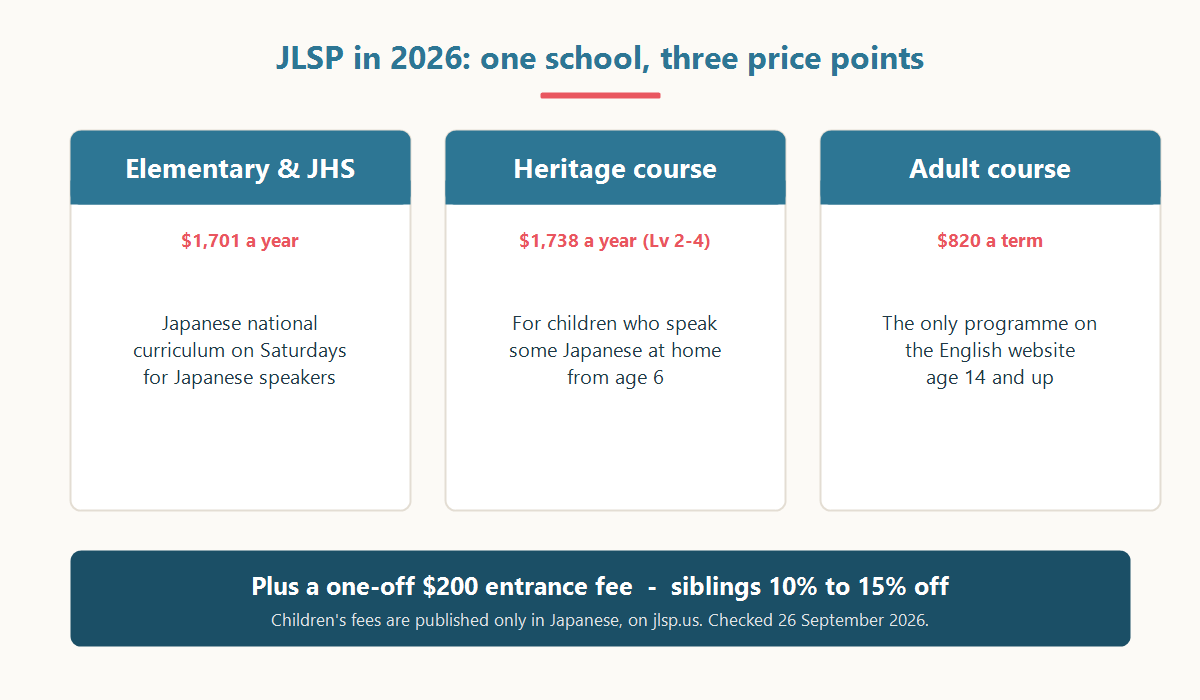
Children’s tuition is billed in three instalments per school year. The school publishes the instalments; the annual totals in the right-hand column are our sums.
| Division | Term 1 | Term 2 | Term 3 | Year |
|---|---|---|---|---|
| Kindergarten (幼稚部) | $436 | $758 | $490 | $1,684 |
| Elementary (小学部) | $480 | $741 | $480 | $1,701 |
| Junior high (中学部) | $480 | $741 | $480 | $1,701 |
| High school (高等部) | $490 | $758 | $490 | $1,738 |
| Heritage level 1 | $463 | $758 | $490 | $1,711 |
| Heritage levels 2–4 | $490 | $758 | $490 | $1,738 |
On top of tuition there is a one-off $200 entrance fee (入学金), and textbooks and materials are billed separately at cost — that amount is not published. A first year in elementary therefore comes to $1,901 before materials. For a second child the tuition drops by 10%, to about $1,531; a third child gets 12.5% off, a fourth 15%. If anyone in the family is also taking the adult course, the school asks you to tell the office before each term, or the family discount may not be applied.
To put that in perspective: it is roughly the same money as one term of the adult course twice over ($820 a term for 17 Saturdays), and a small fraction of what a full-day Japanese school costs. In New Jersey and New York, families comparing weekend-school fees across the state line will find JLSP at the low end. The honest reason it is affordable is the same reason it asks so much of parents — see below.
Two things on the fee page that no English source carries. First, if your child takes a leave of absence (休学), the rules page states that tuition is still payable for the whole period. Second, the fee page contradicts itself: its opening line still says the fees apply to 2023年度 (the 2023 school year), while the table directly below is headed 2026年度. The table is the current one — the page was edited in May 2026 — but if you screenshot it for a spouse, crop accordingly.
How a Saturday at JLSP works
Classes run every Saturday morning on the Japanese school calendar, April to March, split into a first half (April to late September) and a second half (October to March). The school’s May 2026 teacher-recruitment page gives class hours as 9:00 to 1:00; a parent who wrote up her family’s experience in 2022 described the elementary morning as four 40-minute periods — three of Japanese, one of maths — finishing around 12:30.
- Textbooks are the ones used in Japan. The MEXT course follows the national curriculum at the same pace, so a child finishes each grade in the same school year as classmates in Japan. That is what makes the return to a Japanese school smooth.
- One class per grade, 10 to 20 children. That is the 2022 parent account, not a school figure; the school does not publish class sizes.
- High school is a combined-grade class. The 2026 pamphlet’s organisation chart labels the high-school division 複式学級 — students of different years taught together. That is normal for a Saturday school this size and worth knowing before a teenager joins.
- A full Japanese school year of events. Entrance ceremony in April, Children’s Day in May, sports day and a bazaar in October, New Year and mochi-pounding in winter, a presentation day and graduation in March.
- The building is borrowed. JLSP rents Friends’ Central School’s City Avenue campus at weekends. It is a lovely setting — the old Wistar Morris estate, where Nitobe Inazo and Tsuda Umeko stayed in the Meiji era — but the adult course warns that dates can move when they clash with Friends’ Central events.
The Heritage course is the reason to look at this school
Most American Saturday schools have one track: the Japanese curriculum, for children who can already keep up in Japanese. JLSP has had a second track for more than 30 years. Its own page calls the Heritage course 「アメリカ国内の補習校では、なかなか例を見ない当校独自のプログラム」 — a programme rarely seen at other US hoshuko — and the Japan Foundation’s heritage-Japanese platform lists it as a highlighted programme.
| Level | Ages (English page, 2015) | What it aims at (Japanese pamphlet, 2026) |
|---|---|---|
| 継承 1 | 6–9 | Introduction: hiragana, katakana, everyday conversation, through games and activities |
| 継承 2 | 8–12 | Beginner: speaking and presenting alone, the Japanese needed for study, reading stories and explanations, basic composition |
| 継承 3 | 10–14 | Intermediate: discussing and explaining a range of topics; Japan–US cultural comparison |
| 継承 4 | 12–18 | Advanced: Japanese for real social situations and current affairs; a foundation for JLPT N3/N4 and the AP Japanese exam |
The pamphlet is explicit about who this is for: children of permanent residents and international marriages, learning Japanese as the language of a parent. That makes JLSP unusually open to the families most Saturday schools turn away. It is not, however, a beginners’ class in the usual American sense. Placement starts with an interview of both the child and the parents, some children also sit a written test, lessons are conducted only in Japanese with no English allowed in class, and the school says in English that help from a native speaker at home is “critical”. A family with no Japanese speaker at home should ask directly how that would work before enrolling.
Eligibility and what the school asks of parents
For the MEXT course, the school does not publish a Japanese-ability test. What it does publish, in the Japanese rules page 「各種届出」, is this:
- The principal decides admission after reviewing the application form, emergency card and waiver, taking facilities into account.
- A child who needs a continuous assistant or special care may be refused, with specialist advice taken into account. There is no published special-needs provision.
- The first month, or four class days, is an observation period. If the school judges it cannot accommodate the child, it may cancel the admission after talking with the parents.
- Parents must join a school committee. The wording is 「業務委員会への加入を義務として」 — membership is an obligation, not a request.
In practice, the English heritage page lists what parents do: library help, fund-raising, events, parking attendant duty, copying for teachers. The 2022 parent account adds recess supervision (中休み当番) several times a year, and describes homework as heavy — daily reading aloud and compositions using newly learned kanji, which younger children cannot do without an adult beside them. Almost all correspondence from school to home is in Japanese.
The honest review: what the English pages leave out
There are no fabricated review quotes here, and we found no substantive parent reviews on English directory sites — JLSP has no Niche, GreatSchools or PrivateSchoolReview profile, because it is a Saturday school rather than a day school. What we did find is an English record that is out of date in specific, checkable ways.
1. “Over 230 students” is a 2015 figure
The only enrolment number the school has ever published in English — “over 230 students … supported by 30 teachers and staff” — sits on its English About page, which its own site records as last edited in August 2015. Directory sites and search-engine summaries still repeat it as current. The school does not publish a current figure in any language. What the tax filings show is a school that is financially steady: revenue of $509,482 in the year to March 2024, with $421,588 of it from programme fees and no pay for officers. But no one outside the school can tell you from public sources how many children are in your child’s grade today. Ask.
2. English says “volunteers”. Japanese says compulsory
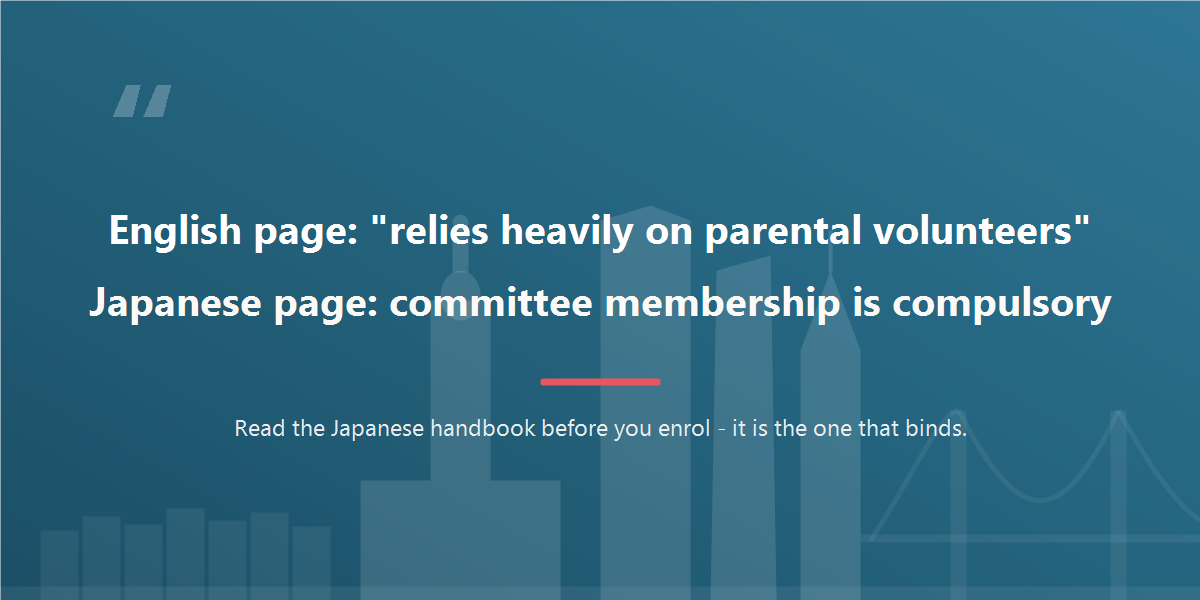
The English heritage page says the school “relies heavily on parental volunteers”. The Japanese rules page says committee membership is 義務, a duty. Both are true in their way, but a family reading only English would plan for occasional goodwill help, not a standing commitment.
| Topic | What the English web says | What the school’s Japanese pages say |
|---|---|---|
| Enrolment | “Over 230 students” | No current figure published; the 230 is from a page last edited in 2015 |
| Parent help | “Relies heavily on parental volunteers” | Committee membership is compulsory (義務) |
| Children’s fees | Not published in English anywhere | $1,684 to $1,738 a year, $200 entrance fee, sibling discounts |
| Scholarships | Not mentioned | 「奨学金の申請制度もあります」 — an application system exists |
| Heritage ages | 6–18 | 6–18 in the 2026 pamphlet, but 6–15 on the 2026 teacher-recruitment page |
| High school | “Grades 1 thru 12” | High school is a single combined-grade class (複式学級) |
| Address and phone | Directory listings: 1445 City Ave #3A; phone 610-642-1201 | c/o Friends’ Central School, 1101 City Avenue; phone 484-417-2310 |
3. A ministry’s name, read as a subject list
One widely read English round-up of places to learn Japanese in Philadelphia tells parents that JLSP teaches “general subjects such as Culture, Sports, Science and Technology”. That is the name of Japan’s Ministry of Education, Culture, Sports, Science and Technology, misread as a timetable. The same page turns “a broad area” into “230 students from abroad”, and says classes begin in September — which is true only of the adult course. Children start in April.
4. The old address is still the one on Yelp
Yelp and at least one local family directory list the school at 1445 City Ave, Suite 3A, with a 610 phone number. The school’s own pages, updated between 2024 and this year, give Friends’ Central School at 1101 City Avenue and (484) 417-2310. Wikipedia’s only mention of JLSP cites a jlsp.us URL retrieved in 2014 that no longer exists in that form, and describes the school as intended for “Japanese nationals and Japanese Americans” — which undersells the heritage track aimed squarely at permanent-resident and international families. Even the English site’s FAQ gives a different email domain (staff@jlsp.org) from every other page (staff@jlsp.us).
5. What is genuinely good, and under-reported
The same Japanese pages show a school that is thoughtful in ways English never mentions. The principal is in the office Tuesday to Friday for parent consultations; a clinical psychologist volunteers as school counsellor; the Heritage course has a clear four-level ladder ending in AP Japanese preparation; and the first-hand parent account describes the school as an emotional anchor for newly arrived children — the one place in the week where everyone around them speaks their language. At about $1,700 a year, that is a lot of school for the money.
Alternatives in the Philadelphia area
Honestly, very few. JLSP is the only Japanese Saturday school in greater Philadelphia, and the only children’s heritage programme we could find on the Pennsylvania side.
| Option | What it is | For children? |
|---|---|---|
| Princeton Community Japanese Language School | Weekend school at Rider University, Lawrence Township NJ, about an hour from Philadelphia. Hoshuko track, a heritage track, and JASL, a Japanese-as-a-foreign-language course for Grades 1–8 on Sunday afternoons. Fees published: roughly $145–$156 a month for the hoshuko and heritage tracks, $545 a semester for JASL | Yes — including complete beginners in JASL |
| JLSP Adult course | Saturday mornings, Genki-based, $820 a term | From age 14 only |
| Japan America Society of Greater Philadelphia | Evening adult classes, currently online; runs Nihongo PhilaCon, a Japanese competition for middle and high school students | No regular children’s class |
| Community College of Philadelphia, Penn Language Center | College-level Japanese | No |
The practical consequence is that a Philadelphia family whose child is not ready for JLSP’s MEXT course, and not a fit for its Heritage interview, has almost nothing local. For a wider view of what exists across the region and how to judge it, see our guide to finding a Japanese Saturday school near you.
How to choose, in four questions
- Is your child going back into Japanese schooling? If yes, JLSP’s MEXT course is exactly what you want: same textbooks, same pace, same school year. Nothing else in the region does this.
- Is Japanese your child’s first language, or a parent’s? If it is a parent’s language and your child is stronger in English, the Heritage course is the better fit — and one of the few of its kind in the US.
- Can someone at home read Japanese and sit with homework every day? Both tracks assume it. Notices, forms and the fee page are in Japanese; the school says native-speaker support at home is critical.
- Can your family give every Saturday morning, plus committee work, for years? That is the real price of a $1,700 school, and it is where most Saturday-school enrolments end.
Where TOMODACHI JAPAN fits
We are not a replacement for JLSP. If your child is returning to Japan, or thriving in its Heritage course, stay. We exist for the families the four questions above leave out — the ones who cannot make Wynnewood every Saturday, who have no Japanese speaker to cover the homework, or whose child’s Japanese sits somewhere between the two tracks.
- Japanese friends of the same age, every day. Classes of eight, with children in Japan. What keeps a child speaking Japanese is rarely the textbook. It is having someone their own age to talk to.
- Teachers working at Japan’s current classroom standard — not a tutoring agency, and not a syllabus written abroad.
- Small classes of eight, so every child speaks in every lesson rather than waiting their turn in a room of twenty.
- Philadelphia is 13 hours behind Japan (14 in winter). A Japanese school evening lands in the Philadelphia morning, and weekend slots work too — without a drive to City Avenue and without giving up the whole Saturday.
- A flat monthly membership. Fees, scholarships and opening dates are in our free school guide, which we email to everyone who registers, with no obligation.
If you are weighing the online route in general, we have written honestly about what an online school can and cannot replace about a Saturday school. And if you are comparing JLSP with its much larger neighbour to the north, our look at what the English pages leave out about the Japanese School of New York uses the same method.
Frequently asked questions
How much is the Japanese Language School of Philadelphia?
For 2026, $1,701 a year for elementary and junior high, $1,738 for high school and Heritage levels 2–4, $1,711 for Heritage level 1, with kindergarten at $1,684, paid in three instalments. Add a one-off $200 entrance fee and materials at cost. Siblings get 10–15% off. The adult course is separate: $820 a term.
Where is JLSP, and when are classes?
Saturday mornings at Friends’ Central School, 1101 City Avenue, Wynnewood, PA 19096, which JLSP borrows at weekends. The children’s year runs April to March. Ignore the 1445 City Avenue address still shown on Yelp.
Can my child join if their Japanese is weak?
Possibly, through the Heritage course, which is levelled from an introductory class for ages 6 to 9. Entry is by an interview with both child and parents, sometimes a written test, and lessons are Japanese-only. The MEXT course follows the Japanese national curriculum and assumes the child can keep up in Japanese.
Is JLSP accredited or recognised by Japan?
It is a non-profit recognised by the State of Pennsylvania and partly funded by Japan’s Ministry of Education, which also assigns its principal. The MEXT course uses the same textbooks and pace as schools in Japan, so a returning child finishes each grade in step with Japanese classmates.
Do parents have to volunteer?
Yes. The Japanese rules page states that parents must join a school committee. Parent tasks include the library, events, fund-raising, parking and recess duty, and the school expects daily homework support at home.
How many students does JLSP have?
Not published. The “over 230 students” figure repeated online comes from an English page last edited in 2015. A 2022 parent account described one class per grade of 10 to 20 children in elementary.
Sources
- Japanese Language School of Philadelphia, main site: jlsp.us; 授業料およびその他費用; 教育課程; 各種届出; 継承日本語コースのご案内 (2026 pamphlet); 教員の募集; Locations; 借用校の紹介
- JLSP English pages: About JLSP; Japanese as a Heritage Language for Children; jlsphila.org (adult course, Fall 2026, FAQs)
- IRS Form 990 data: ProPublica Nonprofit Explorer, EIN 23-2624982
- Parent account (Japanese): kaigai-taido.com, December 2022
- Alternatives: Princeton Community Japanese Language School; Japan America Society of Greater Philadelphia classes
- Third-party records checked and found stale or wrong: Wikipedia “Education in Philadelphia”, Yelp, elementaryconnections.com, EDOPEN Japan “learn Japanese in Philadelphia”, GuideStar. All checked 26 September 2026.