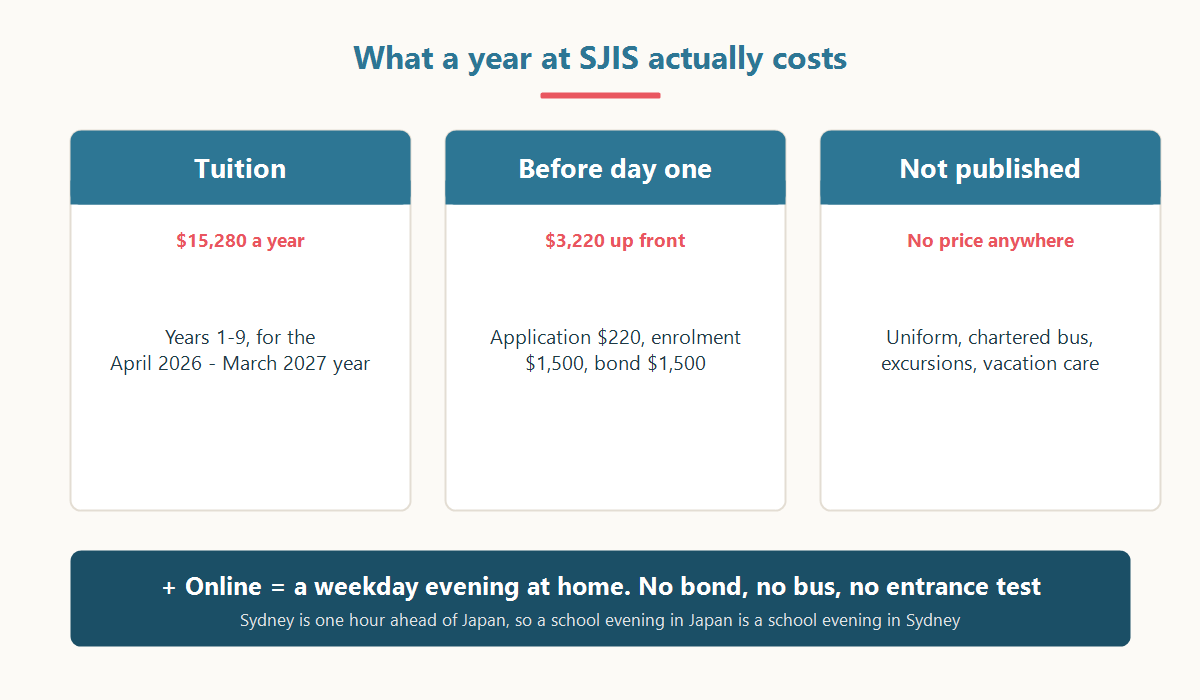
The current Sydney Japanese International School fees run from April 2026 to March 2027: $15,280 a year for Years 1 to 9, $14,880 for Kindergarten, and $18,780 for a first year once the one-off charges are added. Almost every English page quotes a superseded table, because SJIS revises its fees in April, on the Japanese school year — not in January like every other Australian private school. Wikipedia’s figure is two fee years old. Below: the current table with the arithmetic, the money that lives only in the terms and conditions PDF, and the eligibility rule the English FAQ does not mention.
The short answer
| Fee year | April 2026 – March 2027, in the school’s own words: “fees current for the April 2026 to March 2027 period” |
| Tuition, Years 1–9 | $15,280 a year. The table draws no distinction between the Japanese and International Divisions |
| Tuition, Kindergarten | $14,880 a year (International Division only — the Japanese Division starts at Year 1) |
| Tuition, students not eligible for government funding | $28,000 a year. Depends on visa; the fee page names Overseas Student Subclass 500 as its example |
| One-off charges | Application Fee $220 and Enrolment Fee $1,500, non-refundable · Bond $1,500, refunded on withdrawal or graduation |
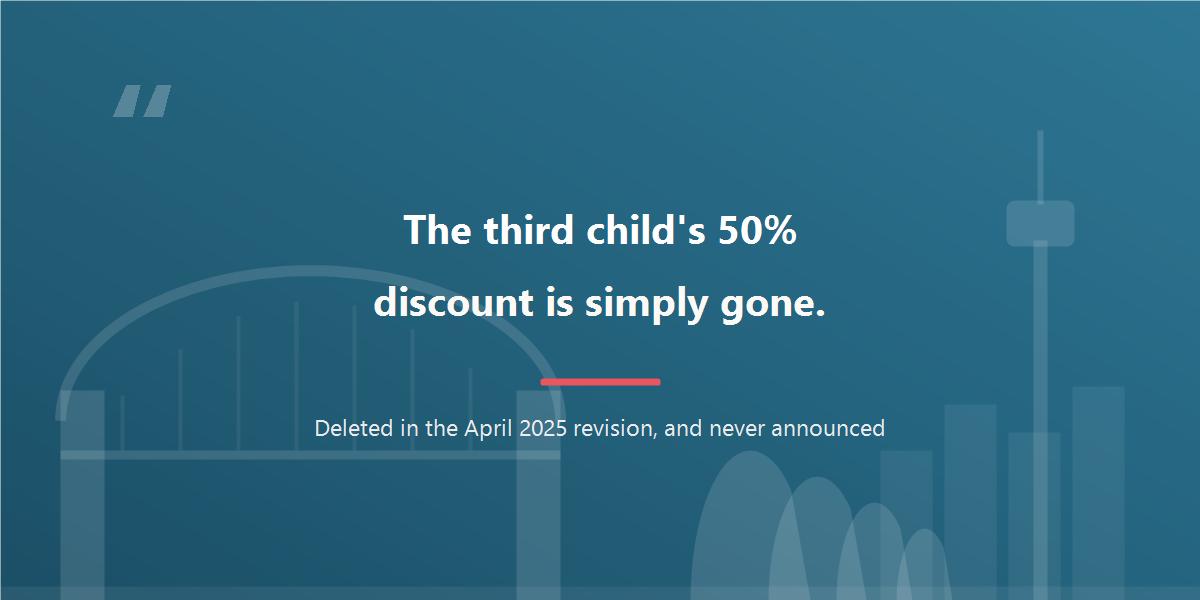
| Sibling discount | 10% off tuition from the second child, and nothing more. The 50% third-child discount was removed in the April 2025 revision |
| First year, one child, Years 1–9 | $18,780, of which $1,500 comes back — net $17,280. Later years $15,560 |
| Not published anywhere | Uniform · chartered bus · “Educational Expenses” · Vacation Care · After School Activities · the credit-card surcharge · the overdue charge |
| GST | Never stated. “GST”, “inclusive” and “plus GST” appear nowhere on the fee pages in either language, or in the terms and conditions |
Looking for a way to keep Japanese going from abroad?
TOMODACHI JAPAN is an online Japanese school for children growing up outside Japan. They talk with peers their own age in Japan every day, taught by teachers working at Japanese schools, in small classes of 8.
🎁 Register and we’ll email you our School Guide (PDF, in English) straight away. You’ll also be first to hear about tuition, scholarships and opening dates.
Free · takes about 30 seconds
Why every English page has an old number
This is structural, and it repeats every year. Australian private schools publish fees by calendar year; SJIS does not. Clause 3.1 of its terms says fees “are revised regularly and may be amended in April each year“. So a comparison site that scrapes once a year and files the result under “2026 fees” shows the previous table for eight months out of twelve. Here is what the three results above this one are actually showing.
| Page | What it shows | Which fee year that really is |
|---|---|---|
| edarabia.com | “AUD 11,280 – 11,680”, no year label at all | April 2022 – March 2023. Four fee years old; understates Years 1–9 tuition by $3,600 |
| goodschools.com.au | Kinder $14,080, Grades 1–6 $14,480, Years 7–9 $14,480 | April 2025 – March 2026. One fee year old. Names the school as its source, but gives no year and no last-updated date |
| English Wikipedia | “2025: A$13,680 per child” | April 2024 – March 2025. Real figure, wrong year label; “per child” hides the Kindergarten and $28,000 rates |
What the first year actually costs
One child, Years 1 to 9, April 2026 to March 2027. The school publishes no annual total, so the arithmetic below is ours, built only from its own unit prices.
| Item | Amount | Nature |
|---|---|---|
| Tuition, Years 1–9 | $15,280 | Annual |
| Enrolment Fee | $1,500 | Once, non-refundable |
| Bond | $1,500 | Once, refunded when the child leaves or graduates |
| Application Fee | $220 | Once, non-refundable, paid at application |
| Technology Levy | $280 | Annual, billed $70 a term |
| Required total, year one | $18,780 | Net of the refundable bond: $17,280 |
| Every year after | $15,560 | Tuition plus technology levy |
| PTA $40, Building fund $500, Library fund $200 | $740 | The funds are voluntary and tax-deductible. Not in the total above |
Two movements matter before you budget. Tuition for Years 1 to 9 has risen by exactly $800 in each of the last three Aprils — $13,680, $14,480, $15,280, a steady 5.5% a year. And in April 2026 the Enrolment Fee and the Bond both went from $1,000 to $1,500 at once, lifting the cost of starting from $2,220 to $3,220: a 45% rise in one year while tuition moved 5.5%.
The third-child discount that was quietly deleted
Until the April 2025 revision the fee page carried a second discount. The 2024 wording was explicit: for “three or more siblings, a 50% discount to tuition fees is applied to the third child“. It is gone. The 2025 and 2026 pages offer only the 10% sibling discount from the second child. There was no announcement; the line was simply removed, and we could find no page, English or Japanese, that reports it.
What it is worth at today’s rates: three children in Years 1 to 9 cost $15,280 for the first and $13,752 each for the second and third after the 10% discount — $42,784 a year. Under the old rule the third child’s tuition would have been halved to $7,640, bringing the family to $36,672. The deletion costs a three-child family $6,112 every year all three are enrolled. Our arithmetic, applying each published rule to current tuition.
No scholarship, bursary or hardship scheme exists
Worth stating as a verified absence, because families ask and then assume they simply could not find the page. We searched the fee page, the FAQ, the Enrolment Terms and Conditions 2026 PDF and the entire 2025 Annual Report for “scholarship”, “bursary”, “financial assistance”, “hardship” and the Japanese 奨学金. Zero hits in every file. The only price reduction SJIS publishes is the 10% sibling discount. Nothing is published, so nothing is predictable: plan on the full figure.
The money that is not on the fee page
The clauses that actually bind a household budget sit in the Enrolment Terms and Conditions 2026 PDF. None appears on the fee page, and none of the three top English results mentions any of them.
Leave costs $2,000 — and cannot be used for a Japanese entrance exam
Clause 4.3, verbatim: “The leave of absence fee is $2,000, regardless of the length of the leave, and must be paid in a lump sum within 7 (seven) days from the date of invoice.” Clause 4.4 adds that if the child returns, the $2,000 can be applied toward tuition. Leave runs one to two terms; beyond that the child is treated as withdrawn.
Then one sentence inside clause 4.1. Leave “will not be approved if the Student is attending another school within the Sydney area or if the leave is for temporary return to Japan for entrance exam purposes.” Families aiming at a junior-high or returnee exam typically go back to Japan for a stretch — cram school, trial exams, presence for the exam period. That stretch cannot be covered by leave. The choice is to keep paying full tuition for an empty desk, or to withdraw, which triggers the notice rule below.
Leaving needs ten weeks’ notice — and moving across Sydney is penalised harder than leaving the country
Clause 5.1: transferring or withdrawing within Australia requires a Departure Form at least ten weeks in advance, failing which “an additional term’s tuition fee will be charged” — a quarter of $15,280, about $3,820. Clause 5.2: moving outside Australia requires only four weeks, penalty four weeks’ tuition. The asymmetry is counter-intuitive: a posting that ends abruptly and sends you home to Japan is the cheap exit, while deciding in October that the local school down the road suits your child better is the expensive one.
Two more clauses belong in the same line of your planning. Clause 3.9: no refund or reduction for absence, for any reason — illness, holidays, suspension, withdrawal. Clause 13: the school may change these terms on one term’s written notice, and the change applies to children already enrolled.
The four routes for a Japanese-speaking child in Sydney
| Route | What it costs | When | Years | Who can enrol | The catch |
|---|---|---|---|---|---|
| SJIS — Japanese Division Terrey Hills | $15,280 tuition. $18,780 first year | Full-time. Year runs April–March | Year 1 – Year 9 | Japanese citizenship required (Enrolment Policy, clause 2) | 72 students in 2025, from 101 in 2023. Years 7–9 total 11 children |
| SJIS — International Division Terrey Hills | $14,880 Kindergarten, $15,280 Years 1–6 | Full-time. Year runs January–December | Kindergarten – Year 6 | All nationalities | Japanese is 45 minutes a day, about 3.75 hours a week. NSW curriculum, not the Japanese one |
| Sydney Saturday School of Japanese Cammeray | $160 per term, per student. Four terms in the 2026 year | Saturdays 8:55–11:50 | Kindergarten year to senior school | Nationality not restricted. The child must hold a conversation in Japanese with the teacher | About 300 students. Volunteer-run: parents rostered roughly once a term. Year starts in May |
| TOMODACHI JAPAN Online, anywhere in NSW | In the school guide | Weekday evenings, Sydney time | Primary and lower secondary | No citizenship requirement, no entrance exam | Not on Japan’s ministry list; we do not deliver the curriculum a repatriating child needs |
There is no single “Sydney Japanese Saturday School”
English pages write it in the singular. No school of that name exists. Sydney has more than ten separate Saturday and weekday schools, each its own legal entity with its own committee, fees and day of the week. Only Japan Club of Sydney runs more than one site.
Two corrections follow, and both matter if you have read that these are “MEXT-recognised”. Japan’s education ministry list contains no supplementary school in Sydney at all — the only Australian one is in Queensland, and SJIS appears on that list as a full Japanese school. Sydney’s Saturday schools sit under a separate regime, designated by the Foreign Minister. And the one clean English-language source is not a Japanese site: the NSW Department of Education’s community languages register lists fourteen Japanese locations with venues and hours — ten on Saturday, two on Sunday, one on Wednesday afternoon and one online on Thursday.
| Term tuition | School | Parent duty buy-out |
|---|---|---|
| $135 | Forest, Year K and above (under Year K, $150) | — |
| $150 | JCS City, Dundas, Edgecliff · NSW Japanese School · Bayside, in person on Wednesday afternoons | JCS Dundas $200 per duty, two duties · NSWJS $400 a year · Bayside advertises no roster |
| $160 | Sydney Saturday School of Japanese, Cammeray | Not published |
| $170 | Hornsby · Japanese Sunday School preschool class | Hornsby $150 × 2 a year · JSS $70 a term |
| $180 | NSW Japanese School preschool · Bayside online | NSWJS $400 a year |
| $200 | North Shore — the only one stating its fees are GST inclusive | — |
| $220 | Japanese Sunday School international class (regular $140) | $70 a term |
| $280 | JCS Edgecliff international class, for non-background students | — |
| Not published | Kookaburra, Lane Cove — no fee in either language, and it advertises no parent duties | None |
The point is not that Saturday school is cheap. It is that a two-fold spread — $135 to $280 — sits behind a thing parents assume is one standard product, and that the parent roster has a published price at four of them. Hornsby’s is the one to watch: its fee list states that if you do not file a Working With Children Check, you are automatically treated as exempt and charged, so $300 a year can land on a family that simply missed a form. The clearest evidence this drives real choices is that two schools now advertise “no duty roster” as a selling point.
Two structural facts change the decision more than any price here. First, the Saturday school at Cammeray has about 300 students on its own, against 189 for the whole of SJIS. Most children doing Japanese schooling in Sydney are not at the full-time school — the opposite of the impression every English page gives. Second, its school year starts in May: its own site explains that the Australian public schools’ Term 2 is its Term 1. So a Sydney family can be running three school-year calendars at once — NSW January to December, the SJIS Japanese Division April to March, and Saturday school from May. Nobody has written that down in English.
And the same language asymmetry shows up here. Cammeray charges full tuition throughout a leave of absence — you keep paying while your child does not attend — but its English site has no equivalent of the Japanese procedures page. We fetched the English procedures URL: no dollar figure, and no mention of withdrawing or taking leave.
The honest review
SJIS is a genuine Japanese school, not a language programme. Founded in 1969, it runs Japan’s national curriculum through to Year 9, and a child who leaves it for a classroom in Japan will be in the right place academically. Nothing below takes that away.
1. In Sydney, what you are told depends on which language you read
This is the finding we did not expect, and it is structural rather than one school’s sloppy translation. Two schools withhold different things from different languages, in opposite directions.
SJIS hides a restriction from English readers. Asked whether it accepts all nationalities, the English FAQ answers that the school “welcomes ALL children from local families as well as from ALL nationalities and religions.” Full stop. The Japanese FAQ, on the same question, opens with a restriction: transfer into the Japanese Division is in principle for children who hold Japanese citizenship, and the International Division is the part open to all. The restriction is published in English — just not where anyone looks. It sits in the Enrolment Policy, reproduced inside the Annual Report PDF: “All children who enrol in the Japanese Division are required to have Japanese citizenship.“
JCS Edgecliff does the exact opposite — it hides a price from Japanese readers. We extracted every dollar figure from both versions of its site. The Japanese page lists six: $50, $25, $150, $75, $30 and $40. The English page carries a seventh that appears nowhere in Japanese: “The tuition fee is $150 per term (International class for non-background students $280 per term).” A Japanese-speaking family reads $150. A family without a Japanese-language background reads $280 — 1.87 times as much — and neither can see the other’s page. The Sunday school at Riverwood runs the same two tiers, $140 and $220, but publishes both in both languages, which is how it should be done.
So the pattern is not “SJIS has a translation problem”. Across Sydney’s Japanese schooling, the version of the school you see is decided by the language you read it in, and no third party reconciles the two. That is the whole reason this page exists.
The practical effect at SJIS: if your child does not hold a Japanese passport, the English front door says all nationalities are welcome while the statutory disclosure says the Japanese Division is not. What is open to you is the International Division and its 45 minutes of Japanese a day — a different proposition at almost the same price, and worth knowing before the $220 is paid.
2. Two school years run inside one school
From the school’s calendar page: “The International Division (NSW Curriculum) operates from January to December annually. The Japanese Division (Japanese Curriculum) runs from April to March of the subsequent year.” The fee year is April to March for both. So International Division families have their fees change in the middle of their school year, siblings in different divisions finish nine days apart (17 and 8 December in 2026), and a family arriving mid-posting can find the division they want has no intake for months. Add a Saturday school starting in May and you are running three calendars.
One caution for Japanese-reading parents: the Japanese calendar page marks that 8 December finish as a Friday. It is a Tuesday. Check the English page before booking flights.
3. The Japanese Division has been shrinking, and its middle school is very small
From the school’s own annual reports, three years running. Japanese Division enrolment: 101 in 2023, 94 in 2024, 72 in 2025. Whole-school enrolment fell from 223 to 189 in 2025, and the Japanese Division’s share dropped from 47% to 38%. The 2025 report offers no reason; we searched it and found no discussion of the decline.
The class-size table shows where it bites. Year 6 in the Japanese Division had five children, and the three middle-school year groups had five, four and two — eleven students across Years 7 to 9. Small is not the same as bad; a class of four gets attention no class of thirty ever will. But if part of why you want a Japanese school is a Japanese-speaking peer group of your child’s own age, in the upper years that group is a handful of children. A fact to weigh, not a verdict.
4. Where the buses do not go
The campus is at 112 Booralie Road, Terrey Hills, about 25 km north of the CBD with no railway station. The published route map runs nine state bus lines plus three chartered lines, serving Hornsby, Turramurra, Ryde, Roseville, Chatswood, Killarney Heights, Cremorne, Cammeray and Elanora Heights.
Read that map for what is missing and it tells you who the full-time school does not work for. Nothing serves the Eastern Suburbs, the Inner West, Parramatta and the Hills District, the South, the South-West or the West. Ryde is as far as the network reaches. From Bondi, Newtown, Strathfield, Castle Hill, Hurstville or Parramatta, attending SJIS means driving across Sydney twice a day, every day.
Be careful not to read that as a Japanese-education desert, because it is not. The Saturday and weekday schools are spread across exactly the areas the SJIS buses miss — Ashfield in the Inner West, Ultimo beside the CBD, Edgecliff in the Eastern Suburbs, Kyeemagh and Riverwood in the south, Dundas towards Parramatta. Distance rules out the full-time school for much of Sydney; it does not rule out Japanese schooling. The real barriers to those are elsewhere: the entry bar, the roster, the Saturday itself and the three calendars.
How to choose, in four questions
1. Is your child going back into a classroom in Japan? If yes, and your child holds Japanese citizenship, the Japanese Division is the right building and there is little to debate. If the return is for an entrance exam, read clause 4.1 first — leave of absence will not cover it.
2. Does your child hold a Japanese passport? A yes-or-no gate on the Japanese Division, and the English FAQ will not answer it for you. If no, your SJIS option is the International Division and its 45 minutes of Japanese a day. Decide whether that is enough Japanese before you compare prices, because the price is nearly the same either way.
3. Can you get there, twice a day, for years? Not “would we like to” — can you, from where you live, with the bus map as it stands. Outside the North Shore and the Northern Beaches, cost this in hours before dollars — but note it rules out the full-time school, not a Saturday school.
4. Is $17,280 net in year one right for your family? Ask it knowing there is no published scholarship or hardship scheme, that uniform, bus and educational expenses sit on top unpublished, and that the figure has risen every April for three years. If the answer is no, a Saturday or weekday school is the other established route at $135 to $280 a term — but price the roster in as well, because buying out of it runs $150 to $400 a year at the schools that publish a figure.
Where TOMODACHI JAPAN fits
We would rather be straight about the boundary than sell past it. If your child is repatriating into a Japanese classroom, SJIS is the right answer and we will tell you so. We are not on Japan’s ministry list and we do not deliver the curriculum a returning child needs.
We will also not claim a geography gap that does not exist. If you live in the Inner West or the Eastern Suburbs, the SJIS buses do not reach you but a Saturday school does. What we are built for is the family Sydney’s options are not designed to take on other grounds: the child without a Japanese passport, left with 45 minutes a day; the child whose Japanese sits below “can hold a conversation with the teacher”, which is the entry bar at every Saturday school; the family planning an entrance-exam return that leave of absence will not cover; the household that cannot put an adult on a duty roster and does not want to buy out of one; and the family whose Saturday morning is already committed. TOMODACHI JAPAN is an online Japanese school for children living outside Japan. Three things define it: children talk with peers their own age in Japan, they are taught by teachers working to the standard of Japan’s current classrooms, and they learn in classes of eight, grouped by the level they are actually at. No entrance exam, no citizenship requirement, no catchment area.
And Sydney has the easiest time zone of any city we serve. Sydney is one hour ahead of Japan on standard time, two hours ahead under daylight saving — close to nothing. Children in Japan are home from school and free from about six in the evening, which is seven o’clock on a Sydney weeknight. In London that same hour lands at eleven in the morning and the weekday window does not exist. In Sydney it does: a Tuesday-evening class with children in Japan is an ordinary school night here. No early start, no Saturday given up, no drive to Terrey Hills. Tuition, scholarships and opening dates are all in our school guide, and we send it to everyone who registers.
Frequently asked questions
How much are Sydney Japanese International School fees?
For April 2026 to March 2027: $15,280 a year for Years 1 to 9, $14,880 for Kindergarten, $28,000 for students not eligible for government funding. A first year for one child in Years 1 to 9 is $18,780, or $17,280 net of the refundable bond; later years $15,560. Uniform, bus and “Educational Expenses” are extra and not published, and GST is never mentioned.
What are the term dates?
Different for each division. Japanese Division 2026–27: 22 April to 30 June, 21 July to 25 September, 13 October to 17 December, then 12 January to 17 March 2027. International Division 2026: 13 January to 18 March, 22 April to 30 June, 22 July to 25 September, 14 October to 8 December. The summer break is slightly shorter than local public schools and the March–April break slightly longer; vacation care runs in that window at a price the school does not publish. If you are also looking at Saturday school, add a third calendar: Cammeray’s 2026 year runs 2 May to 10 April 2027.
Is there a uniform, and what does it cost?
There is a uniform, and the price is not published. We read the 2026 uniform and discipline policy in full and searched it for prices, costs and suppliers: nothing, and the uniform page has no price list either. All the school states is that every item except socks is sold at the school uniform shop.
Is there a school bus?
Yes — nine state routes plus three chartered routes, covering the North Shore, the Northern Beaches and as far as Ryde. State buses are free for citizens, permanent residents and eligible visa holders with a School Opal Card. The chartered buses are not free and the fare is not published anywhere. Kindergarten families do their own drop-off for the first three weeks of Term 1.
What are the reviews, and where does it rank?
We will not give you a ranking, because the data to build one honestly is not public. The review page that ranks for this school carries zero actual reviews next to a four-year-old fee range. The Annual Report publishes attendance and teacher accreditation for the International Division only, by its own headings, and Japanese Division students sit NAPLAN merged into that cohort, so no separate result exists. Verifiable from the reports: 189 students in 2025, 30 teaching staff, and International Division attendance of 94.17%.
Does my child need Japanese citizenship?
For the Japanese Division, yes — the Enrolment Policy and the Japanese FAQ both say so, while the English FAQ does not mention it. The International Division is open to all nationalities, as are the Saturday schools, which set a Japanese-language bar instead of a passport one. Separately, both languages say the school will not enrol a child on a student visa in their own name, while the fee table quotes $28,000 for Subclass 500 holders. Those two statements are not reconciled anywhere; ask before you apply.
What happens if we withdraw part-way through the year?
You give notice on a Departure Form: ten weeks if you are moving elsewhere in Australia, or an additional term’s tuition is charged, around $3,820; four weeks if you are leaving the country, or four weeks’ tuition. The $1,500 bond is returned. There is no pro-rata refund of tuition already paid. If you are pausing rather than leaving, a leave of absence costs a flat $2,000 and is not available for a temporary return to Japan for entrance-exam purposes.
Sources
Every figure here comes from a document published by the school concerned, by a Japanese government ministry, or from a dated archive snapshot of the school’s own fee page. Sources checked on 12 September 2026.
- SJIS fees, English and Japanese: sjis.nsw.edu.au/enrolment/fees and /ja/enrolment/fees
- SJIS FAQ, English and Japanese, compared line by line: sjis.nsw.edu.au/enrolment/faq and /ja/enrolment/faq
- SJIS Enrolment Terms and Conditions 2026 (PDF) — clauses 3.6, 3.9, 4.1, 4.3, 4.4, 5.1, 5.2, 9.3 and 13: 21.Enrolment-Terms-and-Conditions-2026-web.pdf
- SJIS Annual Report 2025 (PDF) — enrolment, class sizes, attendance, workforce and the Enrolment Policy: 2025-SJIS-Annual-report-final.pdf. Annual Reports 2024 and 2023 for the enrolment trend
- SJIS Enrolment Policy 2025 (PDF), clause 2 — the Japanese Division citizenship requirement: 22.Enrolment-Policy-2025.pdf
- SJIS term dates and calendar: school-life/term-dates-school-calendar
- SJIS school bus page, bus route map (PDF) and Kindergarten Parent Handbook 2025: school-life/school-bus, A4_SJIS_Bus_Route_Map_FNL.pdf
- SJIS Discipline Policy and School Uniform 2026 (PDF), searched in full for prices: Discipline-Policy-Shool-Uniform-2026-2.pdf
- Archived SJIS fee pages, used to date the superseded figures: 2022–23, 2023–24, 2024–25, 2025–26
- NSW Department of Education, community languages schools register — the fourteen Japanese locations, venues and hours: education.nsw.gov.au
- Sydney Saturday School of Japanese — fees, terms, class list, parent duty, and the English procedures page that carries no figures: sssj.org.au/enrolment-2, about-us-2, parents-volunteer-2, procedure-2
- Saturday and weekday school fee pages: JCS Edgecliff and its English page (the $280 international class), JCS Dundas, JCS City, NSW Japanese School, Hornsby fee list 2026.4, Japanese Sunday School, Forest, North Shore, Bayside, Kookaburra
- Japan’s Ministry of Education, list of accredited overseas educational institutions — SJIS is listed as a Japanese school for Oceania, and the only Australian supplementary school listed is in Queensland: mext.go.jp. The separate list of Foreign-Minister-designated supplementary schools is the Ministry of Foreign Affairs PDF linked from that page, and the Consulate-General of Japan in Sydney’s education page (updated 9 September 2026) defines the category
- Pages cited above only in order to correct them: edarabia.com, goodschools.com.au and English Wikipedia’s “Sydney Japanese International School”