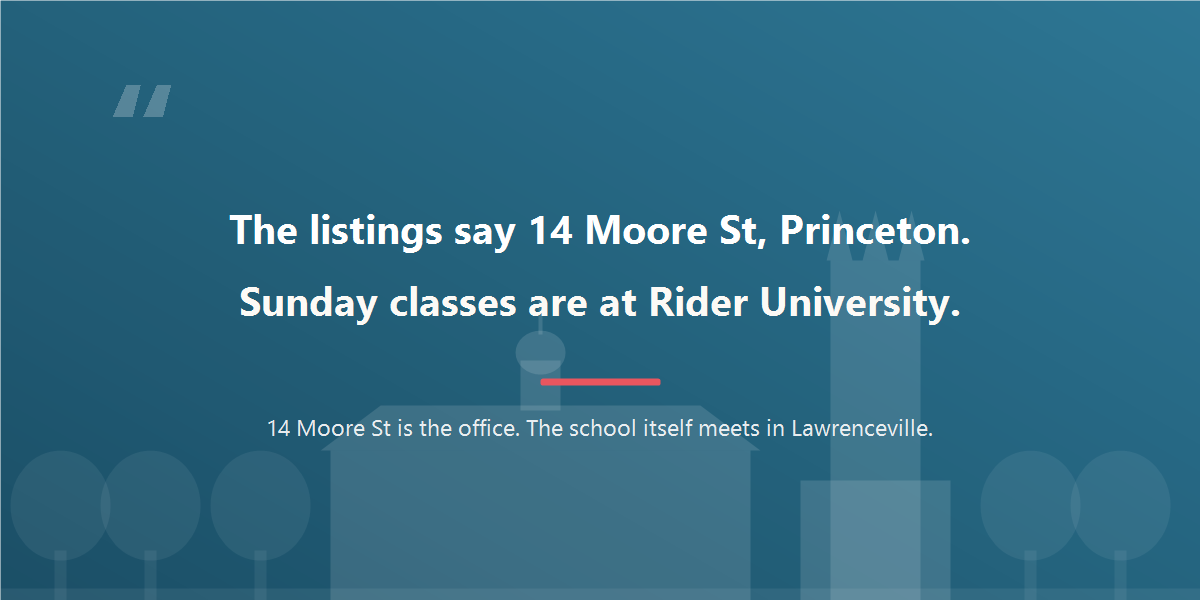
Look up Princeton Community Japanese Language School on Yelp, Sawyer or the Princeton visitor directory and you will be sent to 14 Moore Street in Princeton. No child has a lesson there. It is the school’s office. Classes happen on Sunday afternoons in rented buildings at Rider University in Lawrenceville, and the school itself says it leases those rooms “only on Sundays”. That gap — between where the English web points you and where the school actually is — runs through almost everything written about PCJLS in English.
Everything below comes from the school’s own pages, in both Japanese and English, its tax filings and its dated notices, all checked on 26 September 2026. Where a figure is not published, this page says not published rather than guessing. And where the school’s Japanese pages and its English pages disagree with each other — they do, in ways that matter for who can enrol — we show you both.
The short answer
| What it is | A Sunday school with six programmes in three divisions: a MEXT-recognised 補習授業校 (Grades 1–9), a high-school division, a heritage-language “Princeton Course”, a kindergarten, plus Japanese-as-a-foreign-language classes for children (JASL) and for teens and adults (online) |
| Where | Classes: Rider University, 2083 Lawrenceville Road, Lawrenceville, NJ. Office (no classes): 14 Moore Street, Princeton |
| When | Sundays. Published timetables run 1:00 to 4:20 PM, with optional maths from about noon. Kindergarten 1:05 to 4:10 PM |
| Cost | $145 to $156 a month for the Japanese-curriculum and heritage tracks; $545 a semester for JASL. Plus a $50 registration fee and a $200 entrance fee. The fee table is dated 17 March 2025 — no newer schedule is published |
| Size | 265 students, by the school’s own count — down from 305 in 2021 |
| Can you join now? | Japanese-curriculum and heritage tracks: ask the office. JASL for 2026–27: closed (deadline was 18 August 2026) |
Looking for a way to keep Japanese going from abroad?
TOMODACHI JAPAN is an online Japanese school for children growing up outside Japan. They talk with peers their own age in Japan every day, taught by teachers working at Japanese schools, in small classes of 8.
🎁 Register and we’ll email you our School Guide (PDF, in English) straight away. You’ll also be first to hear about tuition, scholarships and opening dates.
Free · takes about 30 seconds
What PCJLS costs in 2026
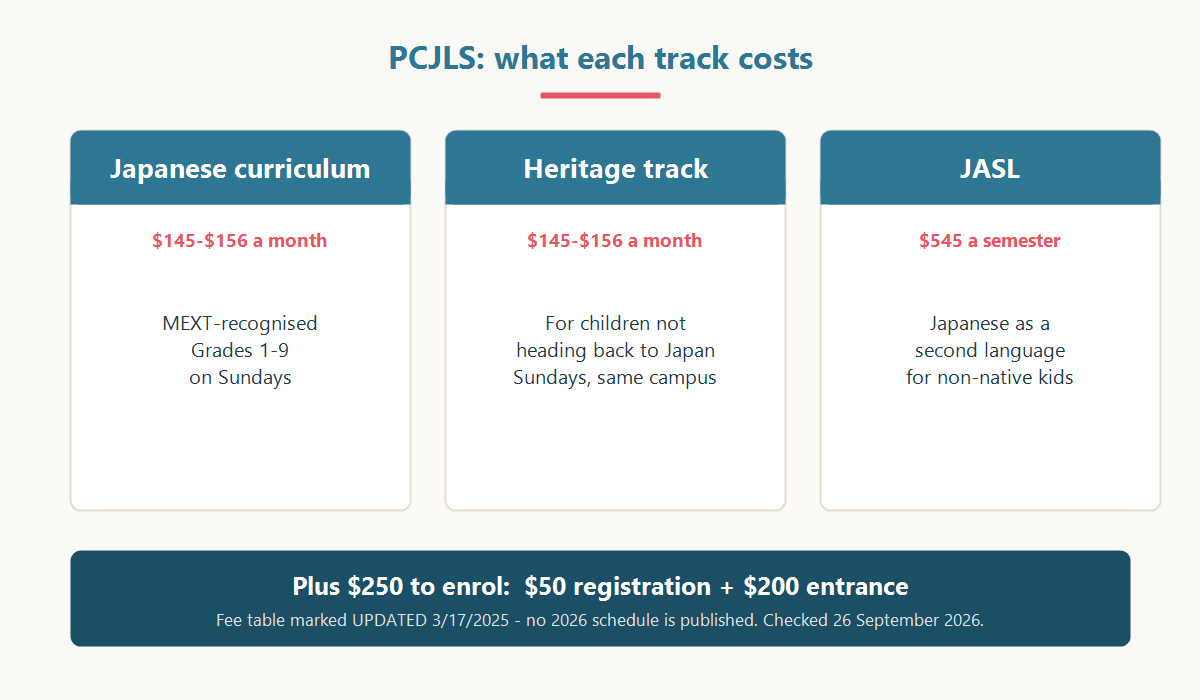
PCJLS is one of the few Japanese weekend schools in the United States that prints its tuition on its website at all. The catch is the date on the page: the fee table on the Japanese admissions page (入学案内) ends with “UPDATED 3/17/2025”. There is no separate 2026 schedule. Treat every figure below as the last published rate, and confirm the current one with the office before you budget.
| Programme | Published fee | Class size cap |
|---|---|---|
| 補習校部, Grades 1–4 | $145 a month | 25 per grade |
| 補習校部, Grades 5–6 | $148 a month | 25 per grade |
| 補習校部, junior high (Grades 7–9) | $156 a month | 25 per grade |
| 高等部, high school | $156 a month | 25 |
| 幼稚園部, kindergarten (all three years) | $145 a month | 20 per year group |
| Princeton Course (heritage), Grade 1 and lower elementary | $148 a month | 15 |
| Princeton Course, middle and upper elementary; junior and senior high | $156 a month | 15 |
| JASL (Japanese as a foreign language, Grades 1–8) | $545 a semester | 15 |
| Community Course (Grade 9 up, adults, online) | $580 a semester | 15 |
On top of tuition:
- Registration fee $50, by cheque with the paper application, then an entrance fee of $200 once a place is confirmed. The English “About PCJLS” page describes the same thing as a single “one-time admission fee of $250.00 per child”.
- Materials, per year: elementary Japanese $104, elementary maths $60; junior-high Japanese $92, junior-high maths $30; kindergarten $100.
- Electives, per month: maths class (Grade 1 to Grade 12) $50; a junior-high Japanese culture and current-affairs class $35. AP Japanese preparation is offered from Grade 9, price not published.
- Parent Association dues: $5 per child per year, collected in September, according to the English page.
- Sibling discount: not published. Refund policy: not published online — the English page says only that tuition “would not be refunded after a certain date” and refers you to the registration form.
What a year actually costs
Here is the awkward part. The Japanese page quotes monthly rates, but it never says how many months you are billed for. The English page says tuition is collected per semester, in September and January — which fits JASL’s September-to-June year, not the Japanese-curriculum and heritage tracks, which the home page says run April to March. The number of billed months is not published.
If the monthly rate is charged for all twelve months of the April-to-March year, the arithmetic is $1,740 a year for Grades 1–4, $1,776 for Grades 5–6; junior high and high school come to $1,872. That assumption has some support: the school’s IRS return for the year to March 2025 reports $470,372 of programme-service revenue, which across 265 students is roughly $1,775 each. That is our arithmetic, not the school’s figure, but it suggests the twelve-month reading is in the right range.
| Example: a new Grade 2 pupil in the 補習校部, with maths | Amount |
|---|---|
| Registration + entrance fee (once) | $250 |
| Tuition, $145 a month (12 months assumed) | $1,740 |
| Maths elective, $50 a month (12 months assumed) | $600 |
| Materials: Japanese $104, maths $60 | $164 |
| Parent Association | $5 |
| First year, estimated | about $2,759 |
For a sense of scale: that is about a fifth of the tuition and materials alone at the region’s full-time Japanese day school, and it is in the same band as the Saturday schools around New York, whose fees we broke down in our guide to the Japanese School of New York and its weekend school.
How the school works: six programmes, one Sunday
The school’s founding line, repeated on its Japanese pages, is to “open the door to everyone who wants to learn Japanese language and culture”. In practice that produces something unusual for a 補習校: the MEXT-recognised supplementary school is only one of several programmes sharing the same Sunday and the same rented rooms. The chairman’s message calls this a structure “with no precedent at other supplementary schools”.
| Programme | For whom, in the school’s words | What is taught |
|---|---|---|
| 補習校部, elementary and junior high | Children who need to fit back into Japanese school; the page adds that most are children of company-posted families (主に駐在員のお子様) | Japanese (国語) from Japanese government textbooks; social studies from Grade 3; maths as an elective |
| 高等部, high school | Students aiming at Japanese universities, and US-bound students who want high-school Japanese at a Japan-level standard | Japanese, Japanese history, Japanese literature and culture; kanji-test and AP Japanese preparation |
| Princeton Course (heritage, since 2004) | Children growing up bilingual who are not expected to enter Japanese schooling: long-term residents, permanent residents, international-marriage families | Heritage-language Japanese in mixed-grade classes, aiming at AP Japanese 4 to 5 by the end |
| 幼稚園部, kindergarten | Ages 3 to 5 — with conditions (see below) | Japanese-language early-years programme, 1:05 to 4:10 PM |
| JASL, Grades 1–8 | Children with little or no Japanese | Japanese as a foreign language, 36 Sundays, September to June, 1:00 to 3:30 PM |
| Community Course, Grade 9 and adults | Beginners and up | Online, using the Genki textbooks, fall and spring semesters |
The Sunday itself is compact. The published high-school and Princeton Course timetables run four periods from 1:00 PM to 4:20 PM, with an optional maths period before lunch (11:50 AM on some pages). High-school students must attend all four periods; the school states that attending a single subject is not allowed. The timetable for the 補習校部 elementary and junior-high classes is not published on its course pages.
One practical upside of Sunday: a family can, in principle, keep Saturday for sport or a second activity. That is a genuine difference from the Saturday schools further north.
Who can enrol, and which track your child belongs in
PCJLS sorts children by plan and ability, not by passport. The deciding question is whether your child is expected to go back into the Japanese school system:
- Returning to Japan → 補習校部. The Japanese page on the school’s history describes it as teaching 国語 “to elementary through high-school students who plan to return to Japan”.
- Staying in the US, speaks Japanese → Princeton Course. Entry needs age-appropriate everyday Japanese — your child can hold a conversation and follow a teacher’s instructions in Japanese. From Grade 2, the page asks for Japanese equivalent to finishing Japanese Grade 1.
- Little or no Japanese → JASL (Grades 1–8) or the online Community Course (Grade 9 up).
- Ages 3 to 5 → kindergarten, subject to the conditions below.
Applications are on paper, posted to the Princeton office with the $50 cheque. The school warns that class composition can change with numbers. For JASL and the Community Course there are hard deadlines, and for 2026–27 both have passed: JASL closed on 18 August 2026 (2027–28 registration opens in late June 2027), and the fall Community Course closed on 1 September 2026 (spring registration opens in mid-January 2027). The kindergarten posted a small top-up intake for its 年中 (four-year-old) class, for children born from 2 April 2021 to 1 April 2022, “若干名” — a handful of places.
The honest review: what the English pages leave out
We found no independent parent reviews of PCJLS with any substance — the directory listings carry addresses, not experiences. So instead of inventing a verdict, here is what a parent reading only English would miss, set against the school’s own Japanese pages.
1. English says the kindergarten is for 3- to 5-year-olds. Japanese adds a parent-language condition
The English “About PCJLS” page describes the kindergarten simply as pre-school classes for three- to five-year-olds, with no other condition. The Japanese kindergarten page sets out who it is actually for: 「原則として保護者の一人が日本語を母語とし、家庭での日常会話が日本語で成り立ち、教師の指示が理解でき、トイレトレーニングが終了している」 — as a rule, one parent must be a native Japanese speaker, everyday conversation at home must work in Japanese, the child must understand the teacher’s instructions, and the child must be toilet-trained. An English-speaking family with a Japanese-curious three-year-old would read the English page as an open invitation. The Japanese page says, politely, that it is not.
2. The directories send you to the office. Classes are in Lawrenceville
Yelp, Sawyer and Experience Princeton all list 14 Moore Street, Princeton. That is the administrative office, open Tuesday to Friday. Classes are at Rider University in Lawrenceville, and the school’s own location page gives a separate Sunday number (609-903-9014). An older after-school directory still places the Sunday school in “Memorial Hall, Room 301” — the building’s former name — with a different Sunday phone number (609-895-5628). The school’s history page says classes moved to Bierenbaum Fisher Hall in 1996, and a February 2026 lecture notice put the event in Lynch Adler Hall, so check which building your child’s class is in before the first Sunday.
3. “MEXT-approved” covers less of the school than you might think
Third-party pages describe PCJLS as “a Japanese hoshu-ko approved by the Japanese Ministry of Education”. True — for one part of it. The school’s own English page is precise: “The Hoshuko consists of Elementary and Middle schools.” The high-school division, the Princeton Course, JASL, the Community Course and the kindergarten sit outside that recognised 補習授業校. That does not make them worse — the Princeton Course is the school’s pride and has its own published curriculum work — but if the reason you want a MEXT school is a smooth return into Japanese schooling, the part that counts is the Grades 1–9 補習校部.
4. English Wikipedia says the Japanese-curriculum track is for “Japanese citizen children”. The school says it is about plans
The Wikipedia article frames the first division as classes “for Japanese citizen children abroad”. The school’s own pages never make citizenship the test. They sort by intention — returning to Japan versus staying — and name permanent-resident and international-marriage families explicitly as the Princeton Course’s intended students. For a dual-national family planning to stay in New Jersey, the English framing points you to the wrong door.
5. Social studies starts earlier than the English page says
The English page says the elementary 補習校部 teaches social studies only in the last two years of elementary school, Grades 5–6. The Japanese elementary page says social studies runs from Grade 3: an introductory overview in Grades 3–4, every textbook unit in Grades 5–6. It is a small difference, but it tells you which page is being maintained. On every point where the two disagree, the Japanese page is the more detailed one.
6. The school is run by parents, and the Japanese says so more bluntly
The English chairman’s message says that “parents play a central role in the school’s operations and various events”. The Japanese original is plainer: 「学校運営、各種行事のほとんどが保護者の手で行われています」 — most of the running of the school and its events is done by parents. Wikipedia adds that, as of 2012, parents made up 70 percent of the teaching staff; that figure is old, but the school’s current staff advert fits it, offering a trainee “support staff” route for applicants with no teaching experience and asking for availability on 40 Sundays a year. A specific parent-duty rota is not published. Ask what yours would be before you sign.
7. The school is getting smaller, and says why
The school gives 265 students today. A 2021 profile in the Japanese weekly New York Seikatsu gave 305; an undated Japanese-language directory gives about 330 with 48 teachers. English Wikipedia’s only enrolment figure is from 1987. The school’s donation page names the cause itself: 「現在のプリンストン周辺の日系企業数の減少動向」 — the number of Japanese companies around Princeton is falling. For you, that means fewer same-age classmates in the 補習校部, and a school that increasingly depends on permanent-resident and mixed families. Financially it looks steady: the last filed year shows revenue of $569,548 against expenses of $512,392, and net assets of just over $1 million.
8. If you search in Japanese, you may find another school’s fees
Search for the school’s tuition in Japanese and a fee sheet for 2026 turns up near the top: an entrance fee of $2,000 and elementary tuition of $13,440. That PDF belongs to the New Jersey Japanese School in Oakland, a full-time weekday school — not to PCJLS. Do not let it scare you off. PCJLS’s published entrance cost is $250 in total.
Alternatives in central New Jersey
For families in Mercer and Middlesex counties, PCJLS is the only Japanese weekend school in central New Jersey we could find. Everything else involves a longer drive, north to Paramus or west to the Philadelphia suburbs.
| Option | What it is | Day |
|---|---|---|
| Princeton Community Japanese Language School | MEXT-recognised 補習校 for Grades 1–9, plus high school, heritage, kindergarten and JFL programmes. Lawrenceville | Sunday |
| Japanese Weekend School of New Jersey (ニュージャージー補習授業校) | Supplementary school from 年中 (age 4) to the second year of Japanese high school (Grade 11), with an international class. Classes in Paramus, 9:00 AM to 2:00 PM. Entry screening | Saturday |
| Japanese Language School of Philadelphia | Founded 1972, partly funded by the Japanese government; heritage and adult courses as well. Classes in Wynnewood, PA | Saturday |
| New Jersey Japanese School | Full-time weekday school, Grades 1–9, in Oakland. 2026 entrance fee $2,000; elementary tuition $13,440 a year before bus | Weekdays |
| Japanese Weekend School of New York | Supplementary school in Bayside, Queens, and Port Chester | Saturday |
The Paramus school is the one most central-Jersey families compare against. We have written a full parent’s guide to the Japanese Weekend School of New Jersey, including its entry screening and how its three-instalment billing works. If you are closer to the city, our overview of Japanese Saturday school in NYC covers the Queens and Westchester campuses. And if you are not sure what exists near you at all, this guide to finding a Japanese Saturday school explains how to search the official lists.
How to choose, in four questions
- Is your child going back into Japanese schooling? If yes, the 補習校部 is what you want, and PCJLS’s Grades 1–9 are the MEXT-recognised part. If no, the Princeton Course is built for you, and it has run since 2004.
- How much Japanese does your child actually use? The Princeton Course expects conversational Japanese; the kindergarten expects a Japanese-speaking home. If your child has little Japanese, JASL is the honest fit — and its 2026–27 intake has already closed.
- Can your family give Sunday afternoons, plus parent time, for years? Most of the school’s running is done by parents. Ask what that means for you, in hours, before you apply.
- Will there be classmates your child’s age? With enrolment down from 305 to 265 in five years and caps of 15 in the heritage track, ask how many children are actually in your child’s grade and class. For many children that is what decides whether they want to keep going.
Where TOMODACHI JAPAN fits
We are not a replacement for a MEXT-recognised school, and if your child is returning to Japanese schooling, PCJLS’s 補習校部 is worth the drive. We exist for the families the four questions above leave out — the child with no same-age Japanese friends, the family whose Sunday is already spoken for, the kindergarten applicant whose home runs in English.
- Japanese peers of the same age, every day. Children join small online classes alongside children of the same age in Japan. The reason children keep going is usually the other children, and that is hard to guarantee in a shrinking weekend class.
- Teachers working at Japan’s current classroom standard — not a syllabus written abroad and not a tutoring agency.
- Classes of eight. Small enough that every child speaks in every lesson.
- New Jersey is 13 hours behind Japan (14 in winter). A Japanese evening class lands on a New Jersey morning, and weekend slots work too — so there is no drive to Lawrenceville, no paper application and no entrance screening.
- A flat monthly membership. Fees, scholarships and opening dates are in our free school guide, which we email to everyone who registers. There is no charge and no obligation.
Many families use both: a weekend school for written Japanese and the curriculum, and daily conversation to keep speech alive between Sundays. We wrote up what an online school can and cannot replace about a weekend school, including the parts we are honest about losing.
Frequently asked questions
How much is Princeton Community Japanese Language School?
The last published fee table, dated 17 March 2025, lists $145 to $156 a month for the Japanese-curriculum, heritage and kindergarten programmes, $545 a semester for JASL and $580 a semester for the online Community Course. New families pay a $50 registration fee and a $200 entrance fee. Materials run $30 to $104 a year per subject. The number of months billed per year is not published; at twelve months, tuition would be $1,740 to $1,872 a year.
Where are classes held?
At Rider University, 2083 Lawrenceville Road, Lawrenceville, NJ, on Sundays. The address most directories show — 14 Moore Street, Princeton — is the school office, open Tuesday to Friday, 10 AM to 4 PM.
Is PCJLS recognised by Japan’s Ministry of Education?
Its elementary and junior-high 補習校部 is. The school’s English page states that the recognised 補習校 “consists of Elementary and Middle schools”, and the school receives a Japanese government grant towards rent, teachers’ pay and textbooks. The high-school, heritage, kindergarten and foreign-language programmes run alongside it.
Can my child join if we speak English at home?
Yes, but probably not in the 補習校部, the Princeton Course or the kindergarten, all of which expect working Japanese — and the kindergarten, as a rule, asks for a parent who is a native Japanese speaker. JASL (Grades 1–8) is built for children with little or no Japanese; its 2026–27 registration closed on 18 August 2026; registration for 2027–28 opens in late June 2027.
Is PCJLS the same as the New Jersey Japanese School?
No. The New Jersey Japanese School is a full-time weekday school in Oakland with a $2,000 entrance fee. PCJLS is a Sunday school in Lawrenceville with published entry costs of $250. Their fee documents turn up side by side in Japanese searches.
How many students does it have?
265, according to the school’s own history page, across all programmes. That is down from 305 reported in 2021, and the school links the decline to fewer Japanese companies in the Princeton area.
Sources
- Princeton Community Japanese Language School: home, 入学案内 (fees, updated 3/17/2025), 所在地 (location), 教育理念 (history, 265 students), コース概要, 補習校部, 高等部, Princeton Course, 幼稚園部, About PCJLS (English), JASL, Community Course, news, donations page
- IRS filings: ProPublica Nonprofit Explorer, EIN 22-2296032
- Third-party records compared: English Wikipedia, Experience Princeton, Time After School, Yelp and Sawyer listings, New York Seikatsu, March 2021, NY Benricho
- Alternatives: Japanese Weekend School of NJ, Japanese Language School of Philadelphia, New Jersey Japanese School 令和8年度 fee notice
- All checked 26 September 2026.