If you have typed “Japanese Saturday school near me” into Google, you have probably had the same experience as every other parent who tries it: the results are a mess. You get a Wikipedia page, a language academy for adults, a Japanese restaurant, and — if you are lucky — one real school whose website was last updated in 2016. Here is the honest answer up front. There are only around 200 supplementary Japanese schools (hoshū jugyō kō, usually shortened to hoshuko) in the entire world, spread across roughly 50 countries, and they cluster tightly around cities with large Japanese business communities. Whether one is genuinely “near you” depends on four things, and only one of them is distance. This guide shows you how to find every real school near you in about ten minutes, what the two very different kinds of Saturday school are, and what to do when the nearest one is two hours away or has a waiting list.
How to actually find a Japanese Saturday school near you
English-language search engines are bad at this, because most hoshuko maintain their websites in Japanese and are run by volunteer parent committees rather than marketers. Use these four routes instead — they take about ten minutes together and will surface essentially every school within reach of you.
1. Search in Japanese, not English
This single change finds more schools than everything else combined. Search your city name in Japanese plus 補習授業校 (hoshū jugyō kō) or the shorter 補習校 (hoshuko) — for example シアトル 補習授業校 or マンチェスター 補習校. If you cannot type Japanese, copy and paste 補習授業校 from this sentence and put your city in front of it in English; Google usually still resolves it. Schools that are invisible in English results appear immediately.
2. Check your nearest Japanese consulate or embassy
This is the most current and most trustworthy source, and almost nobody uses it. Nearly every Japanese Consulate-General publishes an education page listing the Japanese schools and supplementary schools in its jurisdiction, usually with current contact details, because the consulate is involved in supporting them. Search for “Consulate-General of Japan in [your city] education” or 在[city]日本国総領事館 補習授業校. Consulate lists are also the fastest way to discover a school one city over that you did not know existed.
3. Use the Japanese government’s overseas-education pages
Japan’s Ministry of Foreign Affairs maintains an overseas education portal covering full-time Japanese schools (nihonjin gakkō) and supplementary schools, and MEXT — the education ministry — is the body that formally recognises hoshuko and dispatches teachers to the larger ones. These pages are in Japanese and are organised by country rather than by distance, so they are best used as a cross-check once you know roughly what you are looking for.
4. Use the English list as a map, then verify
Wikipedia’s list of hoshū jugyō kō is the fastest way for an English-speaking parent to see the global picture in one screen, and it is organised by region and country. Treat it as a map rather than a directory: schools open, merge and close, so always confirm the current term dates and fees on the school’s own site or by email before you plan around it.
Looking for a way to keep Japanese going from abroad?
TOMODACHI JAPAN is an online Japanese school for children growing up outside Japan. They talk with peers their own age in Japan every day, taught by teachers working at Japanese schools, in small classes of 8.
🎁 Register and we’ll email you our School Guide (PDF, in English) straight away. You’ll also be first to hear about tuition, scholarships and opening dates.
Free · takes about 30 seconds
The two kinds of Saturday school (this matters more than distance)
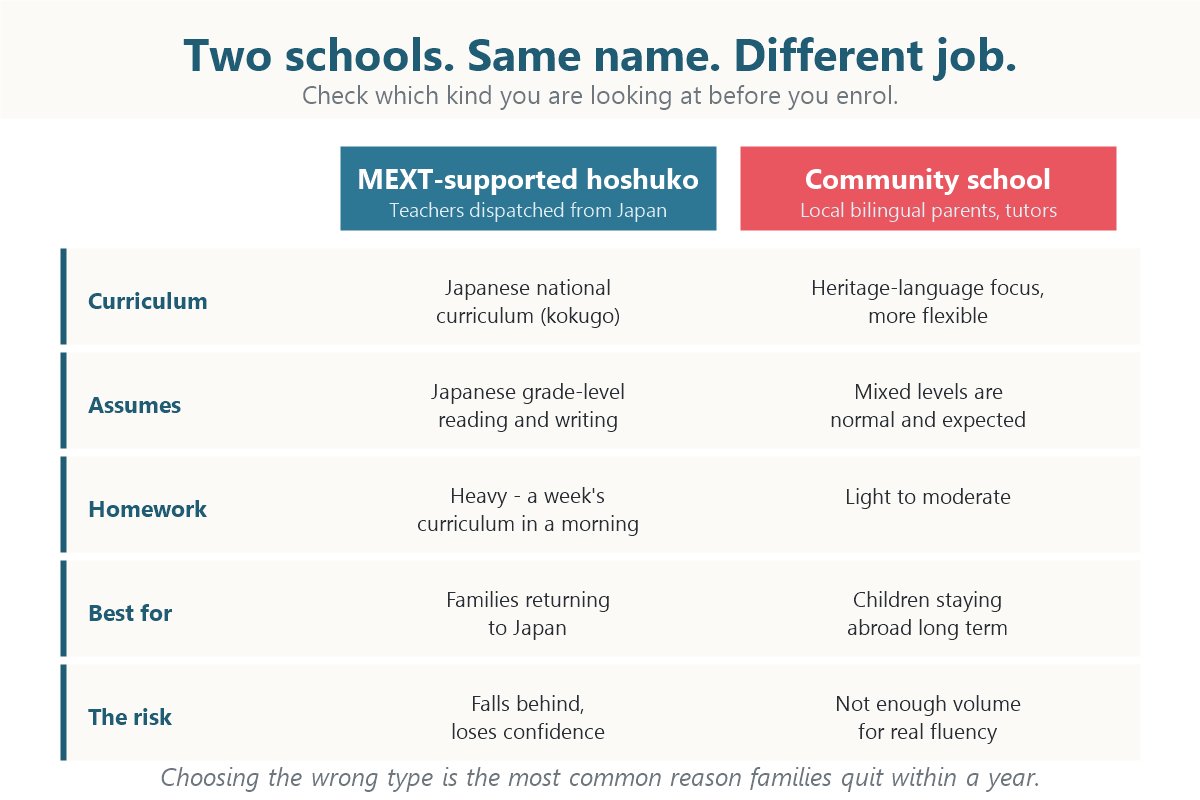
Two schools can both call themselves a Japanese Saturday school and offer children completely different experiences. The dividing line is whether the school receives support from Japan’s education ministry, which in practice means teachers dispatched from Japan and a curriculum that tracks the Japanese national syllabus. MEXT subsidises schools above roughly 100 students and dispatches full-time teachers on a sliding scale as enrolment grows.
| Larger MEXT-supported hoshuko | Smaller community school | |
|---|---|---|
| Teachers | Includes teachers dispatched from Japan | Local bilingual parents and hired tutors |
| Curriculum | Japanese national curriculum, mainly kokugo, often plus maths | Heritage-language focus; more flexible |
| Assumes | Your child can already work at Japanese grade level | Mixed levels are normal and expected |
| Homework | Heavy — a week of curriculum in one morning | Light to moderate |
| Best for | Families returning to Japan; kikokushijo re-entry | Children who will stay abroad and need Japanese to stay alive |
| Typical risk | Child falls behind and loses confidence | Not enough volume to build real fluency |
Neither is better. They answer different questions. A family posted overseas for three years and returning to a Japanese classroom needs the first. A Japanese-Australian or Japanese-American child who will finish school where they are needs the second — and often finds the first one crushing. Choosing the wrong type is the single most common reason a family quits Saturday school within a year.
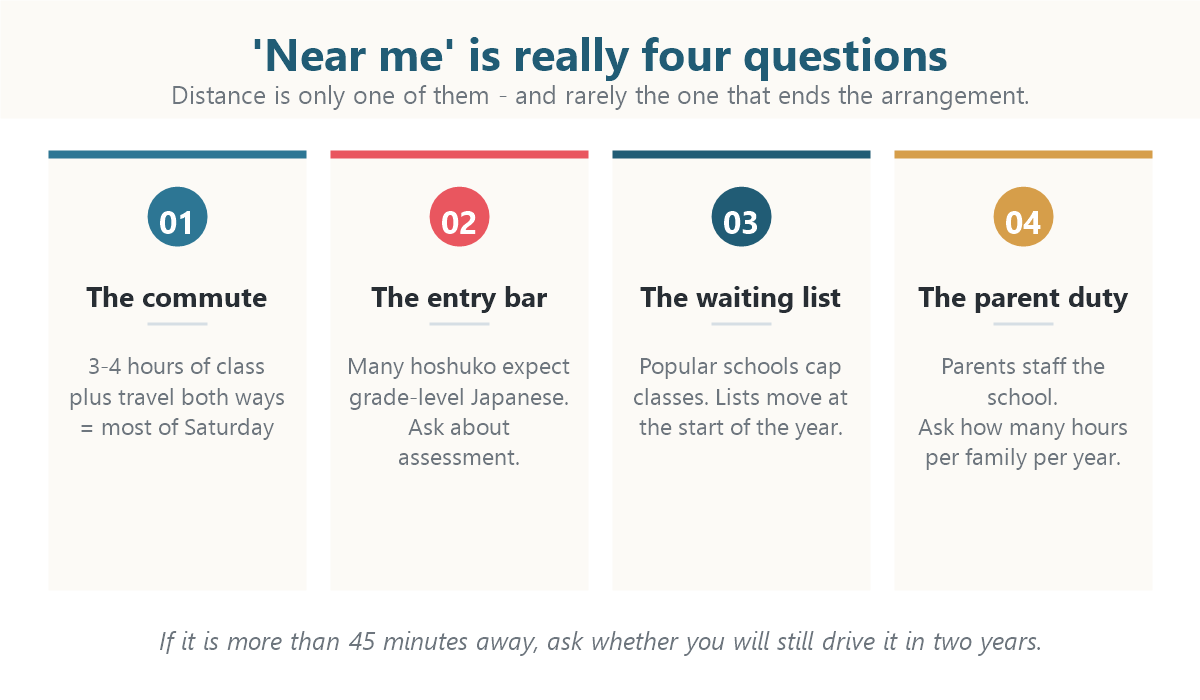
“Near me” is really four questions
1. The real commute is longer than the map says
Do the arithmetic honestly before you fall in love with a school. A Saturday session commonly runs three to four hours. Add a 40-minute drive each way and you have committed five to six hours of every Saturday — the entire day, once you include getting out of the house and eating afterwards. Families routinely underestimate this and then resent it by term three. If the school is more than about 45 minutes away, ask yourself whether you will still be doing this drive in two years, in winter, with a second child.
2. There is usually an entry bar
This is the part that surprises English-speaking parents most. Many hoshuko are designed for children who can already read, write and follow lessons at their Japanese grade level, and some restrict enrolment to Japanese nationals, permanent residents and kikokushijo. A child with strong spoken Japanese but little kanji may be placed a year or two down, or declined. Ask two direct questions before applying: is there an entrance assessment, and what happens if my child is below grade level?
3. Waiting lists are common in the big cities
In cities with concentrated Japanese communities, popular schools cap class sizes and publish waiting lists — we found this openly stated on school websites when we mapped Sydney’s Japanese schools. Waiting lists tend to move at the start of the school year, so applying in the middle of a term often means waiting nine months. If a school is your plan A, get on the list now and treat the interim as its own problem to solve.
4. Fees are low, but the parent duty is real
Supplementary schools are generally excellent value — often a few hundred dollars a term rather than a month — because they are run as non-profit community organisations. The trade-off is that many expect parents to take a turn on the roster: gate duty, cleaning, sports day, the annual festival, committee roles. This is not a hidden fee so much as a hidden calendar. Ask what the parent commitment is per family per year, in hours, before you enrol.
City guides: the real schools, named and compared
Rather than describing schools in the abstract, we have been mapping them city by city — every real provider, what type it is, what it costs, and who it suits — using each school’s own published information. If your city is here, start with that guide.
Regional overviews are also available for families in the USA and Canada and families in Australia and New Zealand, including how the time difference with Japan works from each region.
What if there is no Saturday school near you — or it doesn’t fit?
This is the situation most families outside a handful of big cities are actually in. The nearest hoshuko is ninety minutes away, or it exists but expects grade-level kanji your child does not have, or your child went for a year and came home flat because they were the weakest reader in the room.
It is worth naming what a Saturday school is actually giving your child, because that tells you what a replacement has to do. It is not mainly the worksheets. It is three to four hours a week of Japanese with other children — peers, not adults — and a reason to keep going. Any substitute that is one adult tutor, once a week, on a screen, replaces the worksheets and misses the point. That is why so many families cycle through tutors and quietly give up.
Tomodachi Japan was built for exactly this gap. It is an online Japanese school for children growing up overseas, taught by qualified teachers from Japan in small groups of eight, where children are grouped by conversation level rather than school grade — so a child with fluent speech and shaky kanji is not the odd one out, and a beginner is not drowning. Attendance is unlimited for one flat monthly fee, which means Japanese can become a daily habit instead of a Saturday obligation. Many families use it alongside a Saturday school rather than instead of one — the school supplies the curriculum, the online classes supply the speaking hours and the friendships.
Frequently asked questions
How many Japanese Saturday schools are there worldwide?
Around 200 supplementary Japanese schools operate across roughly 50 countries, with the largest concentration in the United States, followed by Europe, Southeast Asia and Oceania. They are heavily clustered in cities with established Japanese business communities, which is why coverage can be excellent in one metropolitan area and non-existent 100km away.
Can my child attend if we are not Japanese citizens?
It depends entirely on the school. Larger MEXT-linked hoshuko generally serve Japanese nationals, permanent residents and returnee children, and some state this explicitly. Smaller community and heritage-language schools are usually far more open, including to children from one Japanese parent or from families with no Japanese heritage at all. Ask directly — enrolment policies are rarely spelled out clearly on the website.
Is Saturday school worth it if my child already speaks Japanese at home?
Often yes, but for a specific reason: literacy. Home conversation builds speaking and listening well and almost never builds kanji, written expression or the register children need for school and work. What home cannot supply is reading and writing — and peers of the same age. If a school gives you both, it is worth the Saturday.
What does a Japanese Saturday school cost?
Most supplementary schools charge in the range of a few hundred dollars per term rather than per month, plus a one-off enrolment fee and sometimes an annual levy, because they run as community non-profits. Full-time Japanese day schools are an entirely different proposition and can run to five figures a year. Always check the school’s own fee page for the current year — our city guides list published fees as of July 2026.
My child refuses to go. Is that normal?
It is extremely normal, and it is usually not about Japanese. It is about giving up the one free morning of the week and about being the least fluent child in the room. Before you quit, work out which of the two it is — a level mismatch can often be fixed by moving to a different type of school, while a Saturday-morning objection sometimes resolves when Japanese stops being tied to a single dreaded day. We wrote about this in more depth in Japanese Saturday school not working for your child?