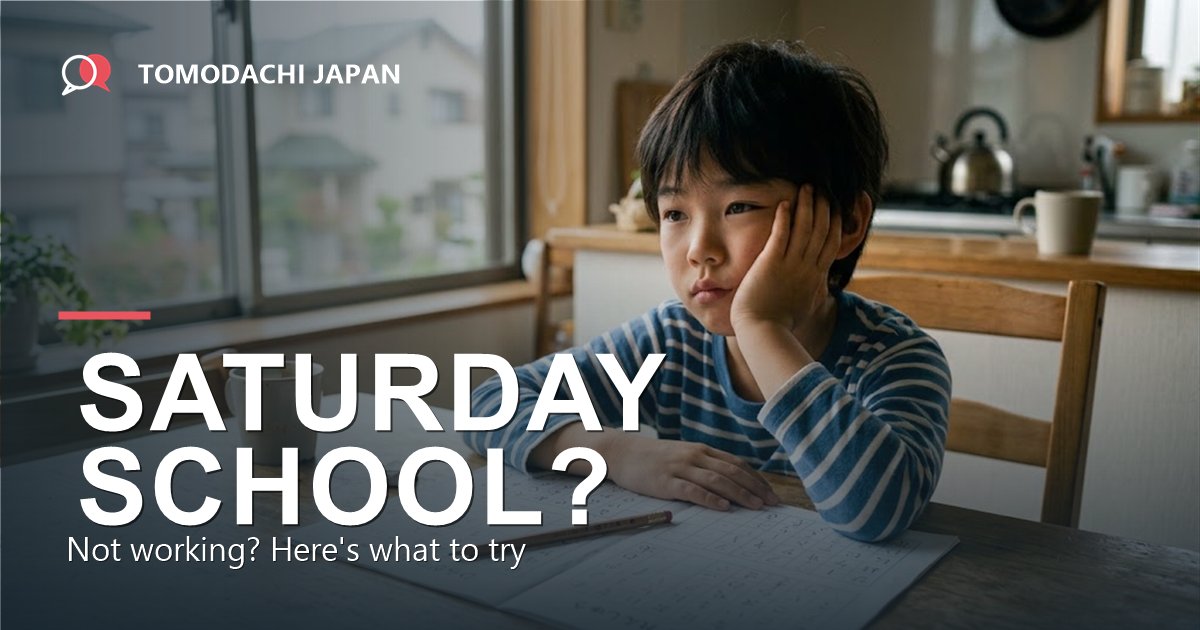
If Saturday mornings in your house have become a battle — the tears over kanji homework, the “I don’t want to go,” the drive across town while other kids sleep in — you are not a failing parent, and your child is not a failing student. Japanese Saturday school (hoshuko) asks a lot: a full second curriculum, on the one morning off, in a language the outside world doesn’t reinforce. Sometimes it works beautifully. Sometimes it quietly stops working. This is an honest look at how to tell the difference, and what to do when it’s the second one.
First: it’s hard for almost everyone
Parents rarely say it out loud, but the research and the forums agree: Japanese Saturday school is a love–hate relationship for most families who do it. It’s “the right thing” and “exhausting” at the same time — the homework, the漢字 tests, the lost Saturday, the juggle with the local school’s sport and birthday parties. So if it feels hard, that’s normal, not a warning sign. The warning signs are different — and worth naming.
Looking for a way to keep Japanese going from abroad?
TOMODACHI JAPAN is an online Japanese school for children growing up outside Japan. They talk with peers their own age in Japan every day, taught by teachers working at Japanese schools, in small classes of 8.
🎁 Register and we’ll email you our School Guide (PDF, in English) straight away. You’ll also be first to hear about tuition, scholarships and opening dates.
Free · takes about 30 seconds
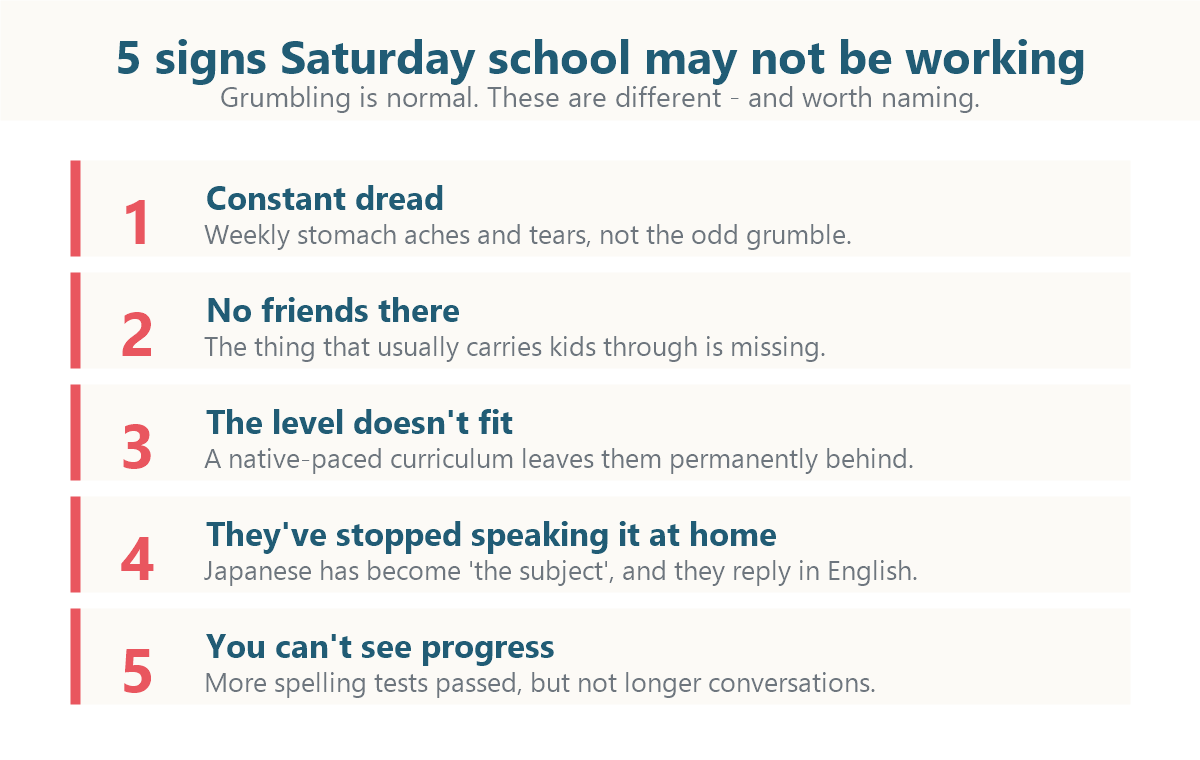
Five signs it may not be working for your child
- The dread is constant, not occasional. Every child grumbles sometimes. But steady, weekly dread — Friday-night stomach aches, tears in the car — is a signal, not a phase.
- There are no friends there. For most kids, the real reason they stay is the friends, not the grammar. If your child has no one they look forward to seeing, the one thing that usually carries them is missing.
- The level doesn’t fit. Hoshuko follows Japan’s grade-level curriculum. A child who moved abroad young, or speaks more English than Japanese, can be permanently behind a class pitched at native kids in Japan — demoralising however hard they try.
- They’ve stopped speaking Japanese at home. If Japanese has become “the school subject” and they answer you in English, the emotional link to the language is fraying — and that matters more than any test score.
- You can’t see progress. After a year, can your child hold a longer conversation, or just pass more spelling tests? Reading and writing can climb while speaking stalls — and speaking is what keeps a language alive.
What’s usually really wrong (it’s rarely the child)
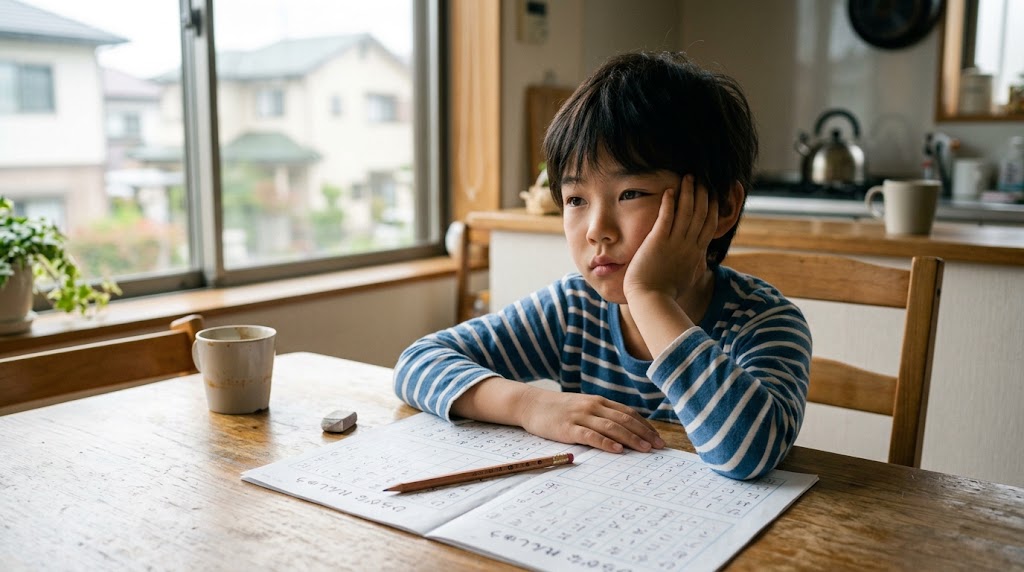
When Saturday school stops working, the cause is almost never that the child “isn’t trying.” It’s a mismatch. Hoshuko is built to keep children on Japan’s academic track — designed for families returning to Japan, marked against native peers, heavy on reading and writing. That’s a wonderful fit for some. But if your goal is a child who loves the language and can actually talk — to grandparents, to cousins, to Japanese friends — a rigorous academic curriculum on a Saturday morning may be aiming at a different target than the one you care about.
You don’t have to quit — you have options
“Push through” and “give up” aren’t the only two choices. A few families find a middle path works far better:
- Keep hoshuko, add speaking. If the academics matter (say, a possible return to Japan), keep Saturday school for reading/writing and add relaxed, regular conversation elsewhere so the language stays fun and spoken.
- Swap the format entirely. If the goal is confident speaking and a love of the language rather than a Japanese report card, an online school with same-age Japanese friends and unlimited attendance can rebuild the joy a struggling Saturday has drained.
- Change the peer group. Sometimes it isn’t Japanese that’s the problem — it’s that your child is the “different” one in the room. Kids who connect with peers their own age in Japan often rediscover why the language is worth having.
We wrote a fuller companion piece on this — see an online alternative to Japanese hoshuko — for families weighing the switch.
What actually keeps a heritage language alive
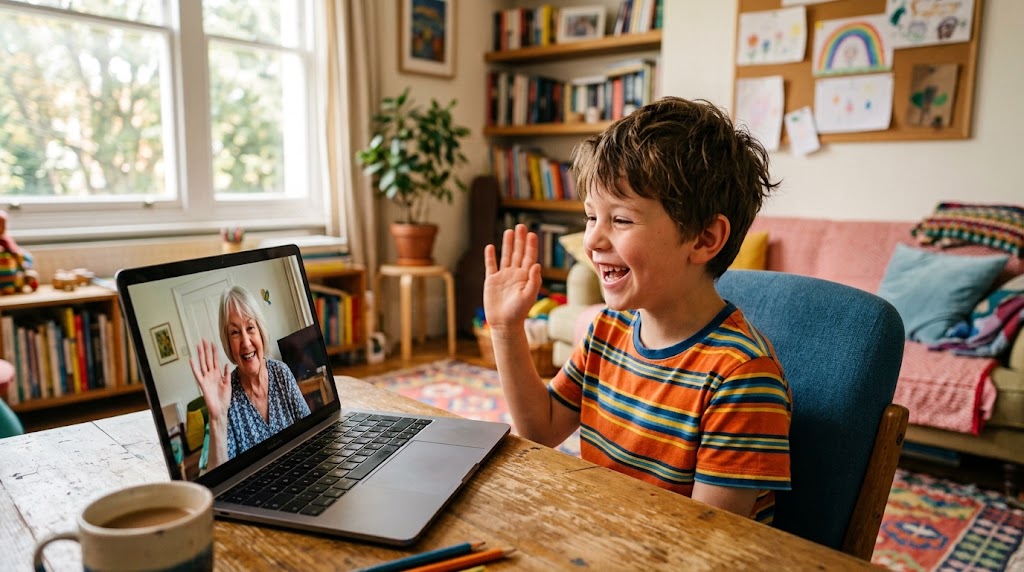
The research on raising bilingual children is consistent and, honestly, freeing: input alone — worksheets, videos, even a heritage school — doesn’t reliably produce a child who speaks. What does is output plus real peers: chances to actually use the language with people their own age. The most common quiet failure is the child who understands everything and answers in English. A Saturday spelling test doesn’t fix that; regular, low-stakes conversation does. (More on this in our guide to raising a bilingual Japanese child abroad.)
FAQ
Is it wrong to pull my child out of Japanese Saturday school?
No. Hoshuko is excellent for families keeping a child on Japan’s academic track, especially if you may return to Japan. But if the goal is confident speaking and a lasting love of the language, another format may serve that goal better. Match the tool to your goal, not to what everyone else is doing.
My child understands Japanese but won’t speak it. Is that normal?
Very. It’s the most common outcome of input-heavy exposure without enough output. The fix is regular, pressure-free conversation — ideally with peers their own age, so speaking feels like play, not a test.
Can we keep Saturday school and add something?
Yes — many families do exactly that: hoshuko for reading and writing, plus relaxed conversation practice during the week to keep the language spoken and enjoyable. Unlimited-attendance online options make the “add-on” affordable.
What does TOMODACHI JAPAN cost, and where does it run?
One flat monthly fee for unlimited daily attendance (billed in Japanese yen; local-currency amounts are on the tuition page). Classes run on Japan time, which lands conveniently for families in Australia, New Zealand and Asia; we map the hours for the US and elsewhere in our class times by time zone guide.