If you homeschool and your child wants to learn Japanese — or you are a Japanese-speaking parent trying to keep your child’s Japanese going at home — the search for a Japanese homeschool curriculum gets confusing fast. Most of what turns up was written for adult self-learners, for American high school classrooms, or for families living in Japan.
We run an online Japanese school for children growing up outside Japan, and many of the families we talk to homeschool. In September 2026 we checked the publishers’, course providers’ and government pages ourselves rather than repeating other lists. This guide sorts the real options by the question that matters most: which kind of Japanese learner is your child?
First, decide which Japanese homeschool curriculum problem you have

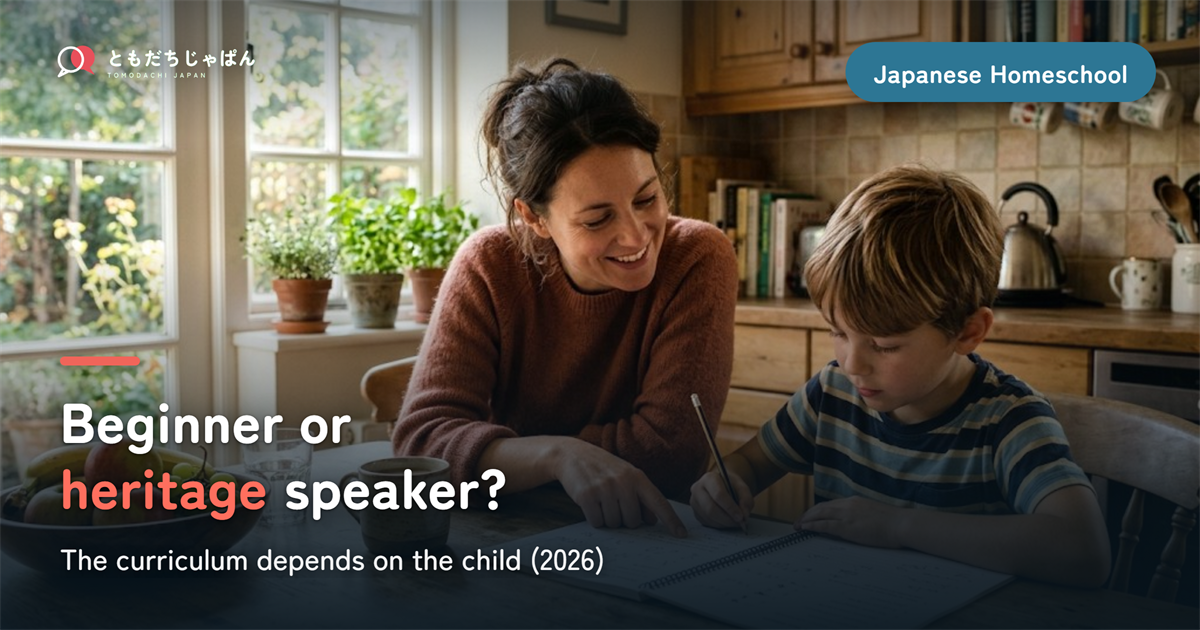
There are two very different children behind this search, and the right curriculum for one is wrong for the other.
- A child learning Japanese as a foreign language. Nobody at home speaks it. They need a course that starts from zero, explains grammar in English, and paces kana and kanji slowly.
- A child keeping Japanese as a family language. They already understand a lot, because a parent speaks Japanese. What they usually need is reading, writing and kanji at something close to their age level — which is a different curriculum altogether.
Many homeschool plans go wrong by buying the right materials for the wrong child: a heritage speaker bored by “this is a pen” dialogues, or a beginner drowning in a textbook written for Japanese first graders.
Homeschooling Japanese? Add the speaking half.
TOMODACHI JAPAN is an online Japanese school for children growing up outside Japan. They talk with peers their own age in Japan every day, taught by teachers working at Japanese schools, in small classes of 8.
🎁 Register and we’ll email you our School Guide (PDF, in English) straight away. You’ll also be first to hear about tuition, scholarships and opening dates.
Free · takes about 30 seconds
Option 1: Textbook series written for young learners
For a child learning Japanese as a foreign language, a structured textbook series is the backbone most homeschoolers settle on. Two are widely used in English-speaking countries.
- Japanese for Young People (AJALT). From the Association for Japanese-Language Teaching, the organisation behind Japanese for Busy People. It is a three-level series designed mainly for middle and high school, with a starter level for younger children, a kana workbook, and dialogues, exercises and tasks. It is one of the few series written for children rather than adapted from an adult course.
- Adventures in Japanese (Cheng & Tsui). A best-selling American high school series, now in its fourth edition, used in school districts from New York to Honolulu. Volume 1 assumes no prior Japanese, dialogues are told through manga, and by the end of Volume 2 students work with 121 kanji. It suits teenagers better than younger children.
The honest limit: a textbook teaches Japanese beautifully if someone can run the speaking parts. The dialogues and pair tasks assume a partner. In a homeschool where the parent does not speak Japanese, that half tends to be skipped.
Option 2: Accredited online courses for high school credit
If your teenager needs Japanese on a transcript, an accredited provider is simpler than building a course yourself. Check carefully, though, because Japanese is offered far less often than Spanish or Chinese.
- BYU Independent Study lists Japanese among its world language courses. They are self-paced, aligned to ACTFL standards, and allow up to twelve months to finish.
- Florida Virtual School (FLVS) does not offer Japanese. In September 2026 its world languages page listed ASL, Chinese, French, Hebrew, Latin and Spanish only. It comes up in homeschool searches often enough that it is worth saying plainly.
- Concordia Language Villages has run Japanese high school credit programmes in some years, including a four-week residential session in Minnesota. See our guide to Mori no Ike, its Japanese village.
The honest limit: self-paced credit courses are excellent for structure and paperwork. They are usually quiet — reading, videos and submitted assignments, with limited live speaking. Always confirm with the receiving school or umbrella programme that the credit will be accepted before you enrol.
Option 3: Japan’s own school textbooks, for heritage speakers
For a child who already speaks Japanese at home, the most useful homeschool material is often the one Japanese children use: the national elementary and junior high textbooks, especially kokugo (Japanese language arts).
- They may be free. Japan’s Ministry of Education (MEXT) has provided free textbooks to Japanese children living abroad since 1967, distributed through embassies and consulates — around 137,000 children received them in fiscal 2023. Families leaving Japan mid-year apply through the Japan Overseas Educational Services (JOES) before departure.
- Eligibility is about nationality and residence. The programme is for children of Japanese nationality living abroad at compulsory school age. Families with permanent residence abroad should check with their consulate, because eligibility is narrower.
- They are written for native speakers. Instructions are in Japanese and the pace assumes a child living in Japan. A child a year or two behind can use the textbook from a lower grade without any stigma at home.
The honest limit: a kokugo textbook assumes a class and a teacher. A parent can absolutely work through it at the kitchen table — many do — but it is heavy going without anyone else your child’s age doing the same thing.
Option 4: Apps and workbooks as supplements
Apps and workbooks are good at one job each: apps build a daily habit and vocabulary, and kana workbooks build handwriting. Neither is a curriculum by itself. We compared the main apps — including which popular “kids” apps do not actually contain Japanese — in our guide to Japanese learning apps for kids.
One useful milestone for homeschoolers: the JLPT has no age limit. Its official FAQ states that the test is open to all non-native speakers, including holders of Japanese citizenship, with no age restrictions. A JLPT level can give a homeschool Japanese course an outside benchmark.
How the options compare
| Option | Best for | Who runs the speaking | Credit |
|---|---|---|---|
| Japanese for Young People | Beginners, roughly middle school up | A parent or partner | No, unless your umbrella school counts it |
| Adventures in Japanese | Beginners in high school | A parent or partner | No, unless your umbrella school counts it |
| BYU Independent Study | High schoolers who need a transcript | Mostly self-paced | Yes, accredited |
| MEXT textbooks (kokugo) | Heritage speakers of Japanese nationality | A Japanese-speaking parent | No |
| Apps and kana workbooks | Daily habit and handwriting | Nobody | No |
| TOMODACHI JAPAN | Children abroad who need people to speak with | Same-age friends in Japan and a teacher, class of 8 | No — a school, not a credit provider |
We deliberately do not quote prices. Textbook editions, course fees and subscriptions change by country and by year, and a number we print today would soon be wrong.
The piece every homeschool Japanese plan is missing
Look down the “who runs the speaking” column and a pattern appears. A homeschool can cover grammar, kana, kanji and even credit very well. What it struggles to supply is other children who speak Japanese — the thing that turns a subject into a language your child actually uses.
That is why we would not frame any of this as a choice between a curriculum and a school. The strongest homeschool plans we see keep the textbook for structure and add a regular live class for the speaking.
What TOMODACHI JAPAN does
TOMODACHI JAPAN is an online Japanese school for children growing up outside Japan. It fits into a homeschool week as the speaking half of the plan.
- Same-age friends in Japan. Your child talks with peers their own age who live in Japan — something no textbook or app can provide.
- Teachers who work in Japanese schools. Current-standard teaching, so a heritage speaker keeps pace with Japan and a beginner is taught by people who teach children every day.
- Small classes of 8. Small enough that every child speaks in every lesson.
- Live lessons on a fixed schedule. A dependable anchor in a flexible homeschool week.
Keep the curriculum you trust. Add the part it cannot do: Japanese friends to talk to.
Frequently asked questions
What is the best Japanese homeschool curriculum for a beginner?
For a child with no Japanese, a series written for young learners — such as Japanese for Young People, or Adventures in Japanese for teenagers — gives the clearest structure. Pair it with someone to speak with, because both series assume a conversation partner for the dialogues.
Can I homeschool Japanese if I do not speak it?
Yes, for reading, writing and grammar — a good textbook with audio will carry you a long way, and you can learn alongside your child. The part that is hard to supply is speaking practice, so plan for a live class, tutor or exchange from the start rather than adding it later.
Can homeschoolers get free Japanese textbooks from Japan?
Children of Japanese nationality living abroad at compulsory school age can usually receive MEXT’s free elementary and junior high textbooks through their embassy or consulate. Families with permanent residence abroad should check with their consulate first. Children without Japanese nationality are not covered.
Does Florida Virtual School teach Japanese?
No. In September 2026 FLVS listed ASL, Chinese, French, Hebrew, Latin and Spanish as its world languages. BYU Independent Study is one accredited provider that does list Japanese.
Is there an age limit for the JLPT?
No. The JLPT’s official FAQ states there are no age restrictions, and the test is open to non-native speakers including holders of Japanese citizenship.
In short
- Decide first whether your child is a beginner or a heritage speaker — they need different materials
- Beginners: a young-learner series such as Japanese for Young People or Adventures in Japanese
- Credit: BYU Independent Study lists Japanese; FLVS does not
- Heritage speakers of Japanese nationality: MEXT’s free textbooks through your embassy or consulate
- Every plan needs someone for your child to speak Japanese with — build that in from the start